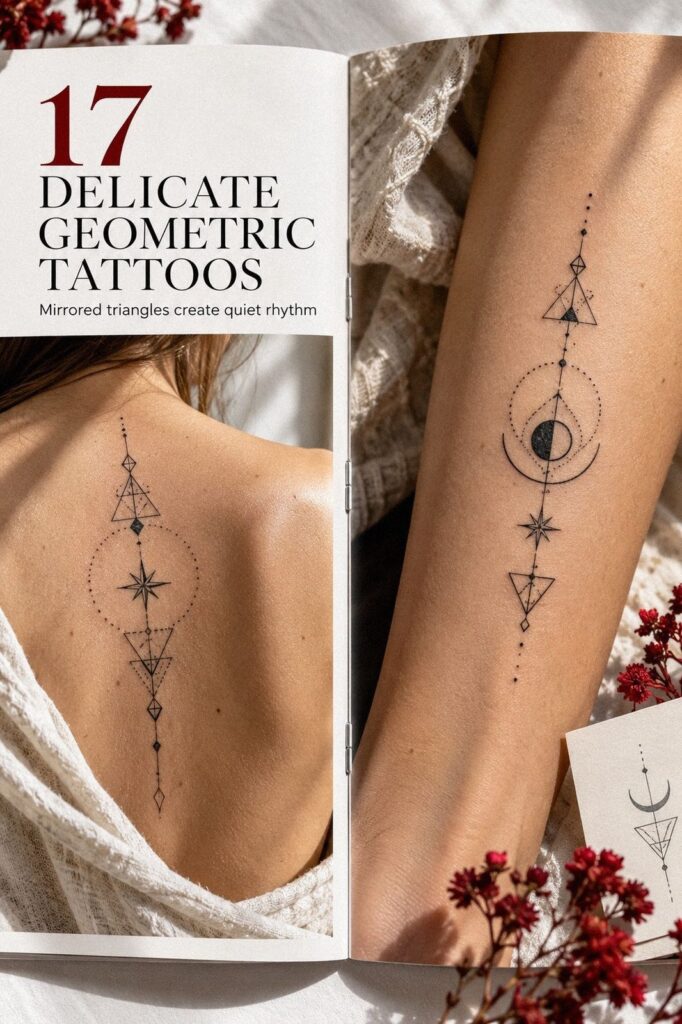
Delicate geometric tattoos can stay private when placement does the quiet work. I once chose a visible spot before thinking through sleeves, meetings, and summer clothes. That mistake changed how I plan every piece now.
Fine lines aren’t automatically fragile, either. These ideas keep the look crisp, personal, and easy to cover when you need to.
The inner forearm is my starting point for a discreet geometric tattoo because it gives you control. You can enjoy the design at home, then cover it quickly when work or family settings call for privacy.
Fine-Line Triangle Tattoos on the Wrist
A fine-line triangle on the wrist gives you a striking symbol without taking over your hand. The precise lines suit a small terracotta ink triangle, especially when you leave the center open.
You’ll want the point aligned with your wrist. Don’t angle it randomly. That small choice makes the design feel elegant when your hand moves.
For privacy, place the triangle on the inner wrist. Keep your watch or cuff in mind. A slim band can cover it quickly, but you won’t lose the shape when your wrist is uncovered.
I’d skip a heavily filled version here. Dense ink can look harsh against a small placement. A single line weight gives the mark a symbolic, fierce, and understated feel.
The wrist moves constantly. Ask your artist how the design will sit when your hand bends. Your reference folder can include small geometric tattoo ideas and delicate fine-line tattoos.
A tiny triangle can feel quietly powerful. Small, but fierce!
Choose a clean interior and enough breathing room around the edges. If visibility worries you, place it slightly toward the palm side.
The surface layer usually heals in about 2 to 3 weeks. Complete healing can take about 2 to 3 months. You’ll need gentle washing, light moisturizing, and sun protection while the fresh tattoo settles.
Tiny Sacred Geometry Behind the Ear
Behind-the-ear geometry feels intimate because your hair can hide it in seconds. A tiny clay-and-brass fine-line rosette or compact triangle works well when the artist leaves the negative space crisp.
You’ll want to bring your loose hair down during the consultation. Check how much of the design disappears. A symbolic piece can stay almost invisible beneath hair, yet still feel meaningful when you tuck it back.
That balance makes this placement popular. It stays close to you. It doesn’t need to announce itself.
I’d choose a simple sacred shape over an intricate mandala here. The skin is limited. Too many small intersections can blur together as the tattoo ages.
Your artist should simplify the geometry until every line has a job. Ask to see healed work. Fresh lines can look sharper than the final result.
For more tiny placement references, compare delicate tiny hand tattoos with small geometric tattoos. The examples won’t match your ear exactly, but they can help you explain the scale you want.
This placement can look ethereal and graceful without feeling ornamental. Ask about healed portfolio work, not only fresh results. Behind the ear gets sun, friction, and hair-product contact, so your aftercare routine matters.
Build Minimalist Mandalas Along the Spine
A minimalist mandala along the spine gives you a powerful vertical rhythm. It stays easy to hide beneath a shirt. Use a compact plum-and-rose-gold mandala at each point, with open skin between the shapes.
You’ll want to decide whether the design follows the spine or floats beside it. I prefer a slightly offset arrangement. It looks more organic and won’t expose every small asymmetry in your posture.
A perfectly centered line can be unforgiving. An offset line often feels more natural. Trust your body’s movement.
The spine is a sacred placement for many people. It also isn’t the easiest spot for discomfort. Your artist may divide the work into a shorter session.
Don’t choose a long piece only because the reference looks dramatic. A shorter sequence can still feel timeless. It may also be easier to keep private.
A clean vertical sequence needs clear spacing. Test it with the shirts, dresses, or work uniforms you wear most. You’ll know quickly whether the design stays private enough.
I’d keep the circles open and the shading restrained. For spacing ideas, browse this geometric hand tattoos guide and compare linework references in delicate fine-line tattoos.
Delicate Geometric Finger Tattoo Ideas
Finger tattoos are visible by default. They make sense only if private means easy to conceal with a ring, glove, or hand position.
A small single-needle navy diamond on the finger’s side can disappear more readily. A design across the knuckle will show much more often.
You’ll want to choose the finger side carefully. Fingers bend, wash, grip, and rub against everything. That movement affects both comfort and clarity.
I’d avoid a complex pattern with many tiny intersections. A crisp outline with one meaningful break will age more clearly than a crowded miniature.
Finger tattoos can fade or soften faster than pieces on protected areas. Your artist should explain possible touch-ups before you book. That conversation is practical, not pessimistic.
For variations, look at delicate simple hand tattoos and delicate side hand tattoos. Compare a slim side placement with a top-of-finger design.
The result can feel dainty, sharp, edgy, and bold at once. Keep the geometry readable from a normal distance. Then ask for a healed example.
Trace Intricate Moon Phases on the Forearm
A moon phase strip gives you several small geometric moments in one composition. Think of an emerald-and-gold linework moon set with open circles, thin arcs, and restrained dot accents.
Your forearm gives the artist more room than a finger. You can still keep the tattoo private with long sleeves.
I’d place the phases along the inner forearm if you want fast coverage. The outer forearm shows more in short sleeves. That difference matters.
The design can feel understated, expressive, and haunting without becoming heavy. Ask your artist to keep each moon distinct. If every phase has the same density, the strip may look flat.
You’ll want to discuss healed linework. UV exposure can soften fine lines over time. Your sun habits matter more than most people expect.
Use gentle aftercare. Avoid pools while the surface heals. A little patience protects the early result.
Browse small geometric tattoo ideas before saving a flash sheet. Compare symbolic references in tribal tattoo designs and meanings. I’d choose fewer phases over a cramped full cycle.
Ariadne’s Thread in a Geometric Tattoo
Ariadne’s thread can become a meaningful geometric idea without copying a literal mythological scene. Use one continuous path, a small turning point, and enough open skin for the line to remain readable.
The Ariadne’s thread concept suits someone who wants a personal symbol about direction, survival, or finding a way back. It can feel romantic, haunting, or empowering depending on the shape.
I’d keep the path flowing rather than forcing every turn into a perfect angle. A little irregularity makes the mark feel human. It also gives your artist room to follow your anatomy.
You’ll want to decide whether the thread ends in a circle, star, or quiet break. That final detail can carry the personal meaning without making the tattoo explain itself to everyone.
A small thread motif works behind the ear, along the rib, or on the inner forearm. Choose the placement according to how much of the story you want to share.
Unique Geometric Floral Tattoos on the Shoulder
A geometric wildflower sprig on the shoulder lets organic curves meet precise linework. A forest-green and rust floral outline can stay readable without relying on heavy fill.
You’ll want to decide where the sprig sits. Options include the front shoulder, upper back, or outer shoulder cap.
The front can show with a tank top. The upper back offers more privacy. I’d choose the back if your daily clothing needs to keep the tattoo concealed.
The design can feel graceful, vibrant, and meaningful when the stem stays simple. Avoid squeezing several flowers into one small area.
One wildflower with a geometric center usually reads more clearly than a crowded bouquet. Let the main shape carry the idea. Extra detail can wait.
A portfolio matters more than a trend board here. Your artist should show healed floral work on several skin tones. Fresh work alone doesn’t tell the whole story.
For more references, save delicate fine-line tattoos and small geometric tattoos. The shoulder can handle a larger composition, but clean gaps still matter.
Symbolic Hexagon Tattoos Across the Collarbone
A hexagon across the collarbone gives you a clean horizontal shape. The precise dusty-rose and charcoal hexagon outline can hold a tiny star, initial, or open center.
You’ll want to check how the design changes when your shoulder rolls forward. Collarbone skin shifts. A shape that looks centered while standing may tilt when you move.
Ask for a stencil. Look at it from several angles before approving the placement. No guessing!
This can feel bold and polished while remaining easy to cover with a high neckline. If you need complete privacy at work, test the stencil under your usual shirts.
A collar can hide the design. A wide neckline may reveal it. Test both before the appointment.
Your artist should use a consistent line weight. Avoid unnecessary shading. Negative space keeps this idea crisp.
For related placement comparisons, see the geometric hand tattoos guide and delicate simple hand tattoos. Those examples can help you decide whether the hexagon should stay purely geometric or carry a small symbol.
Dainty Sacred Geometry Ankle Tattoos
An ankle design can stay discreet beneath socks, trousers, or boots. It still gives you a small detail when your shoes come off.
A camel-and-black sacred geometry symbol works best when it follows the natural curve above the ankle bone. Keep a clear border around it.
You’ll want to think about friction before choosing this spot. Socks, footwear, and movement can irritate a new tattoo. Your aftercare should be careful.
The surface may heal in about 2 to 3 weeks. Complete healing takes longer. Follow your artist’s instructions during that period.
Ankle skin sits close to bone. The session can feel sharper than one on the shoulder or forearm.
I’d choose a compact motif if you’re new to tattooing. You can always build around it later. There’s no need to solve the whole story at once.
The result can feel sacred and ornate without looking crowded. Ask your artist to leave a clear margin around the symbol. That small border helps the geometry remain readable.
Compare delicate side finger tattoos with delicate tiny hand tattoos for scale references. Your ankle piece doesn’t need to be tiny. It should still cover comfortably.
Elegant Geometric Animal Silhouettes on the Rib
A geometric animal silhouette on the rib can be intensely personal. It also stays private beneath everyday clothing.
Think of a midnight-blue and copper fox silhouette, angular bird, or simplified feline. Build it from clean lines instead of dense realism.
You’ll want to choose an animal with a recognizable outer shape. I’d skip a complicated interior pattern. Rib tattoos already demand patience.
One sharp ear or curved wing may say more. A busy silhouette can lose its identity as the lines settle.
The ribs are among the more painful placements. Narrow areas near bone can feel especially intense. Your artist may recommend a shorter appointment.
That isn’t a weakness. It’s sensible planning. A smaller design can still feel fierce and expressive.
You’ll need loose clothing during healing. Avoid friction wherever possible. Your artist’s instructions should take priority over generic advice.
For symbolic ideas, explore small geometric tattoos and tribal tattoo designs and meanings. Use those references for shape language, then make the animal yours through posture and one personal detail.
Playful Dotwork Geometric Tattoos on the Calf
Dotwork can look different during healing. A sage-green dotwork pattern may soften slightly as the skin settles.
You’ll want to choose a calf placement that clothing can cover easily. Tall socks, boots, and trousers offer practical privacy. Shorts will reveal the design.
I’d keep the main shape bold. Let the dots create texture around it. The eye needs a clear place to rest.
The calf is often more tolerable than ribs, feet, hands, or sternum. Everyone’s experience differs. Your artist can explain the expected session length.
This option can feel playful without becoming childish. Don’t overfill the design with dots. A controlled fade from dense to sparse gives the pattern rhythm.
If you like comparing fresh and healed work, save delicate fine-line tattoos. Ask to see the artist’s own healed dotwork.
You’re looking for stable spacing and clean edges. The design should still read from a few steps away. That test matters!
Meaningful Interlocking Circle Tattoos on the Chest
Interlocking circles can represent friendship, family, cycles, or two parts of one private story. On the chest, a terracotta-and-olive circular motif can sit beneath clothing.
You’ll want to decide whether the circles sit near the sternum, upper chest, or shoulder. The sternum can feel more sensitive. The upper chest may offer easier concealment.
I’d keep the overlap clean. Avoid filling every intersection. The design should feel graceful and understated, not like a technical diagram.
Your artist can adjust the scale. The circles should remain readable after healing. Ask how the design will move with your breathing.
The chest shifts with breathing, clothing, and posture. Bring a clear idea of your normal wardrobe. If privacy matters, check the tattoo beneath your most open neckline.
For more geometric placement ideas, browse the geometric hand tattoos guide. A meaningful tattoo doesn’t need a long explanation. You should still know what the circles mean to you.
Test the Cover Before You Commit
The best private placement starts with your real wardrobe. Hold a favorite work shirt over the stencil. Then check the design while sitting, reaching, and walking.
Try the same test with summer clothes. A tattoo hidden by a sweater may show under a tank top. Small changes in fabric can change visibility fast.
Think about uniforms, meetings, family events, and travel. Your cover plan should work in ordinary situations. Keep it practical.
Ask your artist to place the stencil first. Take a few minutes before deciding. If the outline feels wrong, move it.
A private tattoo should give you control. You choose when it enters the conversation. Keep it personal!
Let the Stencil Move With You
A stencil can look convincing while you’re standing still and completely different when your body shifts. Check it while bending your wrist, rolling your shoulder, sitting down, and turning your torso.
The stencil should follow the way your skin actually moves. This matters most on the collarbone, ribs, chest, fingers, and spine.
You’ll want to wear clothing similar to what you use every week. Test a sleeve, neckline, glove, or sock over the stencil. If coverage depends on one exact position, it may not be private enough.
Ask your artist whether the design needs a small adjustment. A slightly higher or lower placement can change visibility without changing the concept.
The final decision should feel practical and personal. You aren’t trying to hide the tattoo from yourself. You’re choosing when other people get access to it.
Which Geometric Lines Stay Clear?
Small geometry needs enough room to breathe. A single line weight often ages better than several competing weights packed together.
Circles, triangles, and hexagons need clean gaps. When lines sit too close, they can merge as the tattoo settles. More detail does not always mean more meaning.
Dotwork needs restraint, too. Dense dots can create a strong shadow. Sparse dots can keep the shape lighter and easier to read.
Ask to see healed examples from the same artist. Look for softened edges, merged lines, and lost openings. Those details tell you more than fresh work.
Your skin, placement, and habits all affect the result. Sun exposure matters. So do friction, movement, and aftercare.
Hidden or Visible? The Privacy Trade-Off
A hidden tattoo gives you control. A visible tattoo gives you more chances to enjoy the design during the day. Neither choice is automatically better.
The inner wrist may be easy to cover, but it still appears during hand movement. The ribs stay private, but the appointment may feel more intense.
A finger design can disappear beneath a ring. It can also show during every introduction. Think about the moments you want to manage.
Ask yourself one direct question: who gets to see this mark? Your answer may point to the right placement. It can also reveal that you want a slightly more visible piece.
Privacy does not mean fear. It can be a thoughtful boundary. That boundary can change later, and your design can still remain yours.
What Should You Ask Before Booking?
Start with the artist’s portfolio. Look for geometric pieces that have healed, not only fresh tattoos posted soon after the appointment. Portfolio evidence tells you more about line stability and spacing.
Ask how the artist approaches fine lines, small intersections, and touch-ups. You can also ask which needle groupings they prefer for the style you want.
Discuss placement while your body is moving. Ask whether your work clothes, daily habits, and future wardrobe will affect the design.
You’ll also want clear aftercare guidance. Confirm the studio’s hygiene standards, expected session length, and aftercare instructions before you pay a deposit.
A good consultation should leave you informed, not rushed. If the artist dismisses your privacy concerns, keep looking.
Typical Planning Numbers for Delicate Geometric Tattoos
These figures are planning ranges, not guarantees. Your final price can vary by artist, region, size, placement, and complexity.
Why Private Placement Matters More Than a Trend
I’ve changed my mind about discreet tattoos more than once. At first, I thought private meant hiding the design completely. Then I noticed how much easier it is to live with a piece when you choose the exposure level.
The wrist, finger, and collarbone can look striking. They aren’t equally private. A forearm disappears beneath a sleeve, while a finger may show during every introduction.
That difference matters if your work, family, or comfort level changes later. Your future self gets a vote. Plan for that person, too.
I also think geometric work improves when the artist edits the idea. People often bring references packed with circles, dots, petals, and tiny symbols. I’ve done that too.
The strongest result usually comes after removing one layer. Then another. The remaining lines feel intentional instead of merely impressive.
A private tattoo isn’t timid. It can be raw or empowering while staying hidden beneath normal clothes. The point is control.
Cost matters, but I’d prioritize portfolio evidence over a bargain. In the US, a studio minimum may run about $50 to $100. Hourly rates often sit around $100 to $250.
Your final price can vary by artist and region. Ask for a custom quote after sharing size, placement, and complexity. A clear brief saves time for everyone.
The Questions I Get Asked Most
How much do geometric tattoos usually cost?
A small piece commonly costs about $100 to $300 in the US. Studio minimums may sit around $50 to $100.
Hourly rates often reach $100 to $250. Artist experience, placement, and detail affect the quote.
Ask for a custom estimate.
Are geometric tattoos a good idea for a first tattoo?
Yes, geometric tattoos can work well for a first piece. Choose a sensible placement and realistic scale.
Clear linework and a personal symbol make planning easier. Forearm, thigh, and shoulder placements are often more tolerable than ribs, feet, hands, or sternum.
How do I choose an artist for geometric tattoos?
Choose an artist with healed examples of fine-line and geometric work. A strong healed portfolio matters more than a fresh social-media post. Check hygiene standards, ask about needle groupings, and make sure the artist explains aftercare before you book.
How much do geometric tattoos hurt?
Pain varies by person and placement. Ribs, feet, hands, and sternum are usually more sensitive.
Forearm, thigh, and shoulder placements are often more tolerable. Your placement changes the experience more than the design style does.
How long do geometric tattoos take to heal?
The surface usually heals in about 2 to 3 weeks. Complete healing can take about 2 to 3 months.
Gentle washing and light moisturizing support the process. Avoid sun and swimming while the tattoo heals, and follow your artist’s instructions.
What’s the best placement for a private geometric tattoo?
The upper shoulder, inner forearm, ankle, and areas beneath normal clothing can offer practical privacy. Your wardrobe should guide the choice.
Test the stencil with work clothes. Also consider visibility, friction, skin movement, and future touch-ups.
Can I design or tattoo one myself on a budget?
You can sketch your own concept, but don’t tattoo yourself or ask an untrained friend to do it. A professional consultation protects the result through hygiene, placement advice, and technique. Save your sketch, set a budget, and ask a studio for a realistic quote.
Where I’d Start First
If I had to pick one, I’d start with the inner-forearm moon phases. You can cover them quickly.
The placement is more forgiving than ribs or fingers. The open circles also won’t turn muddy as easily.
Pin the small geometric tattoo guide for later. Bring your favorite phase sketch to your artist. A clear idea, a sensible placement, and a little patience can make the whole choice feel simpler.