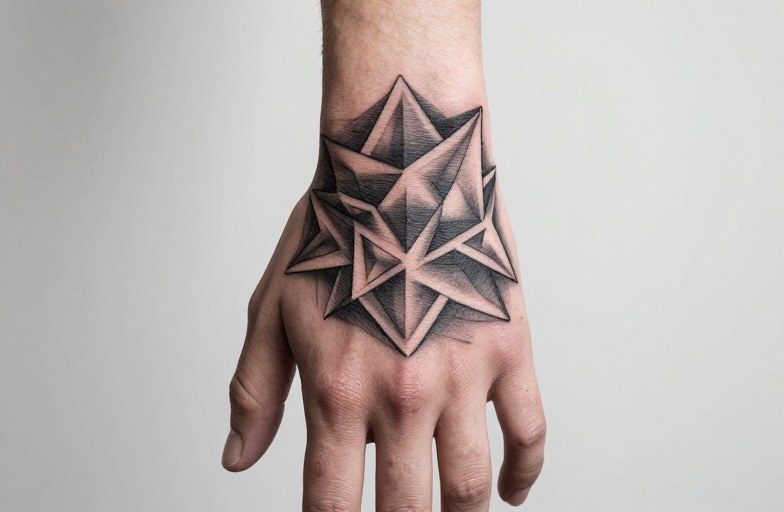
Geometric hand tattoos are exactly what they sound like: clean lines, repeating shapes, and symmetrical patterns applied to the back of the hand, fingers, or full hand coverage. The style draws from sacred geometry, Islamic pattern work, and contemporary abstract design. On the hand, these tattoos face unique constraints, thin skin, constant movement, and near-daily sun exposure mean the geometry must be bold enough to hold and simple enough to age without blurring into mush.
Key Characteristics & Motifs
Lines, Dots, and Repeating Forms
The backbone of this style is consistency. Single-needle lines might look crisp on day one, but on hands they spread. Most reputable artists working this style will use three-round or five-round liners for the bulk of the work, saving tighter needles for fine interior detail that isn’t load-bearing. Common motifs include hexagons and honeycomb grids, mandala centers radiating from the knuckles, dotwork shading that creates gradient without solid black fills, and interlocking triangles or diamond tessellations. Sacred geometry symbols, the Flower of Life, Metatron’s Cube, Sri Yantra, often linked to spiritual traditions, show up frequently but don’t require any particular belief to wear well.
Symmetry vs. Organic Flow
True geometric work demands precision. On hands, perfect symmetry across both hands is harder than it looks; bone structure differs subtly, and swelling during the session throws off visual balance. Some artists solve this by designing for asymmetry from the start, one hand gets a dominant pattern, the other a complementary frame. Others stencil both hands simultaneously and work back and forth to keep the reference fresh. Ask your artist which approach they use. If they don’t have one, that’s a red flag.
Choosing the Right Artist
Portfolio Red Flags and Green Lights
Look for healed photos, not just fresh work. Every tattoo looks sharp at week one. What you need is proof that their lines stayed straight after six months of hand-washing and sun. Green lights: consistent line weight in healed pieces, geometric work on actual hands (not just arms or calves), and evidence they’ve done multiple sessions on the same client (shows people come back). Red flags: portfolios full of geometric designs on flat skin only, lines that waver slightly even in fresh photos, or artists who primarily do other styles and list geometry as a side offering.
Communication and Design Process
A good geometric hand tattoo starts with tracing your actual hand, not pulling a stock design. The artist should account for your knuckle width, finger length, and how your hand flexes. During consultation, they should mark movement points, where the skin stretches most when you make a fist, and either avoid placing critical lines there or design the pattern to accommodate distortion. If they don’t mention this unprompted, they may not have done enough hands.
Color vs Black and Grey
Blackwork Longevity
Black and grey geometric hand tattoos age more predictably than color. The high contrast of black lines on skin tone reads clearly even as lines soften slightly. Solid black fills in geometric patterns can look striking but require heavier saturation, which means more passes, more trauma, and tougher healing. Dotwork shading offers a middle ground, texture and depth without the dense black that can scab thick and patch.
Color Placement Realities
Color on hands is possible but demands commitment to aftercare and sun protection. Red and orange fade fastest on hands, often linked to both sun exposure and the way these pigments break down in high-movement skin. Blue and green hold better but can shift toward grey as they settle. If you want color, consider limiting it to accent points, small triangles, dot clusters, or a single mandala layer, rather than full fields of saturated color. White ink on hands is generally a waste; it yellows or disappears entirely within two years.
Modern Variations
Mixed Media Approaches
Contemporary geometric hand work increasingly blends with other visual languages. Fine-line ornamental patterns overlap with geometric grids, creating lace-like negative space. Some artists incorporate minimal figurative elements, a small eye, a partial animal silhouette, locked into geometric frames. Cyber-sigilism, a newer style often associated with underground tattoo communities, merges sharp geometric angles with organic, almost alien curves. These hybrids require artists fluent in multiple languages; the geometry keeps the tattoo structured, while the secondary style provides personal reference.
Technical Evolution
Stipple shading machines and custom needle configurations have made finer dotwork more viable on hands than a decade ago. However, the fundamental constraint hasn’t changed: hand skin is thin, vascular, and mobile. No machine innovation overrides biology. The best modern geometric hand tattoos still rely on bold, simple shapes with spacing that allows for minor spread.
Best Placements
The back of the hand remains the classic canvas, flat enough for large symmetrical pieces, visible enough for impact. Coverage typically extends from the wrist knuckle to the base of the fingers, stopping short of the digits themselves unless specifically requested. Finger extensions from hand pieces often age poorly; the skin here is thinner, the ink sits differently, and blowouts are common.
- Full back of hand: Maximum impact, allows complex mandalas or large tessellations. Heals with significant swelling; expect 10-14 days before the design looks true.
- Central focal with radiating pattern: A hexagon or mandala centered on the middle knuckle area, with lines extending toward wrist and finger bases. Balances complexity with longevity.
- Wrist-to-hand transition: Geometric bands or patterns that flow from forearm onto hand. Requires planning for how the design reads at multiple angles.
- Single finger accents: Small geometric shapes on one or two fingers, connected to a larger hand piece. Higher fade rate, needs touchup planning.
Side of the hand and palm are generally avoided for geometric work. The side blurs quickly due to friction and movement; the palm sheds ink so aggressively that even the boldest geometry rarely holds.
Cost & Sessions
Pricing Structures
Geometric hand tattoos command premium rates because they demand precision and because mistakes show immediately. Artists typically price by piece rather than hourly for hand work, since rushing a geometric design ruins it. Expect to pay more for an experienced specialist than for a generalist, and expect that cost to reflect design time, stencil precision, and the slower pace required. Small single-session pieces might run shorter, but full hand coverage almost always requires multiple appointments.
Session Planning and Healing
Most full hand geometric pieces need two to four sessions, separated by healing time. The first session establishes the main structure, outlines and key shapes. Subsequent sessions add fill, detail, and refinement. Healing between sessions matters; coming back with swollen or scabbed skin compromises the artist’s ability to see and align. Plan for at least three weeks between sessions, and accept that your hand will be visibly in-progress for months. This is normal, not a problem to solve.
Final Word
Geometric hand tattoos reward patience and punish shortcuts. The style’s visual power comes from precision, and precision on hands requires an artist who respects the canvas. Choose based on healed evidence, not fresh Instagram posts. Design for how the tattoo will look at five years, not five days. And commit to the process, multiple sessions, careful healing, and sun protection for the life of the piece. Done well, geometric hand work holds its structure longer than most styles in this placement. Done poorly, it becomes a blurry lesson in why hands are considered advanced tattooing. The difference is almost always the artist and the time you’re willing to invest.
Frequently Asked Questions
Do geometric hand tattoos hurt more than other placements?
Yes, generally. The hand has thin skin, little fat padding, and dense nerve endings. The back of the hand is more tolerable than fingers or palm, but expect consistent discomfort rather than the variable sensation of fleshier areas.
How long before I can use my hand normally after a geometric hand tattoo?
Plan for 3-5 days of significant limitation and 10-14 days before the tattoo looks settled. Swelling peaks at 48-72 hours. You’ll need to keep it clean and avoid friction, which affects work, gym, and sleep positioning.
Will my geometric hand tattoo need touchups?
Almost certainly. Hand tattoos fade faster than most placements due to sun exposure, washing, and skin turnover. Many artists include one touchup in the initial price; ask upfront. Expect to need refresh work every few years to maintain crisp lines.
Can I get a geometric hand tattoo as my first tattoo?
Technically yes, but most artists advise against it. Hand tattoos are highly visible, harder to heal properly, and require more commitment to aftercare. Building experience with a healed tattoo elsewhere helps you understand your skin’s behavior before committing to this placement.