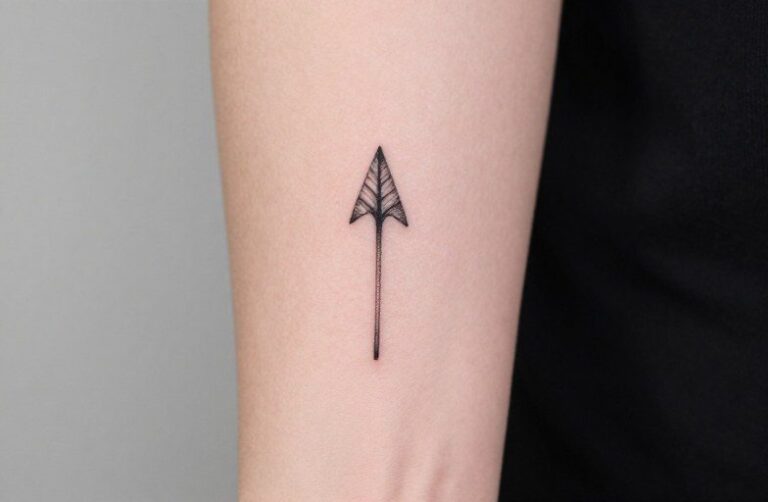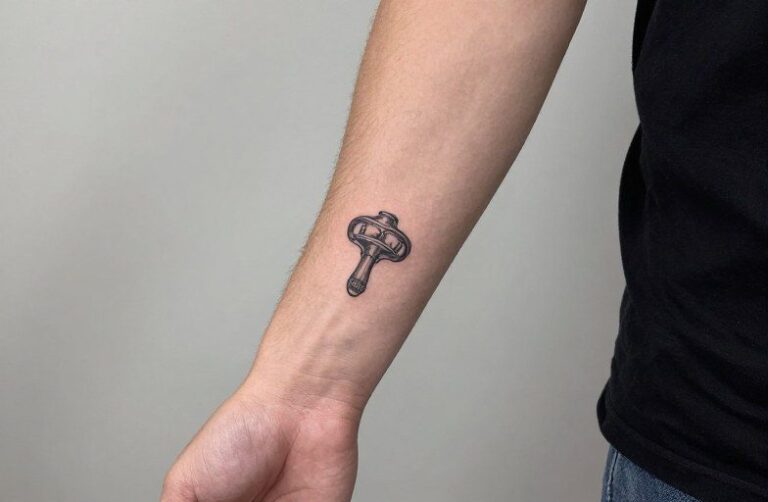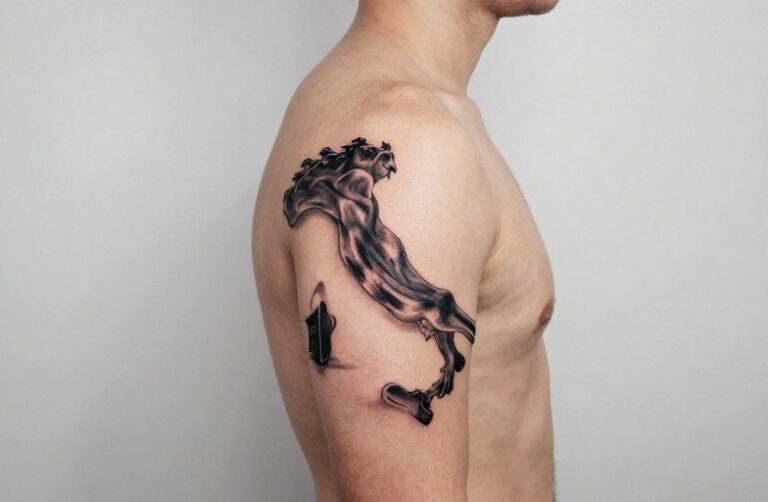
Geometric tattoos carry meaning rooted in mathematics, natural patterns, and the human impulse to find order in chaos. At their core, these designs represent balance, interconnectedness, and the underlying structures that govern both the physical world and personal philosophy. The precision of straight lines, perfect circles, and repeating polygons suggests a search for truth beyond surface appearance, whether that means spiritual harmony, rational clarity, or simply an aesthetic commitment to discipline.
Religious & Spiritual Angles
Geometry has served sacred purposes across nearly every major tradition, and that lineage follows these tattoos onto skin.
Sacred Geometry Traditions
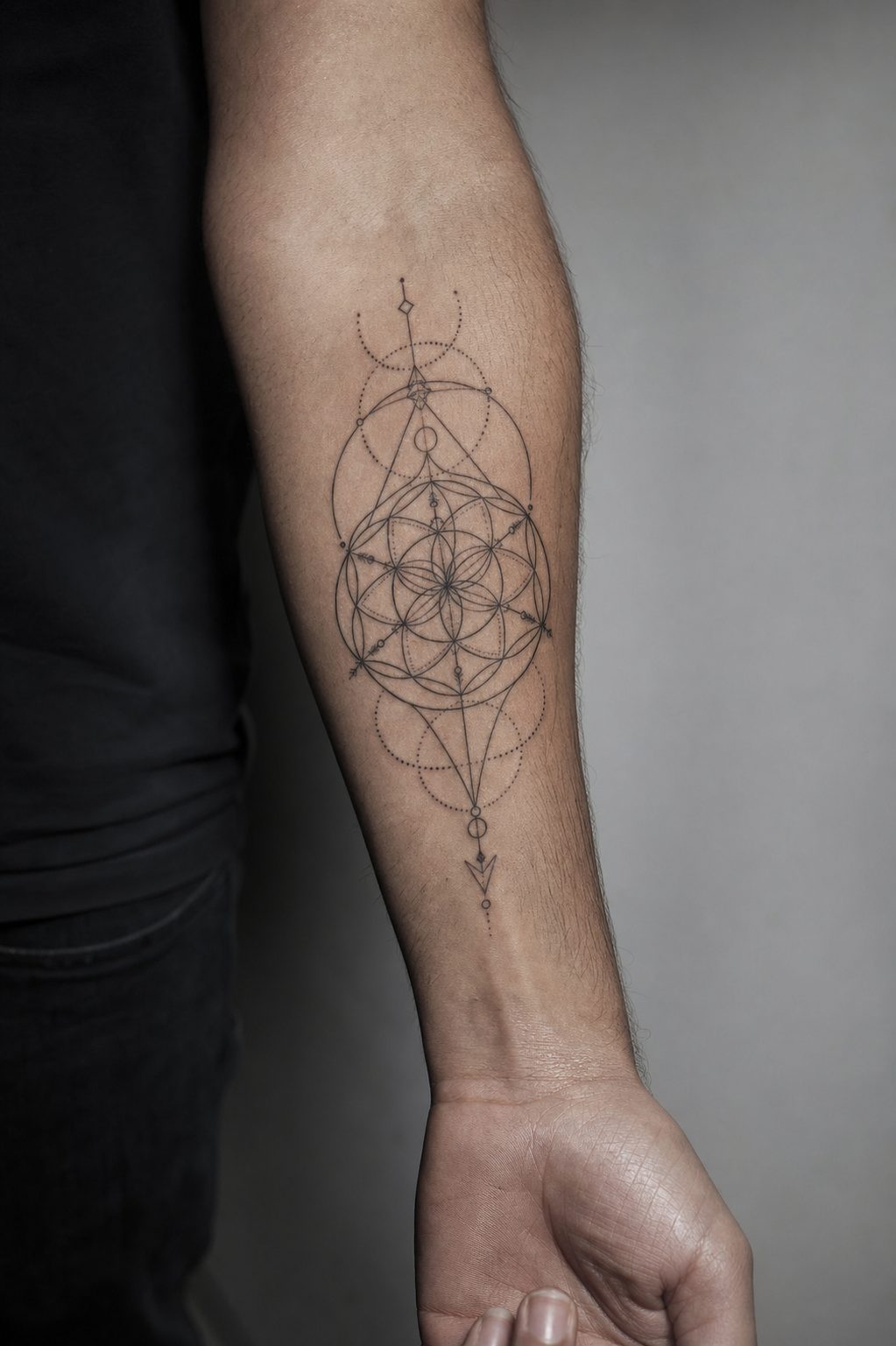
The Flower of Life, Metatron’s Cube, and Sri Yantra each appear frequently in geometric tattooing, often linked to mystical traditions that see mathematical perfection as evidence of divine creation. The Flower of Life’s overlapping circles, commonly associated with ancient Egyptian and later New Age traditions, supposedly contain the blueprint for all organic forms. Some trace it to temple carvings at Osireion, though its precise origins remain debated. The Sri Yantra, a complex diagram of nine interlocking triangles, carries specific meaning in Hindu tantra as a tool for meditation and a map of cosmic creation. Clients drawn to these symbols usually seek something more structured than representational religious imagery, an abstract vessel for belief rather than a literal icon.
Modern Spiritual Use
Contemporary wearers often treat geometric pieces as personal mandalas: focal points for grounding or intention-setting. The repetition in dotwork borders and tessellated patterns mimics meditative practice itself. Unlike a crucifix or Buddha figure, a geometric sacred design requires active interpretation. That ambiguity attracts people who hold eclectic or non-institutional beliefs. The tattoo becomes a private reference point rather than a public declaration of faith.
Symbolism & Core Meaning
Beyond explicit spirituality, geometric forms carry inherent symbolic weight that transcends cultural context.
Fundamental Shapes
- Circle: Wholeness, cycles, eternity. The most universal shape, with no beginning or end. A single circle on the wrist or behind the ear reads as minimal and complete; concentric circles suggest layers of self or expanding consciousness.
- Triangle: Direction, tension, trinity. Pointing upward, traditionally associated with aspiration or masculine energy; downward, linked to receptivity or feminine principle in some Western esoteric traditions. Interlocked triangles create the Star of David or the hexagram, each with distinct cultural baggage.
- Square/Rectangle: Stability, earth, containment. The least “dynamic” shape, which makes it powerful for grounding compositions. Often used as framing devices around more fluid elements.
- Hexagon: Efficiency, natural structure. Found in honeycomb and basalt columns, the hexagon bridges organic and mathematical worlds. Popular for nature-inspired geometric hybrids.
Line vs. Solid
The choice between outline-only geometric work and filled black shapes dramatically shifts meaning. Lines suggest permeability, process, architecture, something built or becoming. Solid black shapes read as absolute, finished, almost totemic. A single outlined triangle on the forearm feels exploratory; the same shape filled and wrapped around the calf becomes a statement of certainty. This distinction matters more than most clients initially realize.
History & Cultural Roots
Geometric patterning in body art predates written history, though direct continuities between ancient practice and modern tattooing are often overstated.
Polynesian and Micronesian tattoo traditions employed geometric elements, triangles, bands, spearheads, as part of larger figurative systems recording genealogy and status. These were not “abstract” in the modern sense; every shape encoded specific information. The geometric revival in Western tattooing, however, owes more to 20th-century art movements and digital design culture than to direct appropriation of these traditions.
Islamic geometric art, developed partly in response to aniconism in religious contexts, created extraordinarily sophisticated interlacing patterns. Some trace contemporary geometric tattoo aesthetics to this visual lineage, though most modern practitioners arrived independently through graphic design backgrounds. The resemblance is sometimes genuine influence, sometimes parallel evolution.
Optical art and 1970s graphic design established the visual vocabulary of impossible figures, tessellation, and moiré patterns that now appear regularly in skin. The current boom in geometric tattooing, roughly the last fifteen years, coincided with wider accessibility of vector design software and the rise of Instagram as a portfolio platform, formats that favor bold, immediately legible graphic impact over narrative detail.
How It Ages on Skin
Geometric tattoos present specific aging challenges that differ significantly from traditional or illustrative styles.
Line Integrity
Perfectly straight lines and precise angles are the first casualties of time and biology. Skin stretches, sags, and rebuilds collagen unevenly. A line that measured 2mm in 2025 may read as 3.5mm and slightly wavering by 2035. This affects geometric work more than flowing organic designs because the eye detects deviation from mathematical perfection instantly. Single-needle and fine-line geometric pieces face particular risk; bolder lines (3-5mm) with slight tapering at ends hold their structure longer. Placement matters enormously, inner bicep and thigh distort more than outer forearm or calf.
Contrast and Readability
High-contrast black geometric work ages better than greywash or stippled shading within shapes. The latter techniques blur and muddy, turning intended precision into visual noise. Solid black shapes can expand slightly (“blowout” at edges or general spread), but maintain their fundamental identity. White ink highlights, popular in geometric pieces for “dimension,” typically disappear entirely within 2-5 years as the body metabolizes the pigment.
Touch-ups are more common and more necessary for geometric collectors than for traditional tattoo wearers. Budget for this realistically if you’re committed to the aesthetic long-term.
Common Variations & Styles
“Geometric” encompasses several distinct substyles with different technical demands and cultural associations.
Dotwork/Pointillism: Shading and form built entirely from accumulated dots. Creates soft gradients impossible with line alone, but requires enormous time investment. A mandala sleeve in pure dotwork can consume 30+ hours. The technique originated in hand-poking traditions and was adapted to machine work; some artists still prefer single-needle hand tools for authentic texture.
Blackwork/Blackout: Large solid black geometric shapes, sometimes with negative-space lines revealing skin. The most aggressive and visually dominant geometric substyle. Healing is harder, more plasma, more scabbing, longer recovery. The commitment level is total; removal or cover-up is functionally impossible for large blackwork pieces.
Geometric/Organic Hybrids: Animals, skulls, or natural forms deconstructed into polygonal facets. Wolves and bears dominate this niche. The style requires genuine understanding of both geometric principles and animal anatomy; poorly executed versions look like low-poly video game renders from 2008.
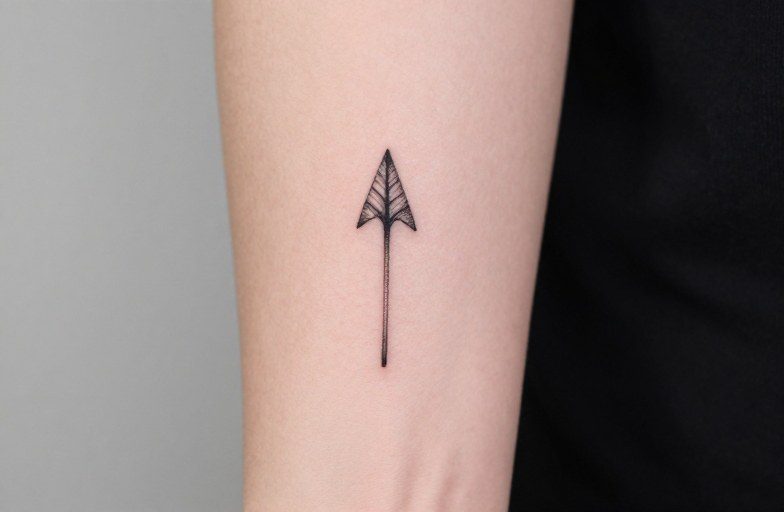
Minimalist/Line: Single shapes, thin precise lines, often small scale. Deceptively difficult technically, there’s nowhere to hide a wobble. Placement on flat, stable skin planes is essential.
Similar & Related Symbols
Geometric tattoos frequently overlap with or reference several related visual traditions.
Mandala tattoos share the radial symmetry and spiritual associations but typically retain more figurative or ornamental detail, lotus petals, deity imagery, color. Geometric mandalas strip away that specificity, becoming pure structure. The distinction matters to practitioners of the traditions involved; a geometric “mandala” that borrows layout without cultural content occupies contested ground.
Celtic knotwork and Nordic rune-stave designs employ geometric repetition but carry specific ethnic and historical weight that abstract geometry avoids. Some artists specialize in the technical overlap, interlacing lines that read as both geometric and culturally specific.
Architectural tattoos, blueprint fragments, floor plans, structural diagrams, share the precision and rational aesthetic but add narrative content: a specific building, a remembered space. Geometric abstraction removes that specificity in favor of universal pattern.
Trash polka, despite its chaotic appearance, sometimes incorporates geometric elements as grounding structure within otherwise explosive compositions. The tension between order and disruption is the point.
Final Thoughts
Geometric tattoos appeal to a particular temperament: people who find comfort in structure, who trust process over spontaneity, who believe that beauty emerges from constraint rather than freedom. The meaning is genuinely in the mathematics, the circle doesn’t represent eternity because someone decided it should, but because its physical properties make that interpretation inevitable. That built-in logic separates geometric work from more arbitrary symbolic systems.
The style demands technical excellence from artists and realistic expectations from collectors. A geometric tattoo that looks perfect on paper must survive the irregularity of living skin. Choosing an artist with specific geometric portfolio depth matters more than general reputation; the muscle memory for straight lines and perfect circles differs from that for traditional illustration. The best geometric work looks inevitable, as if the pattern always existed and the tattoo merely revealed it.
Frequently Asked Questions
Do geometric tattoos hurt more than other styles?
Pain depends on placement and your personal sensitivity, not style. However, geometric work often requires longer sessions for the same coverage due to precision demands, and solid black areas involve more needle passes over the same spot. The cumulative effect can feel more intense than a quicker, more varied technique.
Can any tattoo artist do geometric work well?
No. Geometric tattooing requires specific technical discipline, steady hand speed, consistent depth, and the ability to visualize mathematical relationships freehand or with stencils. Many excellent traditional or illustrative artists struggle with the precision. Always review an artist’s geometric-specific portfolio, not just their general work.
What’s the difference between sacred geometry and just geometric shapes?
Sacred geometry refers to specific symbols, Flower of Life, Sri Yantra, Platonic solids, with established spiritual lineages and claimed mystical properties. Generic geometric shapes carry inherent symbolic resonance but lack that specific cultural and historical weight. The distinction matters for personal meaning and for avoiding appropriation of living religious traditions.
Why do geometric tattoos sometimes look crooked after healing?
Skin isn’t flat paper. Swelling during healing, natural movement of the body part, and long-term changes in skin tension all distort straight lines. Artists compensate by slightly overcompensating angles during application, but biology ultimately wins. This is why experienced geometric artists avoid high-movement areas for precise pieces and why touch-ups are standard practice.