Minimalist finger tats for women can be quick, personal, and easier to plan than a larger piece. I once chose a tiny design without checking how hand movement would affect it, and the placement aged faster than expected. Your best option is a crisp symbol with enough breathing space. Small does not mean low-stakes!
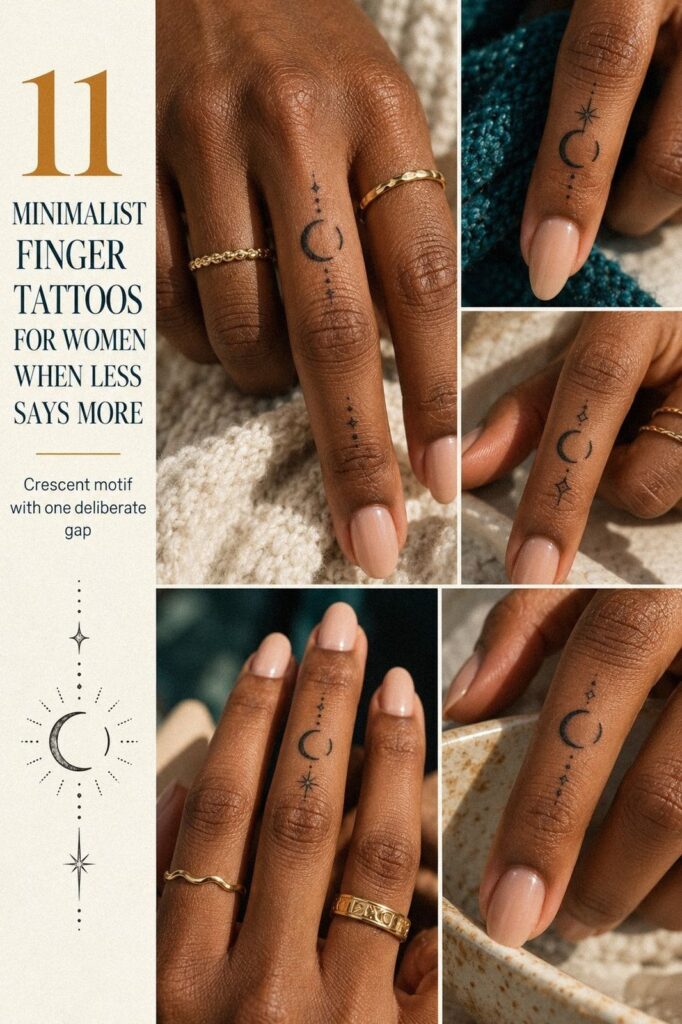
Tiny Crescent Moon Along the Finger
A crescent moon with a few tiny stars looks striking when it follows the finger instead of sitting squarely across it. Ask your artist to keep the curve open and the star spacing deliberate, especially if you want a delicate design that stays readable. Your finger bends constantly, so a minimal shape usually beats crowded detail.
Terracotta and olive ink can look beautiful against a warm neutral skin tone, while the stars can remain small open marks. I’d skip heavy shading here.
It can blur the moon’s edge and make your tattoo look muddy sooner than a simple outline. The Crescent Spacing Rule is easy: leave enough skin between each mark that you can still identify them from arm’s length.
If you like this placement, compare it with these small finger tats for women before you book. Your artist should show healed examples, not only fresh photos. That extra check is worth the cost of a little more planning.
A moon works well for someone who wants a quiet reminder of change, night, or private ambition. You’ll want to check whether the side of your finger gets frequent friction from rings or tools. That detail matters more than the symbol itself.
Fine Line Botanical Finger Band Tattoos
A slim botanical band can wrap partway around the finger with hair-thin single-needle marks and two or three tiny leaves. The effect is intricate, but it shouldn’t look crowded. Choose a crisp stem, one direction of growth, and enough negative skin that the leaves don’t merge after healing.
Your artist can angle the band around the finger’s natural crease rather than forcing a perfect circle. I’d choose an understated sprig over a full wreath because the wreath has more tiny intersections to soften over time. The Botanical Loop Method keeps the design light: one stem, a few leaves, and one intentional opening.
A single-needle configuration may create the fine texture you want. If you prefer color, a muted clay line with a small warm-gold accent can keep the botanical idea expressive without adding clutter. You should still ask to see healed linework from the same artist.
You’ll learn more from those healed photographs than from a filtered portfolio, and that gives you better value for your money. For a more complete reference, browse these minimalist inside finger tattoos. Your choice should match your tolerance for maintenance and visibility, not just the prettiest fresh image.
Dainty Initials Between Knuckle Creases
Initials between the knuckle creases can feel meaningful without taking over your hand. Keep each letter dainty, open, and separated from the crease itself. Your artist may suggest slightly wider spacing than you expected, and that’s wise because compressed letters can lose their identity as the skin moves.
I’d avoid ornate script here. A clean monogram or simple serif has a better chance of staying legible than decorative loops. The Initial Balance Rule gives each letter space to breathe, especially if your initials include narrow forms such as I, L, or T.
Use deep plum-grey linework with a restrained rose-gold accent if you want the letters to feel distinctive against medium olive skin. A tiny mark still needs enough contrast. And if you’re choosing someone’s initial, think about whether you’d want the same symbol if the relationship or season changed.
You can compare different placements in this guide to small hand finger tattoos for women. Your artist should help you test the letters on paper first, then move your hand through a fist, a relaxed palm, and a grip. Keep that testing step in your budget.
Minimalist Snake Wrapped Around One Finger
A slim serpent coiling around one finger gives you a fierce, flowing shape without requiring heavy detail. The body can curve around the finger with a small head and a few deliberate scale lines. Keep the snake edgy through its posture, not through excessive shading.
I’d skip a realistic face on this scale. It often turns into a dark speck once the lines settle, while a simple profile keeps the symbol readable. The Coil-and-Gap Method leaves small openings between each turn, so your design won’t look like one continuous black ring.
Your golden tan skin can carry deep navy ink beautifully, but your artist still needs to consider how much sun your hands receive. UV exposure can soften fine lines and fade contrast.
Ask how the artist expects the tattoo to look after healing, not only on appointment day. That conversation helps you decide whether the design is worth it.
If you want related inspiration, look through these minimalist hand tattoos for women. You’ll want the snake’s head facing a direction that feels intentional when your hand is relaxed.
Delicate Sunburst On the Side Finger
A small sunburst on the side finger can look graceful and elegant, especially when the rays vary slightly in length. Keep the center open and let the rays taper naturally. An emerald center with muted-gold rays may give the design enough contrast without adding extra decoration.
This concept works well as a flash-sheet idea because you can compare several ray patterns before choosing one. I’d avoid making every ray identical. Perfect symmetry can look stiff on a curved finger, while tiny variations make the mark feel more expressive and hand-drawn.
The Side-Finger Light Rule is about visibility. Your tattoo may disappear when your hand rests flat, then appear when you turn it toward someone. That’s a smart choice if you want a personal symbol rather than a design everyone notices first.
You can study other small placements in this small finger tats collection. Your artist should stencil the sunburst in more than one position because a few millimeters can change how the rays sit beside the crease. That can save you an unnecessary cost later.
Tiny Heart Outline Near the Fingertip
A tiny heart outline near the fingertip feels romantic, playful, and easy to personalize. The best version uses one clean contour with no interior fill. On deep ebony skin, forest-green ink with a small rust accent can keep the outline distinctive, but your artist should choose line weight carefully.
I’d skip a heart placed directly on the fingertip pad. That area gets constant contact, washing, and friction, so a slightly lower side placement may be kinder to the design. The Heart Margin Rule leaves a little skin between the outline and the crease, which protects the shape from looking pinched.
Your symbol doesn’t need a dramatic explanation. It can represent affection, self-respect, friendship, or a private promise. And if you’re worried that a heart feels too common, adjust the contour: a slightly uneven hand-drawn line can make it more expressive.
For more placement comparisons, save these minimalist hand tats. You’ll want to ask your artist how the outline may change after surface healing, which usually takes about 2 to 3 weeks. That advice adds real value.
Symbolic Stars Across Multiple Fingers
Small stars across multiple fingers can create an ethereal, symbolic, and sacred feeling without forming one large composition. Use different sizes, but keep the marks visually related. Charcoal outlines, dusty-rose accents, and one tiny gold-filled star can give the set enough rhythm.
I’d limit the arrangement to a few stars rather than covering every available space. More symbols don’t automatically create more meaning. The Constellation Gap Rule keeps each star visually independent, so your hand still looks intentional when your fingers spread or curl.
Your fair cool-pink skin may show dusty-rose and charcoal contrast clearly at first, but you should still plan for everyday exposure. Ask whether the stars should sit on the side, top, or inside of each finger. Those spots experience different levels of friction, and your artist can explain the tradeoff.
If you’re building a larger collection, this minimalist finger tattoos guide may help you compare motifs. Your stars can mark people, places, or milestones, but they’ll look strongest when the spacing matters as much as the meaning.
Sleek Black Dot Finger Tattoos
A row of black dots is sleek, bold, and surprisingly versatile. You can place three dots near a crease, form a tiny vertical trail, or use one larger dot as an anchor. The design is simple, but your artist must make every mark deliberate because uneven spacing will be obvious.
Choose solid black pigment if you want the dots to remain visible. I’d skip pale grey for this idea because it can look soft before it looks intentional. The Dot Rhythm Method uses one dominant dot and smaller companions, giving your eye a clear starting point.
Your medium warm ivory skin can carry this approach with sharp contrast, but hand placement still affects longevity. Black dots may soften at the edges over time, especially where you wash, grip, or rub frequently. That isn’t a failure, but you should know what you’re choosing.
And if you want to see how other tiny marks work across the hand, browse these small hand tats for women. You’ll want the artist to mark the spacing with a pen first, then flex your finger before the stencil is final. For many people, that makes the small design worth it.
Graceful Wave Line Along the Finger
A curling ocean wave can feel timeless, powerful, and personal when the crest follows the finger’s natural movement. Keep the foam as one or two fine curves rather than a cluster of tiny marks. Your medium olive skin can show the shape beautifully with midnight-blue linework and a restrained copper accent.
I’d choose a single wave over several stacked waves. The repeated version can become visually busy, while one crest gives you a clearer silhouette. The Wave-Flow Test asks you to bend your finger and check whether the line still looks like water instead of a random squiggle.
This is a good option if you want a symbol for travel, recovery, or the ability to keep moving. But don’t ask for too much realism. A tiny wave needs a readable gesture, not every foam detail from a large ocean scene.
That restraint is a powerful choice!
You can compare this idea with other unique minimalist finger tats for women. Your artist should show a stencil from both the palm-facing and outward-facing view before you decide.
Unique Geometric Shapes On the Knuckles
Geometric shapes on the knuckles can look daring, ornate, and polished when the design uses only a few strong angles. Think of a tiny triangle, diamond, or split square with precise sage-green and warm-cream geometry. Your artist needs to account for the knuckle’s movement instead of treating it like flat paper.
I’d skip complicated mandalas at this scale. Too many intersections can blur into a dark patch, especially on a high-friction placement. The Two-Scale Rule gives you one visible outer shape and one smaller interior detail, leaving enough skin around both.
The stencil-versus-healed comparison matters here. A design can look perfectly balanced on paper and shift slightly once it sits across a moving joint. Ask to see similar healed work, then bend and straighten your hand while checking the stencil.
For more examples, save these minimalist finger tattoos. You’ll want to favor a shape that still reads when your knuckle is relaxed, not only when your hand is posed for a photograph.
Meaningful Matching Symbols For Women
Matching symbols can be empowering, iconic, and deeply personal when two people choose a small mark with shared meaning. Consider paired stars, linked circles, tiny initials, or two halves of one simple symbol. Your deep brown skin with a warm undertone can carry terracotta and olive ink with strong visual presence.
I’d avoid making the designs so dependent on each other that one person’s tattoo feels incomplete alone. A matching mark should stand on its own if plans change. The Independent Pair Rule keeps the shared idea intact while giving each person a complete symbol.
Your artist should stencil both versions separately and check them under the same lighting. That helps you compare scale, placement, and line weight before the appointments. A fine-line symbol may look dainty on one hand and less visible on another, so identical measurements don’t always create identical results.
If you’re planning a shared appointment, review these minimalist hand tattoos for women first. You’ll want a design that reflects the relationship without turning the tattoo into a test of permanence.
Compare Finger-Side and Finger-Top Placement
Finger-side placement can feel more private, while the top of the finger gives a symbol stronger visibility. Compare both options with a temporary stencil before you commit. This simple test can reveal whether the design still looks balanced when your hand is open, curled, or holding something.
The side may experience friction from adjacent fingers, rings, and repeated contact. The top may receive more sun and attention. Neither choice is automatically better, but one may offer better long-term value for your lifestyle.
Ask your artist to check the placement while your hand is relaxed, not only stretched flat. A tiny moon, wave, or initial can shift visually when the skin folds. If the stencil looks awkward, changing position costs less than regretting the finished mark.
Which Finger Placement Holds Up Best?
There isn’t one universally best finger for a minimalist tattoo. The index finger is visible and expressive, the ring finger can feel romantic, and the pinky often supports a smaller, quieter mark. Your work, hobbies, and daily handwashing matter more than a trend.
High-friction areas usually need simpler shapes and realistic expectations. A minimal dot or open crescent may handle movement better than a dense symbol with several intersections. Ask for healed examples on the same part of the hand.
If you want a visible design that still feels personal, the outer side of a finger can be a graceful compromise. You’ll see it often, but other people may miss it. Start small, but choose deliberately!
Less Detail, More Staying Power
A bold silhouette often survives visual changes better than an intricate miniature illustration. This doesn’t mean every finger tattoo must be plain. It means each line should earn its place.
I’d rather see one iconic curve than six cramped details competing for attention. Open skin helps the eye understand the design, and it gives softened lines less chance of merging into one dark patch.
If your reference image contains tiny text, multiple leaves, or realistic shading, ask whether the idea can be simplified. A slightly understated version may keep its identity longer and deliver better wear value.
Budget for the Tattoo and the Touch-Up
A realistic budget should include the initial appointment, aftercare, and the possibility of a future touch-up. Small tattoos aren’t always cheap because studios often have a minimum, even when the design takes only one sitting.
Here are practical US reference points I’d keep in mind:
These figures vary by artist and region, so they’re planning ranges, not a quote. A personal design can still be a smart purchase when you understand what the price covers and leave room for proper aftercare.
Before booking, ask whether touch-ups are included, how long the studio considers the tattoo newly healed, and whether hand placements follow a different policy. Clear answers help you compare artists by quality, not only by the lowest number.
Ask These Questions Before You Book
Ask how often the artist tattoos fingers, whether they can show healed examples, and what line weight they’d choose for your design. You should also ask how they handle different skin tones and how they expect the mark to change after healing.
Tell the artist about work gloves, frequent washing, sports, instruments, or anything else that affects your hands. Those details can change the best placement and the safest design. Honest information creates a more accurate plan.
Ask what aftercare products and restrictions they recommend. Don’t leave the appointment guessing about washing, moisturizing, sunlight, or swimming.
Finally, ask for the full price before you confirm the date. A clear answer protects your budget and makes the decision feel calmer. Fresh is not the finish line!
The Finger-Wear Rule I Wish I’d Heard First
I’ve learned that finger tattoos demand a smaller promise than people expect. They’re visible, personal, and often exposed to soap, sunlight, friction, and constant movement.
My first mistake was choosing a design because it looked stylish in a fresh photograph, then ignoring how the placement would behave during ordinary days. The result was raw in a way I hadn’t planned for.
A finger tattoo isn’t automatically a bad first tattoo, but it isn’t maintenance-free either. I’d choose a clear symbol over a crowded illustration, and I’d choose strong placement over a trendy one. Your artist should show healed photographs, explain possible touch-ups, and answer questions without rushing you.
These figures vary by artist and region, so they’re planning ranges, not a quote. I’ve also found that the most gritty part of the decision isn’t pain. It’s accepting that a tiny design may need everyday care and, sometimes, a later refresh.
If you’re comparing placements, your hands and feet tend to feel more intense than areas such as the forearm, thigh, or shoulder. That doesn’t mean you can’t choose a finger. It means you should book with realistic expectations.
The Questions Worth Answering First
How much does a minimalist finger tats for women usually cost?
A minimalist finger tattoo in the US often falls around $50 to $100 for a shop minimum or $100 to $250 for an hourly rate. Your artist’s experience, location, size, placement, and studio policy can change the total.
Are minimalist finger tats for women a good idea for a first tattoo?
Yes, if you want a visible, small design and you understand hand tattoos can fade or soften. A simple symbol is easier to read and discuss than crowded detail. Your artist should still show healed work and explain possible touch-ups.
How do I choose a tattoo artist for minimalist finger tats for women?
Look for healed examples, clean linework, and clear hygiene practices. Fresh ink can hide spreading or fading. Your artist should also understand finger placement, not simply offer small versions of larger tattoos.
How much do minimalist finger tats for women hurt?
Finger tattoos can feel sharper than tattoos on the forearm, thigh, or shoulder because hands have less cushioning and more sensitive, bony areas. Pain varies by person, exact placement, and session length, so ask your artist what to expect.
How long does a minimalist finger tats for women take to heal?
Surface healing usually takes about 2 to 3 weeks, while complete healing can take about 2 to 3 months. Wash gently, moisturize as directed, and avoid excess sun and swimming while your artist’s aftercare instructions apply.
What’s the best placement for minimalist finger tats for women?
The best placement depends on visibility, friction, and your design. The side of the finger can feel more private, while the top is easier to see. Ask your artist how each spot may affect fine lines as your hand moves.
Where should I book minimalist finger tats for women?
Book with an artist whose portfolio shows healed fine-line finger work, not only fresh tattoos. A strong portfolio should include different skin tones, simple symbols, and clear aftercare guidance. You don’t need a product seller or affiliate recommendation to choose safely.
Where I’d Start First
If I had to pick one, I’d start with the tiny crescent moon. Its open curve and separated stars give your artist space to protect the design from blur, and it still reads when your finger bends. Pin the moon idea for later and compare it with these small finger tattoos before booking.
That makes it a smart place to begin.