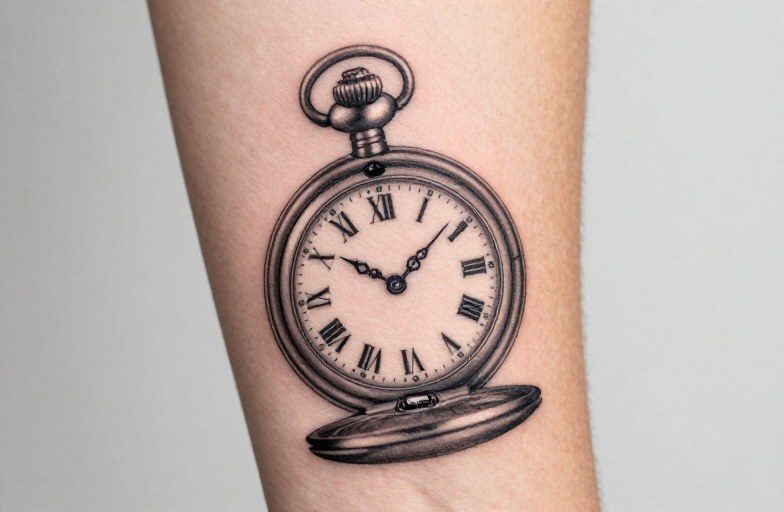
Pocket watch tattoos carry a visual weight that few other designs match. The exposed gears, the Roman numerals, the glass lens catching light on skin, there’s something about that combination of precision and nostalgia that draws people in. But a pocket watch isn’t a simple shape to execute well. The circular face, the depth of the mechanism, the chain or ribbon trailing from it, all of it demands planning. Get it right and you have a piece that ages gracefully. Get it wrong and the numbers blur, the gears flatten into gray mush, and the whole thing looks like a sticker rather than something embedded in your body.
Tips for Choosing
Mechanical Accuracy vs. Artistic License
Real pocket watches have specific proportions. The crown sits at 12 o’clock. The bow (the loop the chain hooks through) extends from that same point. The bezel ring frames the crystal. When these elements get shifted around for aesthetic reasons, the design can feel subtly off to anyone who knows the object. You don’t need engineering-grade accuracy, but understanding the anatomy helps you judge a stencil before it goes on your skin.
Some artists compress the face to make it fit forearms better. Others enlarge the internal gears beyond realistic scale because those interlocking teeth photograph well. Both choices work if they’re intentional. Ask to see healed photos of similar pieces from your artist. Fresh tattoos look sharper than they will in three years. That fine linework inside the movement? It spreads. Plan for it.
Chain, Ribbon, or Nothing
The trailing element matters more than people expect. A chain of small, identical links running down a wrist or ribs can look rigid and repetitive. A broken chain suggests something different than a neatly coiled one. Some designs replace the chain entirely with a ribbon, a vine, or a banner carrying text. Each choice changes the tone. Chains feel historical and masculine-leaning. Ribbons soften the piece. Botanical elements merge the mechanical with organic decay or growth.
- Full chain with realistic links: requires significant vertical space, ages poorly if too small
- Partial chain fading into skin: works for smaller placements, less commitment
- Replaced with ribbon/banner: easier to integrate text or dates
- No trailing element: focused, circular composition, reads faster from distance
Size & Scale
Minimums That Actually Work
A pocket watch face needs room for the numerals to remain legible. Below two inches in diameter, Roman numerals become indistinguishable blobs. The gear teeth inside the movement merge into gray circles. For black-and-gray realism, aim for at least three inches on the longest dimension. Color pieces can sometimes read smaller because the contrast between gold tones and black lining creates separation that monochrome lacks.
The chain multiplies your space needs. Each link needs definition. A compressed chain of ten links in two inches looks like a smudged rope within five years. If you want the full chain dropping from the watch, budget for a forearm, outer thigh, or calf. Ribs and upper arms work better for the watch alone or with a short, partial chain.
Placement and Movement
Skin stretches and shifts. A pocket watch on the inner bicep distorts when you flex. The circular face becomes oval, the gears stretch. Outer forearms stay more stable. The flat planes of the thigh or calf preserve the geometry better than curved surfaces like shoulders or ribs. That said, some distortion is acceptable if the design incorporates it, a cracked face, a melting clock edge, a chain that appears to sink into muscle. Salvador Dalí made distortion the point. Your realism piece probably shouldn’t.
For First-Timers
First tattoos carry enough pressure without adding complex mechanical subject matter. A pocket watch demands longer sessions than simple flash. The shading inside the movement takes time. The fine lines around numerals require a steady hand and a patient sitter. If this is your first piece, consider a smaller, simplified version, a watch face without exposed gears, or a silhouette with minimal interior detail.
Pain varies by placement, but the detailed work in a pocket watch often sits in spots that hurt more: ribs, sternum, inner arm. The artist needs the skin stable to render small elements. Tensing and shifting extends the session. A simpler design in a more forgiving spot (outer forearm, upper thigh) lets you learn your pain response without compromising the tattoo’s quality.
Standout Design Ideas
Broken and Frozen Time
A cracked crystal with hands stopped at a specific hour turns the pocket watch into memorial or commemorative work. The broken glass allows creative fragmentation, shards floating outward, the face visible through cracks, light refracting differently across the surface. This approach works particularly well in black and gray because the crack lines provide natural high contrast without needing color.
Stopped hands require a decision: do you want the time readable? 11:11 reads differently than 3:33 or a custom hour meaningful to you. Some artists hide the hands entirely behind damage or overlap them with other elements.
Merged with Other Objects
The pocket watch form merges cleanly with skulls (the watch face replacing the cranium’s clockwork), roses (petals emerging from the case or wrapping the chain), and compasses (the glass lens becoming a directional face). These combinations succeed when the objects share visual logic, both compass and watch involve precision instruments, both skull and stopped time invoke mortality. Forced combinations feel like two tattoos colliding rather than one coherent piece.
- Watch face + anatomical heart: gears visible through ventricles, chain becoming arteries
- Watch sinking into water: surface distortion, bubbles replacing numerals
- Watch as eye in a larger face: surreal, requires skilled artist to avoid gimmick
How to Personalize It
Dates and Numerals
Roman numerals carry formal weight. Arabic numerals feel more utilitarian, more train-station-clock than heirloom. You can replace standard numerals with significant dates, birth years, anniversaries, death dates, though this works better on the banner or ribbon than the face itself, where readability suffers. Some people engrave the case back with coordinates or names, treating the tattoo like an actual object that carries inscription.
Color Choices Beyond Gold and Silver
Traditional pocket watches come in gold, silver, gunmetal. Tattooed versions often default to these because they’re immediately readable. But oxidized copper, verdigris green, deep blue enamel faces, these create distinction. A black watch with white gold gears inverts the expected value hierarchy. A sepia-toned piece with cream face and brown leather strap references vintage photography. The chain offers color opportunity too: oxidized links, rose gold, even linked gemstones if you want to push toward jewelry rather than instrument.
Trending Variations
Neo-traditional pocket watches have gained ground in recent years. The form stays recognizable but the colors flatten and saturate, teal faces, coral chains, thick black outlines containing everything. This style heals more predictably than realism because the bold lines hold their weight. The tradeoff is less photographic depth, more graphic impact.
Single-needle and fine-line approaches have also emerged, though these suit the pocket watch form less well. The gears need weight to read. Ultra-thin lines that look delicate fresh tend to disappear into skin tone within months. If you’re drawn to that aesthetic, consider a pocket watch outline only, no interior detail, or a very small piece in a highly visible spot where the subtlety reads as intentional minimalism rather than fading failure.
Biomechanical fusion, watch gears emerging from torn skin, metal and flesh interweaving, continues in dedicated communities. This requires an artist with specific experience in the genre. The technique differs from standard realism; the shadows fall differently, the metal needs to read colder, harder than organic tissue. Not every black-and-gray specialist can execute it.
Final Thoughts
A pocket watch tattoo rewards the time you put into planning it. Study actual timepieces. Understand what makes them look authentic versus decorative. Choose scale that lets the details survive healing. Pick an artist whose healed work in mechanical or ornamental subjects you can examine in person. The best pocket watch tattoos don’t just depict an object, they convince the eye that something precise and weighted exists beneath the skin, still ticking in its own way.
Frequently Asked Questions
How long does a detailed pocket watch tattoo typically take?
A full realism piece with exposed gears and chain usually needs two to four sessions of three to four hours each, depending on size. Simpler designs without interior mechanism detail might finish in a single long session.
Do pocket watch tattoos age badly compared to simpler designs?
The fine interior details are vulnerable to spreading and fading. Bold outlines and sufficient contrast between light and dark areas help longevity. Avoid going too small, and expect a touch-up after a few years to sharpen the numerals.
What’s the best style for a pocket watch if I want color?
Neo-traditional handles color most reliably, with saturated flat tones and strong black outlines. Realism color works but requires more maintenance; the subtle gradations in metallic sheen are harder to preserve long-term.
Can a pocket watch tattoo work as a cover-up?
The circular form and dark interior elements can mask older tattoos effectively, but the face needs enough unmodified skin to show the clock details clearly. Your artist should design the gears specifically to absorb and redirect attention from the old piece.