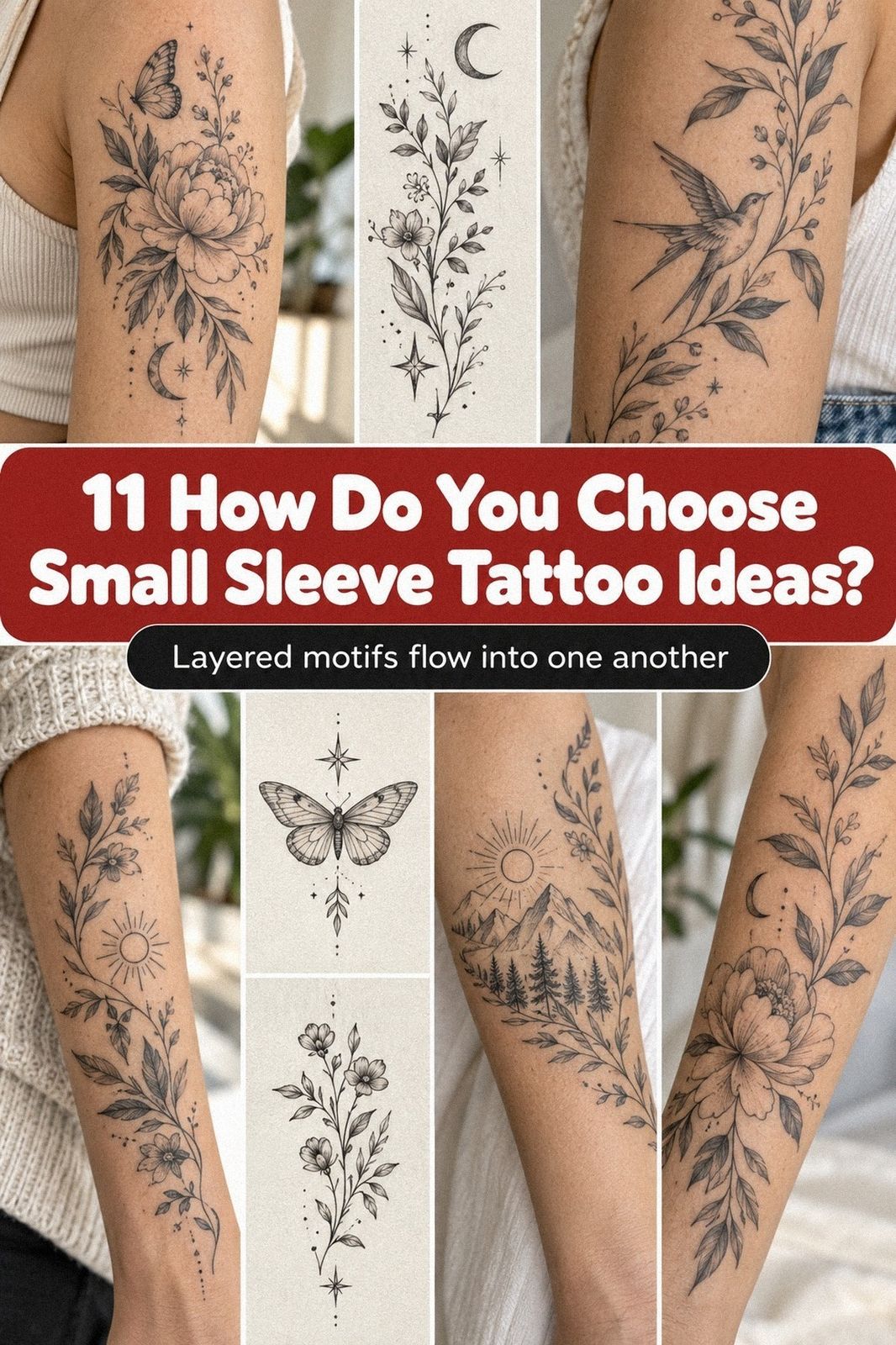
Small sleeve tattoo ideas can fit a real budget, usually around $100 to $300 for a compact concept, depending on placement, artist, and region. I once planned too many tiny details for one forearm and had to cut half of them. Your best sleeve won’t be the busiest one. It’ll be the most deliberate.
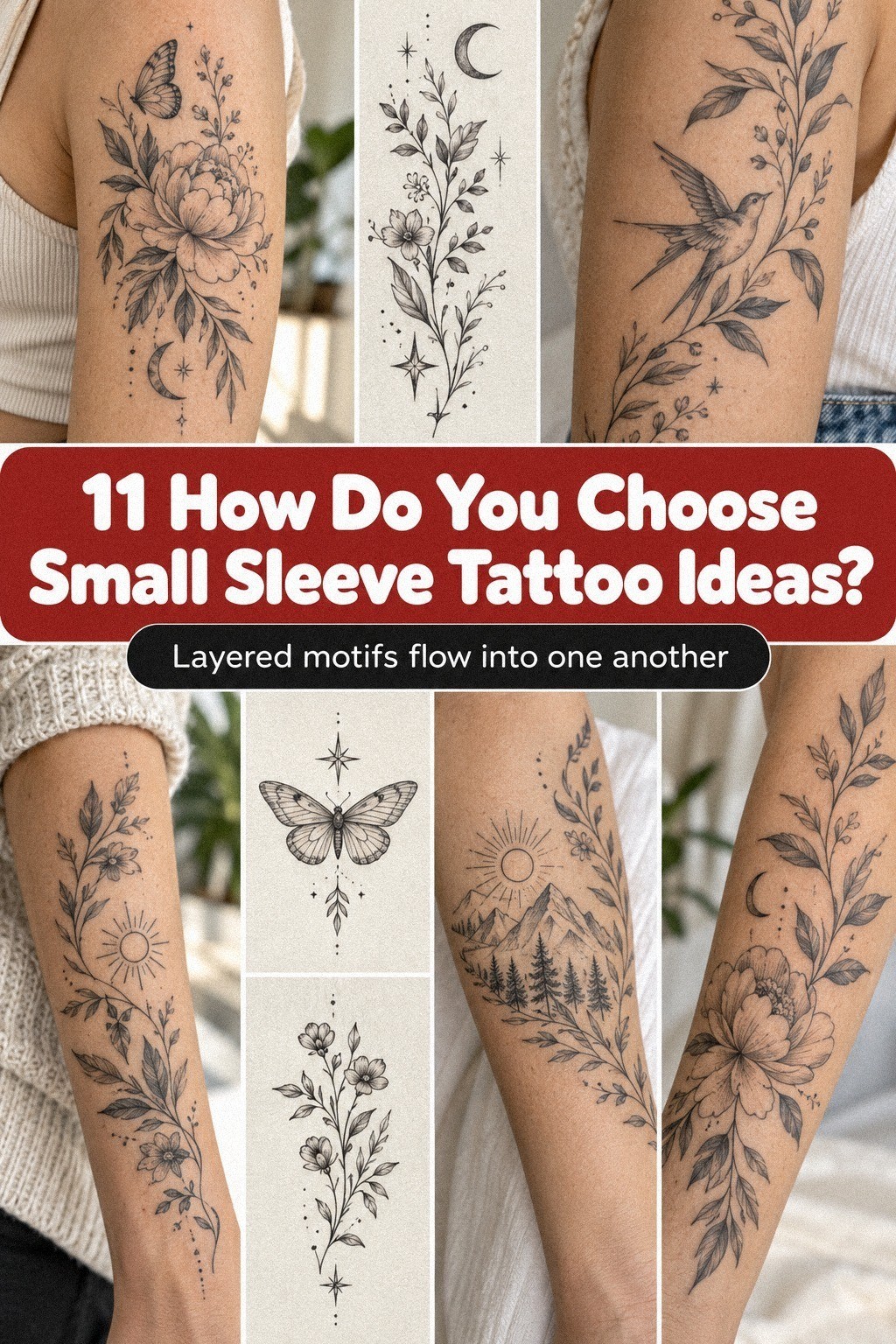
- Let Delicate Botanicals Travel
- Bold Blackwork: How Much Is Enough?
- Map a Fine-Line Celestial Sleeve
- Can Geometry Stay Soft on a Forearm?
- Choose a Meaningful Animal
- One Vibrant Floral Accent
- When Does Abstract Linework Feel Finished?
- Minimalist Wrist-to-Forearm, Maximum Intent
- Why Micro Realism Needs Restraint
- Patchwork Symbols, Not One Story
- Black and Grey: Quiet Contrast, Strong Shape
1Let Delicate Botanicals Travel
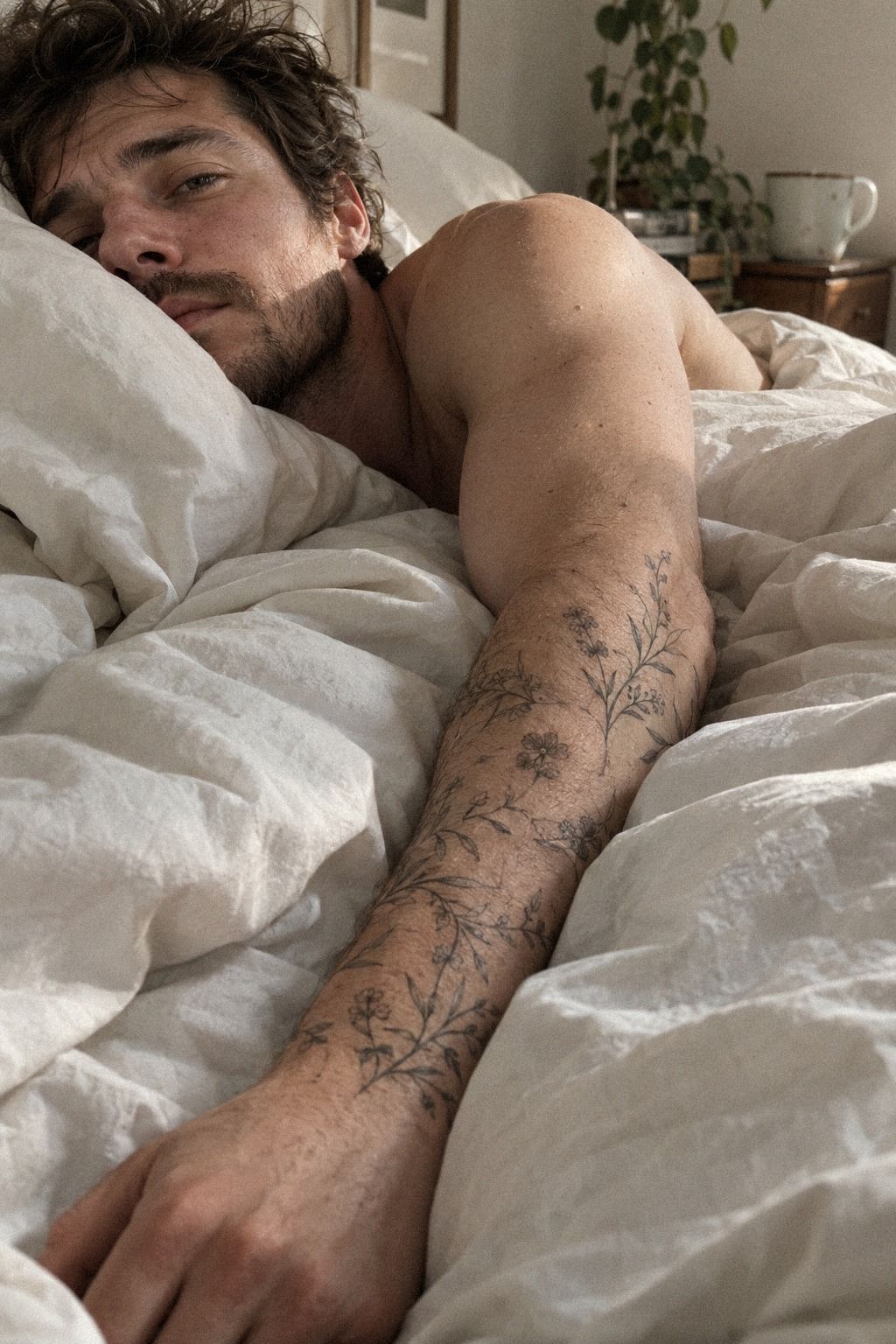
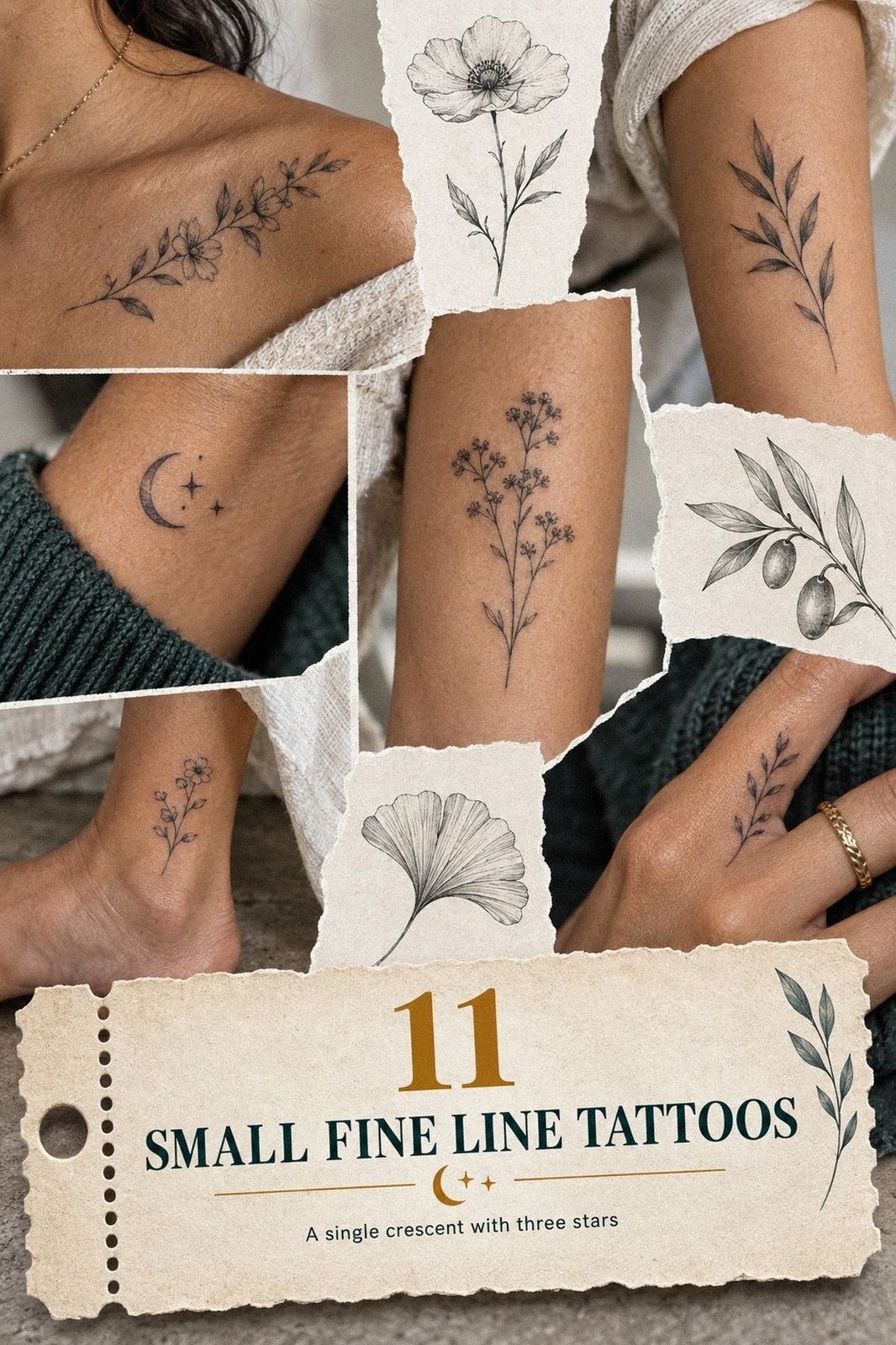
A delicate botanical sleeve works beautifully when you let the stems travel instead of stacking flowers like stickers. Think fine single-needle leaves, a narrow fern, and one wild rose sprig following the forearm’s natural curve.
On cool-pink skin, crisp black lines can look especially graphic. You’ll want enough open skin between each branch so the design still reads from a few feet away.
I call this the Stem-and-Spacing Rule. Your artist should leave breathing room around the fine-line foliage, particularly near the wrist where movement and friction are constant.
I’d skip a dense bouquet here. It sounds romantic, but tiny overlapping petals can blur into a dark patch as they age.
A small olive branch near the inner forearm gives the sleeve a graceful direction without making it feel overly feminine or overly masculine. Your reference folder should include healed work, not only fresh tattoos. Fresh lines look sharp; healed lines reveal whether the artist understands restraint.
And don’t crowd the elbow crease. That skin bends, rubs, and often needs more patience during healing.
A narrow leaf can stop just before the crease, while a second stem begins above it. Your small tattoo designs guide has more ideas for keeping botanical pieces clean and personal.
The result is understated but expressive, especially when sunlight catches the fine lines at an angle. If you want a timeless sleeve that won’t dominate every outfit, this is my first pick.
2Bold Blackwork: How Much Is Enough?
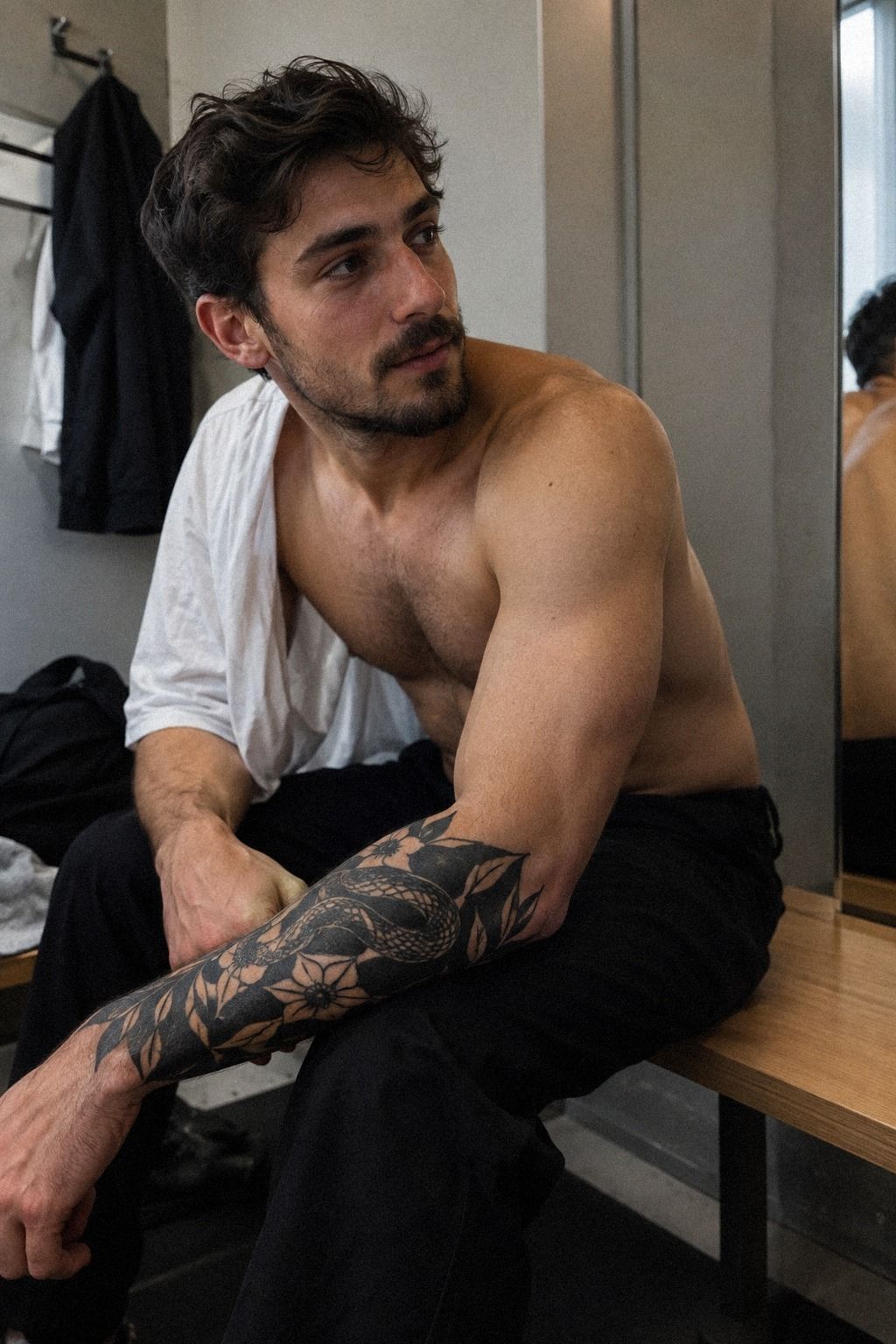
Bold blackwork gives a small sleeve stronger visual weight without requiring a huge number of elements.
3Map a Fine-Line Celestial Sleeve
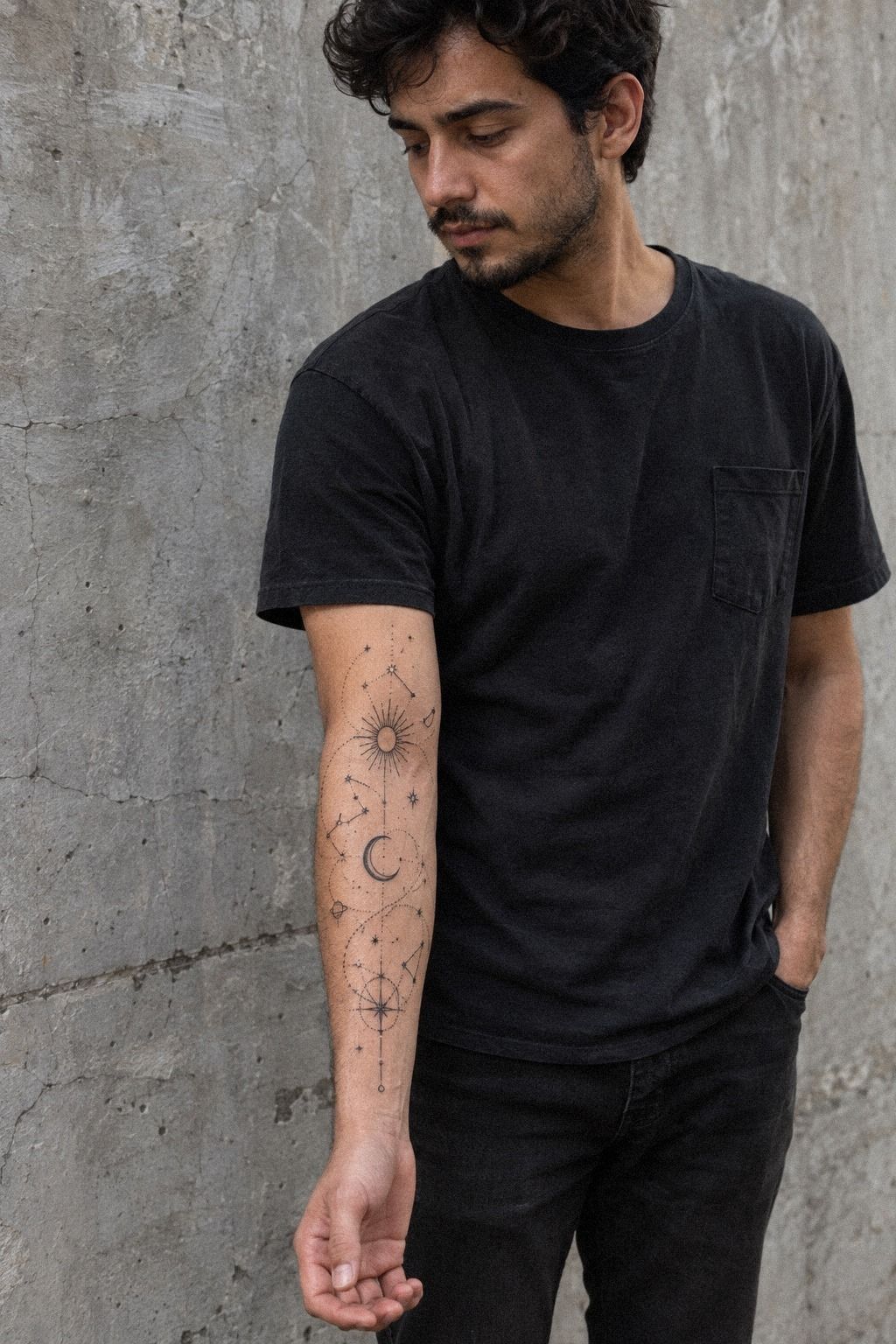
A celestial sleeve can feel ethereal without becoming generic. Use a slim crescent moon, a few uneven stars, and one fine-line sun symbol that follows the forearm’s length. Clear spacing matters here, because delicate marks need room to remain readable.
I’d keep the moon slightly larger than the stars. Your eye needs one visual anchor, and a tiny moon surrounded by equal-size dots can look accidental. The crescent moon should have a clean inner edge, while the star points stay simple enough to survive normal skin movement.
Why cover every inch when three marks can create a stronger rhythm? You’ll save money, and your sleeve will feel more intentional. My preferred layout is moon near the upper forearm, star cluster at mid-forearm, and a small orbit line near the wrist.
A single constellation pattern can carry personal meaning without explaining itself to everyone who sees it. Your artist should still show healed celestial work, because very fine dots may soften over time. UV exposure can speed that change, so sunscreen matters once the tattoo has healed.
If you’re drawn to lunar symbolism, browse these small moon tattoo ideas before you settle on a final arrangement. The finished piece can be romantic, sharp, and quietly meaningful without looking like copied flash.
4Can Geometry Stay Soft on a Forearm?
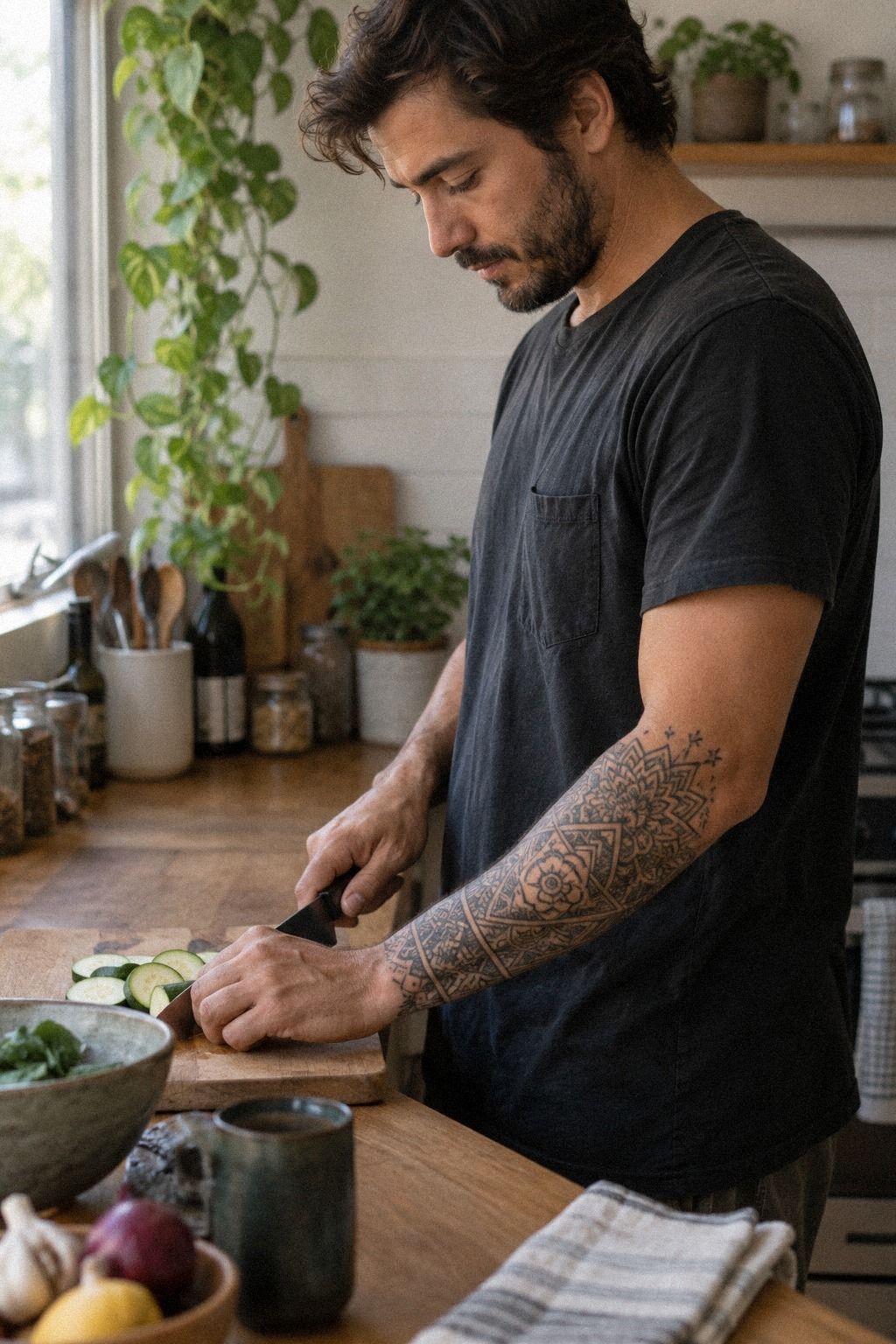
Geometric sleeves suit people who like crisp edges and visual order. On golden tan skin, precise ruled lines, small circles, and a narrow triangle can create a striking forearm composition. Your artist should build the design around your arm’s movement instead of placing a flat grid on a curved surface.
I call this the Three-Shape Framework: one repeated circle, one angled form, and one open line. You don’t need six symbols to make the sleeve feel intricate.
In fact, I’d skip a packed mandala here. It’s ornate, but too much interior detail can lose its sharpness at a small scale.
A geometric compass near the outer forearm gives the piece direction, while two thin parallel lines can wrap slightly toward the wrist. Your artist should check the stencil while your arm is relaxed and while it’s turned. A perfect line on paper may curve differently around real anatomy.
Clean stencil. Precise spacing.
A tiny break where the line meets the elbow. That restrained interruption can make the design feel more expressive.
But don’t treat symmetry as a requirement. Your sleeve can be more daring when one circle is deliberately offset or one line stops short. That small imperfection keeps the design personal instead of sterile.
For unusual references, compare these unique small tattoo ideas. You’ll find that a bold geometric accent can make the rest of your sleeve look more polished without adding much tattoo time.
5Choose a Meaningful Animal
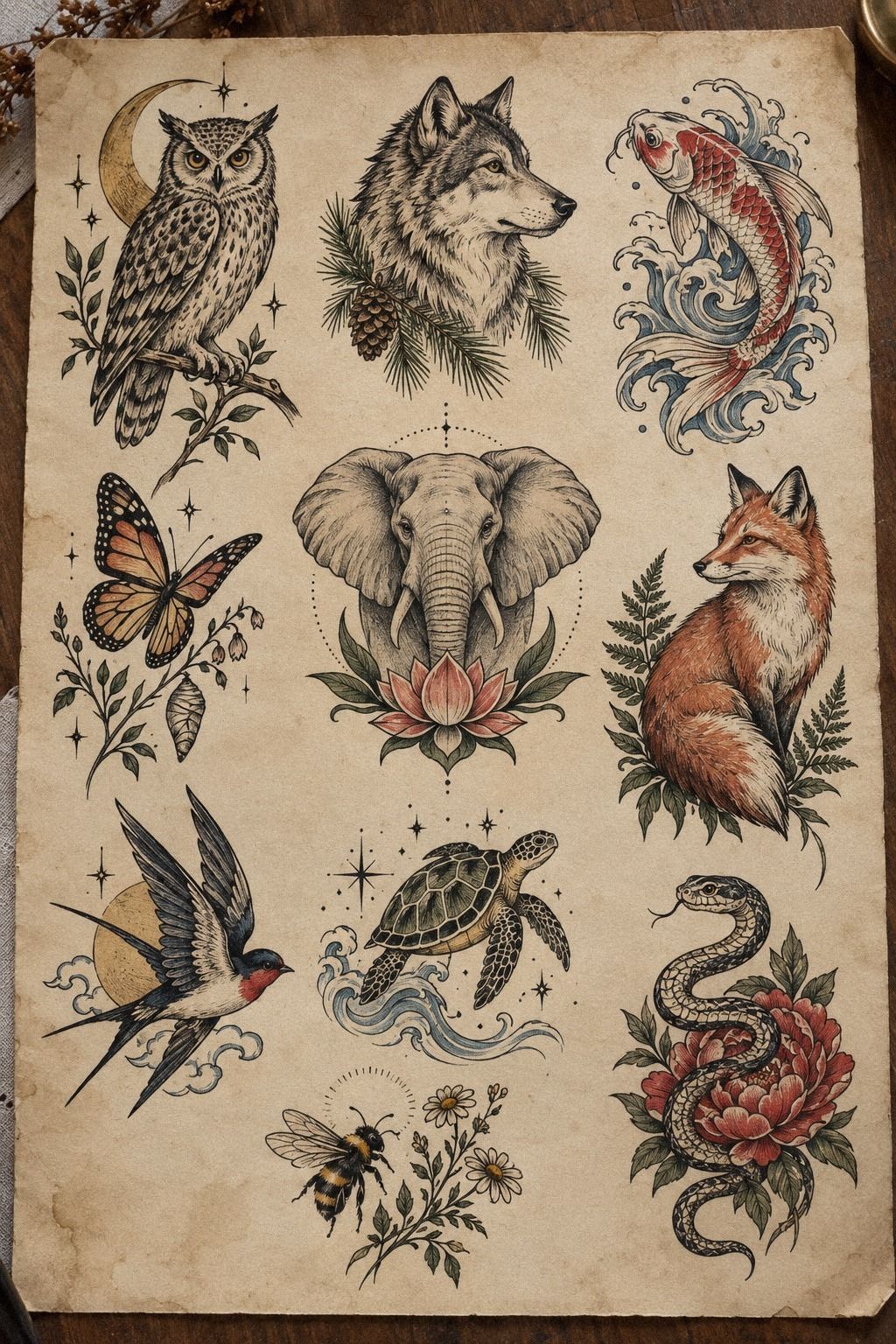
A meaningful animal can give a small sleeve an immediate emotional center.
6One Vibrant Floral Accent
A vibrant floral sleeve doesn’t need full color across every inch. One saturated accent can create a crisp, elegant contrast while the stems remain black. You might use a red petal, muted yellow center, or small blue bloom against a restrained linework base.
I’d avoid asking for five unrelated colors in a compact sleeve. Your skin, the pigment, and the spacing all need to work together. One red poppy bloom can carry more energy than a crowded bouquet, especially when the leaves remain in clean black linework.
The most important question is how your chosen color behaves over time. Your artist should explain touch-ups, sun protection, and how the color may look after the surface settles. Color can be vibrant and playful, but it still needs a strong outline to remain readable.
A wildflower stem can travel from the wrist toward the mid-forearm, with the bloom turned slightly toward the elbow. You’ll want the flowers to follow your arm’s movement, not point awkwardly sideways when your hand rests naturally.
But I’d choose composition before color. If the spacing is wrong, brighter pigment won’t rescue it. For more floral references, see these meaningful small tattoo ideas and save only the pieces that feel genuinely connected to your story.
7When Does Abstract Linework Feel Finished?
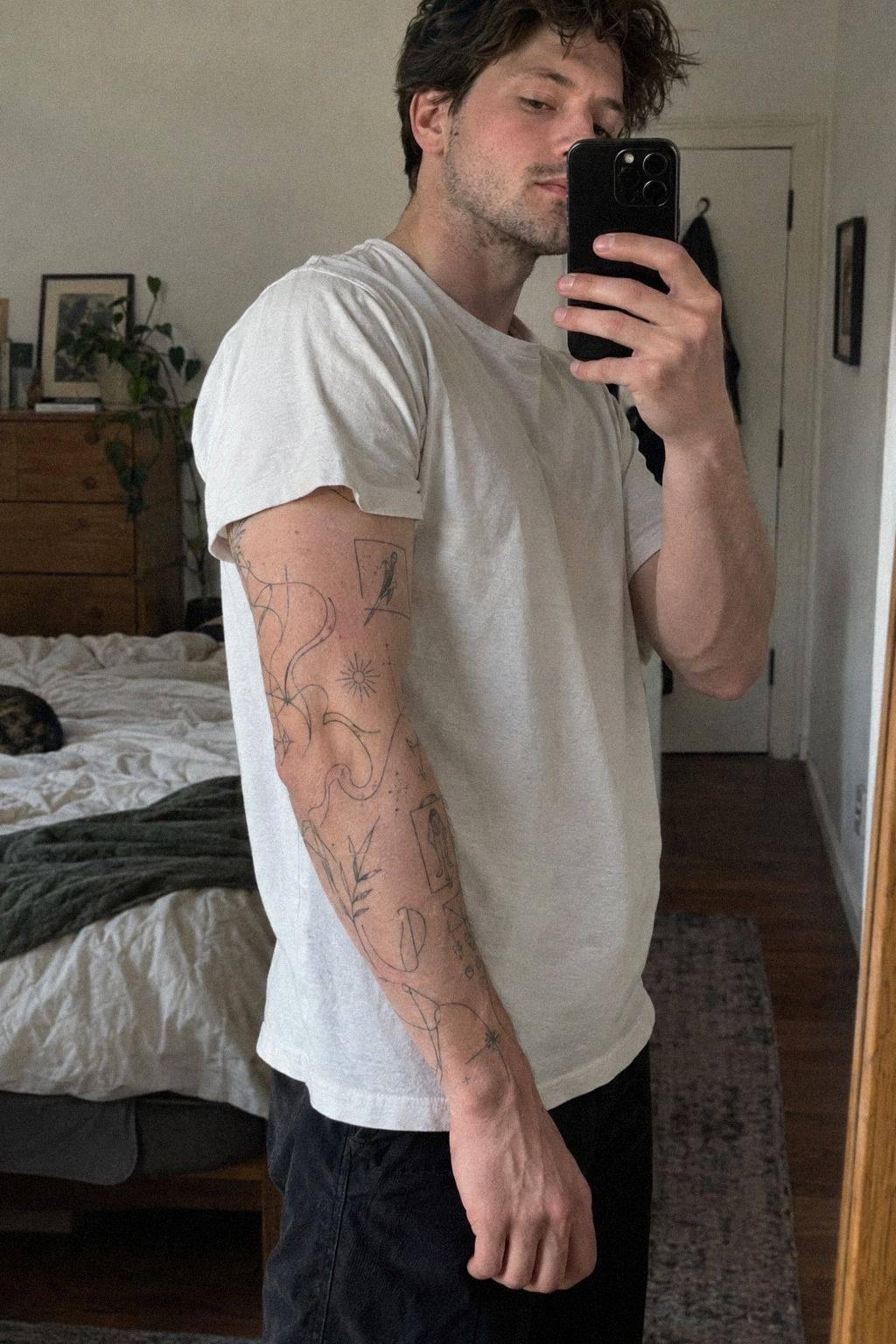
Abstract linework gives you permission to build a sleeve around mood rather than literal symbols. Fair cool-pink skin can pair well with hair-thin lines, uneven loops, and one darker mark placed as a visual interruption. Your piece can feel edgy while staying sleek.
I call this the Controlled-Noise Layout. Your artist creates movement with abstract black linework, then gives the eye a place to rest.
I’d skip random scribbles that only look interesting in a small reference. On your forearm, they may read as unfinished unless the spacing has a reason.
A flowing black curve can start near the wrist, widen through the center, and break into two short marks above. That structure gives your sleeve rhythm without forcing a symbol onto it. The result can feel raw, expressive, and hard to duplicate.
Your artist should stencil the composition in several positions. Turn your arm palm-up, palm-down, and halfway between. A line that looks perfect from one angle may become awkward when you move.
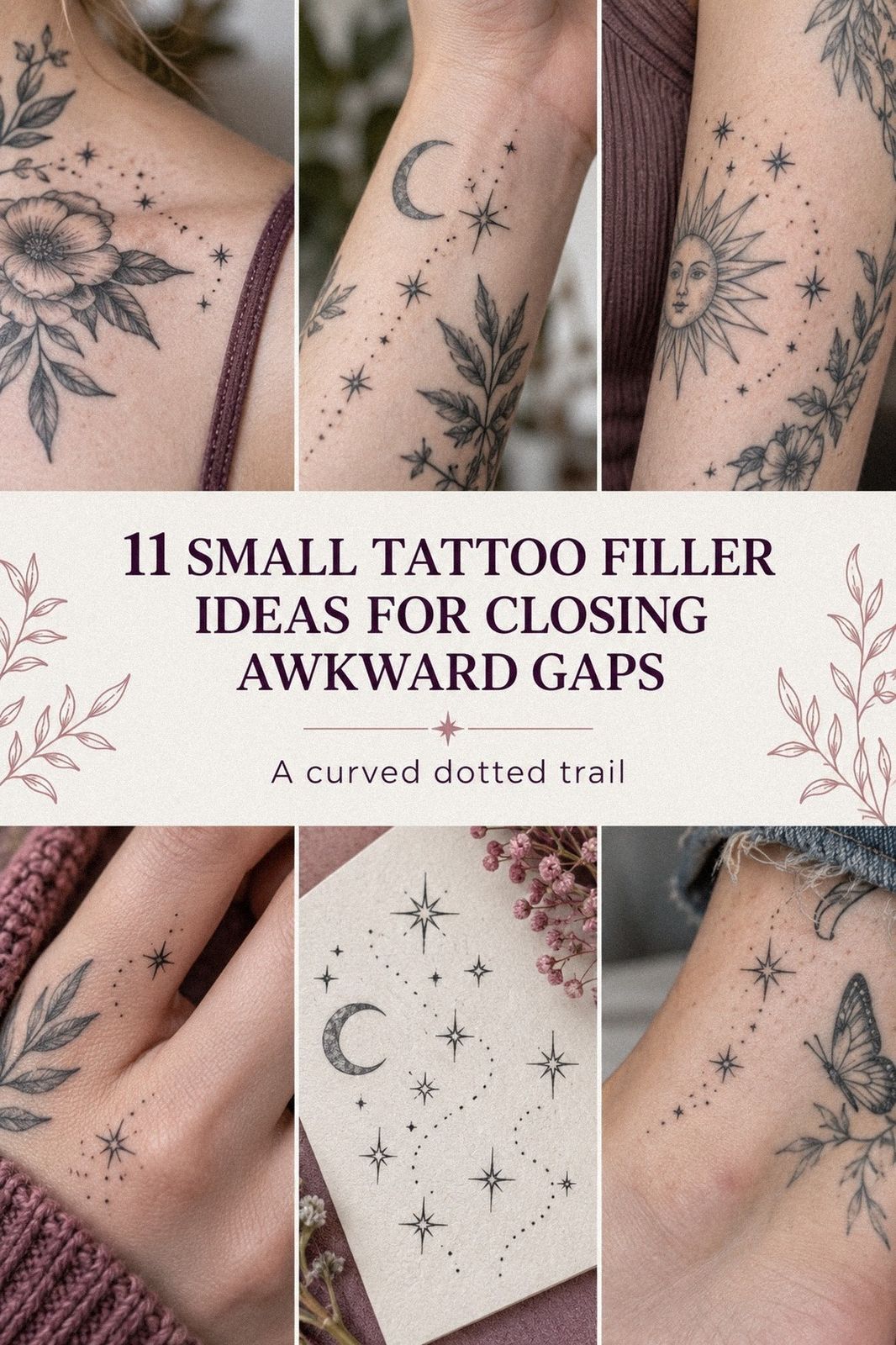
Abstract doesn’t mean vague. You can connect the shape to a memory, a sound, a place, or a personal boundary without printing the explanation into the design. If you’re still collecting references, these small tattoo filler ideas can help you find smaller marks that support the main flow.
8Minimalist Wrist-to-Forearm, Maximum Intent
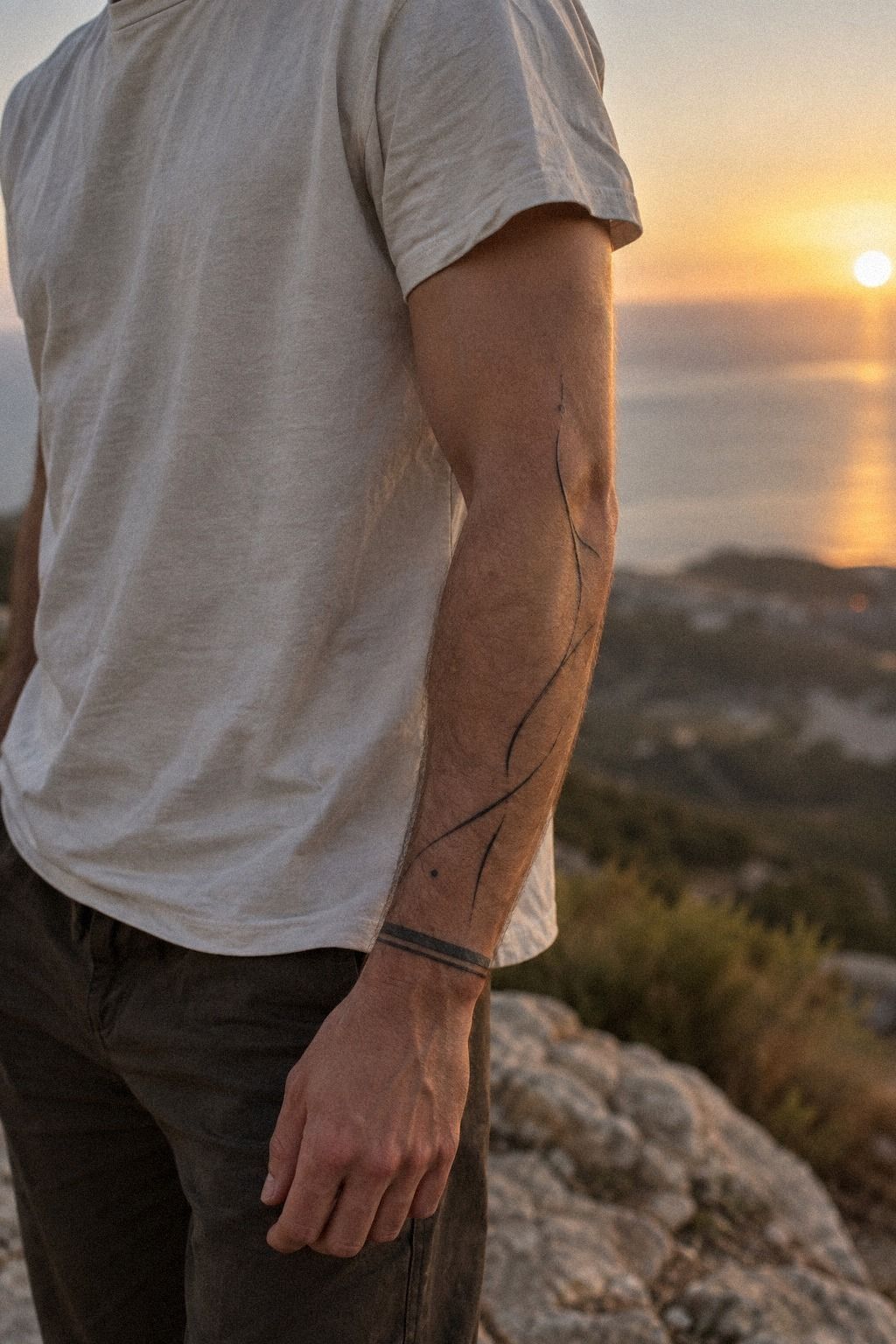
A minimalist wrist-to-forearm sleeve works best when every mark has a job.
9Why Micro Realism Needs Restraint
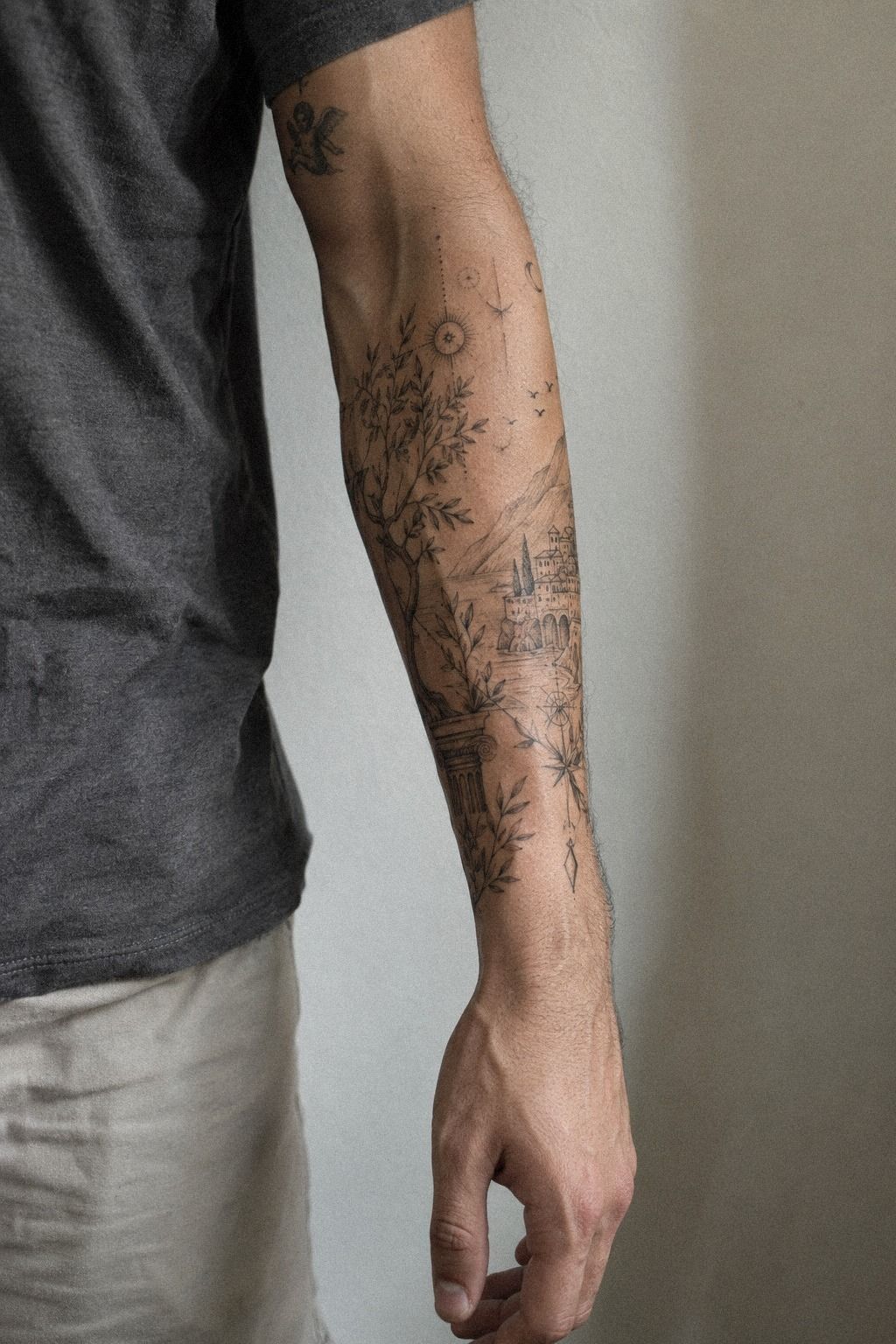
Micro realism can be intricate, but it needs discipline. A tiny object rendered with hair-thin lines and restrained shading can feel personal without requiring every surface texture. The goal is recognizable detail, not microscopic decoration.
I’d choose one focal object instead of a collection of tiny portraits. A micro-realistic moth can show enough wing structure to feel detailed while keeping the overall sleeve compact. Too many miniature subjects will force the artist to shrink important features beyond what skin can hold cleanly.
Your artist’s portfolio should include healed examples, not only fresh close-ups. Fine shading can soften, and tiny gaps may close visually over time.
That’s normal, but the original design still needs sensible spacing. That matters!
A small shaded landscape might include one ridge, a narrow moon, and a dark foreground. You’ll get more emotional impact from three readable values than from twenty microscopic lines. I learned that the hard way after watching an overworked tiny design lose its clarity.
Ask how long the artist expects the session to take. A compact piece may still require focused work, especially if the placement is awkward or the shading is layered. For more design references, browse these small tattoo designs and compare healed detail before booking.
10Patchwork Symbols, Not One Story
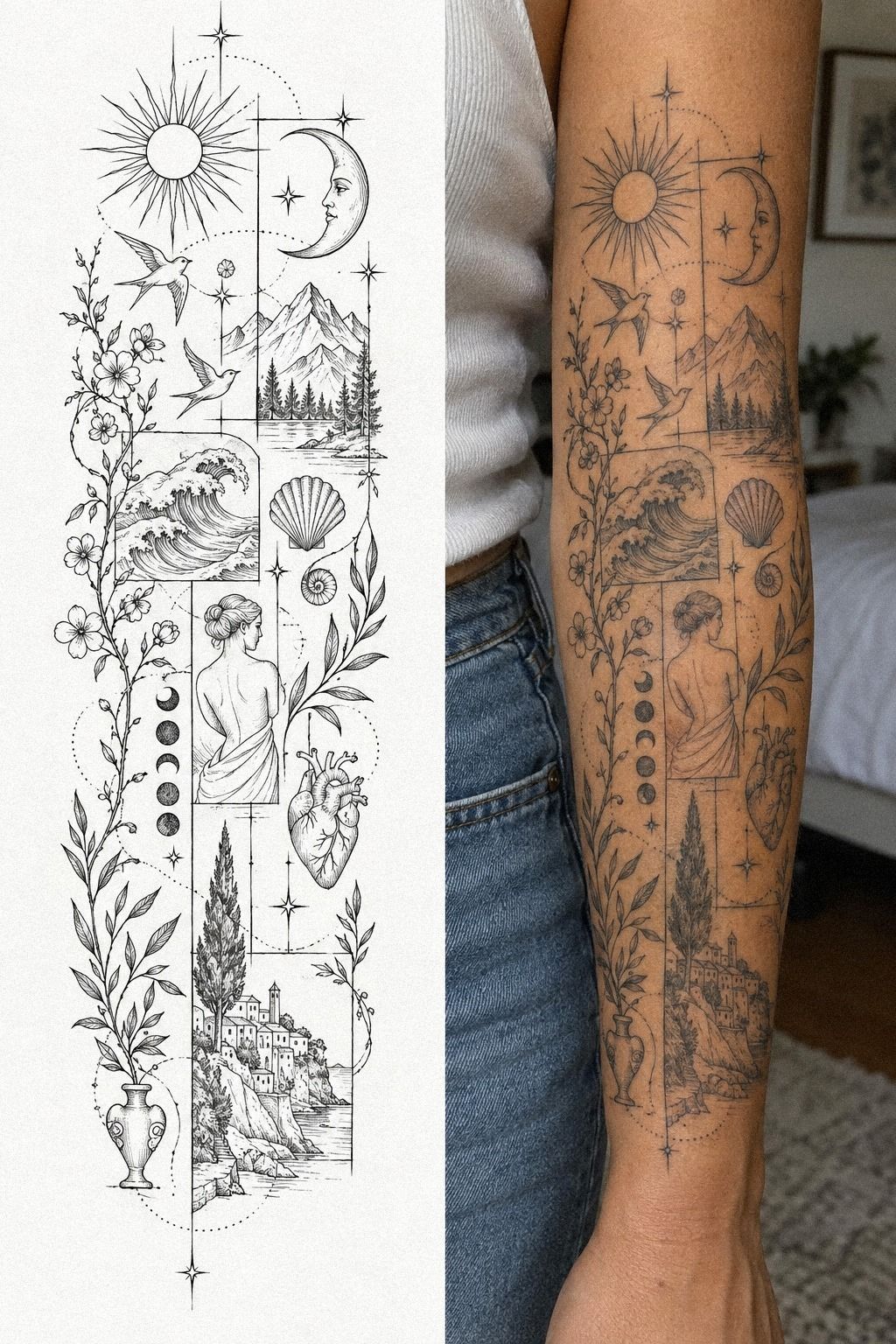
Patchwork sleeves let you collect meaningful images over time.
11Black and Grey: Quiet Contrast, Strong Shape
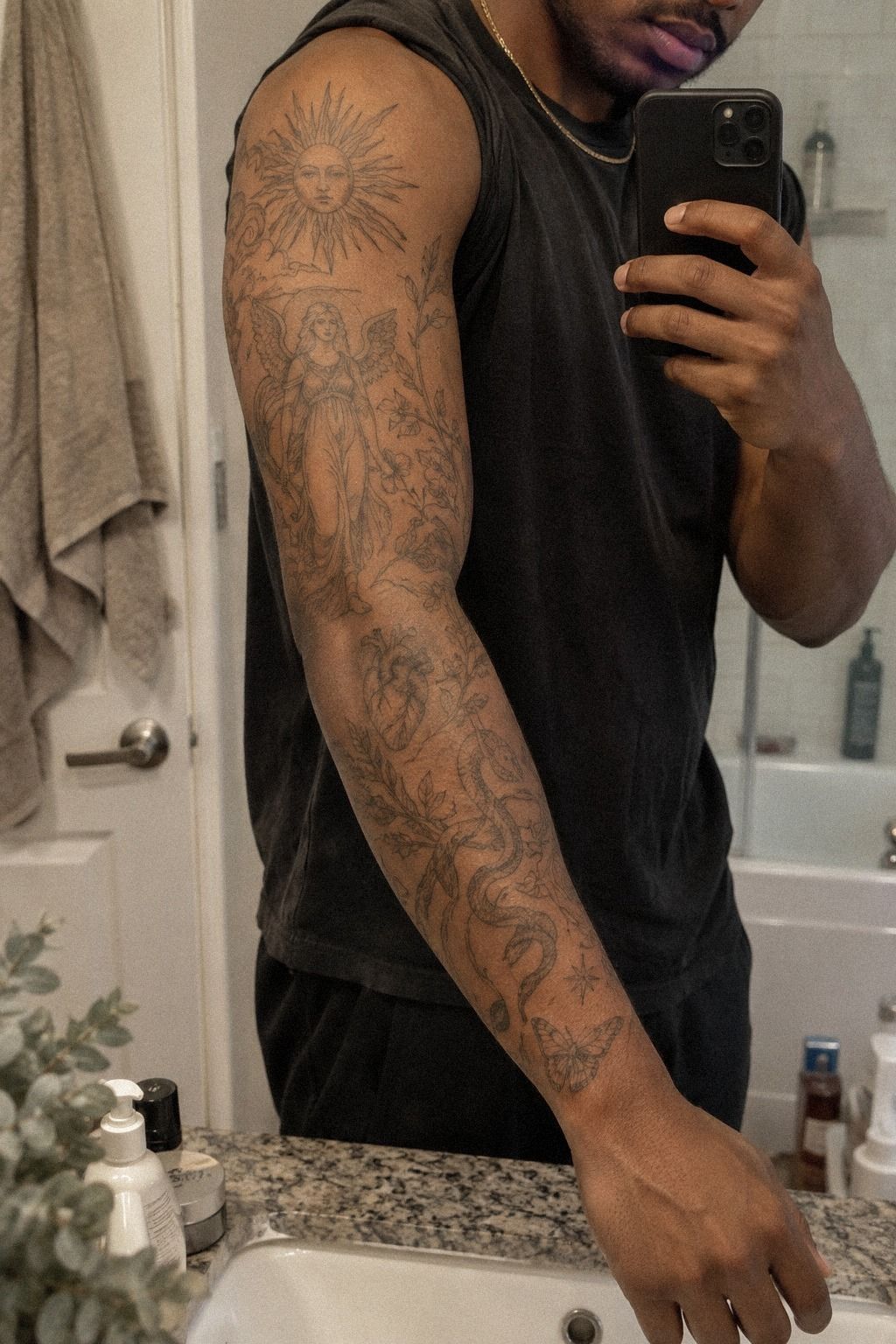
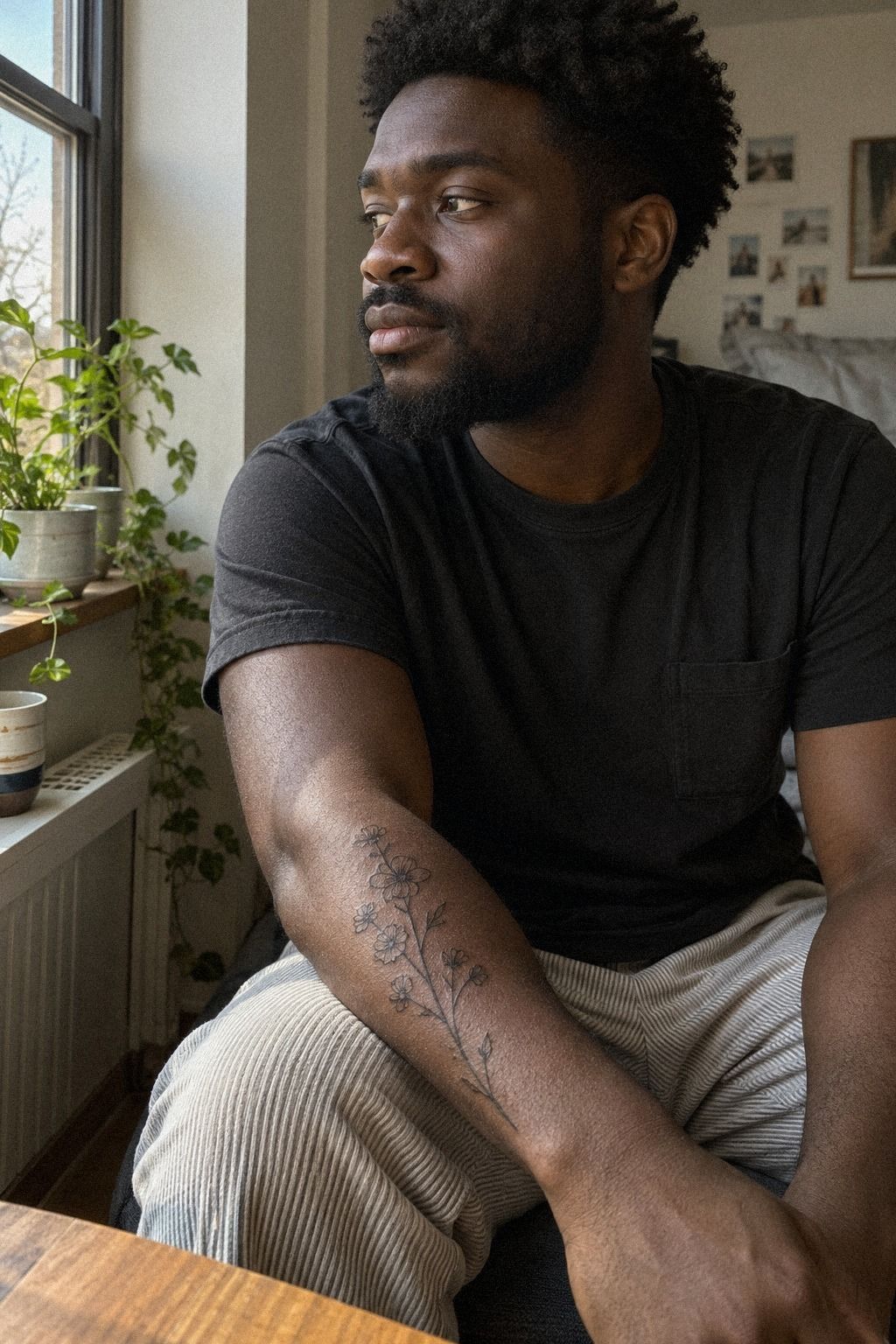
Black and grey work gives a graceful sleeve depth without relying on bright pigment. On deep brown skin with a warm undertone, a fine-line design can combine soft gray shading, clean black contours, and one flowing subject such as a feather, branch, or portrait profile. Your artist should understand how contrast reads on your skin.
I’d choose a black and grey feather over a crowded collection of pale details. The feather can taper from the wrist toward the forearm, with darker sections near the shaft and softer shading at the edges. That gives your sleeve movement while keeping the shape legible.
Your consultation should include healed work on a similar skin tone. Fresh contrast can look dramatic, but settled ink tells you whether the artist’s values remain clear. A polished artist will discuss saturation, placement, and how much open skin the design needs.
A soft grey wash can make the black areas feel less severe, but it shouldn’t turn the whole sleeve cloudy. You’ll want the darkest value reserved for the focal point. That hierarchy is what makes the piece feel elegant rather than flat.
But don’t choose black and grey because it sounds safer. Choose it because you like the quiet contrast and the way the shading moves when your arm turns. For more placement inspiration, see this guide to women’s forearm sleeve tattoo meaning, then adapt the idea to your own story.
Before You Choose a Motif
Start with the feeling you want the sleeve to carry. Do you want something sacred, romantic, gritty, empowering, or quietly personal? Those answers narrow the visual direction before you start saving dozens of unrelated designs.
A personal motif list might include three subjects, two colors, and one non-negotiable feeling. Write it down before your consultation. If every saved design breaks the list, you’re collecting noise instead of building a concept.
Think about your daily clothes and how often the tattoo will be visible. A feminine floral symbol may feel delicate and expressive, while a sharper geometric mark may suit someone who prefers a more masculine or neutral direction. Neither choice is more correct.
You don’t need to explain the meaning to anyone else. A tattoo can be symbolic without being obvious. It can also be purely visual, as long as you’ll still enjoy seeing it after the novelty fades.
For a wider range of starting points, return to this small tattoo designs guide and narrow your saves aggressively. Ten focused references are more useful than one hundred scattered ones.
Ask These Questions Before Booking
Ask whether the artist has healed examples in the exact style you want. A portfolio full of fresh work can look impressive, but healed linework tells you much more about spacing, saturation, and long-term clarity.
Ask how the artist approaches your skin tone and placement. You should hear a specific answer about contrast, line weight, and design scale. “It’ll be fine” isn’t a detailed consultation.
Ask whether the design can be adjusted after the stencil is applied. Your arm won’t look exactly like a flat sketch, and a strong artist will expect to make small changes. A precise stencil is a good sign!
Ask about the minimum charge, hourly rate, deposit, touch-up policy, and expected session length. These details are practical, but they also show whether the booking process is organized.
If you’re comparing artists, study the artist’s healed portfolio alongside their fresh work. You can use these small tattoo filler ideas to discuss supporting marks, but let the artist decide what will remain readable at your chosen scale.
Placement Changes the Whole Story
The same design can feel fierce on the outer forearm, intimate on the inner forearm, or more delicate near the wrist. Placement changes visibility, movement, friction, and how the composition reads when your arm hangs naturally.
An outer forearm placement usually gives a long, clear path for stems, snakes, ribbons, and geometric lines. The inner forearm can feel more personal, while the wrist and elbow require extra attention because the skin bends and moves so often.
Turn your arm palm-up, palm-down, and halfway between. Your artist should check the stencil in each position. A flowing mark should still look intentional when your hand is relaxed, not only when you pose for a photo.
Avoid placing the smallest detail exactly where your arm folds. A wrist-side symbol can sit slightly above the crease, leaving the most active skin less crowded. That small adjustment may protect both readability and comfort.
Cost, Sessions, and Realistic Numbers
A small sleeve can be affordable, but “small” doesn’t always mean quick. Fine detail, awkward placement, layered shading, and a high-demand artist can all increase the price. Get a written estimate before you pay a deposit.
These figures are planning ranges, not promises. A compact tattoo budget should include the deposit, possible touch-up, travel, and aftercare supplies. If the quote is much lower than expected, ask what is included before you assume you’ve found a bargain.
You can reduce cost by limiting colors, choosing one focal subject, and avoiding unnecessary micro-detail. You shouldn’t reduce cost by choosing an artist without healed work. A clean, deliberate design is more valuable than a rushed bargain.
A one-session concept may be easier to budget than an open-ended sleeve, especially if you’re still learning how your skin responds. Leave room for future additions instead of paying for a full plan you may later change.
The Small Sleeve Rule I Trust Most
I’ve changed my mind about small sleeves more than once. At first, I thought a successful design needed to use every available inch, because an empty patch looked unfinished on the stencil.
Then I saw the healed result on a friend’s forearm. The open skin wasn’t missing anything.
It gave the symbols room to breathe, and it made each line easier to read.
Budget matters, but rushing usually costs more than waiting. A clear price estimate should include the shop minimum, hourly rate, approximate session length, and whether a later touch-up is separate. A compact forearm concept may land around $100 to $300, but your artist’s region, portfolio, and appointment length can shift that range.
I’d choose placement before collecting dozens of references. The forearm is often more tolerable than ribs, feet, hands, or sternum, but your own sensitivity still matters. A design that works beautifully on the outer forearm may feel cramped near the wrist or elbow crease.
Fine lines can soften and widen, while solid black tends to hold its visual weight more reliably when the placement and application are sound. That doesn’t mean every bold tattoo ages better. It means you should match detail to scale and protect healed ink from UV exposure.
The part I care about most is whether the sleeve still feels like yours after the reference stops feeling new. Choose one striking idea, give it enough space, and let the next decision come later. You don’t need to finish your whole forearm in one day.
Aftercare Is Part of the Design
Your artist should give you clear aftercare instructions based on the application, placement, and bandage used. Follow those instructions instead of copying a stranger’s routine online.
Keep the fresh tattoo clean and avoid picking, scratching, soaking, or exposing it to direct sun during early healing. Swimming and long baths can wait. A little patience protects the work you just paid for.
Wear clothing that won’t constantly rub the area. If the wrist or elbow feels irritated, reduce friction and ask your artist what they recommend. Don’t add heavy products unless they’ve approved them.
The surface may look healed before the tattoo has fully settled. Colors can appear muted, lines can look slightly cloudy, and the skin may continue changing for several weeks. Take a clear healed photo later so you can judge the result fairly.
For more ideas before your next appointment, browse these small tattoo designs and compare them with healed work. Aftercare won’t fix poor design, but good aftercare helps a strong design stay crisp.
The Questions I Get Asked Most
How much does a small sleeve tattoo usually cost?
A small sleeve tattoo usually costs about $100 to $300 in the U.S., though a shop minimum may run $50 to $100 and hourly rates often fall near $100 to $250. Placement, detail, artist demand, and region will change the estimate, so ask for a quote before booking.
Are small sleeve tattoos a good idea for a first tattoo?
Yes, a small sleeve can be a good first tattoo if you choose a manageable placement and a clear design. The forearm is often more tolerable than ribs, feet, hands, or sternum. A focused concept also lets you learn how your skin heals before adding more.
How do I choose a tattoo artist for a small sleeve tattoo?
Choose an artist whose portfolio shows clean work in your preferred style, including healed photos. Look for consistent linework and strong hygiene practices, then ask about placement, aftercare, session length, and expected cost. Don’t book from a fresh tattoo photo alone.
How much do small sleeve tattoos hurt?
Pain varies, but forearm, thigh, and shoulder placements are often more tolerable than ribs, feet, hands, or sternum. Your session may still feel intense near the wrist or elbow. Shorter sessions and steady aftercare can make the experience easier to manage.
How long does a small sleeve tattoo take to heal?
The surface commonly heals in about 2 to 3 weeks, while complete settling can take roughly 2 to 3 months. Wash gently, moisturize as directed, and avoid sun and swimming during early healing. Do not pick or scratch peeling skin.
What’s the best placement for a small sleeve tattoo?
The outer forearm is a practical choice because it offers visibility, relatively steady skin, and a clear vertical canvas. The inner forearm can feel more personal, while the wrist is more exposed to friction. Your artist should check the stencil with your arm relaxed and turned.
Where I’d Start First
If I had to pick one, I’d start with the delicate botanical sleeve. The open spacing gives fine lines room to age, and one strong stem can grow into a personal collection without forcing a crowded first session.
Pin the botanical layout for later, compare healed portfolios, and give yourself time to decide. Worth it!