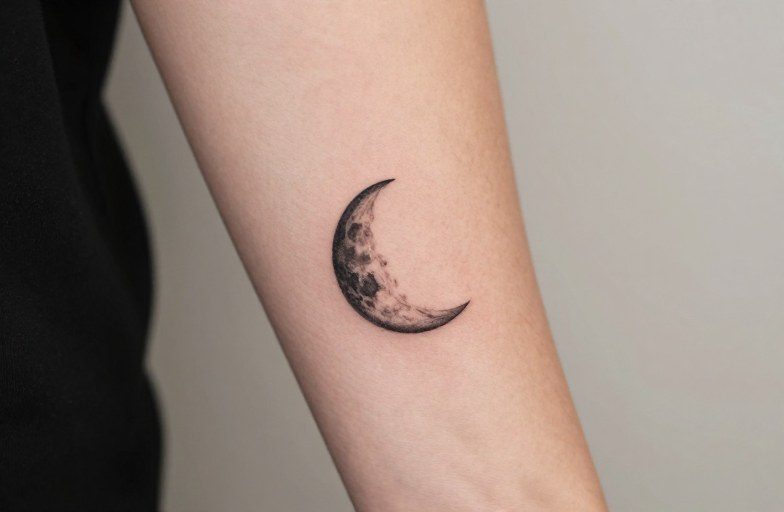
A small moon tattoo carries weight beyond its size. The moon’s phases map directly onto human cycles, growth, diminishment, return, and that symbolism compresses cleanly into something you can hide behind an ear or display on a wrist. But the real challenge isn’t picking a moon; it’s choosing which moon, rendered how, placed where, so it still reads clearly in ten years. This guide covers the practical decisions that separate a lasting small moon from a blurry regret.
Tips for Choosing
Linework vs. Shading
At small sizes, linework outperforms shading for longevity. A clean crescent outline, single needle or tight three-round liner, holds its edge as skin ages and ink diffuses. Soft grey wash meant to suggest lunar surface texture often blurs into indistinct grey blobs within five to seven years on high-mobility areas. If you want dimension, consider dotwork stippling rather than smooth gradients, those discrete points tolerate spread better than blended tones.
Black ink on fair to medium skin offers the strongest contrast and slowest visible aging. On deeper skin tones, a skilled artist can adjust line weight upward slightly or place the tattoo where skin tension is minimal to preserve crisp edges. Ask to see healed photos of small work on skin similar to yours, not just fresh tattoos.
Phase Specificity
Each phase reads differently. A waxing crescent suggests beginning, accumulation. Full moon lands as completion, presence, sometimes folklore associations. Waning phases carry release, stripping away. The new moon, often rendered as a thin outline circle or absent negative space, works for minimalism but risks being misread as an incomplete circle. Decide what you want the image to do before you decide what it looks like.
Size & Scale
Small moon tattoos operate in a narrow functional range. Below half an inch, most phases lose recognizable distinction; a crescent becomes a comma, a gibbous phase reads as lopsided circle. Between three-quarters of an inch and one and a half inches, you get enough room for phase-specific curvature without demanding large placement real estate.
- Under 0.5 inches: Best for simple crescents or solid black circles only; detail impossible
- 0.5, 1 inch: Functional for most single-phase designs; line weight must stay extremely fine
- 1, 1.5 inches: Optimal range for phase accuracy with small accent details (crater suggestion, orbital halo)
- Above 1.5 inches: Still “small” but allows stippled texture, micro-geometric framing, or adjacent tiny stars
Scale should relate to placement. A one-inch moon behind the ear dominates that space; the same size on a forearm reads as delicate accent. Consider your body’s proportions, not abstract measurements.
Best Placements
High-Visibility Spots
Wrist inner or outer edge, collarbone tipping toward shoulder, ankle front-center. These locations frame the moon where it catches light and attention. Collarbone placement follows natural bone geometry; a crescent can echo that horizontal sweep or cut across it for contrast. Wrist moons see sun exposure, plan for touch-ups or consistent SPF use.
Concealed or Semi-Concealed
Behind the ear, nape of neck, inner bicep, ribcage floating under the bra line, top of foot. These suit professional constraints or personal preference for privacy. The nape offers a flat, stable canvas where ink ages evenly. Behind the ear, skin is thin and mobile; expect some spread over time, so keep lines bold enough to tolerate it. Ribcage skin shifts substantially with breathing and body position, designs here need to be simple enough to read despite distortion.
One placement often overlooked: the side of a finger, not the top. A tiny crescent there faces outward when you gesture, disappears when you close your hand. Finger tattoos do fade faster due to constant use and regeneration, but the moon’s simple curved shape retouches more cleanly than complex imagery.
How to Personalize It
Geometric and Structural Additions
A single thin orbital ring around the moon suggests planetary body without clutter. Parallel lines above or below can read as horizon, water reflection, or simply framing device. Small triangles, one, three, an incomplete frame, add architectural counterpoint to organic curves. Keep additions to one or two elements; the moon’s power is in its simplicity, which over-accessorizing erodes.
Embedded Symbolism
Consider negative space: a cat silhouette within the full moon’s circle, a mountain range bisecting the lower edge, a face suggested by crater placement. These require slightly larger scale to resolve, typically one inch minimum. Another approach: your moon as one element in a tiny constellation, connected by authentic star positions from a meaningful date. The lines between stars must be hair-fine or they overwhelm the moon.
Some choose to render the moon not as celestial body but as object, a held coin, a scythe blade, a fingernail clipping. These conceptual pivots demand more from the artist’s drawing skill but produce genuinely singular results.
Color Choices
Black and grey dominates small moon work for sound reason: limited space means every pigment must earn its place, and black offers maximum information density. That said, strategic color can function effectively.
- Single accent: One small star in gold or pale yellow beside a black moon; a thin watercolor wash in blue or purple behind an outlined crescent
- White ink: Risky for longevity, often yellows or disappears entirely; if used, restrict to highlight dots suggesting crater catch-light
- Red: Blood moon variation, striking on any skin tone but prone to faster fading; requires bolder line structure to survive
- Full color: Unusual at small scale but possible, teal and coral “moon,” for instance, abstracted from literal reference
Color saturation demands slightly larger size to prevent muddiness. A color moon under one inch usually reads as dark blob within a few years unless the palette is extremely limited and high-contrast.
Matching & Pairing Ideas
Complementary Celestial Bodies
Sun-moon pairing is classic but benefits from asymmetry: different sizes, different phases, different placements. Matching sun and moon on both wrists or ankles reads as set rather than dialogue. More interesting: sun on one body area, moon on another, connected by your own movement between them. Tiny planets, Saturn with its ring, Jupiter with stripe suggestion, scale well alongside small moons and add astronomical context without competing.
Non-Celestial Pairings
Moon with ocean wave (tidal connection, rendered as simple curved lines). Moon with moth or luna moth (nocturnal affinity, but the insect must be simplified to match moon’s scale). Moon with small botanical, night-blooming cereus, evening primrose, where plant curves echo lunar shape. These pairings succeed when the secondary element is smaller than or equal to the moon, never dominant.
Matching tattoos between people: same phase in same placement, or complementary phases (waxing for one, waning for other) in related placements. The latter acknowledges connection through difference rather than replication.
Final Word
A small moon tattoo succeeds through restraint and precision. The image is already loaded with meaning; your job is to render it so it lasts. Prioritize clean line structure over decorative excess, scale appropriate to placement and your body’s proportions, and placement that accounts for how you live and how your skin moves. The best small moon isn’t the one that impresses on Instagram fresh, it’s the one that still reads as moon, specific phase, intentional design, after years of being yours.
Frequently Asked Questions
Do small moon tattoos fade faster than larger ones?
All tattoos fade, but small ones with fine lines show age sooner because there’s less ink total to buffer the spread. Bold, simple small moons age better than intricate ones. Placement matters more than size, sun-exposed areas and high-friction spots like fingers fade fastest regardless of dimensions.
Can a small moon tattoo cover an older tattoo I want gone?
Generally no, small moons require too much negative space and light areas to effectively mask existing ink. Cover-ups need larger, darker designs with dense pigment. A moon might work over very faded, small previous work if the artist incorporates the old lines into crater texture, but expect significant redesign.
How much should a small moon tattoo cost?
Shop minimums typically run $80, 150 for anything needle touches skin, regardless of size. A small moon from an experienced artist doing custom drawing may hit $200, 300. Extremely cheap work usually means rushed execution, which small tattoos cannot hide. Budget for quality linework; this is permanent.
Is it okay to get a moon tattoo if I’m not into astrology or spirituality?
Absolutely. The moon functions as pure visual symbol, cycles, night, navigation, tidal force, silver light on water. Many people choose it for aesthetic balance, for the curve against their body’s angles, or for personal associations that have nothing to do with horoscopes. Your reasons are sufficient.