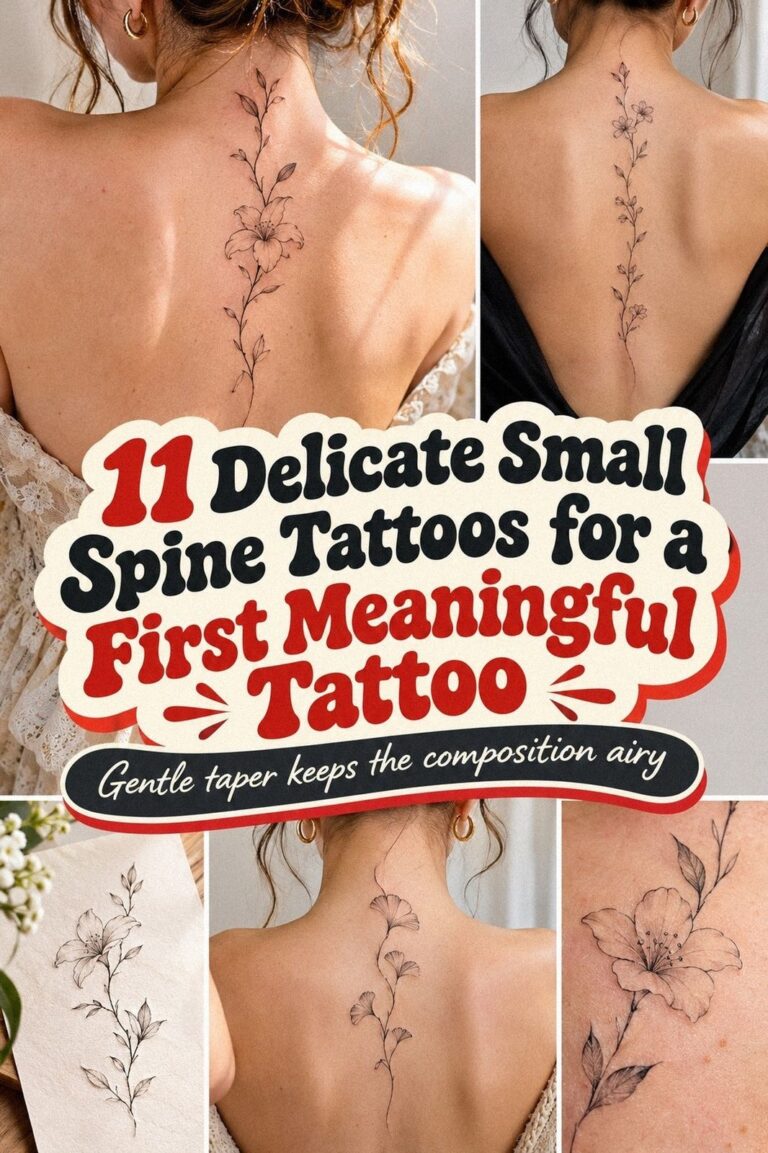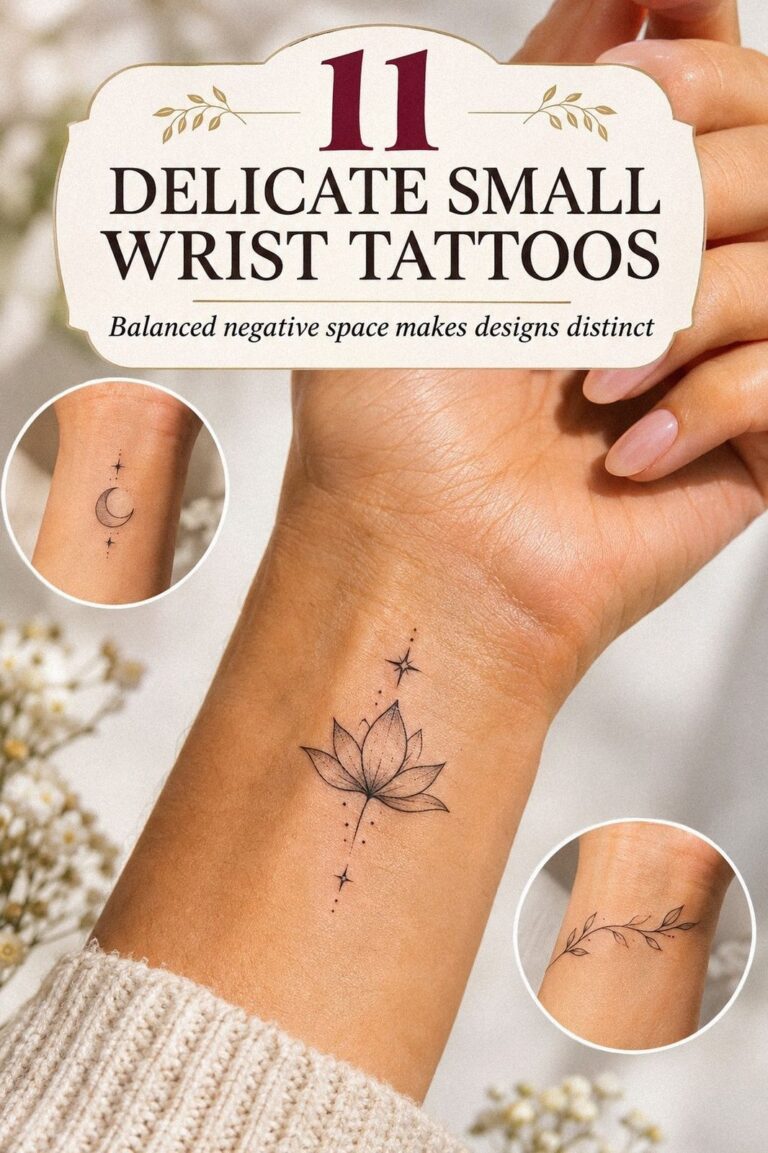
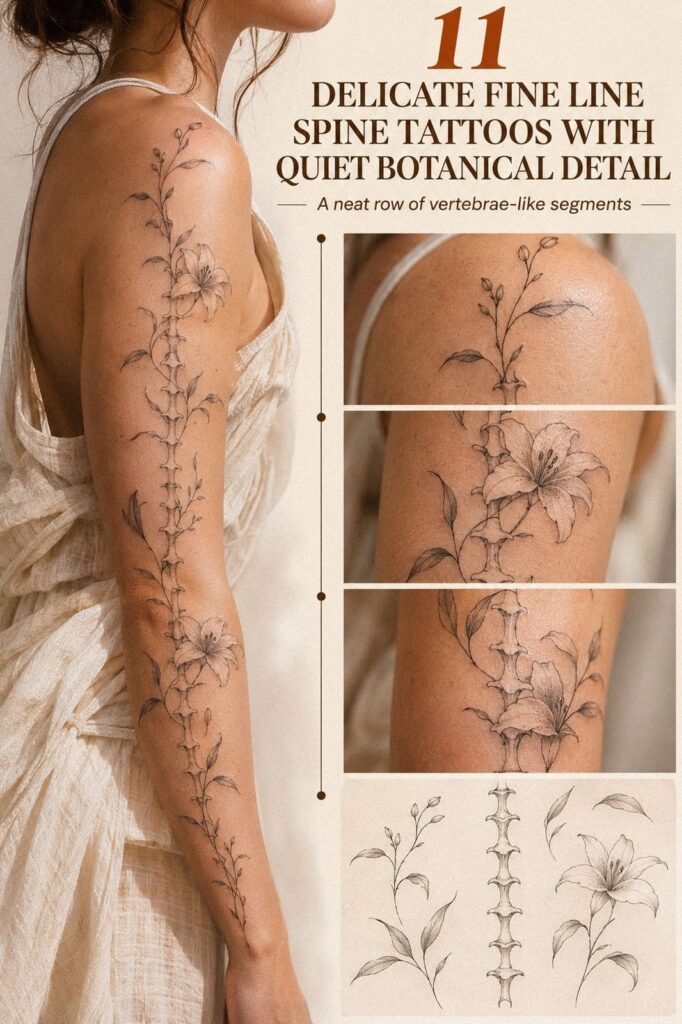
A delicate fine line spine tattoo can work beautifully as a first tattoo when you plan the flow, size, pain-sensitive areas, and aftercare before booking. A small mistake, such as squeezing too many symbols together, can make an intricate design look crowded. Start slowly. Your spine deserves a deliberate plan!
- Start With A Delicate Fine Line Spine Tattoo Concept
- Which Botanical Symbols Create Vertical Flow?
- Choose Unique Celestial Fine Line Spine Tattoo Ideas
- Let Your Natural Spine Set The Placement
- Apply The Spine Taper Rule From Neck To Waist
- How Pain-Sensitive Is The Spine Placement?
- What Should Your Symbols Mean?
- Can Fine-Line Details Age Gracefully?
- Small Or Long: Which Minimal Tattoo Scale Works?
- Protect Fine Lines During Healing And Aftercare
- Add One Bold Accent To Delicate Ink
1Start With A Delicate Fine Line Spine Tattoo Concept
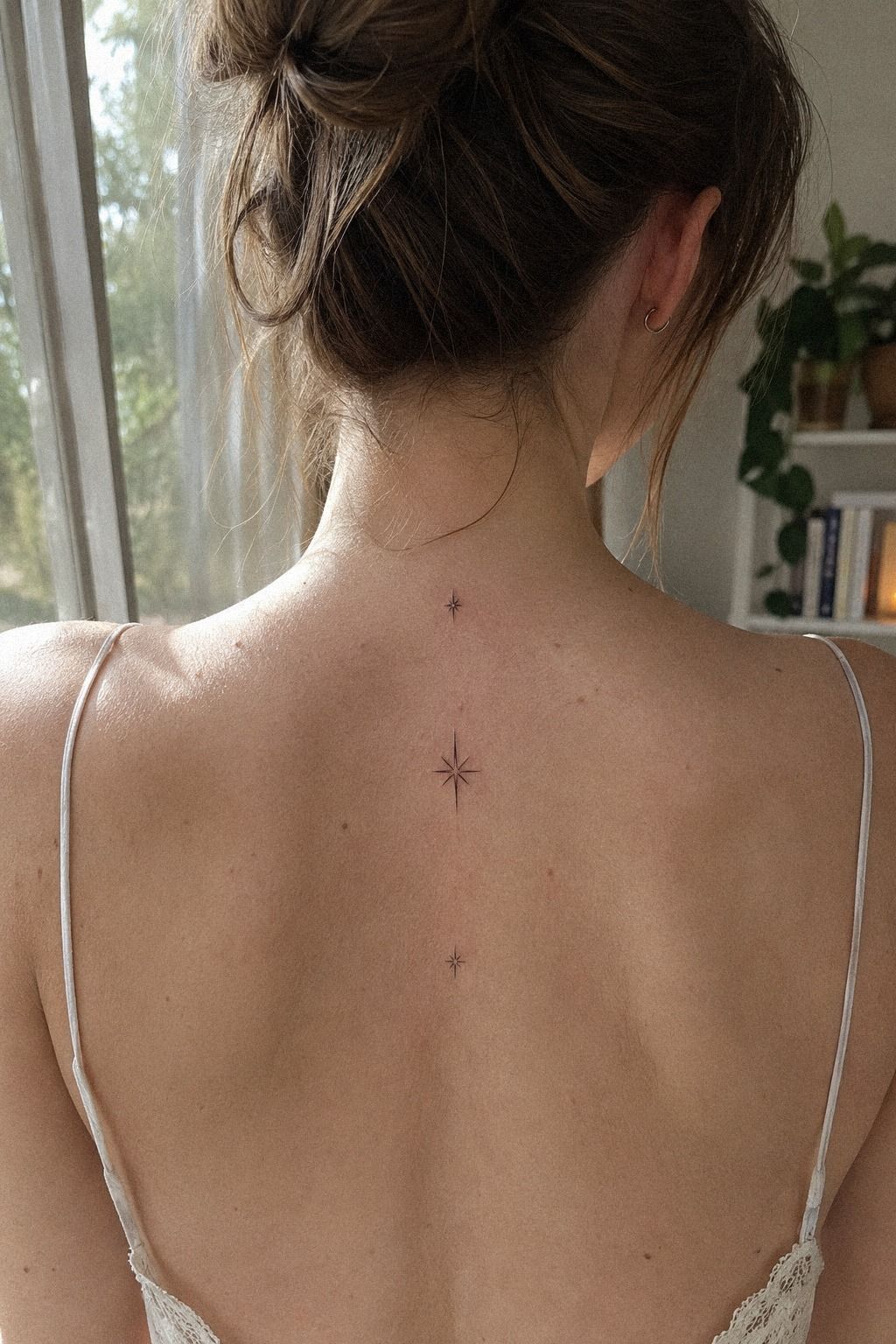
Begin with one clear idea, not a folder full of unrelated screenshots. Your concept might be a vertical trail of stars, a narrow botanical stem, or a symbolic celestial path. I’d choose one visual language first, because a delicate fine line spine tattoo with consistent spacing usually looks more polished than several beautiful symbols competing for attention.
Think about the emotional direction before you think about exact measurements. Do you want something sacred, romantic, fierce, or quietly personal? A strong concept gives your artist a reason for every mark, and that usually delivers better value than paying for a crowded design that never feels cohesive.
A vertical trail of stars can feel striking without becoming heavy. A botanical stem can look graceful and flowing. A small constellation may feel ethereal, while a single dark symbol can add a bold, expressive pause.
Choose three to five references that share the same line quality. Your artist needs to know whether you prefer single-needle linework, tiny solid points, or open outlines.
Don’t send twenty unrelated images and expect one design to emerge. Your consultation will be more useful when the references point in the same direction.
Use a pencil on paper to draw your back as a loose vertical path. Add the first symbol near the upper back, leave clear skin between marks through the middle, and let the final mark stop above the waist. This simple exercise can reveal whether the concept has enough rhythm before you spend money on a consultation.
If you need more starting points, browse these small fine line spine tattoo ideas and notice which concepts still feel meaningful after the first glance. Start with one idea!
2Which Botanical Symbols Create Vertical Flow?
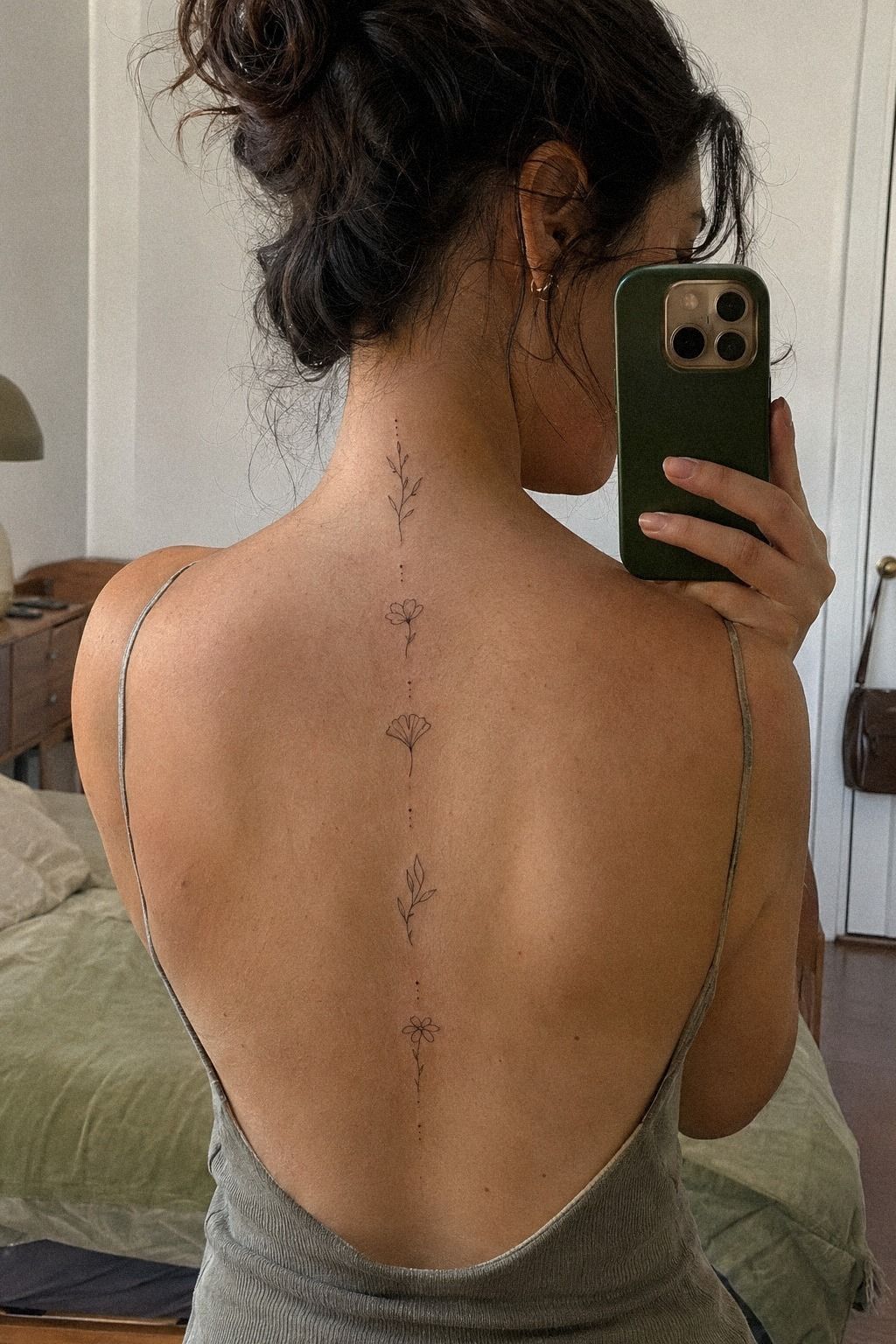
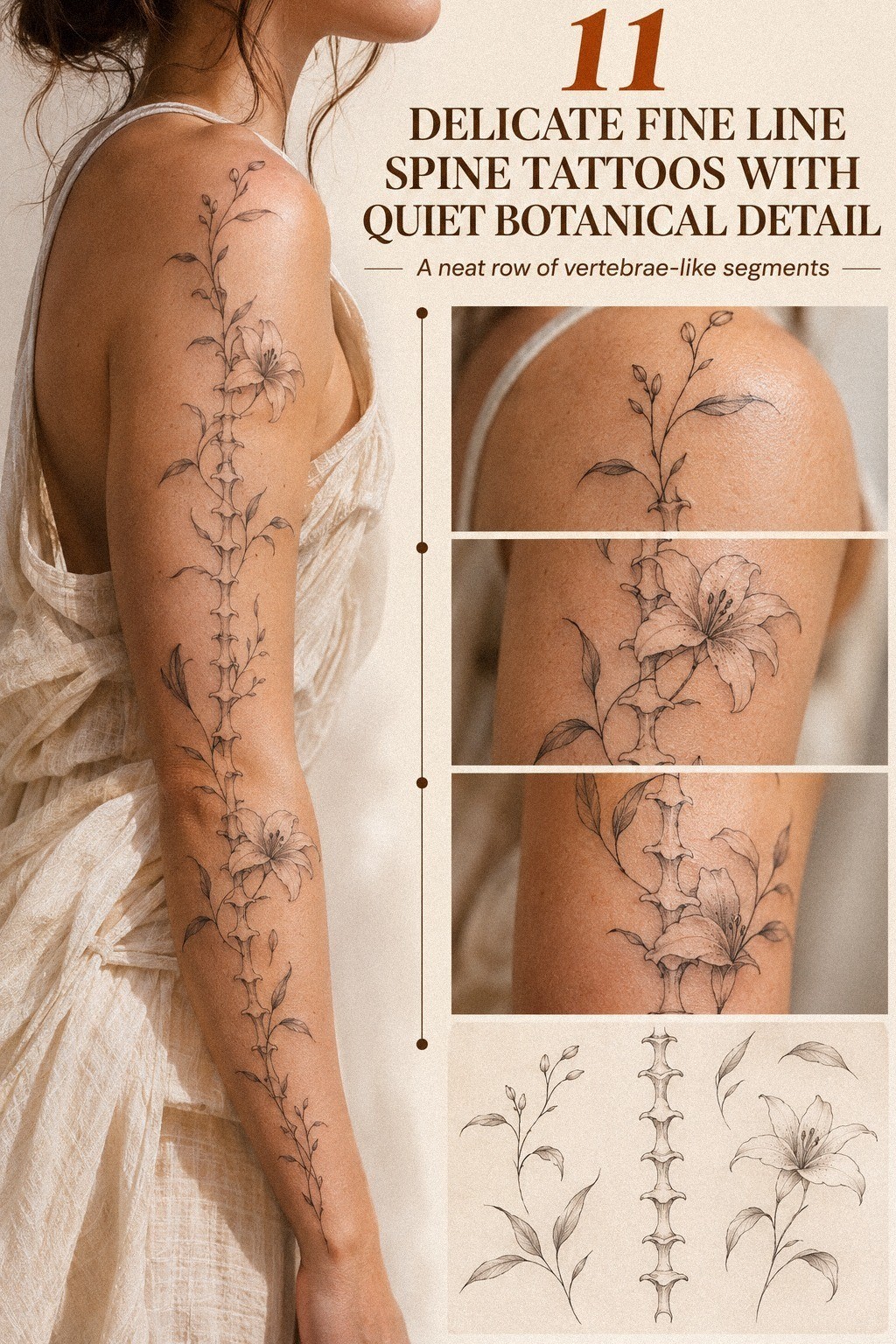
Choose botanical symbols that already have a narrow direction. A little fern, olive sprig, lavender stem, or wildflower can guide the eye down your back without needing a thick outline. A fine-line botanical should feel flowing, light, and spaced rather than packed with leaves.
Ask your artist to vary the stems instead of repeating the same flower eleven times. One open bud near the neck, two tiny leaves at shoulder-blade level, and a longer stem near the lower back can create a graceful rhythm.
I’d skip a dense bouquet here. It may look ornate on paper, but it can lose the open movement that makes a spine tattoo feel elegant. The best choice isn’t always the most detailed one.
A good botanical design has visible structure. Look for distinct stems, clear leaf angles, and enough negative skin between each mark. Those gaps matter because ultra-thin details can visually merge as the tattoo settles.
Keep the smallest leaf larger than a pencil eraser if you want its shape to remain readable. A slightly larger, crisp outline often has more long-term value than a microscopic cluster of lines that only looks impressive on a screen.
For your consultation, bring a sketch with three heights marked: upper back, mid-spine, and lower spine. That becomes the Three-Height Flow Rule, a simple way to prevent every symbol from sitting at the same level.
If you’re comparing placements, browse these small spine tattoo designs and study where each composition begins and ends. Then compare the same page with your budget, body length, and desired level of visibility.
3Choose Unique Celestial Fine Line Spine Tattoo Ideas
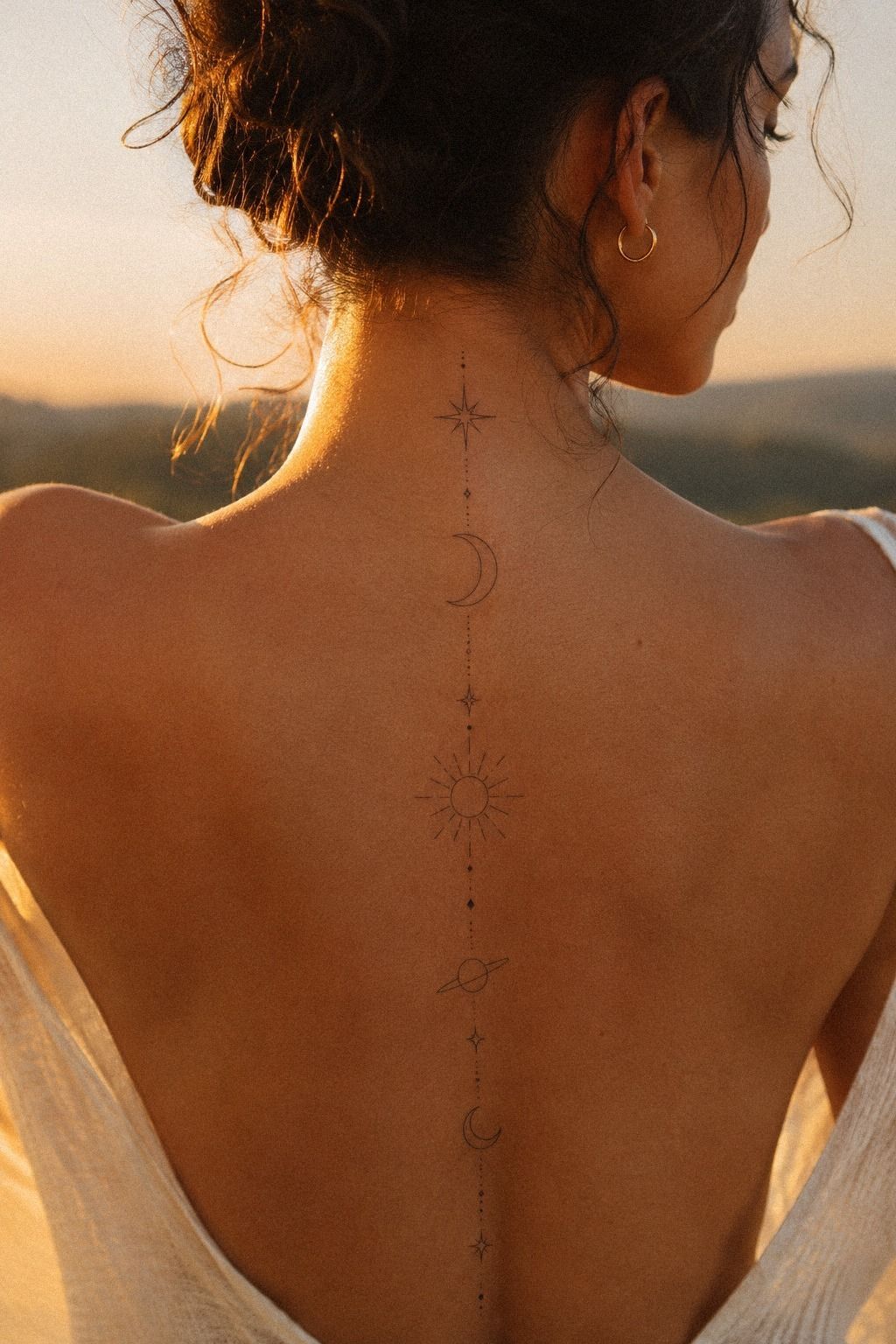
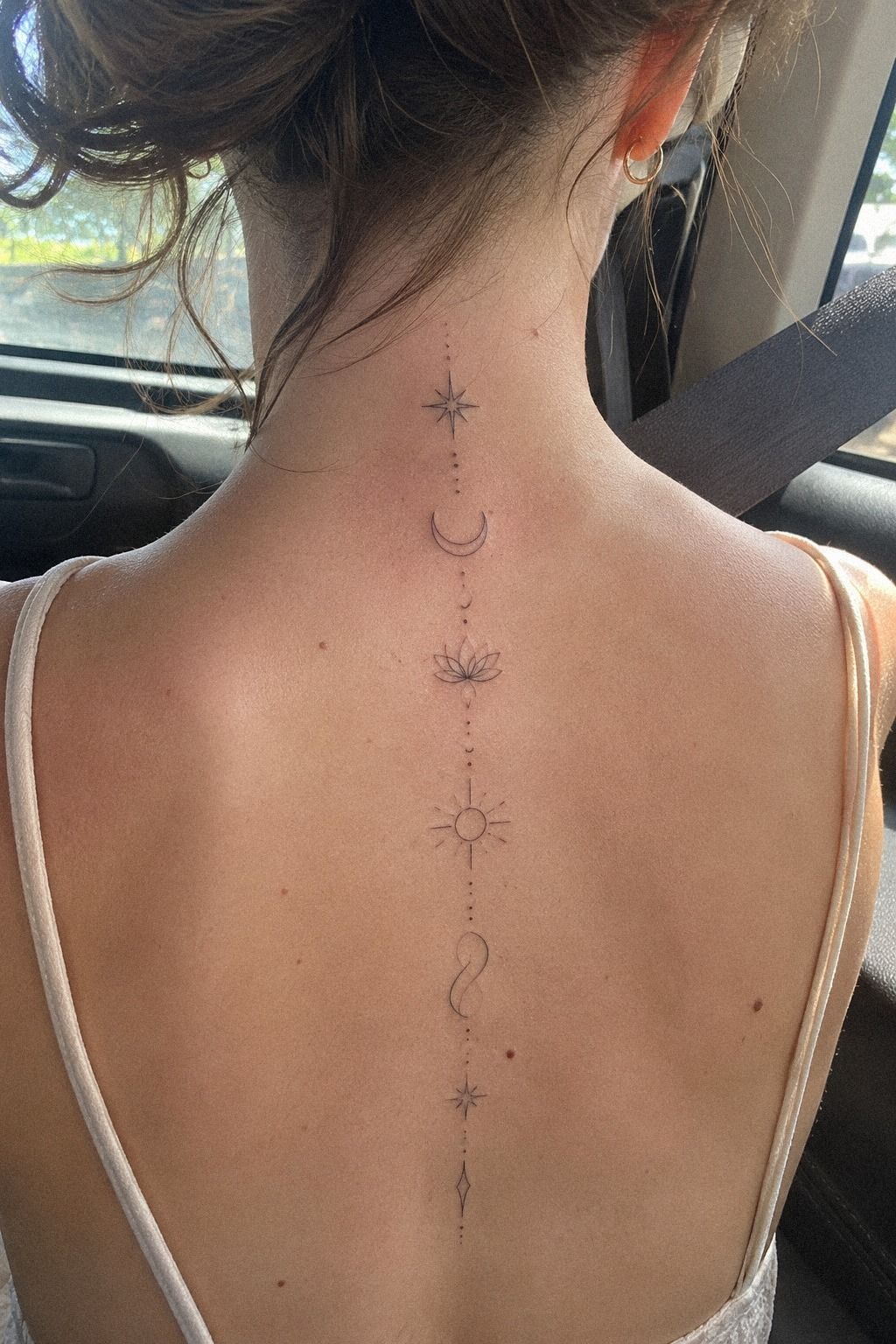
Celestial symbols suit a spine because the vertical placement already suggests a path through the sky. A crescent moon, tiny constellation, four-point star, or sun arc can feel ethereal without becoming overly ornate. A celestial tattoo concept can also carry meaning without requiring a long explanation.
Choose symbols with different visual weights. A small filled star can anchor the center, while open circles and thin rays keep the surrounding marks understated.
I’d avoid placing several moons in a perfectly straight chain. That arrangement can feel predictable, while a staggered sequence looks more personal and expressive. A little irregularity can make the design feel human.
Ask your artist to show the design at actual size, not only on a large digital screen. A celestial mark that looks readable at six inches may become a dark speck at two inches.
You’ll want to inspect every tiny point because negative space is doing much of the design work. Why add more ink when a pause between symbols can make the whole composition feel sharper?
If you love a meaningful sky reference, write down what each symbol represents before the appointment. Your moon might mark a difficult year, while a star could honor a person, place, or promise.
That gives your symbolic tattoo emotional structure instead of leaving you with decoration that feels disconnected. A meaningful design is usually worth the editing time.
For more terminology, read this fine line tattoo guide before your consultation. It can help you explain whether you want a minimal outline, crisp dotwork, or a more expressive celestial mark.
4Let Your Natural Spine Set The Placement
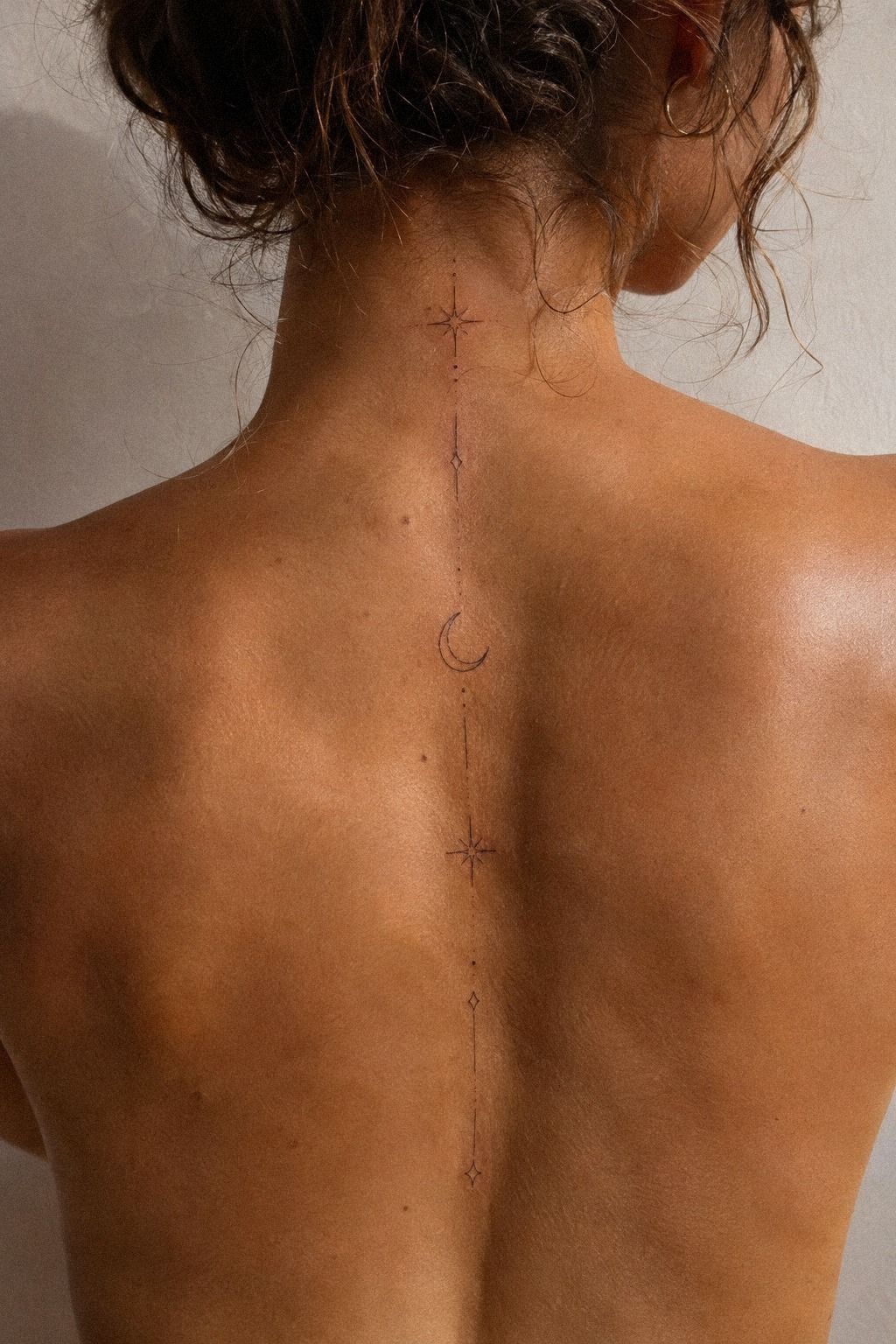
Let your artist place the stencil while you’re standing naturally, not posing with your shoulders pulled back. Your spine curves, your shoulder blades move, and your waist narrows, so a design that looks straight on paper may need small adjustments on skin.
A natural spine placement should follow your body without looking forced. The goal isn’t perfect geometry. It’s a sleek path that feels intentional when you stand, bend, and move.
Ask for a full-length stencil before any ink touches your skin. Check the top mark in a mirror, then bend, twist, and relax your shoulders.
If one star or leaf leans dramatically when you stand normally, your artist can shift it before the appointment begins. I’d rather spend fifteen extra minutes adjusting placement than pay for a permanent decision that never looks balanced.
The center of your back isn’t a flat ruler. Your artist may offset a few marks so the tattoo follows the natural groove without looking mechanically perfect.
That slight movement can make the result feel organic and personal. Don’t confuse precise placement with rigid geometry. A controlled imperfection can look more stylish than a stiff vertical line.
Keep the design away from waistbands and backpack seams during planning if those areas rub your skin often. Your everyday clothing and exercise habits should be part of the placement conversation.
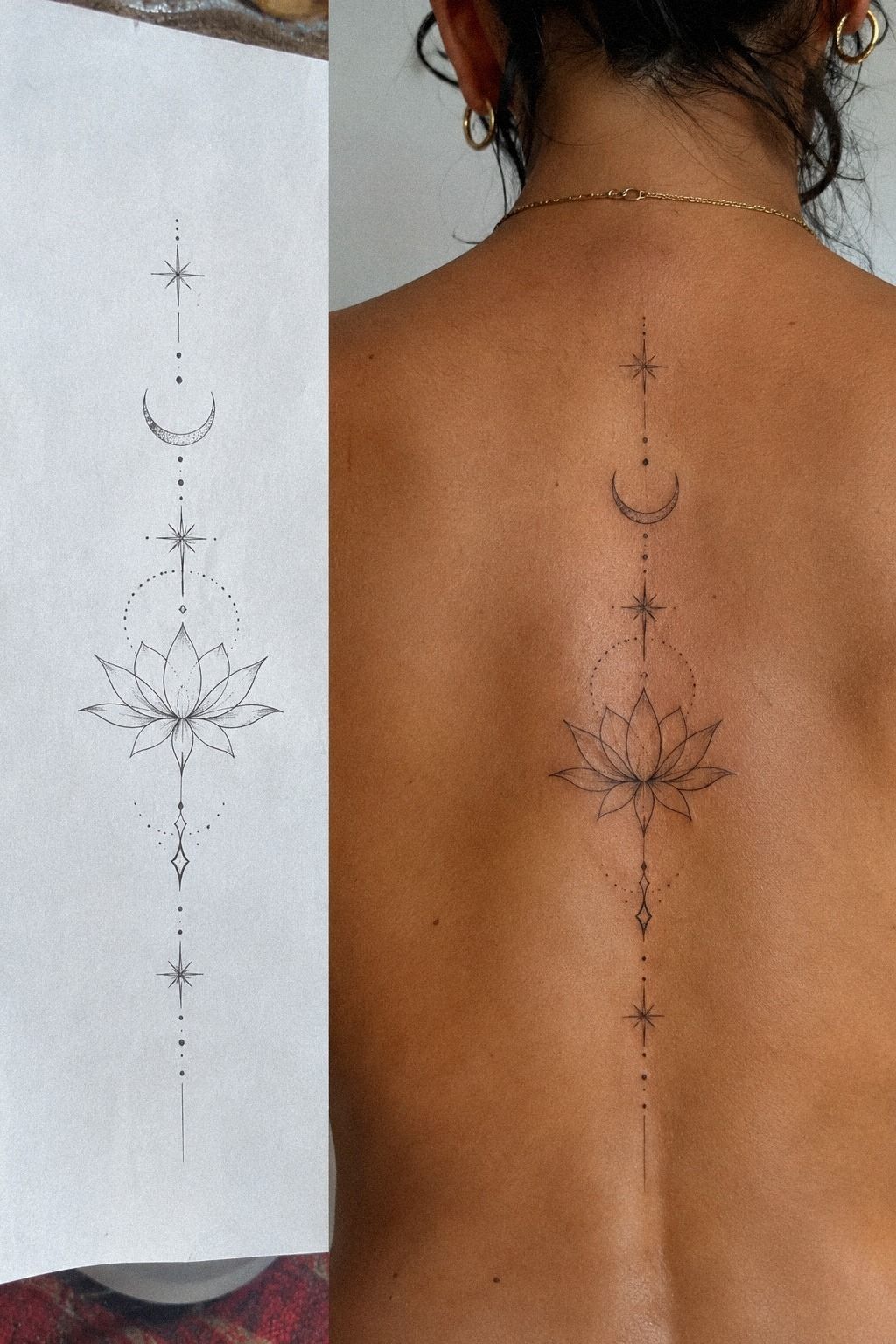
A full-length stencil should show the complete path, including the final mark near your waist. You’ll be able to judge the balance from every angle, which is far better value than approving separate fragments.
5Apply The Spine Taper Rule From Neck To Waist
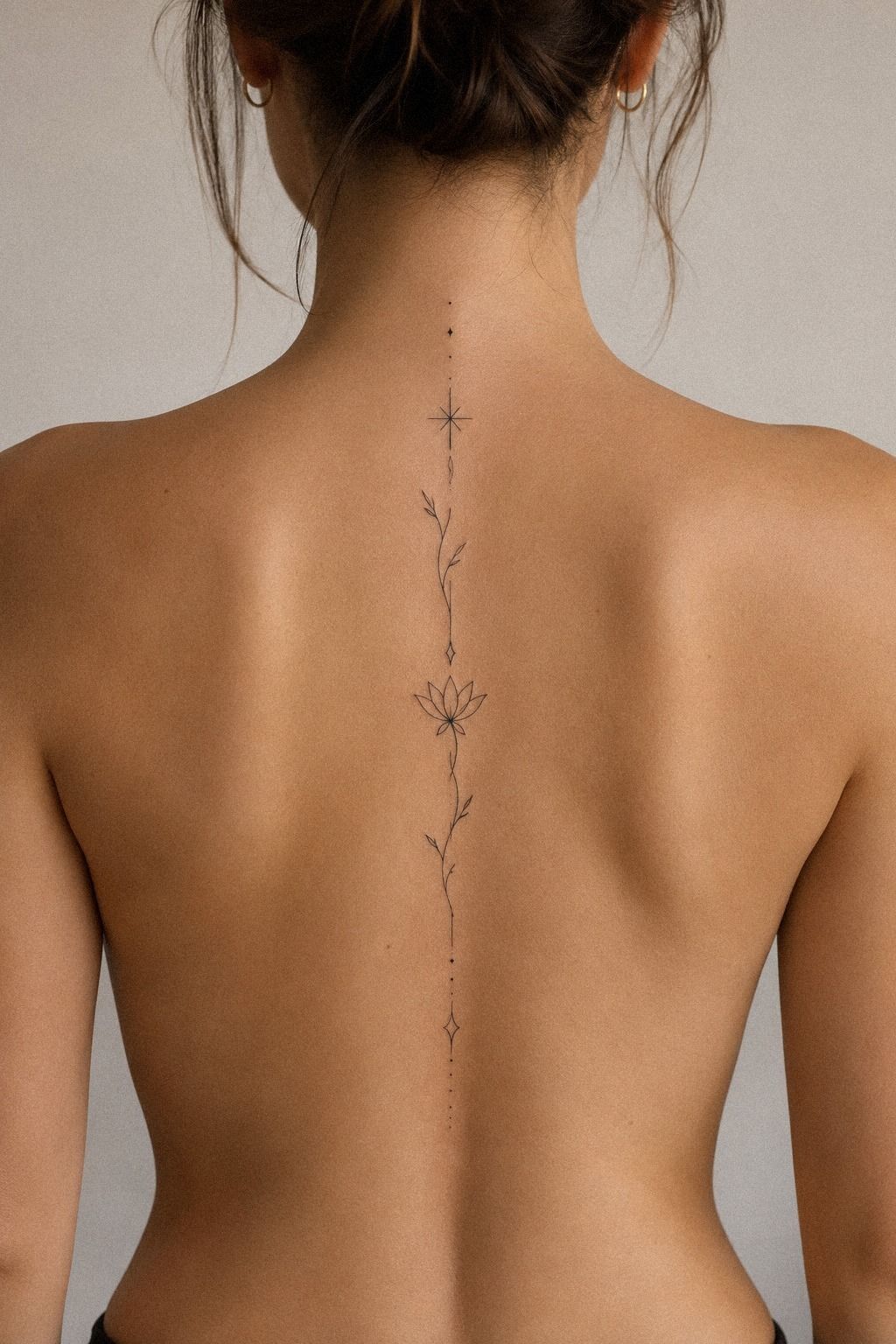
Use a flash sheet to compare several proportions before choosing your final arrangement. Your tattoo can stay understated if you select fewer marks and give each one enough separation to read.
Your goal is a clear beginning, a calm middle, and an ending that doesn’t feel abruptly cut off. That rhythm keeps a narrow tattoo from looking like a sticker strip.
Try the Spine Taper Rule: slightly smaller symbols near the neck, a stronger anchor in the middle, and a gentle reduction toward the waist. That doesn’t mean every mark must shrink perfectly.
It means your eye should travel rather than stop at one oversized flower or star. A powerful center can make a delicate design feel intentional without making the whole piece loud.
Lay tracing paper over the flash sheet and remove one symbol at a time. You’ll notice quickly whether the design needs every dot and ray.
A balanced composition often has fewer elements than the first draft, especially when the linework is extremely fine. Your artist can replace a complicated symbol with one clean outline that carries the same meaning.
Keep the total vertical length realistic for your body. A compact design might sit between the shoulder blades, while a longer piece can travel toward the waist.
You’ll want the artist to measure the stencil in inches or centimeters on your skin, not guess from a phone screen. An actual-size paper mockup makes the cost of each design choice easier to understand.
If you’re deciding between a small and extended layout, compare these small fine line tattoo ideas with your planned stencil. The right scale should feel worth it before the appointment begins.
6How Pain-Sensitive Is The Spine Placement?
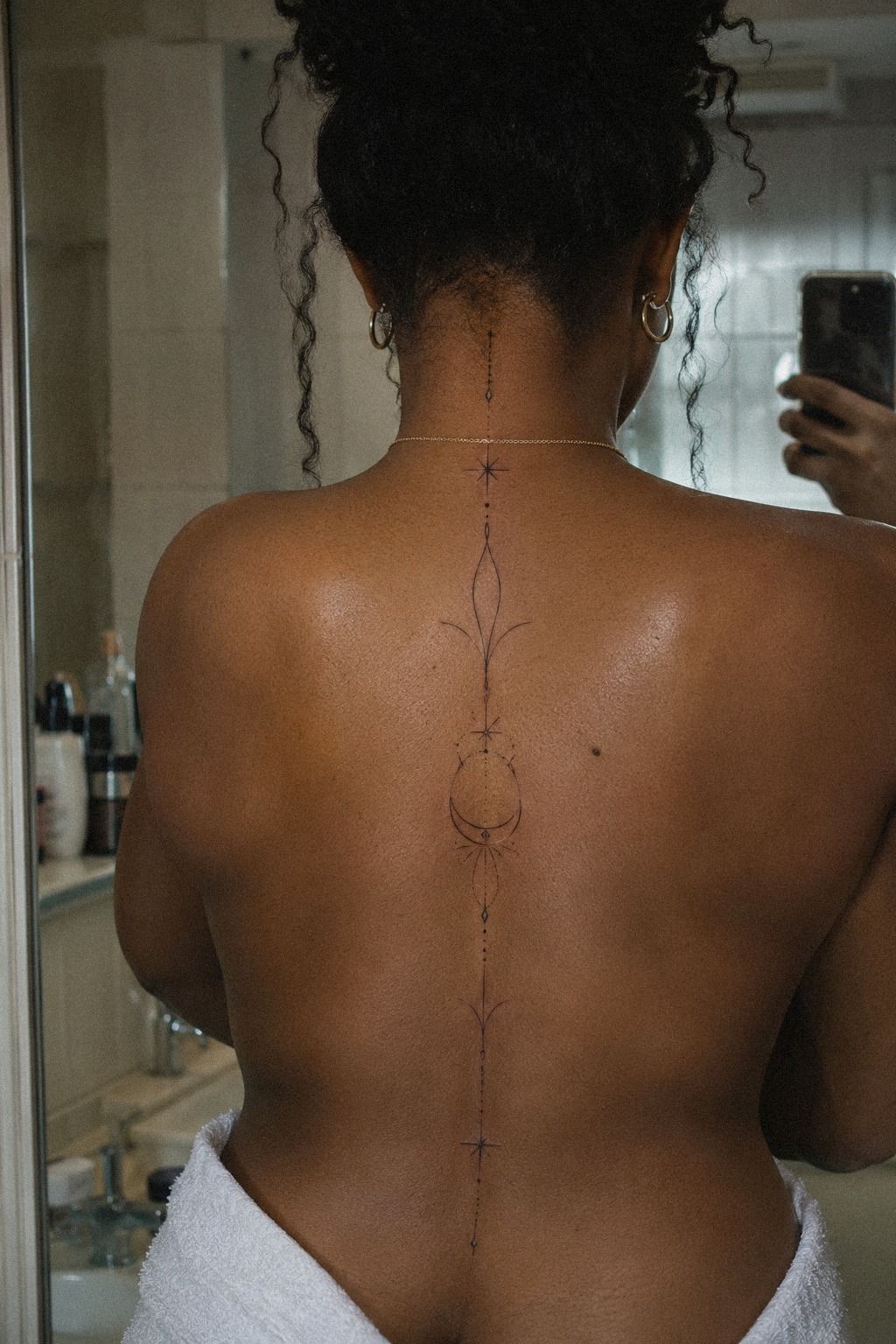
Spine tattoos can feel different from one person to another, and the most sensitive points are usually where skin sits close to bone. Ribs, feet, hands, and sternum are often described as more painful, while the forearm, thigh, and shoulder are commonly more tolerable.
Your own experience may vary, so plan for breaks and tell your artist when you need one. A fine-line session shouldn’t become a test of endurance.
Your artist may work in shorter passes over the bony center, especially near the shoulder blades and lower spine. A calm, controlled session is more valuable than rushing through a bold placement while your body is tense.
You don’t need to prove anything by sitting silently. A comfortable session plan might include water, a meal beforehand, loose clothing, and a scheduled pause.
If you feel faint, overheated, or unusually uncomfortable, tell your artist immediately. That’s practical, not dramatic!
Pain also depends on the design, your sleep, your stress level, and how long the session lasts. Your artist can split a longer spine design into two appointments if needed.
Read this delicate fine line tattoos guide for more planning ideas before you choose a session length. Ask about the expected cost of each appointment so your budget doesn’t become another source of stress.
7What Should Your Symbols Mean?
Start with the story, then choose the symbols.
8Can Fine-Line Details Age Gracefully?
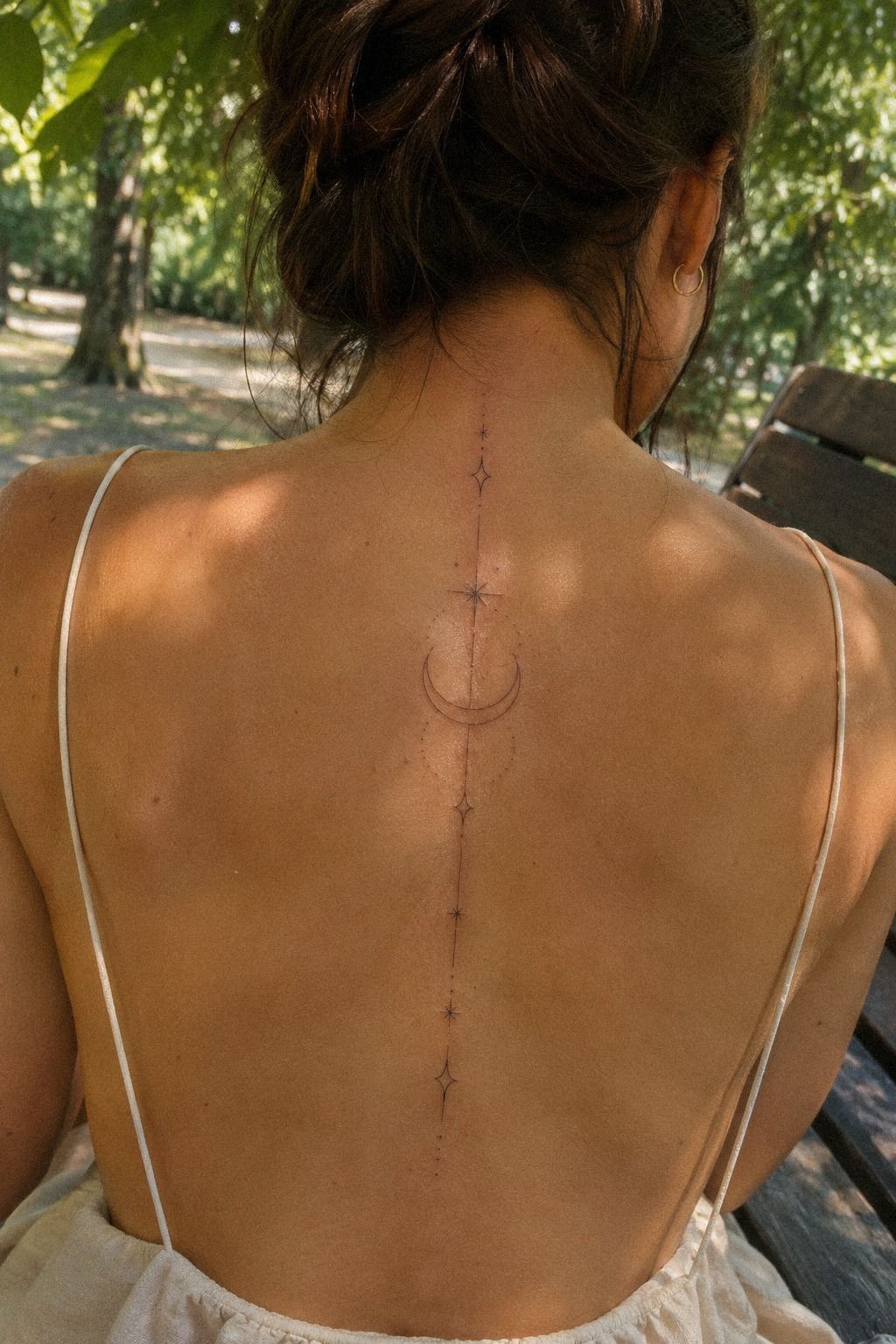
Fine lines can soften or widen as a tattoo ages, so choose details with enough breathing space to survive that change. Your artist should explain which marks may blur or become less distinct over time.
Ask to see healed photographs, not only fresh tattoos. A fresh line can look dark and sharp before the skin settles, while a healed image gives you a more honest view. Ask for the healed view!
I’d skip an artist who only shows day-one work. Your best choice is someone with a healed tattoo portfolio, consistent spacing, and experience with the scale you want.
Keep very small circles, dots, and interior lines limited. A crisp black outline usually ages more clearly than a cluster of microscopic shading marks.
You can still request an intricate design, but your artist should simplify the smallest details until each part reads at the intended scale. Don’t let a computer zoom become the judge of what your skin can hold.
Sun exposure can affect tattoo clarity, especially over years. Once your tattoo has fully healed, use broad-spectrum sunscreen when the area will be exposed.
Follow your artist’s instructions during the healing period. A timeless tattoo still needs practical protection.
Compare line approaches in this minimal tattoo design guide before approving the final stencil. You’ll see why clean spacing often offers better long-term value than extra decoration.
9Small Or Long: Which Minimal Tattoo Scale Works?
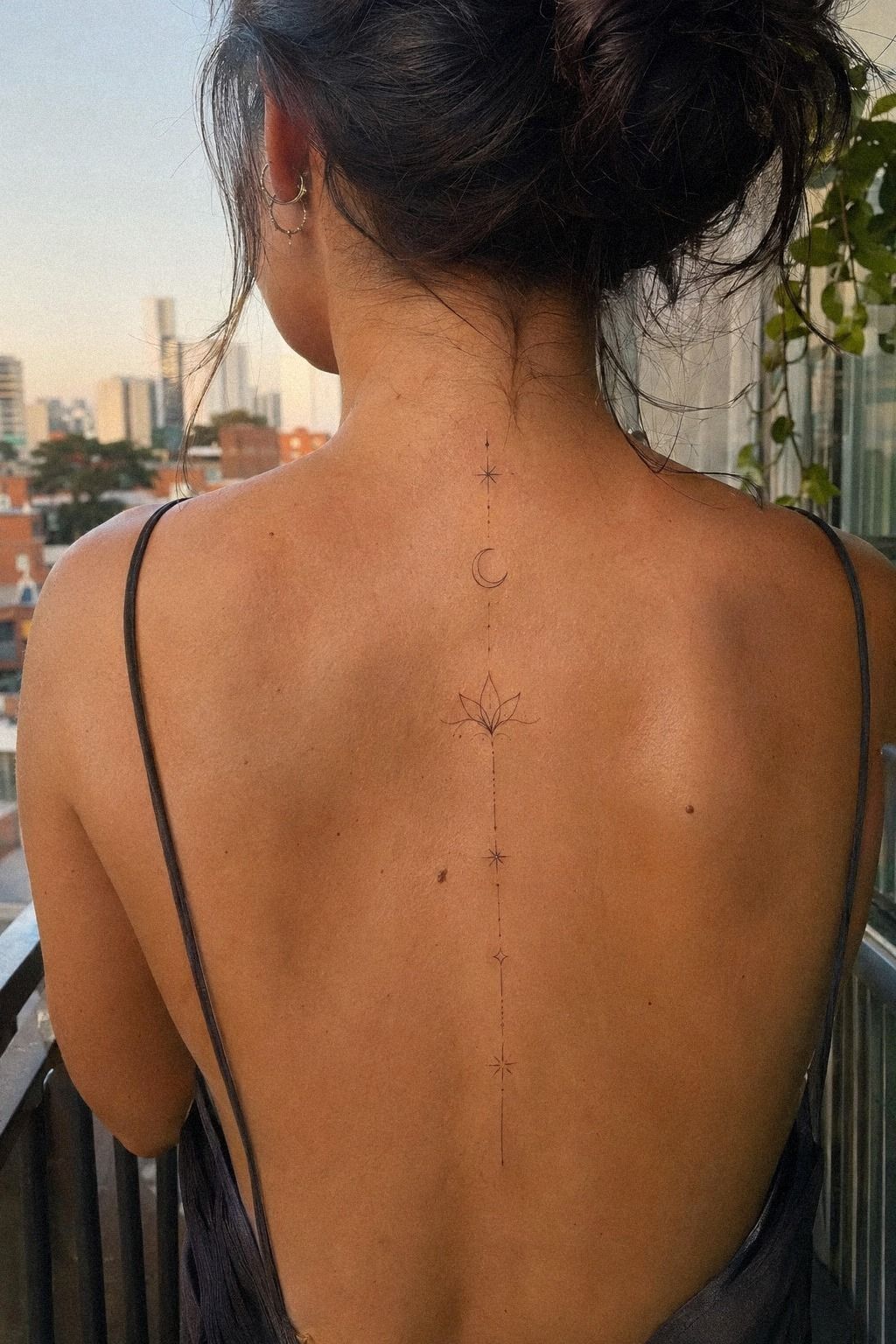
Measure your usable spine area in real units. Your artist may mark a design at four, six, or eight inches, depending on how far it travels from the upper back toward the waist.
The exact size should follow your anatomy and the symbols you’ve chosen, not a number copied from someone else’s photo. A measured tattoo scale keeps the design connected to your body.
A shorter design can look dainty and discreet between the shoulder blades. A longer piece can feel iconic when the spacing is intentional from neck to waist.
I’d avoid making a small design artificially long by stretching the gaps too far. Empty space should support the composition, not make the symbols look stranded.
Ask your artist to print the design at the intended size and place it beside your stencil. You’ll see whether the stars, leaves, or moons remain readable without zooming.
This is also where you can decide whether the piece feels feminine, masculine, or simply personal to you. There’s no rule saying a spine tattoo has to fit one aesthetic category.
Your clothing choices matter too. A narrow lower-back design may brush against high-waisted jeans, athletic wear, or a backpack.
You’ll want loose fabric for the first days after tattooing, and you should plan around work or exercise if the area will rub. That practical planning can make the full tattoo cost feel more worthwhile.
For more scale comparisons, look through these small spine tattoo ideas for women and then assess the same proportions against your own frame.
10Protect Fine Lines During Healing And Aftercare
Follow the written aftercare instructions from your artist because products and bandages can differ.
11Add One Bold Accent To Delicate Ink
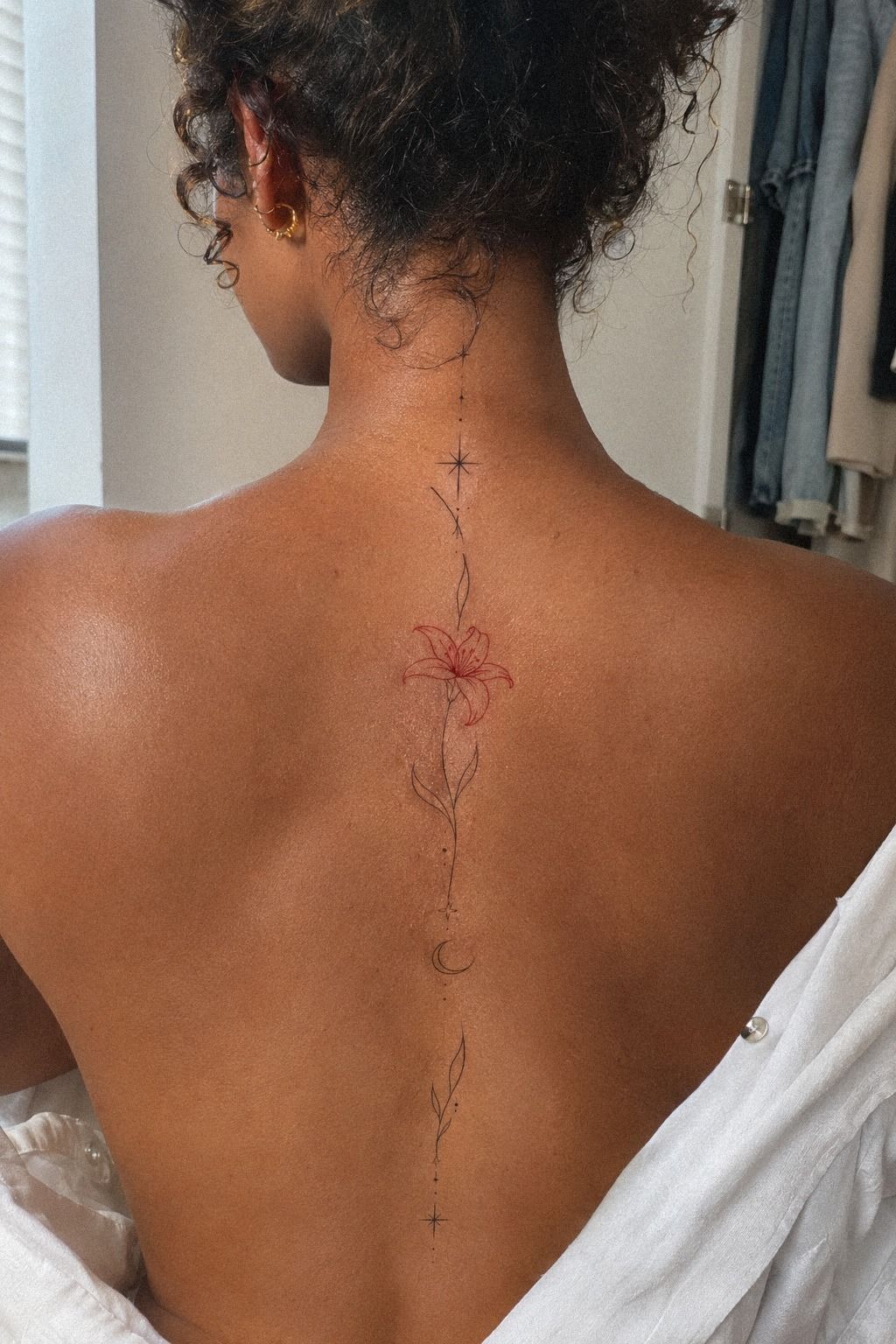
A single bold accent can give a delicate spine tattoo a visual anchor. One darker star, filled crescent, or slightly thicker botanical node can create contrast without overpowering the fine lines.
Choose one mark to carry the extra weight. I’d pick a central symbol rather than making every other star darker.
That contrast can feel fierce and edgy while the rest stays open. A heavy outline around every element would change the entire character of the piece, so resist the urge to make the full design louder.
Ask your artist to show two versions: one with the accent and one without it. You’ll know quickly whether the darker mark improves the flow or interrupts it.
This is the One-Anchor Contrast Rule, and it works because your eye gets one clear place to rest. More contrast isn’t always more personality.
A solid-black detail may hold more clearly than an ultra-thin mark, but your artist should choose the size and placement with aging in mind. You can keep the overall result vibrant, daring, and elegant without adding unnecessary shading.
If you’re deciding between subtle and stronger linework, compare this fine line geometric tattoo guide with your current sketch.
The Three-Anchor Rule Deserves A Closer Look
People often bring too many ideas to a first appointment. They want a moon, a flower, a date, a constellation, and a quote because each one means something.
That emotional urgency makes sense, but your skin still needs visual separation. The Three-Anchor Rule gives you a way to edit without stripping away the story.
Choose one main symbol, one supporting symbol, and one small finishing mark. For a spine tattoo, that might mean a central star, two botanical stems, and a tiny dot near the waist.
Your artist can then build the flow around those anchors instead of trying to give every reference equal attention. The result can feel more refined, classic, and intentional.
The rule also helps you discuss scale. Your main symbol can receive the clearest outline, while the supporting marks stay smaller and more understated.
If your artist says a detail won’t age well at the requested size, you’ll have a hierarchy to guide the edit. That conversation is far more useful than insisting every mark remain unchanged.
Would I remove a symbol you love? Sometimes, yes. A tattoo can be personal and still need restraint.
Your final design should feel empowering and unmistakably yours, but it shouldn’t require a paragraph of explanation before anyone can see its structure. I’d rather leave one meaningful idea out than force it into a crowded spine.
A Consultation Worth Your Budget
A consultation should answer more than “How much does it cost?” You’re also deciding whether the artist understands fine-line scale, spinal movement, healed results, and your preferred visual language.
Bring your references, rough sketch, preferred length, and a realistic budget. You’ll get more useful feedback when the artist knows which decisions are flexible and which ones carry personal meaning.
Ask whether the quoted cost includes the consultation, stencil adjustments, and the expected session time. Studio minimums and hourly rates can vary, so a clear estimate helps you compare value rather than chasing the lowest number.
Ask to see healed work at a similar size. A polished fresh tattoo can look striking, but healed examples show whether the artist’s lines remain crisp and readable.
Discuss whether the artist recommends one session or multiple shorter appointments. A staged plan may cost more overall, but it can be worth it when the design is long or the placement is sensitive.
A good consultation should leave you with a clearer concept, not more confusion. If the artist dismisses your questions, rushes the stencil, or refuses to discuss aging, that isn’t a worthwhile appointment.
Fresh Ink Or Healed Lines? Read Both Carefully
Fresh ink usually looks darker, sharper, and more saturated than healed work. That first impression can be exciting, but it isn’t the whole story.
Healed lines may look softer and slightly lighter. That doesn’t automatically mean the tattoo failed. It means the skin has completed part of its settling process.
Look for spacing, not just darkness. A healed fine-line result should still show the intended symbols and the relationship between them.
Pay attention to whether small circles remain circles, whether leaves remain distinct, and whether separate marks have merged. Those details matter more than a dramatic first-day photograph.
Ask how the artist handles touch-ups if a small area heals unevenly. Some adjustments are normal, but the artist should explain timing, cost, and what they consider part of the original service.
If you want the best value, judge the portfolio at several stages: fresh, healed, and fully settled when available. That gives you a more realistic idea of what you’re paying for.
What I Would Remove First
I’d remove duplicate symbols before removing the one that carries the deepest meaning. Repetition can make a spine tattoo feel longer without making it more expressive.
Next, I’d question microscopic interior details. Tiny rays, veins, and dots may look intricate in a digital draft, but they can compete with the main silhouette.
I’d also remove any mark that exists only because there was empty space. Negative space isn’t a problem that needs filling. It’s one of the strongest tools in a minimal composition.
A quote is another element I’d examine carefully. If the lettering requires shrinking other symbols, the quote may be taking more visual space than emotional value.
Finally, I’d ask whether the accent is truly needed. A single expressive mark can be powerful, but a second and third accent may weaken the hierarchy.
Editing doesn’t make a design less personal. It can make the meaningful parts more visible, crisp, and timeless.
Questions That Clarify The Final Design
Before booking, ask yourself whether you want the tattoo visible in swimwear, work clothing, or everyday outfits. Placement changes how often you’ll see it and how often others will see it.
Ask whether the design still feels stylish without color. Fine-line spine tattoos often rely on silhouette, spacing, and contrast rather than a large color range.
Ask whether you prefer a feminine, masculine, or completely neutral direction. Those labels can help during the consultation, but they don’t have to limit your final choice.
Ask whether you’re comfortable with a tattoo that may soften over time. Every tattoo changes, and realistic expectations protect you from judging normal aging as failure.
Ask whether the planned size gives each symbol enough separation. If the answer is no, the best move may be simplifying the design rather than increasing the budget.
Ask whether you’d still choose the concept if you removed the trend from it. Personal, symbolic ideas often have stronger staying power than motifs chosen only because they’re popular.
What People Always Want to Know
How much does a delicate fine line spine tattoo usually cost?
A delicate fine line spine tattoo often costs about $100 to $300 in the United States, depending on the artist, region, size, and session time. Some studios have a minimum of roughly $50 to $100, while hourly rates commonly run about $100 to $250. Your exact cost should come directly from the studio.
– Artist experience and portfolio – Design size and detail – Studio minimum – Regional hourly rate – Number of appointments
Are delicate fine line spine tattoos worth it as a first tattoo?
Yes, they can be worth it if you’re comfortable with the placement and choose a clean, readable design. Your spine tattoo can stay personal and understated while teaching you what the process feels like. I’d choose an artist whose healed work looks crisp, not only fresh.
– Manageable design scale – Clear personal meaning – Clean linework – Thoughtful placement – Realistic aftercare plan
How do I choose a tattoo artist for delicate fine line spine tattoos?
Review a portfolio filled with healed fine line work, consistent outlines, and well-spaced designs. Your artist should explain hygiene, stencil placement, aftercare, and how the lines may settle. I’d ask direct questions and compare value instead of booking only because a fresh photograph looks striking.
– Healed tattoo photographs – Fine line specialization – Clean studio practices – Clear consultation answers – Transparent pricing
How much do delicate fine line spine tattoos hurt?
Pain varies, but the bony center of the spine may feel sharper than fleshier areas. Ribs, feet, hands, and sternum are often more sensitive, while the forearm, thigh, and shoulder are commonly more tolerable. I’d plan breaks and ask whether the work can be divided into shorter sessions.
– Individual pain tolerance – Session length – Bone proximity – Break planning – Sleep and hydration
How long does a delicate fine line spine tattoo take to heal?
The surface usually takes about two to three weeks to heal, while complete healing can take about two to three months. I’d follow the artist’s aftercare sheet, wash gently, moisturize lightly, and avoid direct sun, swimming, and picking until the skin is ready.
– Surface healing: 2 to 3 weeks – Complete healing: 2 to 3 months – Gentle cleansing – UV and water protection – No picking or soaking
What’s the best placement for a delicate fine line spine tattoo?
The best placement depends on how visible you want the tattoo, how long the design is, and how you handle bony areas. The upper back can feel discreet and balanced, while a longer path toward the waist creates a more dramatic vertical effect. I’d ask your artist to stencil the full design first.
– Upper-back discretion – Full spine movement – Clear negative space – Comfortable clothing plan – Realistic design length
Where I’d Start First
If I had to pick one step, I’d start with the full-size stencil. It reveals spacing, scale, movement, and awkward symbols before ink makes the decision permanent.
Save your favorite concept, book a careful consultation, and let your artist refine the marks with you. That’s where the piece becomes personal.
A meaningful spine tattoo doesn’t need every idea you’ve ever loved. It needs one clear direction, enough skin between marks, and details that still feel like you.