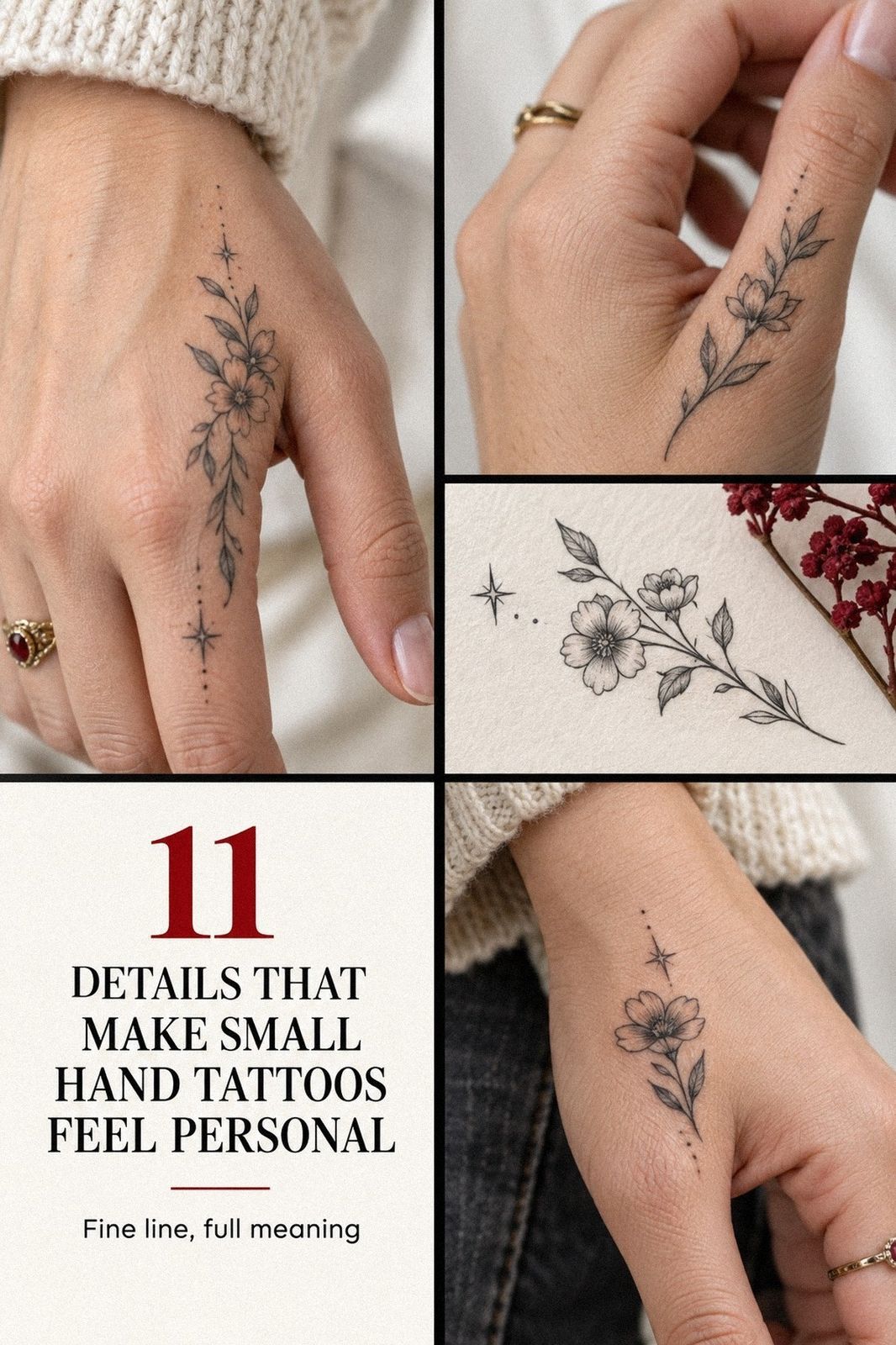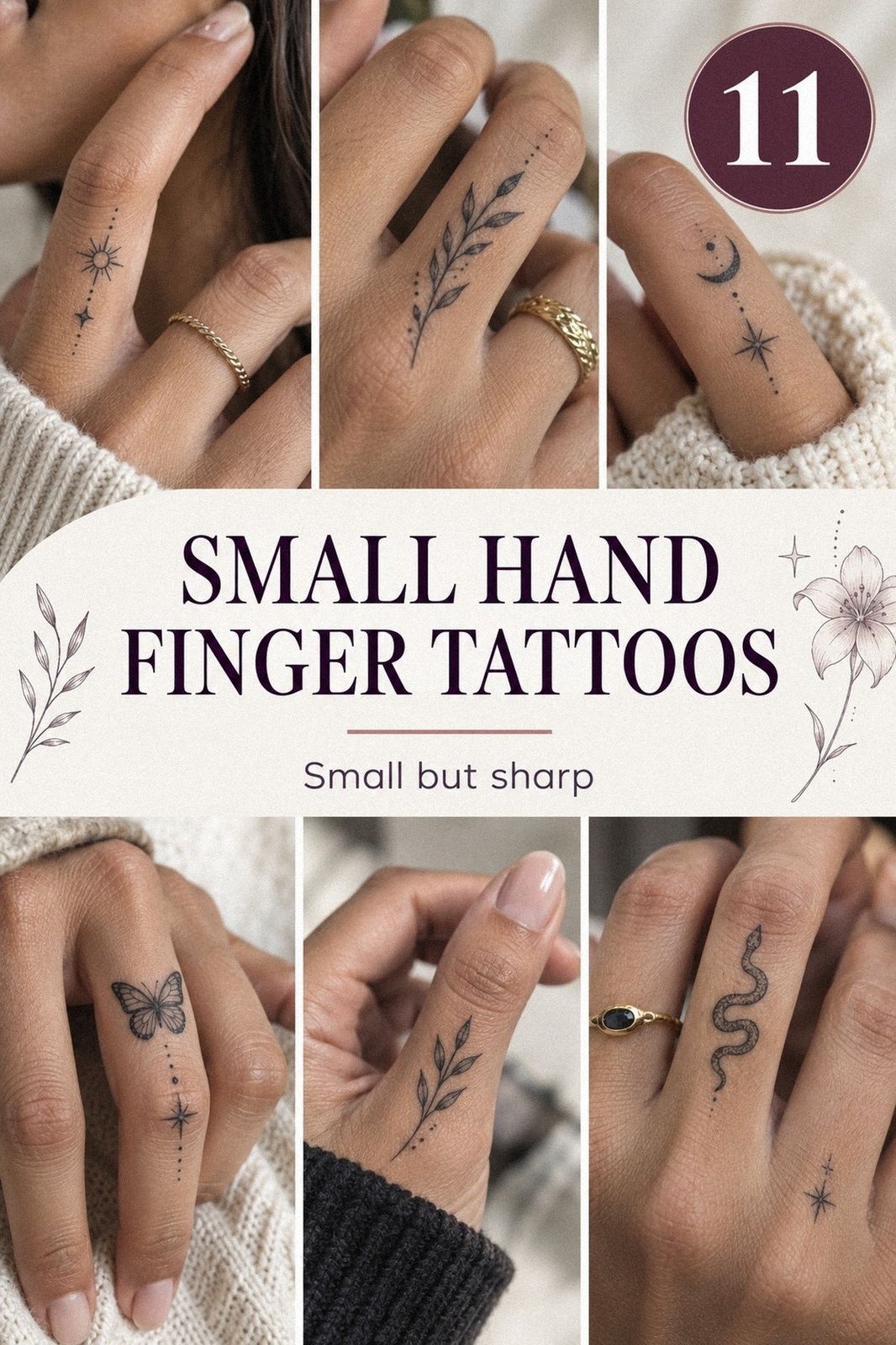
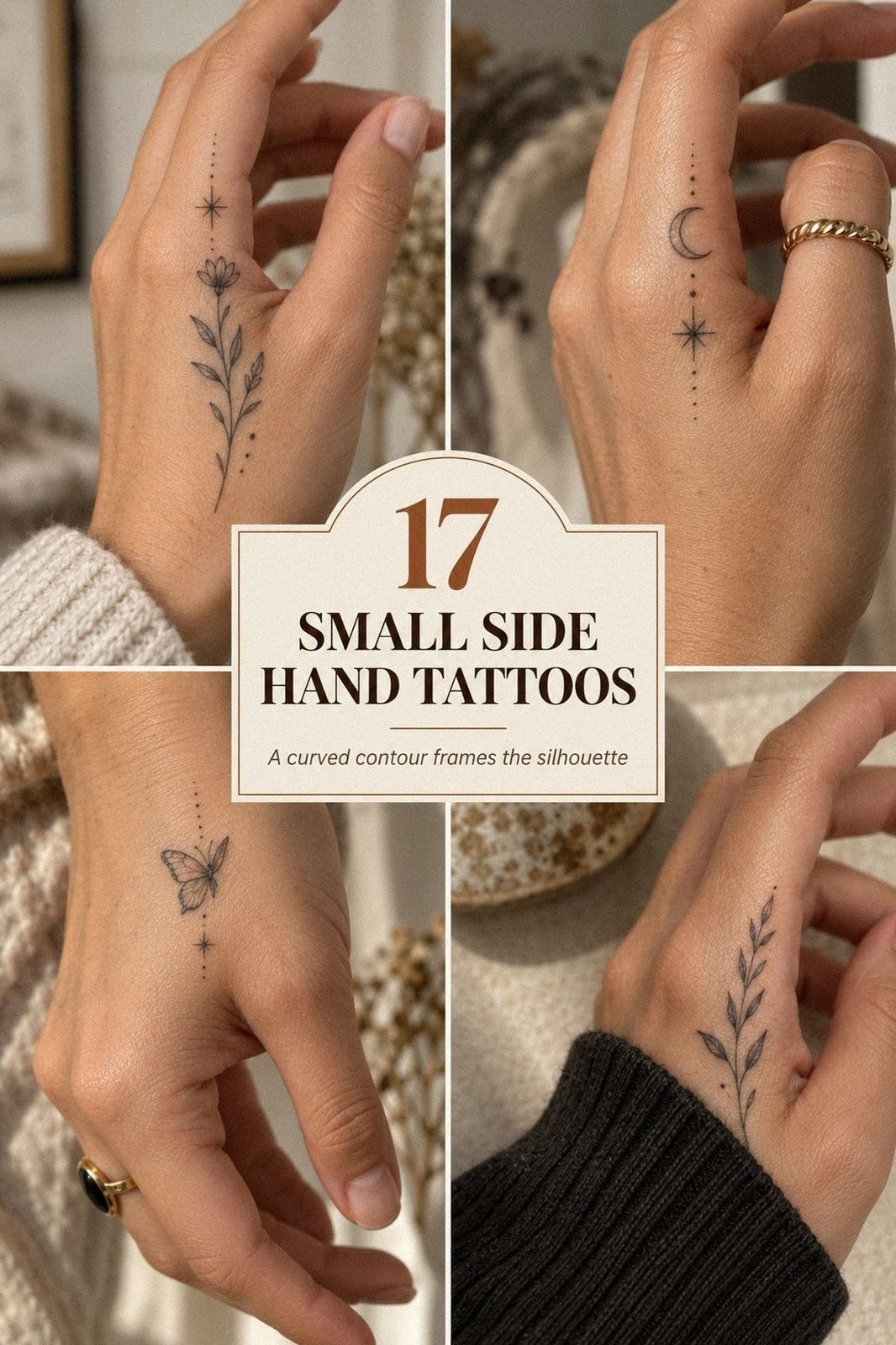
Small side hand tattoos can stay discreet at work when placement, scale, and line weight are planned together. I learned that the hard way after choosing a design that wrapped too far toward my knuckles. These ideas keep the ink personal and easy to cover, while still giving you a striking side-hand placement when your hand turns. You’ll see delicate, bold, and symbolic options ahead!
The best choice isn’t always the tiniest one. A fine-line tattoo can feel personal, expressive, and nearly invisible from a distance when it follows your hand’s natural structure.
Start With Fine-Line Botanicals
A narrow botanical stem follows the outer edge of the hand without taking over your whole silhouette. A single-needle botanical linework design works especially well with one slender stem, two leaves, and enough breathing room between each line. It’s delicate without looking unfinished.
You’ll want the stem to follow the hand’s natural length instead of crossing the knuckles. I’d skip a dense bouquet here. It can blur into a dark strip over time, while one graceful sprig keeps the design crisp and understated.
Think fern, olive branch, rosemary, or a tiny wildflower. Fine black ink gives the cleanest contrast, but your artist can adjust the line weight to suit your skin tone. If you’re collecting botanical ideas, browse these small tiny hand tattoos for related placements.
A discreet design still needs personality. Your best version might be a symbolic herb connected to family, travel, or a private memory.
I’ve seen the most meaningful pieces stay simple because you don’t have to explain every leaf for it to feel personal. Check the stem placement with your hand relaxed and extended.
The smallest designs need room to breathe. That negative space keeps each leaf readable instead of turning the stem into a dark little stripe.
Tiny Script Small Side Hand Tattoos
Tiny script works beautifully along the side of the hand when the word is short and the lettering has enough space to breathe. Hair-thin script lettering can give the design a romantic finish without making it loud.
Choose a word you can read instantly at the size you want. “Still,” “brave,” “soft,” and “always” are easier to preserve than a long quotation. You’ll need to accept that very small letters may soften over time, so I’d favor a sleek handwritten style over ornate loops.
Ask your artist to stencil the word in several sizes before you commit. Black script ink should sit along the side plane, not curve underneath the finger, where friction and movement can affect clarity.
And don’t choose lettering only because it looks pretty in a reference photo. Your hand moves constantly, so your word should still feel right when you’re typing, driving, or reaching for a coffee cup. For more ideas, see these small simple hand tattoos.
A stencil test can reveal awkward spacing before the needle touches your skin. If the letters look crowded when your hand bends, they’ll probably feel crowded after the tattoo heals.
Unique Geometric Side Hand Ink Ideas
Clean geometry gives the side of the hand a sharp, expressive edge. Precise geometric linework works especially well in a small triangle, diamond, crescent, or symmetrical talisman that follows the hand’s long side.
You’ll want every angle checked against the stencil before the needle starts. A design that looks balanced on paper may tilt once it reaches your hand.
I’d avoid an oversized mandala in this location. It’s intricate, but the outer edge doesn’t offer enough space for every detail to stay readable.
A single geometric symbol can feel powerful when the lines are consistent. Ruled black lines create a crisp result, while a small amount of negative space keeps the design from becoming visually heavy. Ask your artist to show you the stencil with your fingers relaxed and extended.
Could your symbol mean something without becoming obvious? That’s the appeal.
You can choose a private shape, a compass point, or a pattern tied to your own story. That check matters!
For adjacent placements, these small side finger tattoos are useful to compare.
A private symbol can be more personal than an obvious portrait or quote. The meaning stays yours, even when coworkers only see a few clean angles.
The Moon, Mars, and a Tiny Star
A tiny moon, Mars symbol, or star can look ethereal along the hand’s edge. Fine celestial linework creates a soft contrast, especially when the design uses one crescent and a few carefully spaced dots.
Keep the symbol compact and let the skin do some of the visual work. You’ll want the moon’s curve to follow the hand rather than point awkwardly toward the thumb. I’d skip a crowded constellation because clustered dots can lose their separation as the tattoo settles.
Black celestial ink is the safest choice for long-term readability, though a small open circle or unfilled star can keep the piece light. Your artist should check the design from several angles since side-hand tattoos can look different when your fingers bend.
I love this approach for anyone who wants something meaningful without a literal image. A moon can mark change, a star can represent direction, and a small eclipse can feel raw and mysterious. If you’re comparing motifs, this small tattoos meaning guide can help you narrow the idea.
An open star is a smart option when you want a meaningful mark without a dense fill. It stays minimal, but it still has a recognizable silhouette.
Minimal Animal Silhouettes On the Hand Side
Animal silhouettes turn a tiny hand tattoo into a recognizable personal emblem. Choose a readable silhouette rather than a portrait packed with facial detail. A fox profile, bird, cat tail, moth, or tiny snake can work well.
You’ll want the silhouette to remain recognizable even when the hand is partly closed, so the outer contour matters more than internal shading. A strong outline will usually age better than several fragile facial details.
Traditional black flash ink gives this concept a timeless quality, but you don’t need a heavy fill. I’d choose a clean outline with one solid accent instead of trying to copy every tiny mark from a larger flash design.
Keep your reference pose simple and ask your artist to redraw it for the narrow hand edge. That keeps the result personal rather than making your tattoo look like a random sticker from a flash wall!
For more miniature animal ideas, compare related small hand tattoo ideas and focus on designs with a strong outer contour.
Intricate Blackwork Small Side Hand Tattoos
Blackwork can be discreet when the placement is narrow and the shape is intentional. Against deep ebony skin, solid saturated blackwork creates a bold, graphic presence that reads clearly without needing a large footprint.
You’ll want your artist to understand how black ink will sit against your skin tone and how much negative space the design needs. A small filled crescent, pointed leaf, abstract mark, or compact ornamental shape can look fierce and polished.
I’d skip ultra-thin blackwork if your main goal is longevity. Dense black pigment with a clean edge tends to hold its visual weight better than a cluster of fragile gray marks, though your artist should choose the final saturation for your skin.
The side of the hand is already a high-visibility placement, so the design doesn’t need extra drama. Your best option may be one sharp silhouette with no text and no shading. For more placement ideas, look through these small hand tattoos for women and notice how scale changes the mood.
Dainty Birth Flower Hand Side Designs
A single birth flower is one of the most personal ways to keep a hand tattoo discreet. A stemmed birth flower gives the design a graceful shape that follows the side of the hand.
You can choose the flower connected to your birth month, a loved one, or a season that matters to you. I’d avoid adding a full date beneath it unless you’re certain about the available space. The flower already carries the meaning, and the cleaner version will age more elegantly.
Fine floral linework looks delicate when the petals are open and separated. Ask for a stem that isn’t too thin, because a disappearing stem can make the flower seem detached as the tattoo heals.
This is also a lovely matching concept. You could each choose a different birth flower while keeping the same placement and line weight.
That feels more personal than identical copies. If you want additional references, compare these small hand tattoos female designs.
A matching placement keeps the connection visible without forcing both people to choose the same flower. That makes the result personal to each wearer.
Meaningful Matching Side Hand Tattoos
Matching tattoos work best when they share a visual language rather than looking like duplicated clip art. Paired minimalist symbols can sit along the side edge while still giving each person room to choose a distinct meaning.
You and your matching person might choose two halves of one shape, two tiny stars, mirrored leaves, or symbols that only make sense together. You’ll want both stencils placed at the same angle because even a slight difference can make the pair feel accidental.
I’d avoid matching names unless you’ve thought through how permanent that choice feels. Coordinated fine line ink gives you room to choose symbols that remain meaningful even if your relationship changes form.
Matching doesn’t have to mean identical. Your piece could be a moon while theirs is a star, or yours could be a flower while theirs is a leaf. The shared line style keeps the connection clear.
These small hand finger tattoos for women offer more paired-placement inspiration.
Bold Red Ink Side Hand Symbols
Red ink gives a small side-hand symbol an edgy, vibrant quality. Clean red linework works especially well when the design is a heart, tiny flame, abstract mark, or compact protective symbol.
You’ll want to discuss color healing with your artist before deciding. Red can look bright when fresh and softer once healed, so the symbol should still work if the final tone becomes more muted. I’d skip a complicated red illustration here and choose one shape with a clear outline.
Red tattoo pigment can make a simple symbol feel daring without increasing its size. Your artist may suggest a slightly stronger line so the design remains visible against your undertone. That doesn’t mean making it heavy; it means giving the color enough structure.
This is the pick for someone who wants discreet placement with more attitude. Your hand can look ordinary from a distance, then reveal a sharp red mark when you turn it. For more small references, visit these small tattoos with meaning and focus on compact symbols.
The final healed color may be gentler than the fresh version. That isn’t a flaw, but you should like the design at both stages.
Playful Miniature Side Hand Tattoo Ideas
A miniature tattoo can feel whimsical when the idea is simple and the stencil matches the healed result. Choose a tiny object with a strong outline: a spark, bow, smiley face, leaf, match, or little charm.
You’ll want your design to remain readable without relying on delicate interior texture. I’d skip micro-realism here because the side hand doesn’t give those details much room.
Healed fine line ink often looks softer than the fresh stencil, and that’s normal. Ask to see healed examples from your artist, not only new work posted immediately after a session.
You can also make the idea quietly personal. A miniature charm from a favorite book, a symbol from a trip, or a tiny object connected to your daily life will feel playful without feeling random. For more understated options, browse these small inside finger tattoos.
A micro-object design can be playful without becoming childish. One unmistakable shape is usually stronger than several tiny details.
Feminine Ornamental Hand Edge Tattoos
Ornamental designs can follow the hand’s edge like a delicate bracelet without wrapping fully around the fingers. Fine ornamental linework creates a graceful, decorative rhythm.
You’ll want the pattern to stay open rather than becoming a dense black band. Small arches, dots, petals, and pointed accents can create an elegant border, but each mark needs enough space to remain distinct.
Ornamental black ink gives the design a strong foundation, while a few unfilled shapes keep it refined. Your artist should place the stencil while your hand is relaxed, then check how the pattern shifts when you flex your fingers.
This style is feminine without requiring a flower or script word. It can feel sacred, symbolic, or simply polished depending on the shapes you choose. If you’re still comparing silhouettes, these small simple hand tattoos show how restraint can make a small mark feel more intentional.
An open pattern keeps the design from becoming a solid strip. That matters when you want ornamental detail without losing discretion.
Choose a Fine Symbol That Carries Private Meaning
A small symbol can carry a full memory without announcing it to everyone around you. Consider a key, tiny flame, compass point, or abstract mark with a meaningful symbol behind it.
Your choice doesn’t need to be universally understood. A private reference can feel more powerful than a trendy design, especially when you’ll see it every day.
A personal motif also gives you flexibility later. You can add a second mark nearby, or leave the original exactly as it is.
Should You Choose the Pinky Edge or Outer Hand?
The pinky edge usually gives you a narrow, discreet strip, while the outer hand can offer a little more width. Outer-hand placement may be easier to read if your design includes a small flower, animal, or geometric shape.
The side near the pinky can disappear more easily beneath certain gloves or long sleeves, but it still won’t be invisible in every hand position. Think about your actual workday before choosing.
Side-finger placement is often more exposed to friction and movement. If your priority is hiding the tattoo at work, keep the design on the hand’s side plane rather than wrapping around the finger.
Black Ink or Color: Which Stays Discreet?
Black is usually the most straightforward choice for a discreet tattoo because it gives strong contrast with a compact shape. Black tattoo ink also makes fine symbols easier to read as the tattoo settles.
Color can be more expressive, though. Red, muted blue, or a small warm accent may give a minimal mark an edgy or romantic quality without making it larger.
Red pigment needs a realistic healing conversation with your artist. Ask how the shade behaves on skin close to yours, and choose a design that still works if the final tone becomes softer.
A Short Name Can Become a Sharp Mark
If you’re choosing lettering, keep the word short enough to remain legible without stretching the design. A single name, initial, or meaningful word can feel sleek when the short script has enough breathing room.
Ask your artist to show the lettering at the actual size. A word that looks elegant on a screen may become crowded when it follows the hand’s narrow edge.
Letter spacing matters as much as the font. Tiny gaps can close during healing, so a simpler style may be more timeless than ornate loops.
When a Bold Design Needs Less Detail
A bold tattoo doesn’t need to be large. One dark crescent, compact animal, or graphic symbol can feel fierce when the bold linework follows the hand instead of fighting it.
The best approach is choosing one focal shape. Multiple small elements may look exciting at first, but they can merge into visual noise on a narrow placement.
A solid shape can stay readable from across a desk while remaining easy to cover. If you want privacy, let the scale create the discretion instead of forcing the design to carry too many details.
Place the Stencil Before the Appointment
Start with an artist whose portfolio shows healed hand work, not only fresh tattoos. A licensed tattoo artist should also be willing to discuss placement, line weight, color, and realistic healing expectations.
Ask how the artist handles hygiene, stencil adjustments, and skin-tone variation. You shouldn’t feel rushed into a design because the appointment is already booked.
A sterile setup and clear aftercare instructions matter just as much as style. Choose someone who answers practical questions without dismissing your concerns.
Bring examples of work you like, but don’t expect an exact copy. A thoughtful artist can turn the reference into a skin-tone portfolio decision that suits your anatomy and contrast.
What Should You Check Before the Appointment?
Bring your work requirements into the conversation early. If your employer expects visible skin to remain clear, even a narrow side-hand tattoo may need a placement that disappears beneath gloves or long sleeves.
Check the design with your hand relaxed, extended, and partially closed. A symbol that looks balanced in one position can tilt in another, especially near the knuckles.
Ask whether the artist has healed examples on skin close to yours. Fresh ink can look sharp on everyone, but healed contrast varies with pigment, placement, line weight, and aftercare.
You should also discuss the practical side of the appointment. Ask about the shop minimum, payment expectations, touch-up policy, and how long the stencil process usually takes. Those answers make the decision feel more grounded.
The Difference Between Fresh and Healed
Fresh ink often looks darker and sharper than the final result. Your fresh tattoo may appear extremely crisp at first, while mild softening develops as the surface settles.
That’s why healed examples are so valuable. A healed tattoo shows whether the line spacing, contrast, and small details actually survived the early stages.
You’ll want to follow the aftercare routine your artist gives you. Wash gently, moisturize as directed, and avoid prolonged sun or pool exposure while the surface heals.
The Side-Hand Rule I Keep Coming Back To
The most important decision isn’t whether your idea is bold, delicate, or playful. It’s whether the design respects the hand’s movement. I’ve seen people fall in love with a reference, then discover that its prettiest detail lands exactly where the skin folds.
Your stencil should be checked with your hand relaxed, extended, and partially closed. Those three positions tell you whether the lines remain balanced or whether the symbol twists. This movement test takes only a minute, but it can save you from an awkward placement.
I prefer one clear focal shape over a collection of tiny decorations. A crisp placement stencil gives you a chance to judge the angle, scale, and visibility before the session begins.
If something feels slightly wrong, say so. You’re allowed to pause, move the stencil, or change the idea.
There’s also a practical question: do you need the tattoo hidden every day, or only during work hours? A side-hand design may disappear beneath certain gloves or clothing, but it won’t be invisible in every position. Consider the tattoo’s workplace visibility before you commit.
The data is fairly simple, but it’s worth keeping nearby:
A tattoo cost depends on artist experience, region, design detail, and placement. Those prices are typical US guides, not a promise. A reputable artist may charge more for a short appointment because setup, sterilization, and experience still matter.
The side hand can be more sensitive than a forearm because there’s less padding over bone and many moving structures. You’ll want to follow aftercare carefully: wash gently, moisturize as advised, and avoid prolonged sun or pool exposure while the surface heals.
And remember that fine lines may spread or soften with time. Solid black pigment usually keeps its visual weight better than extremely fragile lines, especially when UV exposure is controlled.
That doesn’t mean delicate work is a bad choice. It means you should choose delicacy with realistic expectations.
I’d also ask for healed photos on skin tones close to yours. Fresh work can look crisp on everyone, but healed contrast varies. Your artist’s portfolio should show linework, placement, and healed results, not just dramatic close-ups taken minutes after the session.
If you’re choosing between two ideas, ask yourself which one you’d still want if nobody else could see it. That answer usually points toward the most meaningful design. The small mark that feels personal will outlast the one chosen only because it photographed well.
A Few Things Worth Answering
How much does a small side hand tattoo usually cost?
A small side-hand tattoo usually costs about $100 to $300 in the US, though a shop minimum may be around $50 to $100 and hourly rates may run about $100 to $250. Your final price depends on the artist, region, detail, and appointment setup.
Are small side hand tattoos a good idea for a first tattoo?
Yes, they can be a good first tattoo if you understand the visibility and healing demands. The compact placement lets you choose a meaningful symbol without committing to a large design, but hand skin can be more sensitive and may need careful aftercare.
How do I choose a tattoo artist for small side hand tattoos?
Choose an artist with clean healed linework, strong placement photos, and experience with your chosen style. A trustworthy portfolio should show healed tattoos across skin tones, clear hygiene standards, and designs that remain readable after the surface settles.
How much do small side hand tattoos hurt?
Hand tattoos can hurt more than tattoos on the forearm, thigh, or shoulder because the area is bony and sensitive. The sensation varies by exact placement, your tolerance, and the design length, so ask your artist what to expect before booking.
How long does a small side hand tattoo take to heal?
The surface usually heals in about 2 to 3 weeks, while complete healing can take roughly 2 to 3 months. Gentle aftercare includes washing carefully, moisturizing as directed, and avoiding strong sun or swimming while the surface is healing.
What’s the best placement for small side hand tattoos?
The outer hand edge and side near the pinky can offer discreet placement, while the side finger is more visible and may experience more friction. Your best placement depends on how hidden you need the tattoo to be and how much line clarity matters to you.
Where I’d Start First
If I had to pick one, I’d start with the fine-line botanical stem. It follows the hand’s shape, stays personal, and doesn’t need extra detail to remain meaningful.
Pin the botanical idea for later and compare it with these small tiny hand tattoos before you book. That balance of personal meaning and discreet scale is hard to beat!