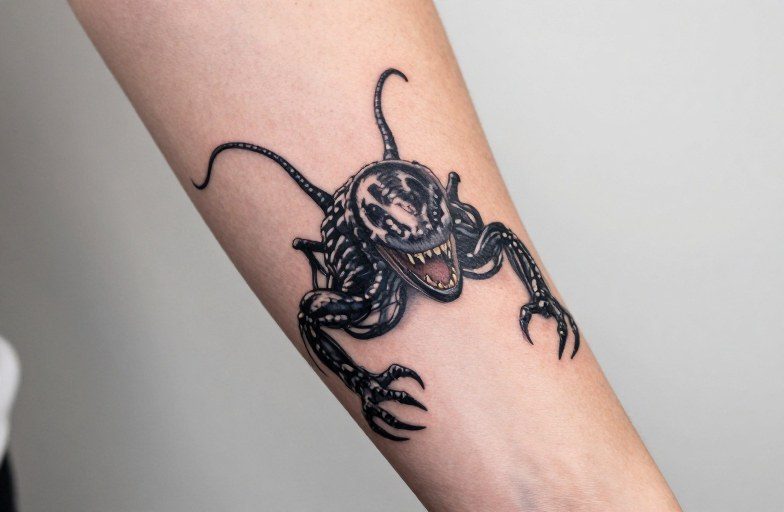
Venom tattoos hit that sweet spot between horror and hero, between organic threat and pop-culture icon. The concept works because it’s visually immediate, dripping black ink, exposed teeth, tendrils that seem to move. But the best venom pieces aren’t just reproductions of a Marvel poster. They play with texture, negative space, and the tension between human form and something consuming it from within. Here’s how to make a venom tattoo actually work on skin.
Matching & Pairing Ideas
Single venom pieces stand alone fine, but pairing opens up narrative possibilities most people ignore.
Symbiote and Host
The classic split-face, half human, half venom, works best when the transition line isn’t straight down the middle. A diagonal tear, starting at the jaw and ripping toward the opposite temple, follows natural muscle flow and reads as transformation rather than mask. For couples or close friends, one person takes the human side, the other takes the symbiote. The connection reads without being identical. Placement matters here: forearms that touch when standing side-by-side, or calves that align when seated, create the reveal moment.
Venom vs. Carnage Pairings
- Black ink versus red, strict color discipline makes the contrast pop without clutter
- Smooth tendrils versus jagged chaos; the line quality difference tells the story
- Shared negative space: two separate pieces that form a single shape when bodies align
- Same body placement, opposite limbs, mirrored poses
Avoid the obvious face-off composition. Two characters screaming at each other is comic-cover energy. More interesting: venom consuming, carnage bursting outward, both caught mid-motion so the negative space between them vibrates.
Best Placements
Venom’s visual language, drip, flow, consume, maps naturally to certain body contours.
Where the Tendrils Flow
The neck and shoulder junction reads as emergence. Venom pushing up from the collarbone, tendrils wrapping the throat, the head tilting back, this placement uses the body’s architecture as part of the image. Risk: high visibility means career considerations. Thigh pieces offer similar flow with easier coverage. The inner thigh, specifically, carries that sense of something hidden, intimate, spreading.
Hands and Fingers
Small venom faces on the back of the hand, tendrils extending onto fingers, this is commitment placement. The knuckles become teeth, the webbing between fingers becomes stretched symbiote membrane. Healing is rough; hand tattoos settle softer than other placements, lines blur faster, blacks can go blue-gray within a few years. Budget for touch-ups. The tradeoff is immediate, unmistakable presence.
Forearms split the difference: visible, workable canvas, enough flat space for detail, enough curve for flow. The inner forearm’s softer skin takes shading beautifully but fades faster than the outer’s tougher dermis.
Trending Variations
The venom concept has stretched beyond the character into something more abstract.
Organic Poison
Drop the character entirely. Think actual venom, snake fangs, dripping liquid, chemical structures. A coiled serpent with viscous black fluid pooling beneath it. The molecular structure of actual toxins rendered as geometric overlay. This variation ages better; character tattoos date with casting changes and franchise fatigue. Organic venom stays current because it references something permanent.
Venom as Substance
Tattoos that show the symbiote as material rather than creature. Black liquid pooling in a cupped hand, dripping from a sleeve edge, spreading across skin like spilled ink. The body becomes surface, not subject. These pieces rely heavily on smooth black fill and careful highlight placement, white ink or skin-break, to suggest viscosity. The technique is unforgiving; uneven saturation reads as flat black blob rather than living fluid.
Popular Styles
Not every style handles venom’s particular visual demands equally.
Black and gray realism dominates for good reason. The character’s palette is already monochrome; translating that to tattoo ink is direct. The challenge is maintaining the glossy, wet look. That means heavy contrast, strategic skin-break for highlight, and often a second pass once healed to push the darkest areas deeper. Single-session black and gray venom pieces almost always look flat. Plan for the long game.
Traditional and neo-traditional approaches surprise here. The limited palette forces simplification, bold black shapes, limited red for tongue or eye, clean outlines. What you lose in detail you gain in readability at distance and longevity over decades. A traditional venom head, three inches across, still reads clearly at twenty feet. A photorealistic piece that size dissolves into texture.
Biomechanical fusion makes sense conceptually, venom as machine-organic hybrid, but execution trips people up. Too many elements compete: mechanical gears, torn flesh, symbiote tendrils, human features. The best biomechanical venom pieces simplify to one or two of these, letting negative space do the heavy lifting.
Standout Design Ideas
Specific compositions that separate memorable pieces from generic ones.
The Consumption Sequence
Multiple small pieces showing progressive takeover. First: a human eye, white beginning to show black at the corner. Second: half the face, tendrils visible. Third: full venom, but with one human eye still visible, fighting. This works across a sleeve, across multiple sessions, or as separate pieces that accumulate meaning. The progression mirrors how tattoos themselves accumulate, fitting for collectors.
Venom as Environment
The character becomes landscape rather than portrait. A full back piece where venom’s face is the moon, tendrils the night sky, teeth the horizon line. A figure, small, human, vulnerable, stands within the mouth. Scale inversion creates psychological weight. The character becomes place, atmosphere, threat you inhabit rather than observe.
- Venom’s tongue as a road, a river, a path leading somewhere undefined
- The white spider emblem as negative space within a larger black field, discovered rather than declared
- Reflection pieces: venom in a mirror, water, chrome surface, the reflection more real than the source
Tips for Choosing
Practical decisions that separate good intentions from good tattoos.
Reference Discipline
Bring references, then be willing to abandon them. The best tattoo artists translate, don’t transcribe. A comic panel is two-dimensional, static, designed for paper. Your arm moves, stretches, ages. The artist needs freedom to adapt. If you can’t trust them to reinterpret, you haven’t found the right artist.
Size Reality
Venom’s detail density demands space. The face alone needs palm-size minimum to read as anything but dark blur. Tendrils extending from it need room to breathe. Budget for the size that works, not the size that fits your current budget. A small venom tattoo is a smudged venom tattoo in five years.
Consider the long arc. Black-heavy pieces soften and blue-shift over time. That glossy wet look requires maintenance. White highlights, often used for saliva gleam and eye catchlights, yellows and can disappear entirely. Plan for a piece that works even when the bells and whistles fade.
Artist selection trumps design every time. Venom requires confident black fill, smooth gradation, understanding of how tendril lines flow with body movement. Look at their healed work, not just fresh photos. Instagram shows you the best day; healed work shows you the truth.
Final Word
Venom tattoos work because they tap something primal, the fear of being consumed, the seduction of power, the body as battleground. The best versions don’t just reproduce a character; they use that character’s visual vocabulary to say something specific about the person wearing it. Whether that’s control and its loss, hidden strength, or the simple appeal of teeth and darkness rendered well, the tattoo succeeds when the concept and the body become inseparable. Take the time to find an artist who sees what you see, budget for the size it needs, and let the thing have room to become what it wants to be.
Frequently Asked Questions
How well do venom tattoos hold up over time?
Black-heavy designs like venom age reasonably well since black ink is the most stable pigment, but the fine tendril details and white highlights tend to soften and fade within five to ten years. Plan for touch-ups, especially on high-movement areas like elbows and wrists.
Can a venom tattoo work with color instead of just black?
Absolutely, though it shifts the concept. Red-heavy venom reads as Carnage or blood-infected variants. Green, purple, or blue symbiotes exist in comics but read as less immediately recognizable. Color demands more maintenance and fades faster than black and gray.
What’s the most painful placement for a venom tattoo?
The neck, throat, and sternum rank highest for most people due to thin skin and proximity to bone. Ribs and inner bicep follow close behind. Venom designs often wrap these sensitive areas precisely because the tendril flow benefits from the body’s contours.
How do I find an artist who can actually execute a good venom piece?
Look for healed photos of black and gray work with smooth saturation and crisp edges. Ask specifically about their experience with large black fills and how they handle the transition from solid black to skin-break highlights. Any artist strong in horror, dark surrealism, or comic-style realism should have relevant portfolio pieces.