Egyptian imagery compresses remarkably well into small tattoos. The Eye of Horus, scarab beetles, ankhs, and hieroglyphic characters were already designed as compact symbols thousands of years ago. That built-in simplicity makes them ideal for fingers, behind the ear, the wrist, or tucked along a collarbone. But not every Egyptian motif shrinks equally. Some lose their detail to ink spread; others need specific line weight to read as anything more than a dark blob after five years. Here is what actually works at small scale, where to place it, and how to keep it legible long-term.
Matching & Pairing Ideas
Small Egyptian tattoos pair naturally because the visual language is so unified. Two ankhs on each wrist, matching Eye of Horus tattoos for siblings, or a small scarab paired with a lotus on a couple, these combinations feel intentional rather than trendy. The key is keeping the style identical between both pieces. Mixing a fine-line ankh with a bold traditional Eye of Horus on your partner looks mismatched, not complementary.
Complementary Symbols
- Ankh + Eye of Horus: protection and life, a classic pairing that reads instantly
- Scarab + Sun disk: rebirth and renewal, often linked to Khepri, the morning sun god
- Two matching hieroglyphs: sound-based characters that spell a shared name or word
- Lotus + Bastet silhouette: feminine energy, commonly associated with home and protection
Placement for Pairs
Symmetrical placement strengthens the connection. Inner forearms facing each other, both shoulder blades, or matching finger tattoos on the same finger of each hand. Avoid pairing a visible finger tattoo with a hidden rib piece, the asymmetry undermines the intention. If one person needs concealment, place both somewhere coverable: the ankle, upper arm under a sleeve, or behind the ear.
Trending Variations
The current wave favors single-needle and fine-line approaches, but Egyptian iconography demands restraint. The Eye of Horus, for instance, contains six distinct elements: the eyebrow, the pupil, the teardrop, the spiral, the cheek markings, and the tail. At under two inches, single-needle work often drops the teardrop or spiral entirely. Some artists now use slightly thicker outlines, 0.25mm to 0.35mm, to preserve those details without bloating the overall size. Dotwork and stippled shading have also gained traction for scarabs and Nefertiti profiles, creating texture without heavy black fill.
Modern Stylization
- Geometric framing: the ankh inside a hexagon or triangle, adding structure without clutter
- Negative space eyes: the Eye of Horus carved out of a black shape, reversing the traditional approach
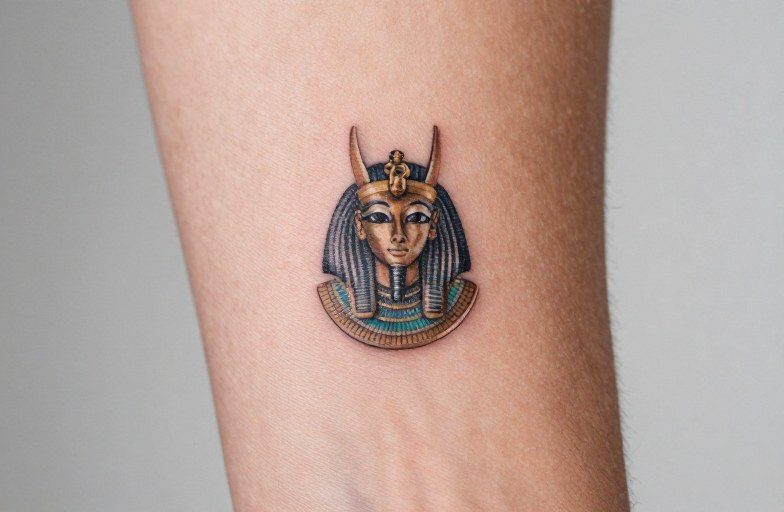
- Minimalist line profiles: Nefertiti or pharaoh silhouettes reduced to a single continuous stroke
- Hieroglyphic bands: three to four characters in a horizontal line, often placed on the forearm or sternum
Color vs. Black and Gray
Small Egyptian tattoos overwhelmingly stay black. Gold ink exists but fades to mustard yellow within two years. Lapis blue for the Eye of Horus can work if saturated heavily, yet in small sizes it often heals patchy. The exception: a single dot or line of red in an ankh, representing the lifeblood concept, effective when minimal, garish when overdone.
How to Personalize It
Personalization with Egyptian tattoos usually fails when people force it. Adding a birthdate in Roman numerals next to a hieroglyph looks pasted-on. Better approaches integrate the personal element into the Egyptian visual system itself. Your name in actual hieroglyphic phonetic characters, for example, or your astrological sign mapped to the corresponding Egyptian decan.
Meaningful Integration
- Hieroglyphic spelling: your name or a short word rendered in authentic Middle Egyptian signs
- Decan star map: the Egyptian constellation corresponding to your birth period, often linked to specific protective deities
- Protective deity: Bastet for home, Sekhmet for strength, Thoth for writing, choose based on actual attributes, not just appearance
- Cartouche frame: an oval enclosing your chosen symbols, traditionally reserved for royal names
Avoiding Generic Mashups
The ankh with wings, the Eye of Horus inside a dreamcatcher, these combinations dilute both traditions. If you want Egyptian, commit to Egyptian. If you want to honor multiple heritages, separate them into distinct pieces or find a genuinely integrated concept, not a Pinterest overlay. A skilled artist can weave a lotus into a geometric pattern that references both Egyptian and Art Deco influences, for instance, without either feeling like an afterthought.
Standout Design Ideas
Certain small Egyptian tattoos distinguish themselves through unusual placement or unexpected detail. A scarab rendered from above, showing the full wing casing rather than the side profile, transforms a common image into something architectural. The shen ring, a loop of rope symbolizing eternal protection, works beautifully as a finger or toe ring tattoo, its circular form fitting the anatomy naturally.
Underutilized Motifs
- The was scepter: a stylized animal-headed staff, surprisingly elegant at one inch on the wrist
- Tyet knot: Isis’s protective knot, less common than the ankh but similarly compact
- Ba bird: the human-headed bird representing the soul, haunting and distinctive in profile
- Uraeus cobra: the rearing cobra worn on royal headdresses, striking as a standalone finger piece
Detail Preservation Techniques
For complex small pieces, ask your artist about double-pass lining or a slightly heavier initial line weight that settles to your desired thinness. The teardrop of the Eye of Horus, the antennae of a scarab, the crossbar of an ankh, these elements need explicit protection in the stencil and during healing. Some artists now use white ink highlights on black healed Egyptian tattoos to restore definition after a few years, though this requires an experienced hand.
Tips for Choosing
Start with the symbol’s function, not its aesthetic. The ankh means life, yes, but specifically eternal life through the gods’ favor. The Eye of Horus is restoration and wholeness, often linked to the myth of Osiris’s reassembly. Understanding this grounds your choice in something beyond visual preference. For a broader look at how symbolic weight works across tattoo styles, small tattoos for men with real meaning is worth a read before committing. From there, consider your pain tolerance and lifestyle. Finger tattoos of hieroglyphs look sharp but fade fast; the ribcage preserves detail but hurts significantly more.
Artist Selection
- Look for portfolios with small blackwork that healed well, not just fresh photos
- Ask specifically about their experience with Egyptian line consistency, hieroglyphs require even stroke weight
- Avoid artists who freehand Egyptian symbols; the proportions are too specific
- Request a healed photo of a similar-sized piece from their portfolio
Research Before Committing
Many hieroglyphic tattoos contain errors. The owl sign (M) placed backward, the seated man (A) used as a decorative fill, the ankh drawn with unequal arms, these mistakes persist because clients trust stencils uncritically. Cross-reference your chosen symbols against academic sources or ask an Egyptologist on social media. The effort takes an hour and prevents permanent embarrassment.
Size & Scale
The practical minimum for most Egyptian symbols is about one inch in their longest dimension. Below that, the ankh’s loop and cross become indistinguishable from a generic cross. The Eye of Horus needs roughly 1.5 inches to retain all six components. Scarabs can compress smaller if viewed from above, but side-profile scarabs need the full body, legs, and wing casing, minimum 1.25 inches.
Scaling by Placement
- Finger: stick to simple hieroglyphs, the ankh, or the tyet knot; avoid the Eye of Horus
- Wrist/inner forearm: ideal for 1.5 to 2-inch pieces with moderate detail. More placement options are covered in this guide to small forearm tattoos for men.
- Behind ear: the shen ring or a small profile works; anything with internal detail fails
- Ankle/collarbone: 2-inch maximum for comfort during healing; these spots swell and move
- Rib/side: can accommodate larger small pieces, but breathing distorts the stencil, choose simpler designs
Longevity Expectations
Small tattoos age through ink spread and sun exposure. Egyptian blackwork holds up better than color but still blurs. Expect to need a refresh at five to eight years for finger pieces, ten to fifteen for protected areas like the upper arm or thigh. The crispness of hieroglyphic lines makes them particularly vulnerable; the difference between a clear water sign and a smudged blob is often two years of unprotected sun.
Final Word
Small Egyptian tattoos reward the prepared. The symbols carry weight because they have carried weight for millennia, not because of mystique, but because of precise, repeated use in a culture that treated images as functional tools. Respect that precision in your choice: accurate proportions, appropriate scale, placement that protects the detail. A half-inch ankh behind your ear can be perfect if it is clean. A sprawling inaccurate Eye of Horus on your forearm fails regardless of size. The best small Egyptian tattoos look like they could have been stamped onto papyrus, immediate, legible, and deliberately placed.
Frequently Asked Questions
Do Egyptian finger tattoos fade faster than other placements?
Yes, significantly. Finger skin regenerates rapidly and experiences constant friction. Even solid black hieroglyphs soften within two to three years. Plan for touch-ups or choose a less high-wear spot if longevity matters to you.
Can I get my name translated into hieroglyphics for a tattoo?
Phonetic translation is possible, but English sounds do not map perfectly to Middle Egyptian. Some letters have no equivalent. Work with a translator who understands tattoo constraints, not just academic Egyptology, to ensure the result fits spatially.
Is the Eye of Horus culturally appropriate for non-Egyptians?
Ancient Egyptian symbols are not tied to modern religious practice in the same way as living spiritual traditions. However, treating them with accuracy and respect matters. Avoid combining them with unrelated sacred imagery from other cultures.
How small can a scarab tattoo be while still looking like a scarab?
From above, with simplified wing casing, about one inch. Side profile needs 1.25 to 1.5 inches to distinguish the head, legs, and wing structure. Below these sizes, the form collapses into an unidentifiable oval.