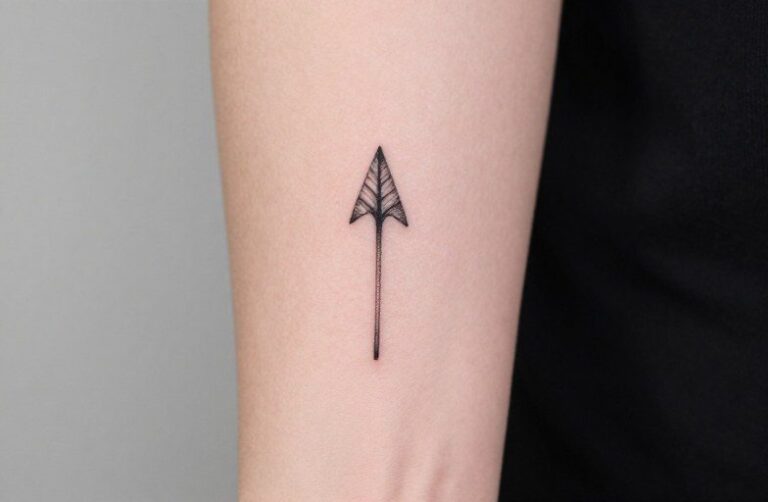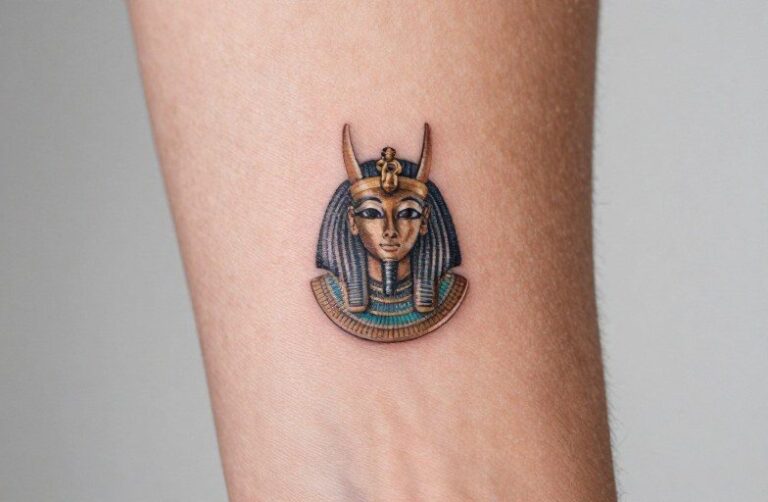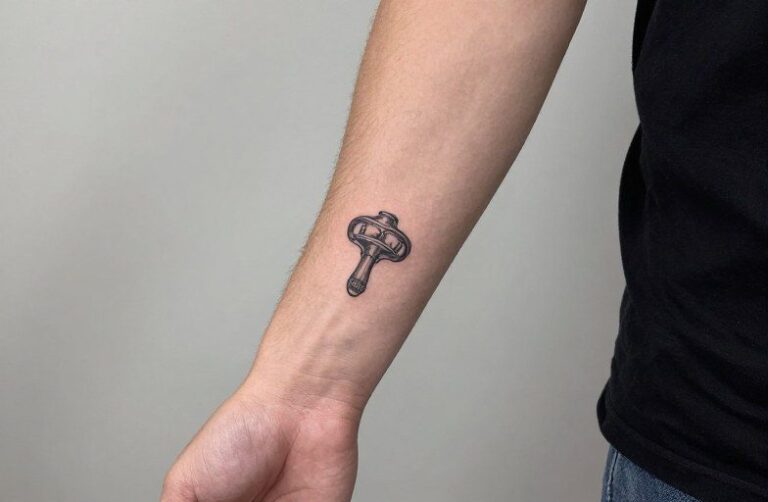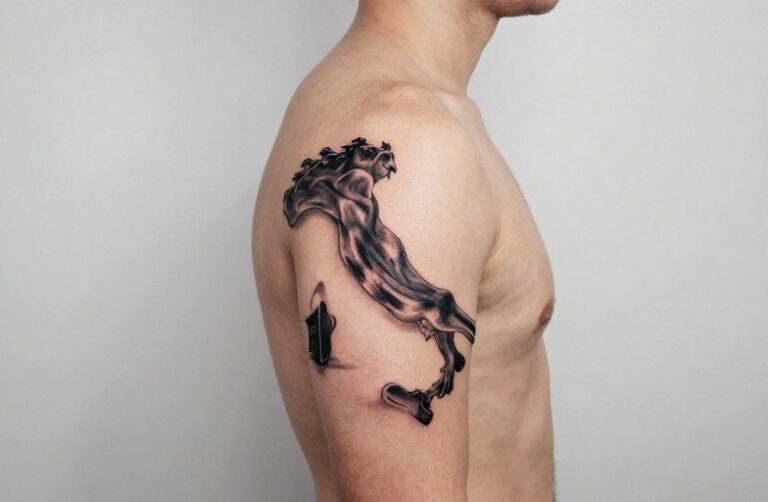
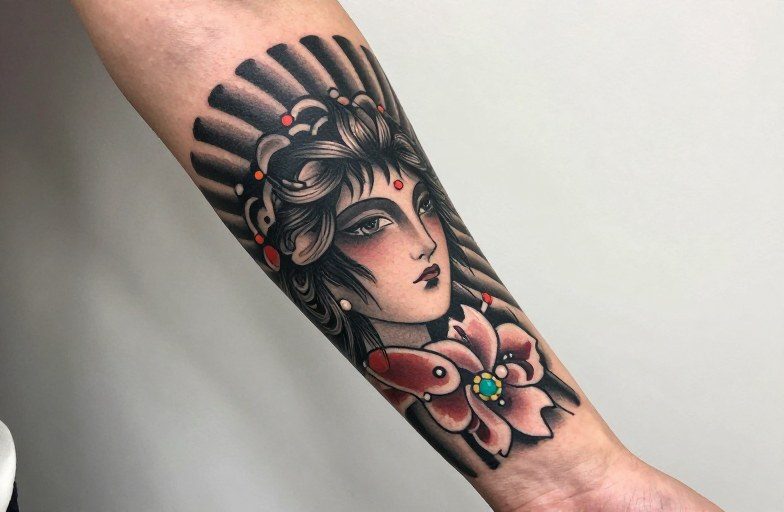
A traditional forearm tattoo follows the American or “old school” style: thick black outlines, limited but saturated color palettes, and iconic imagery like roses, anchors, swallows, daggers, and pin-up figures. The forearm’s flat, visible surface makes it ideal for this bold, readable aesthetic, designs stay legible from a distance and age with character rather than turning to mush.
Key Characteristics & Motifs
Traditional tattooing on the forearm leans into imagery that reads instantly. The style was built for sailors and soldiers who needed tattoos that held up under harsh conditions and remained recognizable decades later. That DNA still governs what works best.
Classic Imagery That Holds Up
Roses, snakes, panthers, clipper ships, eagles, and nautical stars dominate for good reason. These motifs carry established visual shorthand, strength, travel, loyalty, luck, and their bold shapes suit the traditional palette. A single rose with a banner across the forearm reads clearly at twenty feet. A photorealistic portrait of the same rose, by contrast, softens and blurs within five to ten years on this high-movement, sun-exposed placement.
- Bold black outlines: Typically 5-7RL or 9RL needles, creating lines that stay distinct even as color fades
- Limited color palette: Red, yellow, green, blue, and black, no gradients, no subtle transitions
- Flat shading: “Whip shading” or solid fills, never smooth gray-wash transitions
- No negative space tricks: Skin tone serves as the only “light” color; highlights are carved out, not airbrushed
Forearm-Specific Design Considerations
The forearm’s cylindrical shape rewards certain layouts. Wraparound designs, snakes coiling the wrist, banners circling the arm, use the anatomy rather than fighting it. Flat compositions, like a ship in a bottle or a dagger through a heart, sit best on the inner or outer flat planes where they won’t distort when the arm rotates. The wrist-to-elbow flow matters: a design that starts too close to the wrist bone can creep onto the hand as aging skin shifts, while elbow-proximate work must account for the joint’s movement and thicker skin texture.
Origins & History
The traditional style’s roots are often linked to 19th-century maritime culture, with sailors returning from Pacific voyages bearing Polynesian-influenced markings. By the early 1900s, American tattooers like Samuel O’Reilly (who patented the electric tattoo machine in 1891) and later Bert Grimm, Sailor Jerry, and Don Ed Hardy codified the visual language we recognize today. The forearm became a natural canvas, visible enough to display, easy enough to cover with a sleeve.
Some trace the style’s color limitations to practical constraints: early inks were chemically simple, and bold pigments held better in skin than subtle mixes. The limited palette became aesthetic preference rather than mere necessity. Military service members in WWII and Korea spread the style globally, with forearm tattoos marking unit affiliation, deployment records, or protective talismans. The imagery carried communal meaning, swallows for nautical miles traveled, pigs and roosters for survival at sea, though individual wearers always layered personal significance atop these conventions.
Cost & Sessions
Pricing varies by geography and artist reputation, but traditional forearm work follows predictable patterns. A palm-sized piece (roughly 4×5 inches) on the outer forearm typically runs $300-600 in most US markets. A full forearm sleeve in traditional style, dense coverage from wrist to elbow, can demand 15-25 hours across multiple sessions, totaling $1,500-4,000.
Session Breakdown
Traditional tattooing’s bold approach actually speeds the process compared to realism or fine-line work. Large areas of solid color fill quickly. A skilled artist can knock out a substantial inner-forearm piece in a single 3-4 hour session. The trade-off: these sessions hurt more. Saturated color packing requires multiple passes over the same area, and the forearm’s radial nerve proximity (especially on the inner surface) makes this intense.
- Small single motif: 1-2 hours, one session
- Half-forearm composition: 2-4 hours, potentially one session
- Full sleeve: 4-6 sessions of 3-4 hours, spaced 3-4 weeks apart
Tip density affects cost too. A design with heavy black fills requires less needle change than one with five separate colors, but the color-heavy piece may take longer to execute. Discuss this with your artist when budgeting.
Linework & Technique
The traditional style’s longevity depends on its technical foundations. Lines must be solid, consistent, and deposited at the correct depth, too shallow and they fade within months; too deep and they blow out, creating fuzzy edges that destroy the crisp aesthetic.
Needle Groupings and Their Roles
Traditional artists typically rely on round liners for outlines and round shaders or magnums for color packing. A 14RL might outline a thick banner border, while a 7RS fills the red field inside. The forearm’s skin varies in thickness: the outer surface (extensor side) takes ink more predictably, while the inner surface (flexor side) is thinner, more sensitive, and prone to overworking. Experienced artists adjust their hand speed and voltage accordingly.
Line weight variation creates visual hierarchy without shading complexity. A dagger’s primary outline might be 9RL, its decorative filigree 5RL, and the blade’s edge a single confident 7RL pass. This hierarchy survives aging better than fine-line work because the differential remains legible even as the thinnest lines soften slightly.
Color Aging on the Forearm
Forearm tattoos age harder than most placements. Sun exposure, frequent washing, and constant movement accelerate fading. Traditional pigments, particularly cadmium reds and yellows, are more lightfast than many modern alternatives, but they still shift. Reds tend to hold best. Blues and greens can muddy toward gray. Black stays black, which is why the style’s heavy outline dependency preserves readability decades later. A well-executed traditional piece looks “vintage” rather than “ruined” at year fifteen.
Choosing the Right Artist
Not every tattooer who “can do traditional” should. The style requires specific technical habits: confident line drawing without excessive wiping (which overworks skin), understanding of color theory within a restricted palette, and willingness to let boldness trump detail.
What to Look For in a Portfolio
Examine healed photos, not just fresh work. Crisp lines on day one mean nothing if they’re blown out by month six. Look for consistent line weight, solid color saturation without patchiness, and designs that read clearly at thumbnail size, the forearm’s visibility demands this. Be wary of portfolios heavy on “traditional-inspired” work that sneaks in gradients, realistic shading, or excessive detail; these departures often signal discomfort with the style’s constraints.
Geographic clusters of strong traditional artists exist, Los Angeles, New York, Richmond, VA, and parts of the Pacific Northwest have deep benches, but exceptional practitioners work everywhere. Travel for the right fit if local options disappoint. A traditional forearm piece is too permanent and too visible to compromise on artist quality.
Aftercare Notes
Forearm aftercare presents specific challenges. The arm moves constantly, flexing the tattooed skin and disturbing the healing film. Clothing friction, from shirt sleeves, watch bands, laptop edges, irritates the area. And the forearm’s visibility makes it tempting to show off before healing completes.
Healing Timeline and Protection
The first 3-4 days require keeping the area clean and lightly moisturized, with no soaking. By day 5-7, peeling begins; resist picking, as the forearm’s thin skin scars easily. Full settling takes 4-6 weeks, though surface healing completes sooner. During this period, long sleeves offer protection from sun and abrasion better than loose bandages, which shift and stick.
- Days 1-3: Wash gently 2-3x daily, pat dry, apply thin layer of recommended aftercare product
- Days 4-10: Peeling and itching peak; keep moisturized, avoid scratching against furniture edges
- Weeks 3-6: Color may look dull or dusty as the top layer settles; this is normal
- Ongoing: SPF 30+ whenever exposed; sun damage is the primary cause of premature aging in traditional color work
Heavy color packing can weep more than fine-line work; change any protective wrapping if it becomes saturated. The forearm’s accessibility makes over-application of aftercare products common, use less than you think, more frequently, rather than glopping it on.
Before You Decide
A traditional forearm tattoo commits you to a visible aesthetic with strong cultural associations. The style reads as intentional, not trendy, this is its strength and its limitation. Consider your professional environment, though forearm visibility has become broadly accepted in most fields. Consider, too, whether you want single pieces or eventual sleeve continuity; traditional style accommodates both, but random placement of mismatched motifs without planning can look accidental rather than collected.
The forearm offers an ideal proving ground for traditional tattooing’s enduring appeal: bold enough to satisfy, practical enough to heal, readable enough to last. Choose imagery that resonates beyond mere aesthetics, find an artist whose healed work convinces you, and commit to the aftercare. The result, done right, improves with age rather than merely surviving it.
Frequently Asked Questions
How well do traditional forearm tattoos hold up over time compared to other styles?
Traditional tattoos age exceptionally well on the forearm because their heavy black outlines and saturated color blocks remain readable even as fine details blur. While sun exposure and movement cause some fading, the style’s bold fundamentals prevent the muddy, indistinct aging common in realism or fine-line work.
Can I get a traditional forearm tattoo if I need to cover it for work?
Yes, though the forearm’s visibility requires planning. Long sleeves cover outer forearm pieces completely. Inner forearm work is more concealable in short sleeves but visible when arms are raised. Consider placement relative to your typical work attire and whether occasional visibility is acceptable.
What’s the difference between American traditional and neo-traditional forearm tattoos?
American traditional sticks to the classic rules: limited palette, bold outlines, flat shading, iconic imagery. Neo-traditional expands the color range, allows more detail and dimensionality, and incorporates more varied subject matter while keeping some traditional structure. The forearm suits both, but purists prefer the original for its longevity.
How painful is getting a traditional forearm tattoo compared to other placements?
The outer forearm rates moderate on the pain scale, fleshy and tolerable. The inner forearm, near the wrist and elbow creases, hurts significantly more due to nerve proximity and thinner skin. Traditional style’s color packing requires repeated passes, intensifying sensation compared to lighter shading techniques.