Stomach tattoos sit at the crossroads of commitment and canvas. The skin here stretches, folds, and shifts more than almost anywhere else on the body, which makes placement strategy matter as much as the image itself. Done well, a stomach piece commands attention, frames the torso, and moves with you in ways that arm or back tattoos simply can’t replicate. Done poorly, it warps, fades unevenly, or fights the body’s natural lines. This guide covers what actually works on this terrain, styles that hold up, placements that age gracefully, and the design decisions that separate striking stomach ink from regrettable experiments.
Popular Styles
Not every style translates to stomach skin. The area’s constant motion and varying thickness demand approaches that either embrace distortion or strategically avoid it.
Traditional and Neo-Traditional
Bold lines and limited color palettes hold up remarkably well here. Traditional Japanese work, think koi, dragons, or phoenixes, has filled stomach panels for centuries precisely because the heavy outlines and saturated pigments resist the blurring that softer styles suffer. Neo-traditional builds on that backbone with more color variation while keeping the line weight strong enough to stay readable as the skin ages.
Blackwork and Ornamental
Large-scale geometric patterns, mandala derivatives, and dense black fills dominate modern stomach tattooing for good reason. These styles don’t depend on fine detail that disappears into stretch marks or weight fluctuation. A solid black ornamental piece centered below the sternum or wrapping the sides ages into a softer, still-coherent image rather than a muddy mess. The trade-off: blackwork shows every needle inconsistency, so artist selection matters enormously.
- Realism: Portraits and photorealistic imagery struggle here. Subtle shading shifts blur faster on stomach skin than on flatter, more stable areas like the chest or thigh.
- Fineline: Single-needle work and hair-thin lines generally don’t survive five years without significant spread. Exception: small pieces placed above the navel where skin movement is minimal.
- Watercolor: The style’s reliance on diffuse edges and minimal outlining makes it particularly vulnerable to stomach-specific distortion.
Tips for Choosing
Stomach skin behaves differently depending on your body, your history, and your future plans. Design choices need to account for reality, not just Instagram aesthetics.
Accounting for Body Changes
Pregnancy, weight fluctuation, and aging all reshape stomach skin dramatically. Designs with rigid symmetry, perfect circles, straight lines, mirrored halves, show distortion most obviously. Organic, flowing shapes with built-in asymmetry hide change better. A coiled snake or trailing vine adapts to skin shifts where a geometric clock face would look increasingly off-kilter.
Line Weight and Spacing
Lines need to be thick enough to stay distinct but not so heavy they blur together. For most stomach work, minimum line weight of 3-5 needles (roughly 0.35-0.5mm) provides reasonable longevity. Negative space between elements should be generous, ink spreads over time, and cramped designs become indistinguishable blobs faster here than on the forearm or calf.
- Plan for touch-ups; stomach tattoos typically need refreshing at 7-12 years depending on size, color, and your skin type.
- Consider future surgical scars, appendix removal, hernia repair, C-sections, when placing designs.
- Dark skin tones: high-contrast designs (black with white highlights, not pastel washes) maintain visibility longest.
Best Placements
The stomach isn’t one uniform surface. Different zones offer different advantages, limitations, and pain profiles.
Central and Upper Stomach
The area between the sternum and navel provides the most stable canvas. Skin here moves less with breathing and posture changes than lower regions. Centered pieces, medallions, animals facing forward, symmetrical mandalas, work naturally. The upper stomach also offers the cleanest transition point for chest pieces that extend downward or full torso work that connects stomach to ribs.
Side and Lower Stomach
The flanks and area below the navel accommodate longer, vertical compositions that follow the body’s lines. Japanese bodysuit traditions often place waterfall scenes, bamboo, or descending figures here. The iliac crest (hip bone) anchors designs that wrap toward the back or thigh. Pain increases significantly closer to the hip bones and pubic area, and healing requires more careful movement management.
- Full stomach panels: Connecting both sides across the center creates the most cohesive large-scale work but requires multiple sessions and significant commitment.
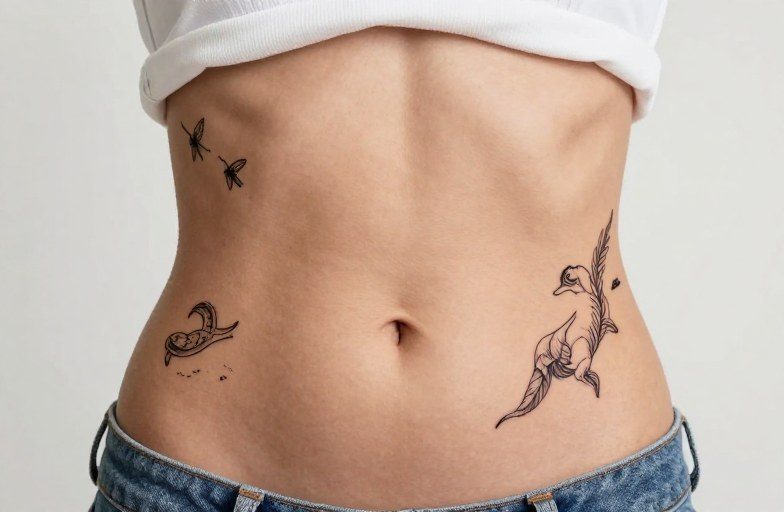
- Small accent pieces: Single images placed off-center (side of navel, hip bone) work for first-timers testing the placement.
- Around the navel: Ring or sunburst designs centered on the navel itself are classic but challenging, the raised skin texture and constant friction from clothing complicate healing.
Standout Design Ideas
Certain motifs have proven themselves on stomach skin across decades of tattooing. These aren’t trend-chasing choices; they’re approaches that solve the placement’s specific problems.
Creatures with natural curves: Snakes, eels, and dragons follow the body’s contours without fighting them. A snake coiling across the stomach from hip to rib cage moves with the body rather than against it. The form implies motion already, so skin stretch reads as intentional dynamism.
Botanical and organic matter: Wisteria, peonies, and trailing vines accommodate asymmetry and natural flow. Japanese peony work often fills stomach panels specifically because the flower’s layered petals maintain structure even when skin shifts. Leaves and stems can extend toward the ribs or hips without requiring rigid framing.
Masks and faces: Tengu masks, Hannya, or animal faces centered on the upper stomach create focal points that draw the eye. The sternum-to-navel zone functions like a natural frame. These designs demand strong symmetry, so they’re best suited to people with stable weight and no plans for pregnancy.
- Script and lettering: generally poor choice for stomachs. Text requires consistent baseline alignment that skin movement disrupts. Small exceptions: vertical phrases along the side, large single words as graphic elements rather than readable sentences.
- Scar cover-up: stomach tattoos excel at integrating surgical or stretch marks into imagery. The right design doesn’t just cover but redirects the eye through the composition.
Trending Variations
Contemporary stomach tattooing has moved toward specific approaches that solve old problems with new techniques.
Ornamental and Sacred Geometry
Dotwork mandalas, lace patterns, and geometric frameworks have surged in popularity for stomach placement. The precision possible with modern machines allows patterns that would have blurred instantly a decade ago. These designs often incorporate the body’s center line as a structural element rather than ignoring it. The trend toward larger, single-session pieces (4-6 hours) reflects improved numbing options and client endurance.
Mixed Media Approaches
Combining blackwork sections with limited color accents, or integrating ornamental frames around central figurative elements, creates hierarchy that guides the eye. A black geometric border containing a single colored creature or flower provides both longevity (the frame) and visual interest (the focal point). This solves the problem of all-blackwork pieces reading as flat or all-color pieces aging poorly.
- UV and white ink: generally avoid on stomach. These fade fastest on high-movement areas and often heal inconsistently.
- Minimalist single-line: extremely vulnerable to distortion; occasional success with tiny placements above the navel only.
How to Personalize It
Customization on the stomach requires working with the body’s architecture, not imposing arbitrary preferences.
Start with your existing tattoos or planned future work. A stomach piece that ignores surrounding ink creates visual isolation; one that flows into rib, chest, or hip work extends a coherent narrative across the torso. Even standalone pieces benefit from considering how they’d connect to hypothetical future additions.
Your pain tolerance and session capacity shape what’s possible. A full stomach panel might require six to eight hours of tattooing, realistically split across multiple sessions. Designing for shorter sessions (3-4 hours) means breaking the composition into coherent sections that stand alone while contributing to a larger whole.
- Reference your own movement: bend, twist, and breathe in front of a mirror. Notice where skin folds and stretches. Place critical detail away from high-motion zones.
- Consider your typical clothing: waistbands, belt lines, and fitted shirts interact differently with high vs. low stomach placement.
- Collaborate with artists who show healed stomach work in their portfolio, not just fresh photos. Fresh tattoos look sharper; healed work reveals actual skill.
What to Remember
Stomach tattoos demand more planning than most placements but reward that investment with unmatched visual presence. The skin here will change, that’s not a flaw to work around but a variable to design for. Choose styles with structural integrity: bold lines, coherent negative space, forms that accommodate gentle distortion. Place with intention regarding your body today and its likely trajectories. Select artists based on healed results in their portfolio, not fresh photography. And commit to the aftercare reality: stomach tattoos heal slower than arm or leg work because of constant movement, friction from clothing, and the difficulty of keeping the area clean and undisturbed. The stomach remains one of tattooing’s most powerful canvases for those who respect its specific demands.
Frequently Asked Questions
How painful is a stomach tattoo compared to other placements?
The stomach ranks among the more painful areas, especially near the sternum, navel, and hip bones where skin is thin over bone or sensitive nerve clusters. The lower stomach and sides are moderate, while the upper stomach below the sternum is generally most tolerable. Pain varies significantly by individual body composition.
Will a stomach tattoo stretch if I gain weight or get pregnant?
Some distortion is inevitable with significant skin stretching. Designs with organic, flowing shapes and built-in asymmetry handle this better than rigid geometric or perfectly symmetrical pieces. Many people successfully carry stomach tattoos through pregnancy, though touch-ups are commonly needed afterward.
How long does a stomach tattoo take to heal?
Surface healing typically takes 2-3 weeks, but full settling of the ink and complete skin recovery often extends to 6-8 weeks. The constant movement of breathing, bending, and torso rotation makes stomach tattoos slower to heal than more stable areas like the forearm or calf.
Can you tattoo over stretch marks on the stomach?
Yes, though healed stretch marks accept ink differently than surrounding skin, they may hold pigment more densely or resist it slightly. Experienced artists can work with this texture variation, often incorporating it into the design rather than fighting it. Fresh, red stretch marks need to fully mature (typically 6-12 months) before tattooing.