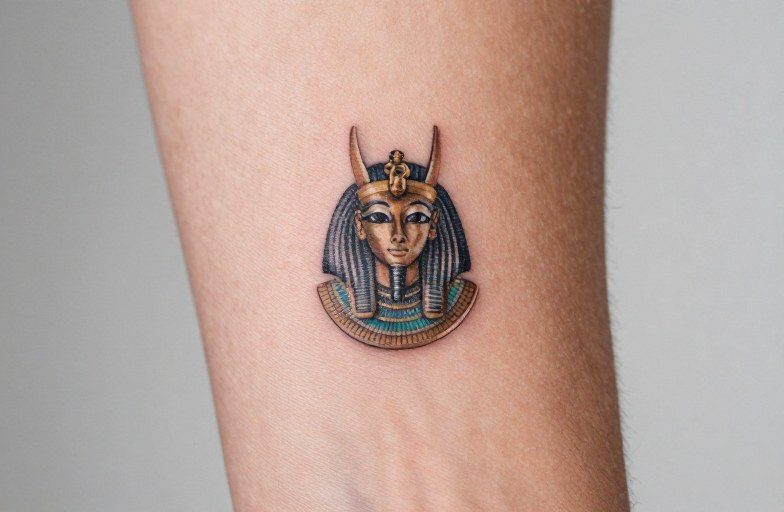
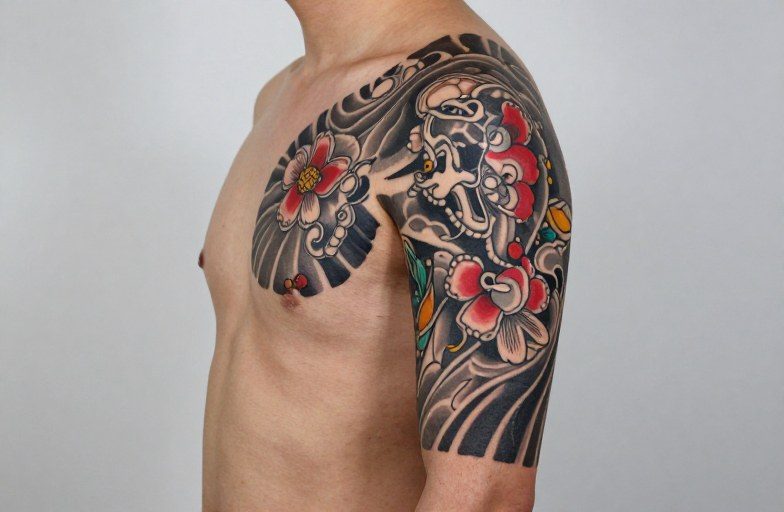
Traditional tattoo design carries a visual language built for longevity. Thick black outlines, saturated color fields, and readable imagery at a distance, these aren’t stylistic choices so much as engineering decisions. The style evolved to stay legible on skin that ages, tans, and stretches. What reads as “retro” now was originally practical: limited colors meant fewer variables for inconsistent ink supplies, bold lines held up under hands that hadn’t yet mastered single-needle subtlety. Today’s traditional work honors that functional DNA while opening into personal territory the original sailors and soldiers never imagined.
Color Choices
The traditional palette is deliberately narrow, and that constraint is where its power lives.
The Classic Palette
Red, yellow, green, blue, black. That’s the core. These pigments were historically stable and available, cadmium reds, ochre yellows, verdigris greens, Prussian blues. Modern formulations are safer and more consistent, but the range hasn’t expanded much in practice. Skin tone matters enormously here. On darker skin, yellow and green can shift toward brown or disappear entirely without strong black anchoring. Red holds remarkably across complexions. Blue sometimes heals toward purple or gray depending on the specific pigment batch. A skilled artist tests how these read on your particular skin rather than working from a generic chart.
Black and Gray Variations
Blackwork traditional has surged in recent years. Same bold outlines, same imagery, but all values rendered through black ink density, whip shading for gradients, solid fills for darkness. This approach eliminates color-shift anxiety entirely. It also ages with exceptional clarity. The tradeoff: less immediate visual pop, more reliance on composition and negative space to create interest. Some artists specialize in this; others consider it a separate discipline requiring different technical habits.
How to Personalize It
Traditional’s recognizable vocabulary doesn’t mean cookie-cutter results. The framework is rigid; the content is flexible.
Subject Matter Twists
Swallows remain common, but a swallow carrying a specific flower, or rendered with regional wing proportions, shifts generic to particular. Daggers through roses can be replaced by daggers through objects that carry private significance, books, musical instruments, hometown landmarks simplified to readable icons. The traditional format demands simplification, which paradoxically forces clarity: you must know what matters enough to keep when detail gets stripped away.
Lettering and Banner Integration
Scrollwork banners with names, dates, or phrases anchor many traditional pieces. Font choice within the style is narrower than you might expect, heavily slanted serifs, sometimes Gothic blackletter variants. The banner’s curve must follow body contours or fight them deliberately; flat application looks pasted-on. Spacing matters: too many words, and the lettering compresses below readable size within a few years.
Popular Styles
“Traditional” covers more territory than the single term suggests.
- American Traditional: The baseline. Heavy linework, limited palette, nautical and military imagery, often linked to Sailor Jerry and the WWII-era Honolulu scene. Eagles, pin-ups, clipper ships, hearts with Mom.
- Japanese Traditional (Irezumi): Distinct lineage with some crossover influence on Western traditional. Dragons, koi, cherry blossoms, wind bars. Uses more color gradation and background fill, but shares the commitment to bold readability.
- Neo-Traditional: Expands the color range, softens outlines slightly, allows more illustrative detail and naturalistic shading. Still recognizable as cousin to the original. Flowers, animals, and female portraits dominate.
- Traditional Americana with Modern Subjects: Same technical rules, contemporary imagery, video game characters, modern brand logos rendered as flash art, political iconography.
Each variant demands different artist specialization. Someone excellent at American Traditional may struggle with neo-traditional color blending; the tool choices and hand speed differ significantly.
Best Placements
Traditional design was built for the body as it actually moves and ages.
High-Visibility Classics
Forearms, upper arms, calves, chest panels. These areas offer flat or gently curved surfaces where bold imagery reads without distortion. The outer forearm in particular became iconic because it was always visible, easy to show and easy to hide with a long sleeve. Traditional chest pieces often center on the sternum with symmetrical flanking elements, eagles with spread wings, ships with mirrored scrollwork.
Challenging but Rewarding
Hands, necks, throats. Skin here is thinner, moves constantly, and sheds faster. Traditional’s heavy outlines help compensate, but detail still blurs faster than on the upper arm. Finger tattoos in traditional style exist but require touch-up commitment; the side of the hand (between thumb and index) holds slightly better. Throat work demands exceptional technical precision, the skin’s thinness and vascularity make consistent saturation difficult.
Stomach and ribs present their own problems: stretching with weight fluctuation, compression when sitting, expansion when standing. A traditional ship on a stomach can look magnificent standing, distorted seated. Artists experienced with these placements design specifically for the distortion, not despite it.
Standout Design Ideas
Specific combinations that transcend the flash-sheet generic.
- Broken hourglass with traditional roses: Memento mori imagery rendered in period-appropriate technique. The glass shards allow creative negative space.
- Two-headed traditional eagle: Unusual symmetry, often holding contrasting banners in each beak. Demands a broad, flat placement.
- Traditional lighthouse with visible beam: The beam requires careful whip-shading or negative space management to read as light rather than solid color.
- Snake and dagger with specific regional snake: Copperhead versus coral snake versus rattlesnake, each carries different patterning that must simplify to traditional readability.
- Traditional coffin with living contents: Flowers growing from within, or a hand emerging. The contrast of death imagery with vitality is an old traditional trope worth updating.
These succeed when the artist understands why the original vocabulary developed, not just how to copy it.
Matching & Pairing Ideas
Traditional pieces relate to each other through formal rules more than thematic ones.
Complementary Opposites
Life and death imagery paired on symmetrical placements, ship on one forearm, anchor on the other. Eagle on left chest, snake on right. The visual weight should balance; the content can contrast. This approach builds a coherent body over time rather than collecting disconnected pieces.
Sleeve Construction
Traditional sleeves require planning gaps. Unlike Japanese work, which often fills continuously, traditional sleeves historically left skin showing between major pieces. The negative space becomes part of the design. Modern collectors sometimes fill these gaps with smaller “filler” pieces, stars, dots, small flowers, but purists maintain the breathing room. Either choice works; mixing them without intention looks accidental.
Couples or friends seeking matching traditional work should avoid identical pieces. Same subject, different composition; or complementary subjects (lock and key, compass and anchor) rendered by the same artist in the same session. Identical matching tattoos in traditional style read as novelty rather than commitment.
Final Word
Traditional tattoo design offers a paradox: the most rule-bound style allows the most confident personal expression because the rules do the heavy lifting. You don’t need to reinvent visual language; you need to choose your words within it carefully. The best traditional work I’ve encountered wasn’t the most technically perfect, it was the most specific. A sailor’s swallow with a particular harbor’s coordinates in the banner. A dagger through a rose that matched the variety growing in the wearer’s childhood garden. The bold lines and saturated colors will do their job of staying readable for decades. Your job is deciding what deserves that permanence.
Find artists who specialize in this work specifically, not as one option among many. Traditional demands different needle groupings, different hand speed, different healing expectations. The consultation should include discussion of how your chosen colors behave on your skin, how the placement will age with your particular movement patterns, and how the design scales to the space available. The style’s longevity is earned through technical discipline at every stage.
Frequently Asked Questions
How do traditional tattoos age compared to other styles?
Bold black outlines and saturated color fields hold up exceptionally well because the design doesn’t depend on fine detail that blurs over time. The heavy linework acts as a fence keeping color in place, and the limited palette means less variation in how different pigments fade.
Can dark skin tones pull off traditional color work?
Absolutely, but color choice and black anchoring become more critical. Red and dark blue generally hold well; yellow and light green need stronger black outlines to remain visible. An experienced artist tests pigment behavior on your specific skin rather than applying generic rules.
What’s the difference between American Traditional and Neo-Traditional?
American Traditional sticks to the historical palette, heavy outlines, and simplified imagery. Neo-Traditional loosens the color range, allows softer edges and more illustrative detail, and often features more naturalistic subjects like detailed animal portraits or ornate floral work.
How much should a traditional sleeve cost and how long does it take?
Traditional sleeves typically require 15-30 hours depending on size, gap strategy, and detail level. At standard rates, this ranges widely by region and artist reputation, budget for multiple sessions spaced 4-6 weeks apart for healing. The planning consultation is often separate from tattooing time.