Religious tattoos occupy complicated territory. They carry genuine weight for believers, function as cultural identifiers, and get chosen by people outside those traditions for aesthetic reasons alone. That tension shapes everything about how these designs age, how they’re read by others, and what actually works on skin versus what looks powerful in a sketchbook. The goal is to understand the technical and symbolic decisions that separate a religious tattoo you’ll still respect in fifteen years from one that starts looking questionable once the swelling goes down.
Choosing With Intention
Placement and Visibility
Religious imagery carries social consequences that floral sleeves or animal portraits typically don’t. A visible crucifix on the throat or a full Shiva face on the hand will be read by employers, family members, and strangers in ways you cannot control. That is not an argument against bold placement. It is a reason to decide consciously rather than spontaneously. Inner bicep, upper back, and ribs keep the option of revealing or concealing. Forearms, hands, and neck commit you to the conversation every day.
Skin movement matters too. Designs with fine facial features or small text placed over joints will distort. A Madonna’s face on the elbow crease, a prayer wrapping around a wrist, ink shifts there, lines spread, and what read as serene expressions can become unsettling. Chest placements over the sternum hold detail well but hurt significantly; the pectoral flat planes preserve geometry better than the belly’s softer tissue.
Related reading: religious tattoo designs | Christian tattoo ideas | symbolic tattoo ideas | eye of Horus tattoo design
Symbol Accuracy
Getting the details right isn’t pedantic when the symbol carries actual religious significance. Buddhist mandalas have specific directional elements. Hindu deities hold particular objects in particular hands. Christian iconography follows established conventions: St. Peter’s keys, Mary’s colors, the wounds of Christ. A quick image search rarely captures these accurately. If the tradition matters to you, reference legitimate sources: actual temple art, approved iconographic guides, or consultation with someone knowledgeable. If the tradition doesn’t matter to you and you’re choosing purely for visual impact, understand that inaccuracy will be obvious to those who do know, and that misreading can range from embarrassing to genuinely offensive.
Designs That Endure
Architectural and Object-Based Work
Some of the strongest religious tattoos step back from literal figures. Gothic cathedral windows rendered in stained-glass color palettes, deep cobalt, blood red, gold, translate beautifully to skin and age with the structural clarity of their lead lines. Prayer beads, whether Catholic rosaries wrapping wrists or Buddhist malas circling forearms, create natural movement in the design. Incense burners, menorahs, reliquaries: objects carry meaning without demanding portraiture skill from the artist.
- Rose windows simplified to their radial geometry, not every petal
- Single candle flames with realistic glow effects against black backgrounds
- Mezuzah cases, tefillin straps, or phylactery boxes rendered at actual size
- Islamic geometric patterns derived from specific mosque tiling
Figural Work That Survives
When faces or full figures are the goal, certain approaches hold up better. Byzantine and Orthodox icon styles, flat perspectives, gold backgrounds, stylized proportions, were developed for two-dimensional devotional surfaces. They translate to tattoo more naturally than attempts at Renaissance realism. The graphic clarity of their line work and limited color palettes resist the blurring that destroys softer shading. Similarly, Buddhist thangka traditions offer established color conventions and compositional rules that guide the artist rather than leaving everything to invention.
Contemporary Approaches
Current religious tattooing has moved toward hybrid approaches that acknowledge modern contexts without abandoning tradition. The praying hands motif with modern additions, rosary beads replaced with family initials, or hands holding something personal rather than a cross, has become common enough to feel fresh only when executed with genuine technical skill. More interesting are designers incorporating architectural photography’s perspective into religious buildings, or using the visual language of scientific illustration to present sacred objects.
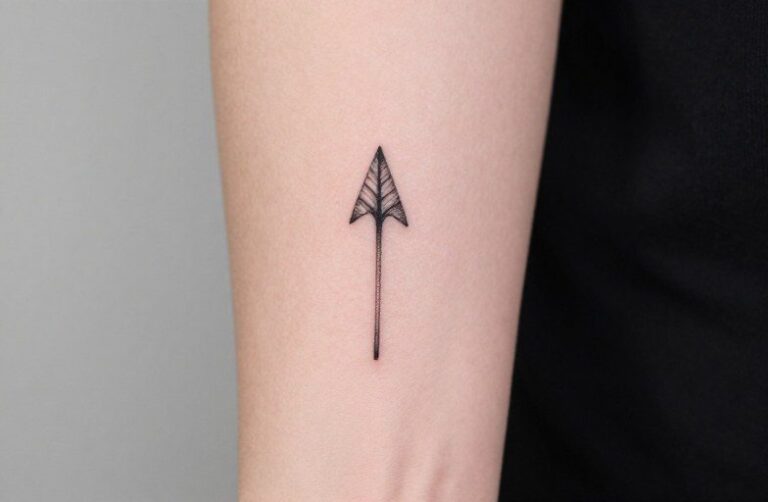
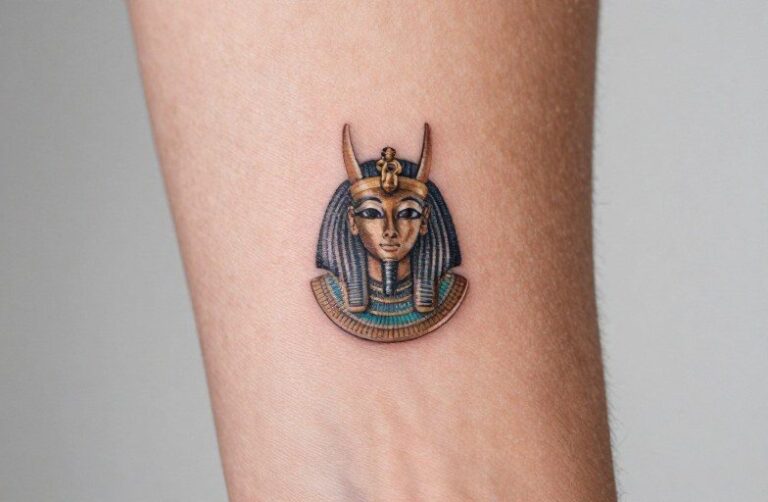
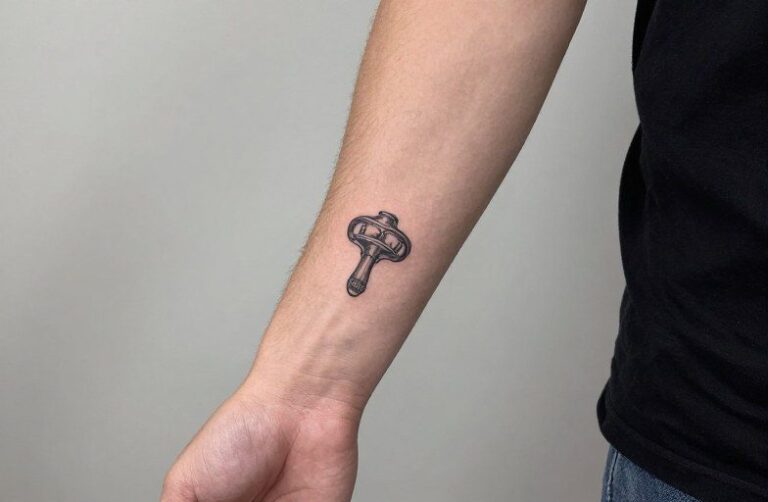
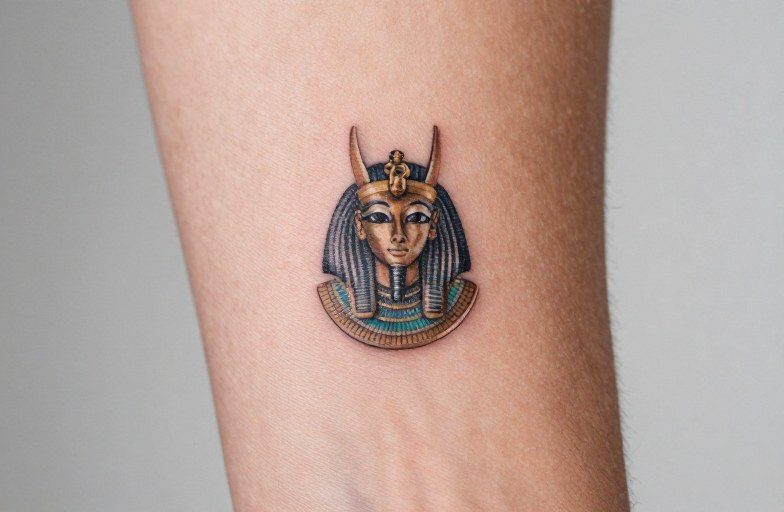
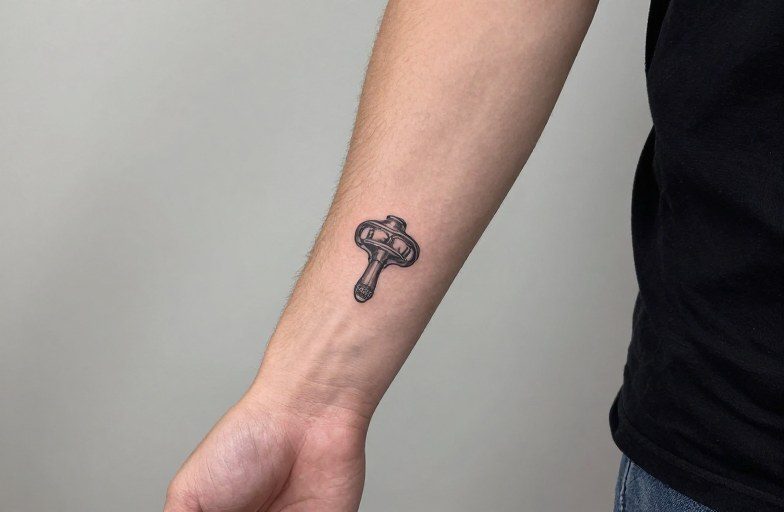
Another current approach involves negative-space techniques: the divine figure formed by the absence of ink in a blacked-out sleeve, or scripture text where the letters are skin-toned within dark fields. These require extremely confident black work and heal with less margin for error than positive-space designs. The trend toward micro-realism, tiny highly detailed religious medals, miniature scapulars, single-millimeter script, looks impressive fresh but degrades faster than slightly larger, more graphic alternatives. The line weight in micro work is so fine that even minor spread renders text illegible and faces muddy.
Style-Specific Guidance
Black and Gray Realism
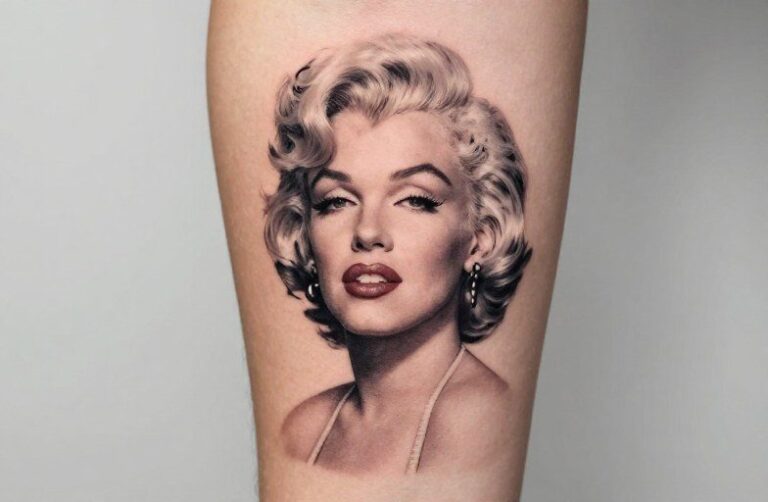
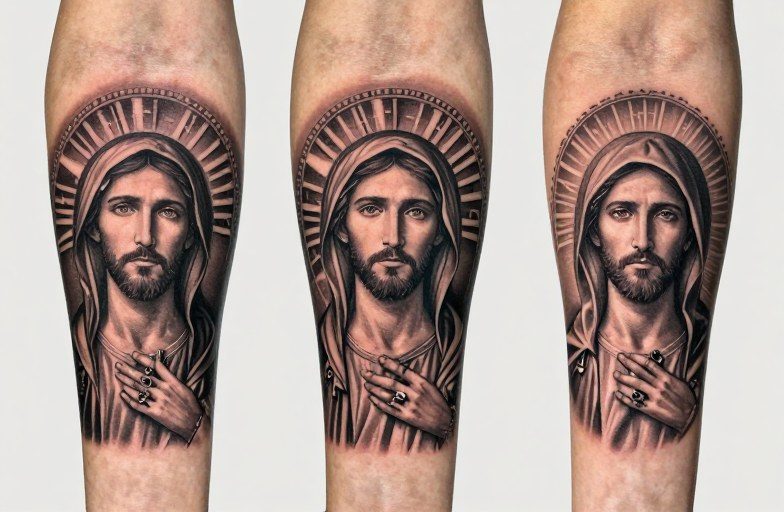
The dominant style for Christian imagery in Western shops, black and gray realism demands an artist who understands how religious subjects differ from standard portrait work. The emotional register is specific: serenity, suffering, transcendence. Generic dramatic lighting can make sacred figures look like movie stills. The best work in this style draws from actual sculpture: Bernini’s Ecstasy of Saint Teresa, Michelangelo’s Pietà, specific devotional statues with established emotional postures. The stone origin gives the tattoo natural justification for monochrome treatment and provides reference material with clear light sources.
Traditional and Neo-Traditional
American traditional’s bold lines and limited palettes suit religious imagery surprisingly well. The style’s origins include significant sailor and military religious tattooing: crosses, praying hands, banners with Christian context. Neo-traditional allows more color complexity while keeping the graphic strength that ages cleanly. These styles work particularly well for symbols rather than figures: crosses, anchors with or without explicit Christian reference, hearts with flames, angel silhouettes. The readability at distance and the way bold lines hold up over decades make these practical choices for something intended to last a lifetime.
Geometric and Ornamental
Islamic geometric patterns, often linked to aniconism in religious art, have influenced tattooing far beyond specifically Muslim clients. The interlacing, the mathematical precision, the infinite-seeming repetition, these translate to skin as sleeve fillers, back pieces, or standalone compositions. The technical demand is high: slight asymmetries in geometric work are immediately visible and cannot be hidden by artistic interpretation. Artists specializing in this style typically work with guides, stencils, and sometimes digital preparation that standard freehand tattooers don’t employ.
Making It Yours
Integrating Specific Devotional Elements
Generic crosses and generic Buddhas read as generic. Personalization comes from specificity: the particular mountain monastery you visited, not any temple; the exact medal your grandmother carried, not any saint. Dates in Roman numerals, coordinates of meaningful locations, text in the actual language of the tradition rather than translation, all of these ground the design in lived experience rather than borrowed significance. One approach that works well is pairing a primary religious image with a secondary element that narrates personal connection: the Virgin of Guadalupe with the specific flowers associated with your family’s regional devotion, or a Celtic cross with the actual knotwork pattern from your ancestral county.
Handling Text
Scripture tattoos are perennial but notoriously problematic. Small text blurs. Long passages become illegible. Translation errors in Hebrew, Greek, Arabic, or Sanskrit are common and permanently embarrassing. If text is essential, choose short phrases, single words even, and verify through multiple sources. Consider having the text form the visual element rather than sit beside it: Arabic calligraphy where the script itself becomes floral pattern, Hebrew letters forming the shape of the menorah they’re describing. This integrates language and image rather than treating text as caption.
Pairing and Complementary Imagery
Religious tattoos pair with complementary imagery in ways that either reinforce or complicate the primary meaning. Matching designs for couples or family members require particular care. Shared faith isn’t identical faith, and symbols that mean devotion to one person might read as obligation or performance to another. Natural pairings that work across many traditions include religious imagery with botanical elements: the lotus in Buddhist and Hindu contexts, the rose in Catholic devotion, the olive branch across Abrahamic traditions. These soften the declarative quality of religious symbols and allow the design to occupy space on the body with less confrontational presence.
Time-based pairings also function well: a religious symbol with an hourglass, with specific celestial phases, with architectural ruins. These introduce mortality and temporality into the eternal claims of religious imagery, a tension that thoughtful clients often want to explore. The pairing should be discussed thoroughly with your artist, not added as an afterthought. The visual weight of each element needs balance, and the composition must resolve as a single image rather than two tattoos forced together.
What to Remember
The religious tattoos that hold up over time share common qualities regardless of tradition. They respect the source material enough to get the details right, or they depart from it so completely that the reference becomes unrecognizable and therefore unaccountable. They choose placement with awareness of how visibility shapes meaning. They prioritize graphic clarity over temporary impressiveness, understanding that a slightly simplified design that reads at twenty years is preferable to a hyper-detailed one that becomes ambiguous at five.
Your relationship to the imagery, whether devout, cultural, aesthetic, or some combination, should inform the design but not be performed by it. The tattoo is not your faith. It is a permanent mark that refers to something, and the most successful examples let that reference remain legible long after the initial decision. Work with artists who have specific experience in the style you’re pursuing, not generalists who claim they can do anything. Religious imagery has conventions that take time to learn, and mistakes in this territory carry weight beyond the merely visual.
Finally, sit with the design. Religious impulse, whether genuine devotion or aesthetic attraction, can feel urgent. The traditions these images come from generally value deliberation. Honor that, even if your own connection to the tradition is indirect. The waiting period won’t diminish the image, and it might save you from a permanent mark that you cease to understand or respect.
Frequently Asked Questions
How do I know if a religious symbol is accurate enough to tattoo?
Cross-reference multiple sources: academic iconography references, official religious texts or guides, and if possible, consultation with someone actively practicing the tradition. Single image searches are unreliable. For text in Hebrew, Greek, Arabic, or Sanskrit, verify through at least three independent sources, as translation errors in tattoos are extremely common and permanent.
Will a detailed religious portrait age as badly as any other realistic tattoo?
Generally yes, unless executed in styles designed for flat surfaces: Byzantine icons, thangka traditions, or bold graphic approaches. Renaissance-style realism with soft shading on skin will blur similarly to any other realistic portrait. The religious subject doesn’t grant immunity to how skin ages.
Is it disrespectful to get a religious tattoo if I don’t practice that faith?
That depends on the symbol, the tradition, and how you carry it. Some symbols are broadly cultural; others carry specific initiatory or devotional meaning that practitioners protect. Research the specific tradition’s perspectives, consider if you’re prepared to answer questions about it honestly, and choose placement that reflects your actual relationship to the imagery rather than performing a connection you don’t have.
Why does micro-realism fail for religious text and medals?
Micro-realism relies on extremely fine lines that sit at the edge of what tattoo pigment and human skin can hold. Minor spread, common over years, renders tiny text illegible and small faces muddy. Religious medals and scapulars often carry detail that requires magnification to appreciate; this detail simply doesn’t survive at tattoo scale. Slightly larger, more graphic alternatives preserve the reference without demanding impossibly fine execution.