Christian tattoos carry centuries of visual tradition, from the fish scratched in Roman catacombs to the elaborate crucifixion scenes of Orthodox iconography. Today, the same symbols translate across every tattoo style imaginable, bold traditional, fine-line blackwork, photorealistic shading, minimalist single-needle. What separates a design that stays meaningful from one that fades into generic religious imagery comes down to specificity: the particular cross form, the exact verse reference, the chosen language for scripture, the interplay of positive and negative space. This guide walks through what’s actually being requested in shops right now, how these designs wear over decades, and where on the body they function best.
Popular Styles
Three style families dominate Christian tattoo requests, each with distinct technical demands and aging characteristics.
Traditional and Neo-Traditional
Thick black outlines, limited but saturated color palettes, and bold readability define this approach. Crosses in this style typically feature exaggerated proportions, elongated bottom arms, flared ends, decorative filigree at the intersections. The heavy line weight holds up exceptionally well; even after fifteen years of sun exposure, the core shape remains legible. Color choices tend toward deep reds, navy blues, and gold yellows. A traditional cross on the outer forearm or upper arm remains one of the most common requests for good reason: it reads clearly at conversation distance, doesn’t warp significantly with muscle movement, and touch-ups are straightforward.
Blackwork and Fine Line
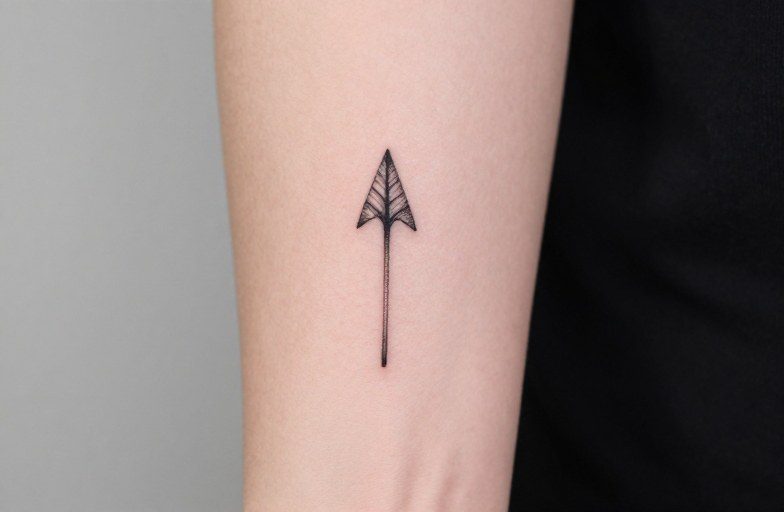
Single-needle and three-needle techniques produce delicate crosses, ichthys symbols, and scripture in precise, hair-thin strokes. These age faster than traditional work, lines spread, details blur, and the contrast softens over five to ten years depending on placement and sun exposure. The tradeoff is elegance and subtlety. A fine-line cross behind the ear or on the inner wrist functions as quiet personal marker rather than declaration. For scripture, blackwork demands careful font selection: overly ornate scripts collapse into illegibility as lines thicken; clean sans-serif or simple serif faces maintain readability longer.
Realism and Portrait
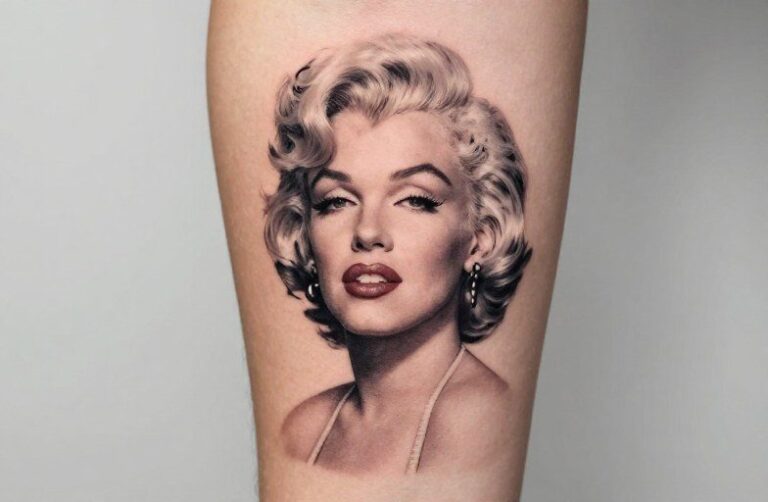
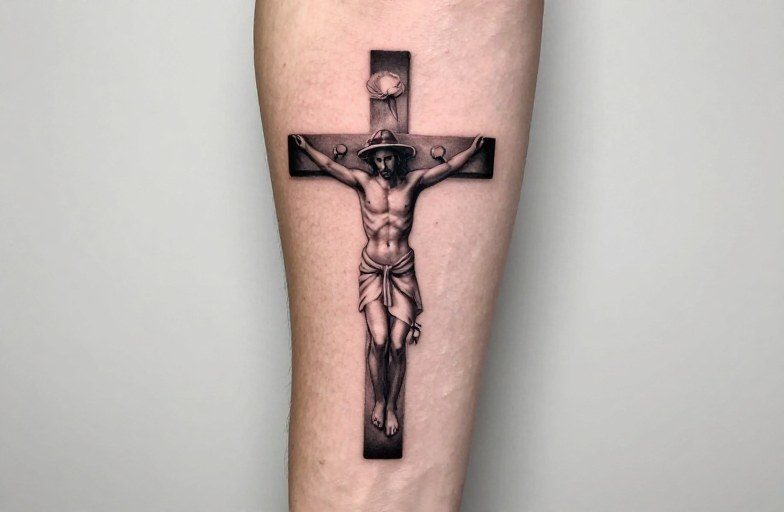
Christ portraits, praying hands, and crucifixion scenes require experienced specialists. The technical challenge isn’t just likeness, it’s how photographic shading translates to skin. Smooth gradients in paper or digital mockups often break into mottled, patchy tones on human canvas, especially over areas with uneven texture. These pieces demand larger scale to accommodate detail; a palm-sized Christ portrait typically fails, whereas a full forearm or upper back piece allows the artist to build proper value ranges. Healing is more involved too, with longer periods of plasma weeping and scabbing that can pull ink if not managed carefully.
Standout Design Ideas
Beyond the basic cross, specific iconographic elements carry distinct weight and visual interest.
Cross Variations
- Latin cross: The simplest form, balanced and immediately recognizable. Works across all styles and sizes.
- Orthodox cross: Three horizontal bars with the lowest slanted bar, adds complexity and denominational specificity. The asymmetry creates dynamic visual flow.
- Celtic cross: Ring surrounding the intersection, often with knotwork. The circular element softens the geometry and provides space for intricate pattern work. Knotwork ages well when kept bold; overly tight interlacing blurs within years.
- Crucifix: Corpus figure attached. Dramatically changes the tone from symbol to narrative scene. Requires larger scale to avoid cartoonish distortion of the figure.
- Anchor cross: Early Christian symbol predating the Latin cross in some regions. Appeals to those wanting historical depth without obvious contemporary religious signaling.
Scripture and Text
Verse references versus full quotations present different challenges. “John 3:16” as text is compact, readable at small sizes, and carries meaning for those who know the reference. Full verses, “I can do all things through Christ who strengthens me”, require more space and commit to a specific translation’s wording, which may feel less personal over time. Greek, Hebrew, or Aramaic originals offer alternatives that read as scriptural without the immediate accessibility of English. Lettering must be meticulously proofread; misspelled Hebrew or incorrect Greek accents are permanent errors that shops see regularly.
Other text-based options include the ichthys (fish symbol, often with Greek acrostic ΙΧΘΥΣ inside), the Alpha and Omega paired characters, and the Chi-Rho (☧) monogram, one of the earliest Christograms, combining Greek letters chi and rho.
Matching & Pairing Ideas
Couples, family members, and close friends frequently request coordinated Christian designs with actual visual coherence rather than just “matching” in the loose sense.
Split compositions work across two bodies: a cross whose horizontal bar continues from one person’s wrist to another’s, or a verse split across two forearms that reads complete when the arms align. These require precise measurement and simultaneous or near-simultaneous execution to ensure line consistency.
Complementary symbols offer more flexibility. One person carries the anchor, another the fish; or a parent takes the Chi-Rho while children receive Alpha and Omega. The visual language connects without requiring physical proximity to function.
Denomination-specific pairings matter practically. A Catholic rosary integrated with a cross pairs naturally with a Marian symbol on a partner. Protestant traditions might emphasize sola scriptura with paired verses from Old and New Testaments. Orthodox imagery, specific icon styles, three-bar crosses, carries strict conventions that artists should respect rather than approximate.
For family groups, consider generational scaling: the same core cross design executed at different sizes appropriate to each person’s age and body, with subtle personalization (birth dates in Roman numerals, small patron saint symbols) distinguishing individual pieces.
Trending Variations
Current requests show two notable directions: maximalist combination pieces and extreme minimalism, with little middle ground surviving.
Sacred Geometry Integration
Mandalas, flower of life patterns, and geometric frameworks surrounding or intersecting with crosses. The geometric structure provides visual organization that can rescue a poorly conceived cross shape, but the combination risks aesthetic confusion if not unified by consistent line weight. Successful pieces treat the geometry as architectural, supporting the central symbol rather than competing. These read as contemporary and appeal to younger requesters who want religious identification without traditional iconography’s cultural baggage.
Minimalist Reduction
Single continuous line forming a cross. Negative-space cross where skin shows through black surrounding field. Microscopic ichthys, sometimes under 10mm, placed on fingers or behind ears. The technical constraint becomes the entire concept. These age poorly at the smallest scales but serve purposes of discretion and personal private reference rather than public display.
Another emerging variation: deconstructed scripture where text fragments, partial verses, or isolated words scatter across a limb rather than forming continuous readable passages. “Grace” on the wrist, “Mercy” on the inner arm, “Peace” on the shoulder, coherent theme without narrative linearity.
For First-Timers
First Christian tattoos carry extra weight, often the first tattoo period, or the first with explicit religious commitment. Several practical considerations reduce regret likelihood.
Placement discretion: Hands, neck, and face remain visible in professional and religious contexts where other placements don’t. A forearm cross rolls under a sleeve; a hand cross doesn’t. Consider your actual weekly environments, not aspirational ones.
Size and detail realism: Small, intricate designs promise subtlety but deliver blurring. A cross the size of a quarter with internal filigree becomes a blue-black blob within a decade. Simpler shapes survive better at smaller scales; reserve complexity for larger pieces.
Denomination and doctrine: Some Christian traditions discourage or prohibit tattooing. Leviticus 19:28 is frequently cited, though interpretive traditions vary dramatically. Understanding your own community’s stance before permanent marking prevents later spiritual discomfort that has nothing to do with the art quality.
Artist selection: Religious imagery demands respect for the source material. An artist who treats a cross with the same casual approach as a generic tribal band may misrender proportions, misorient elements, or simply produce work that feels spiritually inert. Review portfolios for previous religious work; the care shown there predicts the care you’ll receive.
Best Placements
Where skin characteristics and daily function intersect with Christian tattoo conventions.
Upper Arm and Shoulder
The classic placement for crosses since military tattooing traditions. Deltoid skin is relatively stable, minimal stretching, moderate sun exposure, good healing vascularity. A cross here reads clearly in short sleeves, hides in professional contexts. The curved surface suits vertical compositions; horizontal scripture bands wrap awkwardly. For crucifixion scenes with corpus figures, the upper arm’s cylindrical shape maps naturally to the body’s vertical axis.
Forearm and Wrist
High visibility, which is either feature or bug depending on intent. Inner forearm offers flatter canvas for text; outer forearm for imagery that displays when arms hang naturally. Wrist crosses are common but technically challenging, tendons create uneven surface, constant flexing stresses healing, and the thin skin there ages ink faster than fleshier areas. Scripture on the inner wrist, reading orientation toward self or toward others, is a deliberate choice about who the message serves.
Chest and Back
Large-scale narrative pieces: full crucifixion scenes, angelic figures, extensive scripture passages. The chest’s sternum area is notoriously painful and heals with longer scabbing periods; the upper back offers more forgiving canvas. For pieces meant to be personally significant rather than publicly displayed, these placements allow private contemplation. A cross centered on the chest, over the sternum, carries obvious symbolic resonance but requires commitment to the pain and extended healing.
Ribc and Side
Scripture passages following the rib curve, or crosses oriented to the body’s lateral line. Painful placement, significant movement during healing, but the concealment is total and the personal intimacy maximum. “The old rugged cross” as a side piece, literal wound-adjacent placement, has been requested enough to be recognizable trope, though the execution quality varies enormously.
Final Word
Christian tattoos succeed when the specific choice, this cross form, that verse, this placement, reflects actual belief rather than borrowed sentiment. The symbols are ancient; your relationship to them is what requires articulation. A simple Latin cross, well-executed, outlasts elaborate compositions that outstrip the wearer’s connection to the content. Work with artists who understand the visual tradition, choose placement for your actual life rather than imagined one, and accept that ink ages, shifts, and softens like any material thing. The permanence is in the commitment, not the pigment.
Frequently Asked Questions
Do Christian tattoos violate any biblical prohibitions?
Interpretations vary widely across denominations. Leviticus 19:28 is the primary cited text, but most Christian traditions distinguish Old Testament ceremonial law from moral law. Some Orthodox Jewish communities maintain the prohibition; many Christian denominations don’t. Consult your own tradition’s teaching rather than assuming universal consensus.
Which cross style works best for very small tattoos?
The simplest Latin cross with clean lines survives best under 2 inches. Avoid Celtic knotwork, crucifixes with corpus figures, or ornate filigree at small scales, all blur into indistinct dark shapes within years. Bold, minimal geometry beats detail when space is constrained.
How do I choose between Greek, Hebrew, or English for scripture tattoos?
English offers immediate personal connection but commits to one translation’s interpretive choices. Greek (New Testament original) or Hebrew (Old Testament) carries scholarly weight and visual distinction, but requires rigorous proofreading by someone literate in the language, permanent misspellings are common and embarrassing.
Can a Christian tattoo be covered or modified if my beliefs change?
Black crosses and dense blackwork are among the most difficult elements to cover or remove, black pigment absorbs laser wavelengths but often requires more sessions than colored ink. Consider placement that allows coverage with clothing, and avoid designs so large or dark that modification options disappear.