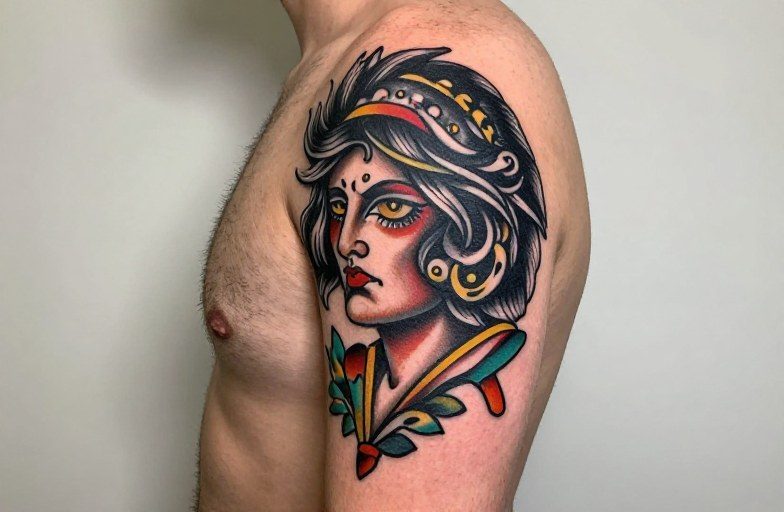
Old school tattoos carry a visual language that refuses to fade into obscurity. The thick black outlines, saturated color blocks, and deliberate simplicity aren’t stylistic quirks, they’re engineering decisions that keep these designs readable at thirty years old. Sailor Jerry, Bert Grimm, and the unnamed shop artists who standardized this vocabulary built something that works on skin, not just on paper. If you’re drawn to this aesthetic, the real question isn’t whether to get one, but how to choose imagery that feels personal without betraying the style’s constraints.
How to Personalize It
Working Within the Rules
Old school has guardrails, not a prison. The best personalization happens inside the format: swapping a generic banner text for coordinates, dates, or names that matter to you. A swallow becomes yours when the direction it faces carries meaning, traditionally, two swallows meant 10,000 nautical miles sailed, but a single bird facing homeward works for anyone with a fixed point worth returning to.
Consider these proven customization paths:
- Dagger through a heart: replace the heart with a specific flower (rose for someone, lily for another)
- Ship in a storm: add a banner with a latitude that means something
- Panther: change the holding element, rope, dagger, or scroll, to reflect a trade or hobby
- Skull: pair it with a specific gambling token, flower, or military insignia
The constraint is your friend. Old school doesn’t do subtle gradients or photorealistic portraits. Work with an artist who understands that “personal” here means symbolic substitution, not stylistic hybridization.
What to Avoid
Mixing old school linework with new school color saturation creates a visual identity crisis. Similarly, squeezing too many elements into the compact format muddies the read. A traditional eagle needs sky to breathe; crowding it with a full landscape behind it kills the impact. One strong focal point. One banner max. Let the negative skin do its job.
Matching & Pairing Ideas
Couples and friends often gravitate toward old school for matching work because the style’s boldness reads clearly even at distance. The classic pairing is symmetrical: two swallows, one on each person’s chest or hand, mirroring each other. But more interesting options exist.
Consider complementary rather than identical designs. A ship and an anchor, traditionally separate motifs, speak to each other across two bodies. A dagger and a rose, split between partners, carry narrative weight without being literal about the relationship. For siblings or close friends, matching snake and panther pieces, both traditional power animals, create visual rhyme without being twee.
Placement pairing matters as much as image choice. Two people with matching upper arm pieces create a photographable moment; two with matching ribs have something private. Decide which register you’re working in before committing to the design.
Best Placements
Where the Style Was Born to Live
Old school tattoos were developed for the parts of the body that sailors could reach and artists could access on a rolling ship. That history leaves fingerprints on where these designs still look most at home.
The upper arm, from shoulder to elbow, remains the canonical canvas. The cylinder shape suits the vertical orientation of ships, daggers, and pin-up figures. The flat plane of the outer forearm handles eagles and banners well. Hands and knuckles carry the smallest traditional motifs, swallows, stars, letters, with the understanding that palm-side fading will require touch-ups.
The Aging Factor
Thighs and calves hold color longer than anywhere else on the body; the skin is stable, relatively protected, and doesn’t stretch dramatically with weight fluctuation. Chest pieces spread and soften over decades as pectoral muscle builds or declines. The upper back, between shoulder blades, offers a flat billboard for symmetrical designs but sees sun exposure that fades red pigments fastest.
Neck and throat placements read as aggressive in old school style, the bold lines amplify the visibility. This isn’t a warning against them, but a calibration of expectations. A throat panther is a commitment to being seen as someone with a throat panther.
Trending Variations
Contemporary artists are stretching the vocabulary without breaking it. One viable direction is the “all-black” traditional piece, using heavy whip shading instead of color blocks to create value contrast. This reads as old school from across the room but reveals its modernity up close. It also sidesteps the red-ink allergy issue that affects a small percentage of collectors.
Another variation: the “patch” tattoo, where the design is framed as a sewn fabric patch with visible stitching around the border. This meta-move acknowledges the style’s connection to military and biker culture without being literal about it.
Some shops are reviving the “flash challenge” format, picking a random sheet design and executing it without modification. This produces authentic period pieces, though the collector surrenders personalization for historical fidelity. Worth considering if you value the tradition more than the individual statement.
Color Choices
The Limited Palette
Traditional old school operates on a tight roster: black, red, yellow, green, blue, and white (used sparingly, as highlights that yellow over time). Brown enters for wood tones and animal fur. Purple and orange appear but less frequently. This isn’t scarcity for nostalgia’s sake, each pigment was chosen for how it held in skin under unknown conditions.
Modern inks offer more stable purples and oranges, but the traditional palette persists because it works. Red and black together create maximum contrast. Yellow against black pops at distance. Green, the least lightfast of the traditional colors, is typically used in smaller areas where fading matters less.
What Fades and What Lasts
Black outline is the skeleton; without it, old school collapses. Prioritize crisp blackwork even if it means reducing color complexity. Red holds well but can shift toward orange in some skin chemistries. Blue (particularly cobalt-based) tends toward greenish tones over decades. White highlight almost always yellows; plan for it becoming cream or light tan.
Skin tone affects apparent color saturation. The same red reads more vividly on lighter skin, appearing slightly muted on darker complexions, not a quality difference, but a perceptual one. Experienced artists adjust pigment density accordingly, laying slightly heavier passes on melanin-rich skin to achieve equivalent visual impact.
Size & Scale
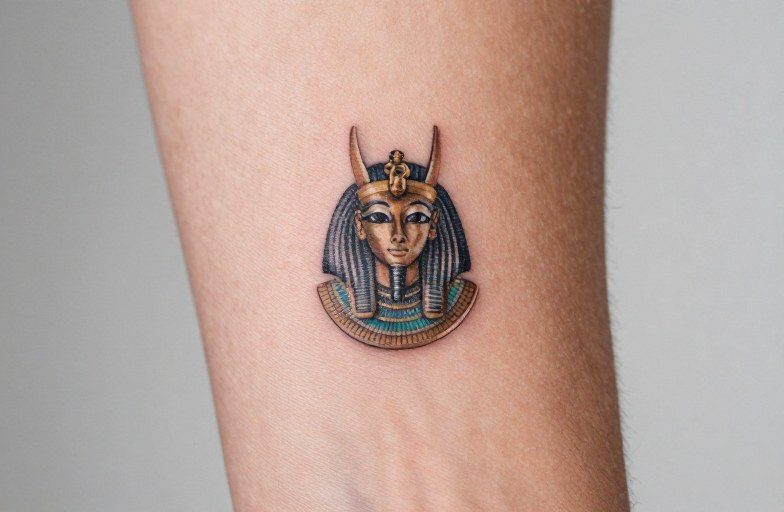
Old school has a minimum viable size. Below approximately two inches in the longest dimension, detail becomes unworkable and lines blur together during healing. A traditional rose at one inch is a blob; at three inches, it breathes. The style’s reliance on distinct color separation demands physical space between elements.
Large-scale old school exists, full back pieces, full sleeves, but requires planning. The traditional approach builds these as collections of individual designs with intentional negative space between them, rather than as continuous murals. A sleeve assembled from separate flash pieces, unified by consistent line weight and palette, honors the format better than a single flowing scene rendered in traditional style.
For first pieces, the 3-5 inch range offers the best compromise: large enough for clean execution, small enough for easy concealment if professional contexts demand it. The upper arm or outer calf accommodates this scale naturally.
Final Thoughts
Old school tattoos reward patience and punish impatience. The collector who researches shops, studies healed work, and accepts the style’s limitations gets something that looks intentional at year one and year thirty. The one who rushes for trendiness, who demands photorealistic detail crammed into a format that rejects it, ends up with a compromise that satisfies no one.
The best traditional tattoo is one you could explain to a stranger in a sentence, recognize across a crowded room, and still want to look at when your skin has loosened and your tastes have shifted. That durability isn’t accidental. It’s built into every thick line and limited color choice. Choose accordingly.
Frequently Asked Questions
Do old school tattoos hurt more than other styles?
The bold outlining requires consistent needle passes through the same area, which some people find more intense than the scattered shading of other styles. However, the sessions are often shorter because the designs are simpler, so total discomfort may actually be less.
How do I find an artist who actually specializes in traditional work?
Look for portfolios with consistent thick line weight, limited color palettes, and healed photos from one to five years out. Artists who truly specialize will have dozens of examples in this specific style, not one or two mixed among other work.
Can I cover up an old tattoo with old school style?
The bold black lines and dense color blocks make traditional work excellent for cover-ups, but the new design must be larger than what’s underneath. A skilled artist can incorporate faded existing lines into banner scrolls or animal fur patterns.
Why do some old school tattoos look blurry after healing?
This usually happens when lines are too thin or too close together for the skin to hold them distinctly. Proper traditional work uses lines thick enough to survive the healing process, with adequate spacing between parallel marks.