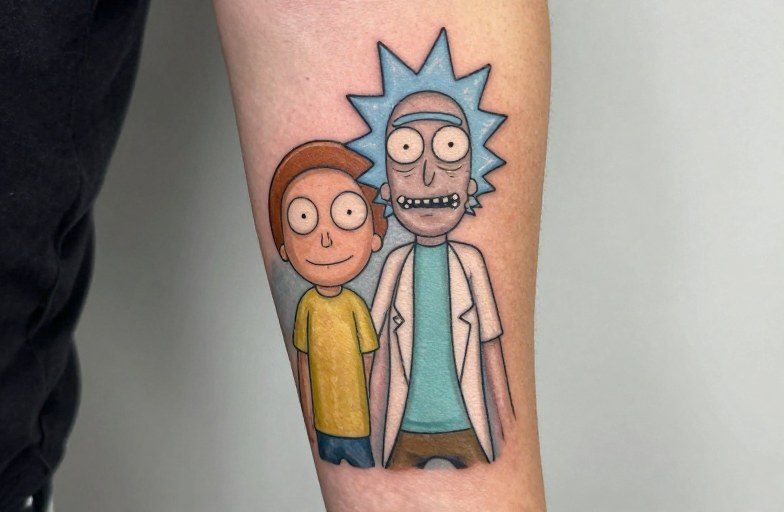
Rick and Morty tattoos thrive on the show’s visual chaos: drooling aliens, broken portals, and characters who look like they were drawn during a panic attack. That looseness is actually a gift for tattooing. The crude, expressive style translates well to skin because it forgives imperfection, wobbly lines and blown-out color feel intentional rather than accidental. But the best pieces don’t just copy screenshots. They use the show’s vocabulary to build something that holds up as a tattoo, not just fan art that’ll feel dated by next season.
Color Choices
The show’s palette is aggressively synthetic, acid greens, electric blues, that particular Morty-yellow that almost vibrates. On skin, these colors behave differently than they do on a backlit screen.
Neons vs. Muted Tones
Neon green and cyan blue look incredible fresh but fade fast, especially on lighter skin tones where the contrast drops within a few years. Muted, slightly desaturated versions, think olive drab instead of slime green, slate instead of electric blue, last longer and often read better from a distance. Some of the strongest Rick and Morty pieces use a limited palette: two or three colors max, treated like traditional tattoo pigment rather than digital approximation.
Black and Grey Options
- Portal swirls in heavy blackwork with stippled galaxies inside
- Pickle Rick rendered as a woodcut-style illustration
- Character portraits using only black, grey wash, and negative space for the eyes
Black and grey suits the show’s darker moments, Cronenberg world, the funeral planet, any scene where Rick’s nihilism actually lands. It also ages cleaner and works on any skin tone.
Popular Styles
The show’s animation is deliberately crude, which means “show-accurate” isn’t always tattoo-accurate. Different tattoo styles handle the source material with different results.
American Traditional and Neo-Traditional
Thick bold lines, limited color fields, and strong readability. Rick’s spiky hair becomes a series of clean wedges. Morty’s anxious hunch translates to a solid silhouette. Traditional handles the characters better than you’d expect because it simplifies what’s already simple. The downside: you lose the show’s gross-out texture. No oozing wounds or glitching reality in a Sailor Jerry framework.
Illustrative and Sketch-Style
Closer to the show’s actual energy. Wobbly linework, crosshatching, watercolor washes bleeding outside the lines. This captures the manic, improvised feel but requires a tattooer who understands controlled chaos, too loose and it looks like a mistake; too tight and it kills the mood. The best sketch-style pieces use varying line weights: thick contours for the figure, hair-thin scribbles for background radiation or portal static.
Other approaches that work:
- Dotwork for space backgrounds and Meeseeks texture
- Japanese-inspired with Rick as a wrathful oni, Morty as the cowering attendant
- Biomechanical, Rick’s portal gun merged with actual forearm anatomy
Best Placements
The show’s vertical compositions, tall characters, stacked portal layers, suggest certain body mapping.
Vertical Spaces
Outer forearm, calf, side of the thigh. These let Rick and Morty stand in their natural poses without awkward compression. A full-figure Rick pointing his portal gun reads clearly at forearm length. The calf’s cylinder shape suits the show’s portal tunnels, ink it so the portal swirls wrap slightly around the muscle.
Flat Planes and Small Spots
The show’s iconography is strong enough for tiny work. A single portal, a Plumbus outline, the three-circle Council of Ricks symbol. These fit behind the ear, on the wrist bone, between fingers. The Mr. Meeseeks box is basically a square, perfect for a palm-sized spot on the inner bicep or above the ankle.
Areas to avoid or plan carefully:
- Hands and feet, the show’s fine lines blur fast here, and the bright colors fade unevenly
- Ribs, unless you want the characters stretched across the compression of breathing; some do, most don’t
- Stomach, weight fluctuation distorts the already-distorted anatomy
Size & Scale
Small doesn’t mean simple. A two-inch Pickle Rick with proper line weight and selective color packing can read from across a room. Large doesn’t mean better, a full backpiece of the opening credits sequence becomes unreadable mush unless the tattooer breaks it into distinct value zones.
Micro-Details That Actually Work
Butter Robot rendered at actual butterfly size. The tiny food blobs from the commercial breaks. A single frame of Rick’s drool, isolated and enlarged. These work because the source material is already crude, there’s no fine detail to lose. The show’s “bad” drawing becomes a tattoo advantage.
Large-Scale Compositions
Best when they use the show’s architecture: the garage with its portal silhouette, the spaceship cockpit with its infinite dashboard buttons, the Citadel’s layered cityscape. These give the eye paths to follow. A giant floating head of Rick, by contrast, is just a giant head. The background matters more than the character at larger sizes.
Standout Design Ideas
Moving beyond the obvious portraits separates memorable pieces from forgettable ones.
Portal as negative space: the classic green swirl becomes a cutout, revealing skin tone as the “other dimension.” Surround it with heavy black space junk, stars rendered as solid black dots. The contrast is immediate and ages well because the lightest part is literally untouched skin.
Deconstructed characters: Rick’s head separated into floating components, eyes, flask, portal gun, unibrow, arranged like a technical diagram. Morty’s body split by a portal, half emerging from the skin. These use tattoo-specific logic rather than illustration logic.
Text integration that isn’t cringe: the show’s episode titles are genuinely strange. “Pickle Rick” works as a banner. “The Wedding Squanchers” doesn’t. Select phrases that function as graphic elements, not just references. “Wubba Lubba Dub Dub” in the show’s actual title font, distorted as if spoken through a portal.
Crossover concepts that respect both sources:
- Rick as a traditional Japanese namakubi (severed head), still holding his flask
- Morty in the pose of a weeping Buddha, but sweating and clutching his backpack
- The spaceship reimagined as a 1950s hot rod, flames included
Matching & Pairing Ideas
The show’s central relationship, destructive genius and anxious accomplice, maps onto actual human dynamics with surprising flexibility.
Partner and Friend Sets
Rick and Morty as separate tattoos for two people works best when the connection is spatial rather than identical. One person gets the portal gun firing; the other gets the portal opening, positioned so they align when standing side by side. Or Rick on one person’s calf, Morty on the other’s, both walking in the same direction. Matching doesn’t mean mirroring.
Sibling and Group Combinations
The multiverse concept is built for this. Same character, different versions: Cronenberg Morty, Hammer Morty, President Morty. Each sibling gets one variant. The visual link is the base design; the variation is the personalization. For groups, the Council of Ricks symbol with each person’s chosen number or colorway.
Solo multi-piece planning:
- Portal on one arm, destination on the other, continuity across the body
- Rick’s face hidden in one larger piece, revealed in another as the collector’s style evolves
- Seasonal rotation: summer job Morty, snow globe Morty, Halloween nightmare Morty
The Takeaway
Rick and Morty tattoos succeed when they treat the show as raw material, not finished product. The crude animation, the nihilistic humor, the genuine emotional beats underneath, these are tools, not templates. Pick the visual vocabulary that suits your actual skin and your actual life. A tiny Butter Robot that makes you laugh in the mirror beats a full sleeve you’ll explain into exhaustion. The show’s already about infinite possibilities; your tattoo only needs to commit to one good one.
Frequently Asked Questions
Do Rick and Morty tattoos age badly because the art style is so crude?
Crude styles often age better than hyper-detailed realism because bold shapes hold up as lines spread slightly. The key is matching the line weight to the size, too thin and it blurs, too heavy and it blobs. A good tattooer calibrates this during the stencil phase.
Is it hard to find a tattooer who knows the show well enough to get the characters right?
Most tattooers under forty know the show, but technical skill matters more than fandom. Look for clean linework in their portfolio, then bring clear reference images. The best results come from artists who understand cartoon proportion, not necessarily ones who can quote episodes.
What’s the most overdone Rick and Morty tattoo to avoid?
Pickle Rick in a fighting pose is extremely common, and the joke has outlasted its freshness for many. If you love it, consider a less direct version, Pickle Rick as a still life, or integrated into a larger scene rather than isolated as a portrait.
Can you cover up or rework an old Rick and Morty tattoo if you fall out of love with the show?
The bold outlines and saturated colors typical of these pieces actually make cover-ups easier than fine blackwork. A skilled cover-up artist can often transform Rick into a generic mad scientist or recontextualize the portal as an abstract vortex, preserving what’s technically sound.