Moon phase tattoos occupy that rare space between visually striking and quietly symbolic. The lunar cycle translates naturally to skin: seven distinct phases, each readable at a glance, arranged in sequences that wrap around limbs or float as standalone icons. What separates a memorable piece from a forgettable one usually comes down to spacing, scale, and whether the artist understands how curved lines behave on different body planes. Below is a practical breakdown of what works, where it works, and how to make it yours without defaulting to the same Pinterest layout everyone already has.
Standout Design Ideas
Linear Sequences
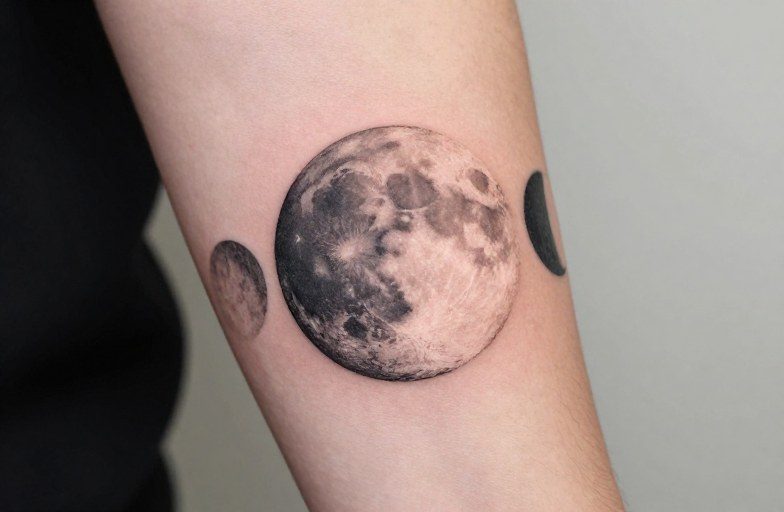
The classic horizontal progression, new moon to full and back, works best when the diameter of each moon stays consistent and the transitions between phases feel mechanically precise, not hand-wavy. A skilled artist will map the negative space so the waxing and waning crescents mirror each other with actual geometric accuracy. Popular executions include: a thin line across the collarbone with each phase no larger than a dime; a vertical stack down the ribcage with subtle size variation to suggest perspective; or a wraparound forearm band where the full moon sits at the top and tapers toward the wrist.
Deconstructed and Scattered Layouts
Breaking the sequence apart can feel more organic. One strong approach places the full moon at a focal point, shoulder cap, sternum center, thigh front, then distributes the remaining phases nearby like satellites. Another treats each phase as a separate small tattoo, healed at different sessions, collected over time. This demands a consistent artist to maintain line weight and ink saturation across years. For single-session cohesion, consider a crescent tucked behind the ear, a gibbous on the inner bicep, a full moon on the ankle, all in matching dotwork or blackwork.
- Horizontal collarbone bar: demands perfect symmetry, high visibility
- Vertical spine or sternum line: elongates the torso, painful on bone
- Wraparound forearm: reads as jewelry, ages well with proper line weight
- Scattered constellation-style: requires planning, rewards patience
Best Placements
High-Visibility Areas
Forearms, collarbones, and the back of the neck put moon phases where light hits them. The forearm’s relatively flat planes preserve circular shapes better than curved areas like the bicep or calf. Collarbone placements need careful centering; even a quarter-inch drift toward one shoulder throws off the entire composition’s balance. Back-of-neck pieces work as vertical sequences but limit width, anything over three inches starts wrapping onto the sides and distorting.
Hidden or Intimate Spots
Ribs, hips, and the inner upper arm suit private pieces. Ribcage skin moves significantly with breath, so lines here blur faster than on static areas; opt for bolder line weight or heavier black fill if longevity matters. The inner bicep offers a flat canvas but ages poorly if the design sits too close to the armpit fold, ink migrates there within a few years. Hip placements, whether along the iliac crest or lower abdomen, accommodate horizontal spreads but stretch with weight fluctuation; keep this in mind for any design relying on precise proportions.
For First-Timers
Start small and monochrome. A single crescent moon, two inches max, in solid black or fine line, lets you experience healing and fading without committing to a complex composition. Single moons also test an artist’s circle game, any wobble in a lunar outline becomes obvious immediately, unlike organic shapes where irregularity passes as intentional.
If the full sequence appeals, consider a forearm band rather than a spine or rib piece. The pain is manageable, the healing is straightforward, and you’ll see it daily to assess whether you want more. Avoid watercolor or heavy gradient fills for a first tattoo; they require more technical skill to execute well and fade to muddy patches faster than clean linework. Ask to see healed photos of similar work from your artist, not just fresh tattoos. Fresh moon phases look crisp; healed ones reveal whether the artist understands how black ink settles and spreads in different skin densities.
Trending Variations
Botanical Integration
Moon phases threaded through laurel wreaths, climbing vines, or pressed-flower arrangements have gained traction, particularly in fine-line studios. The botanical elements soften the astronomical geometry, but they also introduce more variables that age unevenly. Thin leaves and stems blur faster than solid moon shapes. If you want this combination, prioritize the lunar forms as the dominant visual anchor and let the botanicals serve as secondary texture.
Ornamental and Sacred Geometry
Metatron’s cubes, flower of life patterns, or dotwork mandalas framing the moon cycle add density and spiritual association without requiring literal imagery. These pieces demand artists comfortable with geometric precision, freehanding a 12-point mandala around a moon sequence rarely ends well. Stencil placement and careful measurement separate successful ornamental work from lopsided attempts. The trend here leans toward upper back pieces and thigh fronts where the artist has uninterrupted flat space.
- Floral wrap: moon phases as stem nodes, popular on calves and forearms
- Geometric mandala center: full moon at the core, phases radiating outward
- Minimalist dotwork: single dots representing phases, extremely subtle
- Double exposure: lunar surface texture mapped onto each phase icon
How to Personalize It
Personalization works best when it modifies the structure rather than tacking on generic symbols. Birth dates mapped to specific phases, what the moon actually looked like on a particular night, give concrete data to build from. Several astronomy tools generate accurate lunar appearances for any date; bring this reference rather than asking the artist to guess.
Consider integrating actual topographic detail from NASA imagery into the full moon phase, keeping crescents and gibbous phases as clean silhouettes. This creates visual hierarchy: one phase carries texture, the rest read as graphic symbols. Another approach uses the negative space between phases to hide initials, coordinates, or tiny figurative elements meaningful to you. The gap between waxing crescent and first quarter, for instance, can hold a micro-letterform without disrupting the overall rhythm.
Color choices also individualize. Most moon phases stay black or near-black, but a single phase in deep indigo, rust orange, or muted gold shifts the entire piece’s temperature. Use color sparingly; one accent phase against six black ones reads as intentional, while rainbow sequencing tends toward cluttered.
Popular Styles
Blackwork and Solid Fill
Heavy black moons with stark negative-space crescents offer the most longevity. The contrast stays readable even as lines soften over decades. This style suits larger pieces where the solid masses balance the composition’s visual weight. On smaller scales, blackwork risks becoming indistinct blobs; keep individual phases at least half an inch in diameter for clarity.
Fine Line and Single Needle
Delicate, hair-thin lines define contemporary fine-line moon phases. The aesthetic is ethereal and immediately appealing, but the technical reality is demanding. Single-needle work fades faster, requires touchups, and shows every imperfection in the artist’s hand. For a sequence across visible skin, fine line demands a budget for maintenance. The payoff is a piece that photographs like jewelry and sits lightly on the body.
American traditional and neo-traditional approaches treat moon phases with bold outlines, limited color palettes, and sometimes anthropomorphic faces in the full moon. These read as tattoos first, lunar diagrams second, good if you want the imagery without the minimalist aesthetic. Japanese-inspired work occasionally incorporates moon phases into larger compositions with waves, rabbits, or pine branches, though this usually subordinates the sequence to a broader narrative scene.
The Takeaway
Moon phase tattoos succeed when the geometry is honest and the placement respects how bodies move and age. The most common failure is a beautiful stencil that ignores the curvature of the chosen area, resulting in moons that look oval or phases that crowd together as skin shifts. Bring reference images of the actual lunar cycle, not stylized clip art, and discuss with your artist how the sequence will read from multiple angles. Whether you want a single subtle crescent or a full sleeve mapping a year of personal phases, the core principles hold: consistent scale, accurate negative space, and line weight matched to the placement’s exposure and movement. The moon itself has been there; your tattoo just needs to hold up long enough to feel like it belongs.
Frequently Asked Questions
Do moon phase tattoos have to follow the actual lunar sequence?
No. Many people arrange phases for visual flow rather than astronomical accuracy. However, using the real sequence from a meaningful date adds personal significance and gives your artist precise reference to work from.
How well do fine-line moon phases hold up over time?
Fine-line work fades faster than bold blackwork, especially on high-movement areas like wrists and ribs. Expect touchups within 3-5 years. For longevity, choose slightly thicker line weight or a placement with less skin stretching.
Can moon phases be added to later if I start with just one or two?
Yes, but plan the spacing and sizing from the beginning. An experienced artist can map the full sequence even if you only tattoo a portion initially, ensuring additions match in scale and style.
What’s the most painful placement for a full moon phase sequence?
The sternum and ribcage rank highest due to proximity to bone and thin skin. The outer forearm and calf are more manageable for longer sessions. Spine placements vary by individual but generally exceed forearm discomfort significantly.