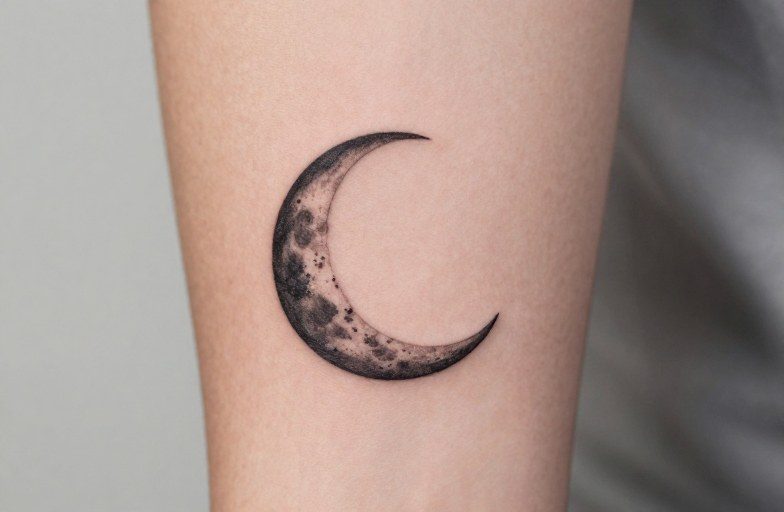
A simple moon tattoo works because it doesn’t try to do too much. The shape is instantly recognizable, holds up for decades, and leaves room for your artist to interpret it. What separates a good one from a forgettable one is restraint, knowing what to leave out, where to put it, and how much detail actually survives under skin. Here’s what actually matters when you’re planning one.
Popular Styles
Not every “simple” moon looks the same. The style you choose changes how it reads from across the room and how it ages in five years.
Line Work
Single-needle or fine-line moons look delicate and modern. A clean crescent in unbroken black line, maybe with a small dot or two for texture, stays readable even as the line softens slightly over time. The risk here is going too thin, lines below a certain threshold can blow out or fade into a blurry suggestion. Ask your artist about their needle grouping and what minimum line weight they guarantee. A confident single-needle moon with consistent ink saturation beats a wispy one that disappears.
Black Fill and Negative Space
Solid black moons with cut-out stars or craters inside them use contrast instead of detail. The negative space stays bright as the black settles, creating a graphic punch that reads from distance. These age better than stippled or shaded moons because there’s less subtle gradation to lose. A solid black crescent with a small white highlight (left uninked, not scarred) mimics how moonlight actually hits a curved surface.
- Outline-only: fastest to execute, easiest to touch up later
- Black fill with negative space: highest long-term contrast
- Minimal stippling: risky; dots spread and merge over time
- Gradient wash: requires skilled application; soft edges blur faster
Best Placements
Small moons need real estate that matches their scale. Too large an area and they float; too small and they cram into awkward healing zones.
High-Visibility Spots
Behind the ear, the side of the finger, and the collarbone are classic for a reason. The curve of a crescent mirrors natural body contours there. Behind the ear works best for moons under an inch, anything larger twists around too much and distorts when you turn your head. Finger moons need to be bold: simple outline, no interior detail, because finger skin sheds ink aggressively and fine work doesn’t survive.
Hidden or Personal Areas
Ribs, inner bicep, and the back of the ankle suit moons meant for private viewing. Rib skin moves with breathing, so the shape should be simple enough not to warp distractingly. Ankle moons sit where socks rub; expect faster fading and budget for a refresh in a few years. The inner wrist, despite popularity, sees constant sun and friction, moons there often need reinforcement sooner than other spots.
Matching & Pairing Ideas
Moons pair naturally with certain imagery, but the combination only works if both elements stay simple. Adding a complex wolf or elaborate floral wreath defeats the purpose.
Small stars in matching line weight create an immediate night-sky constellation feel without clutter. A single star slightly offset from the moon suggests orbit, balance, or a relationship between two points. Keep the count low, three stars maximum, or it becomes a sticker sheet.
Phase sequences work as multiple tiny moons: new, waxing, full, waning, arranged in a line or curve following the body. Each phase should be identical in style and scale, or the set looks accidental rather than intentional. Five phases across the upper back shoulder line, or three phases trailing down the spine, read as deliberate without being busy.
- Moon + single star: balanced, timeless
- Moon + small wave or mountain line: landscape suggestion, keep both elements equally minimal
- Two moons (different phases): relationship or duality symbol
- Moon phase sequence: requires planning spacing; measure before inking
How to Personalize It
Personalization doesn’t require adding more stuff. It often means removing what’s expected.
Orientation and Phase
A waxing crescent faces right; waning faces left. That distinction actually means something if you mark a specific date, direction, or intention. A full moon reads as completion or peak; a thin crescent as beginning or potential. Choose based on what phase resonates, not just what looks prettiest in the reference photo. Your artist can mirror or rotate any reference; don’t settle for the first orientation you see.
Subtle Modifications
Slightly elongating the crescent, flattening one horn, or adding a single small crater circle in negative space distinguishes your moon from the thousands of identical Pinterest saves. A tiny letter or number hidden in the black fill, your birthday, a coordinate, a single initial, adds personal weight without visual noise. These modifications should require a second look to notice, not announce themselves.
Color Choices
Simple moon tattoos are predominantly black. Color, when used, should be specific and restrained.
Yellow or pale gold can suggest harvest moon warmth, but skin tone affects how it reads. On deeper skin, bright yellow can heal toward orange; on very fair skin, it can look like a nicotine stain. A safer approach is to keep the moon black and add a thin color halo around it, or color a small paired element like a star.
White ink alone rarely works for moons, it heals to a faint scar-like visibility and yellows. If you want a “white moon,” negative space in black fill achieves the effect more reliably. Blue or purple washes age poorly in small tattoos; they tend to muddy into gray-green. If you want color, commit to a bold, saturated block, not a soft wash.
Trending Variations
What’s shifting now in simple moon design is less about adding complexity and more about precise execution of familiar forms.
Hand-Poked Revival
Hand-poked (non-machine) moons have gained traction for their organic, slightly irregular line quality. The technique suits the moon’s natural imperfection. These heal differently, often with less trauma, but the line can be less perfectly uniform. The variation itself becomes the feature. If you want a moon that looks ancient rather than digital, this method merits research into artists who specialize in it.
Micro-Scale Commitment
Extremely small moons, under half an inch, are being placed in clusters or as single hidden marks. The challenge is finding an artist whose fine-line work actually holds at that scale. Ask to see healed photos, not fresh ones. A fresh micro-tattoo always looks sharper than it will in six months. The trend toward tiny works when the design is stripped to absolute essence, no interior marks, no second color, just the clean arc.
The Bottom Line
A simple moon tattoo succeeds on confidence and restraint, not embellishment. Pick a phase that matters to you, choose a placement that fits your daily life and pain tolerance, and find an artist whose healed work proves they can execute clean lines at your chosen scale. The moon has been tattooed millions of times. Yours doesn’t need to reinvent it, it needs to be done well, specifically for you, with the understanding that what stays simple stays readable for years to come.
Frequently Asked Questions
How small can a moon tattoo be before it starts to blur or fade?
Below half an inch, lines begin to spread and details merge as the ink settles and skin ages. A clean outline moon can hold at 3/4 inch, but anything with interior detail needs more room. Your artist’s needle grouping and your skin type both factor in, oily skin tends to blur faster than dry.
Do moon tattoos on fingers really need frequent touch-ups?
Yes, finger tattoos shed ink rapidly due to constant use, sun exposure, and the thick, shedding skin layer. Most finger moons need a refresh within two to five years. Plan for bold, simple designs there, and budget for maintenance rather than expecting permanence.
What’s the difference between a waxing and waning crescent in tattoo symbolism?
Waxing (right-facing, growing) commonly associates with new beginnings, building momentum, or setting intentions. Waning (left-facing, shrinking) often links to release, reflection, or letting go. The distinction matters if you’re marking a specific life event or personal transition with the phase.
Can a simple moon tattoo be covered or expanded later if I change my mind?
Absolutely. A basic outline moon is easy to build into a larger piece, add surrounding stars, extend into a phase sequence, or incorporate into a larger composition. Solid black fill offers more cover-up options later than intricate detail, since black provides a foundation to work over.