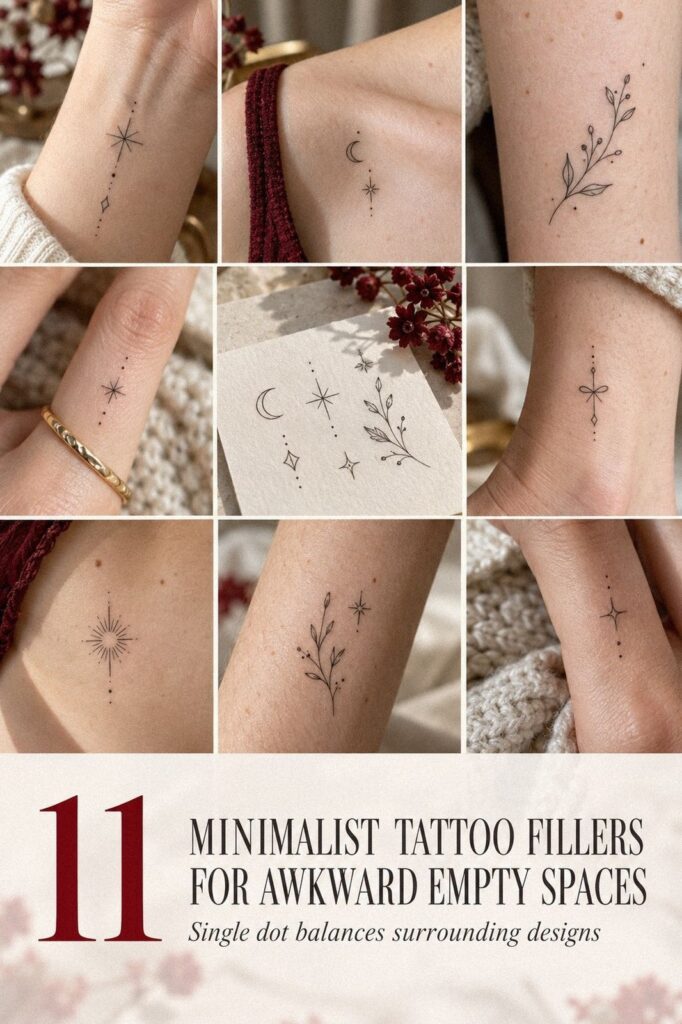
Minimalist tattoo filler ideas age cleanest when the spacing, ink weight, and placement work together. I learned that after squeezing a tiny symbol into a gap that needed air, not another mark. Your best filler should look intentional at arm’s length and crisp up close. These spots can do both!
Tiny Stars Between Finger Tattoos
Tiny stars can make open finger space feel expressive without turning your hand into a crowded flash sheet. Choose fine-line star clusters with three different sizes, then let the smallest mark sit slightly apart from the others. You’ll get a delicate rhythm instead of a sticker-like row.
Your artist should keep the stars crisp and slightly irregular. Perfect symmetry can look stiff on a finger, especially when your hand bends. I’d skip a dense black star between every tattoo because the marks can visually merge as the skin moves.
The understated design leaves each existing piece readable.
Ask for a placement that respects your knuckles and finger creases. Black tattoo ink usually reads more clearly than pale color in this area, but your artist should still explain how fine lines may soften over time. Finger tattoos need practical expectations, not just a pretty reference.
Before booking, save a few small tattoo filler ideas and compare the negative space between each design. Your favorite may look tiny on a screen but feel crowded on your hand.
If the design still feels worth the cost after you compare healed examples, keep it on your shortlist. And don’t forget sunscreen once the skin has fully healed!
Delicate Dots Along Wrist Linework
A few deliberate dots can connect wrist linework without competing with the main design. Think of single-needle dotwork placed at uneven intervals, with one slightly larger point acting as the visual anchor. It’s minimal, but it won’t look accidental.
Your wrist moves constantly, so the filler should follow the existing flow rather than sit in a rigid line. I’d place the dots beside a botanical stem, crescent, or fine geometric mark, not directly across every break. That choice keeps your tattoo graceful and gives your eye somewhere to pause.
If your skin has a medium warm ivory tone, your artist can adjust the contrast and needle depth carefully. Black pigment tends to stay more legible than soft grey in small details, though a polished artist will still consider your undertone, skin texture, and lifestyle.
Bring healed reference examples, not only fresh tattoos. A minimalist tattoo artist should show you how similar wrist work settled after several months. You’ll learn more from softened, healed lines than from a dramatic fresh result.
If your budget is limited, one carefully placed dot cluster offers better value than several rushed additions.
Miniature Moons Filling Ankle Gaps
A crescent moon with a few small stars is a striking way to fill an ankle gap while keeping the overall composition light. Use fine crescent linework with a clean opening, then place the stars where your existing tattoos leave breathing room. The result feels symbolic without becoming ornate.
Your ankle has less padding than your forearm, so the sensation can be sharper and more focused. I’d choose a slightly stronger outline rather than an impossibly thin curve that may soften into visual noise. You’re still getting an ethereal mark, but it has enough presence to survive everyday movement.
For medium olive skin, your artist should assess contrast in person instead of copying a design blindly. Solid black accents can give the moon a crisp edge, while tiny open stars keep it delicate. Don’t ask for heavy shading if your goal is a clean filler that stays readable beside older pieces.
Think about footwear, too. Socks and shoes can rub a fresh ankle tattoo, so schedule your appointment when you can keep the area protected and clean.
The surface usually settles in about 2 to 3 weeks, while the deeper healing process can take roughly 2 to 3 months. Compare the expected cost with the placement benefits before deciding whether the idea is worth it.
For more celestial variations, browse this minimalist moon tattoo collection and simplify any design that feels too dense.
Fine Botanical Sprigs Between Florals
A small wildflower sprig can soften the gap between larger floral tattoos without copying their exact shapes. Choose fine botanical stems with two or three leaves, then let the flowers remain sparse. Your filler should connect the pieces through movement, not fill every empty patch.
I’d avoid a thick bouquet in this location. It’s tempting to make the new sprig more detailed, but intricate petals can blur when they’re packed beside older ink. A graceful stem with a few pointed leaves gives your composition a flowing bridge and keeps the main flowers in charge.
Your artist can adapt the design to golden tan skin by checking how black lines appear beside the existing tattoos. Crisp black linework will usually give the strongest contrast, while selective open space keeps the sprig soft. Ask where the stem should bend when your torso moves, especially if the filler sits near the sternum.
If you’re still deciding between a sprig and a small floral symbol, browse minimalist tattoo ideas unique for shapes that won’t repeat your current work. I made the mistake of matching every flower once. The collection looked less personal afterward, because nothing had room to be its own idea.
That kind of restraint is often worth the price of another consultation.
Geometric Sparks Around Existing Ink
Geometric sparks work well when your existing tattoos have clear edges but lack a small energetic connector. On a flash sheet, angular spark symbols can appear as short rays, open diamonds, or tiny four-point bursts. Pick one shape family so the page feels edited rather than random.
Your artist should vary the scale slightly and rotate each spark with intention. I’d skip identical copies placed at equal distances, since that pattern can look stamped on. A bold spark beside a smaller open mark feels more expressive and gives your eye a natural path around the page.
If you’re choosing from a traditional tattoo flash sheet, check whether the paper design translates to your skin placement. Aged off-white flash paper may make every mark look softer than it will in black ink. Ask for a stencil preview, then look at it while your body is relaxed and moving.
This is a good place to use the Three-Point Spark Rule: one dominant mark, one medium mark, and one tiny mark. Your filler will read as a connected group without becoming a separate centerpiece.
The price may rise slightly with extra planning, but the composition can deliver much better long-term value. And yes, a little asymmetry can make the finished composition feel more human!
Symbolic Commas Along Collarbone Tattoos
Small comma shapes can fill collarbone gaps with a meaningful, understated gesture. Use curved comma marks that echo the direction of the bone, rather than placing them upright like punctuation on a page. The shape can suggest pause, continuation, or a private reminder without needing a large symbol.
Your collarbone is close to the surface, so this placement may feel more intense than an upper-arm filler. I’d keep the mark open and compact, especially if your existing tattoos already have strong outlines. A dark, oversized comma can dominate the area and make the rest of your collection look disconnected.
On deep ebony skin, your artist should explain contrast, pigment choice, and healed results with care. High-contrast black ink can create a sharp silhouette, but the final look depends on technique and your skin’s response. Ask to see healed work on a similar tone, not only fresh examples.
You can pair the comma with a small dot, but don’t force a second symbol if the gap doesn’t need it. Look at minimalist semicolon tattoo references for ideas about punctuation-inspired meaning. Your version should stay meaningful, not become a copy of a trend you’ll outgrow.
If you’re watching your budget, one intentional mark is usually a smarter choice than a larger filler you don’t love.
Micro Hearts Filling Knuckle Spaces
A micro heart gives a knuckle gap a romantic, personal note without demanding attention from every angle. Choose clean outline hearts with enough open center space to remain legible. If your fingers already carry several marks, one heart may do more than a row of tiny symbols.
Your hands are expressive, but they’re also exposed to friction, washing, sunlight, and constant movement. I’d avoid an ultra-thin heart made only to look dainty when fresh. A slightly confident outline will usually hold its shape better, and your artist can keep the overall design feminine or masculine without making it fragile.
The placement should follow the natural pocket between your existing tattoos, not sit exactly where your knuckle bends most. Healed hand linework can soften faster than work on less active areas, so ask about realistic touch-up expectations.
That doesn’t mean the idea is bad. It means you’re choosing it with clear eyes.
For more symbolic options, compare minimalist tattoo ideas female meaningful and notice which shapes still appeal when you remove the trendiest examples. Your heart can be playful, sacred, or quietly empowering. Pick the meaning you’ll still recognize when the original excitement settles, even if the final cost is higher than a rushed flash design.
Whimsical Clouds Between Shoulder Designs
Tiny clouds can give shoulder tattoos a whimsical pause, especially when the surrounding designs feel sharp or heavily outlined. Use open cloud contours with a few uneven curves, then leave generous skin around them. The shape should float between your existing pieces instead of forming a solid patch.
Your shoulder has enough movement that a cloud can follow the curve without looking forced. I’d keep the design simple and skip dense fill, since a soft outline creates a more graceful contrast beside bold tattoos. If your current ink is fierce or graphic, this gentle interruption can make the whole collection feel more expressive.
For medium warm ivory skin, your artist can decide whether black or muted grey will keep the cloud readable. Crisp black contouring usually gives a stronger long-term shape, while grey may fade into the surrounding skin sooner. Ask what your artist has seen in healed shoulder work, not what looks delicate on a phone.
You’ll also want to think about sun exposure. Once healed, protect the area with broad-spectrum sunscreen, especially if your shoulders spend time outdoors.
I’d place the cloud where your clothing won’t constantly rub it during healing. A minimalist tattoo artist can help you judge that placement before the stencil becomes permanent. Good placement gives the design more value than a trendier symbol.
Crisp Constellations Across Rib Tattoos
A small constellation can fill rib gaps while keeping the design personal and ethereal. Use fine constellation points with short connecting lines, but don’t connect every star. A few deliberate breaks make the pattern feel more organic and prevent the filler from reading like a technical diagram.
Rib tattoos can be more painful because the skin sits close to bone, so your session may feel intense even when the design is small. I’d choose a compact constellation instead of a sprawling map that keeps you still for too long. Your body will thank you, and the finished piece won’t compete with your breathing movement.
On medium olive skin, your artist should keep the star points clear and avoid packing too much pigment into tiny spaces. Black constellation ink gives the strongest crispness, but your artist may adjust the dot sizes to suit your skin and existing tattoos. Ask whether the smallest points are meant to remain visible after healing.
You might use a real constellation, a birth-month arrangement, or a pattern that only looks celestial to everyone else. Which matters more to you, accuracy or memory? Browse minimalist star tattoo references, then simplify the one that feels most personal.
That edit is where the meaningful part usually appears. It can also protect your budget by preventing unnecessary detail.
Dainty Arrows Connecting Forearm Pieces
A dainty arrow can connect two forearm tattoos and give the eye a clear direction. Choose fine arrow linework with a simple shaft and restrained fletching, then align it with the natural length of your arm. The design should guide the composition without pointing awkwardly toward your wrist or elbow.
Your forearm is usually more tolerable than ribs, feet, hands, or sternum, which makes it a practical place for a first filler. I’d avoid adding multiple arrows just because the first one looks good. One arrow can feel powerful and personal; three may turn the collection into a visual diagram.
The stencil-to-healed comparison matters here. White-paper stencil planning shows spacing, but healed ink reveals whether the line weight still supports the surrounding pieces. Ask your artist to place the stencil, move your arm, and check it from several angles before you approve it.
If your current tattoos have different styles, use the arrow as a quiet bridge rather than forcing a match. You can study minimalist tattoo artist portfolios and look for artists who combine varied pieces without flattening their personalities. That’s the skill you’re hiring for, and it’s often better value than choosing solely by the lowest price.
Single Line Waves Around Existing Ink
A single-line wave can wrap around existing calf tattoos with a flowing, expressive motion. Choose continuous ocean-wave linework that rises and curls once, then stop before the shape becomes tangled. The open design gives your calf movement without covering the work you already love.
Your calf has more room than a finger or ankle, but that doesn’t mean you need a larger filler. I’d keep the wave narrow and let its curve follow the muscle instead of drawing a generic horizontal stripe. A sharp crest can feel daring, while a slower curve reads more peaceful and timeless.
For deep brown skin with a warm undertone, your artist should assess how the line will contrast after healing. Bold black wave ink may give the cleanest silhouette, especially if the surrounding tattoos are already softened. Ask whether a single pass will hold the intended shape or whether the design needs slightly more visual weight.
Keep the aftercare simple: wash gently, moisturize as directed, and avoid swimming and strong sun while the skin heals. Your surface healing may take around 2 to 3 weeks, but the tattoo can continue settling for 2 to 3 months. A small tattoo filler ideas board can help you compare waves with stars, dots, and arrows before you choose.
Match the Filler to Your Existing Style
A minimalist filler does not need to match every tattoo exactly. It needs one visual handshake with the pieces around it. Shared line weight can connect a vintage rose to a modern symbol, while a repeated curve can make separate designs feel more intentional.
Look at the age, saturation, and personality of your existing work. A vintage tattoo may welcome a classic star or ornamental comma, while an edgy blackwork piece may need a sharper spark or angular wave. The best choice adds contrast without creating visual confusion.
I’d also consider whether your collection feels mostly feminine, masculine, romantic, graphic, or abstract. Those labels aren’t rules. They’re simply clues about what your eye already accepts.
A meaningful filler should add a new note, not erase the voice of the tattoos you already chose.
Save references from different artists, then remove anything that repeats a symbol you already own. The small tattoo filler ideas list can help you compare categories before you book. You’re buying a composition, not just a five-minute mark.
Black Ink, Grey Ink, or Open Skin?
The cleanest filler is not always the darkest one. Black ink can hold a small shape with authority, while grey may create a softer and more understated transition. Open skin can be even more effective when your existing tattoos already carry heavy saturation.
Ask your artist how each option behaves on your skin tone and in the chosen placement. A greywash accent may look polished when fresh but lose definition sooner in a high-friction area. A small black mark may age more clearly, though it can also feel stronger than you expected.
This is where healed work matters. Fresh tattoos often look crisp, saturated, and vibrant under bright lighting.
Healed examples show the actual softness, contrast, and spacing you’re likely to live with. Don’t choose a pigment solely because it looks fashionable in a saved reference.
If you want a lighter result, ask whether the design can use fewer marks instead of weaker marks. That usually creates a more elegant solution. The right choice depends on skin, placement, style, and the long-term value you want from the appointment.
The Three-Point Spark Rule
The Three-Point Spark Rule works for any small filler cluster: one dominant mark, one medium mark, and one tiny mark. Three-point spacing gives the group hierarchy without making it compete with your main tattoo.
Place the largest spark nearest the visual gap, then let the smaller marks lead the eye outward. This creates a polished rhythm while preserving enough skin to keep each symbol readable. Identical copies rarely feel as intentional.
You can use the same principle with stars, dots, leaves, or tiny moons. One iconic shape establishes the idea, while the supporting marks create movement. Keep the group small enough that it still looks minimal from a distance.
If you’re unsure how many marks you can afford, start with the dominant symbol and ask whether the other two improve the design. More is not automatically better. Sometimes the single mark has the strongest value.
What Will Still Read After Healing?
Ask yourself what the filler should look like after the fresh contrast fades. Healed linework may become softer, especially on fingers, feet, ankles, and areas exposed to constant friction. A design that depends on microscopic detail can lose its identity.
Your artist should explain how line weight, spacing, and pigment density affect the result. Sensible line weight gives delicate work a better chance of staying legible without making it heavy. The answer won’t be identical for every skin tone or placement.
Think about sun exposure, skincare, work, sports, and how often the area gets washed or rubbed. Those details affect aging more than a trend label does. A timeless filler respects your actual routine.
Before you book, compare fresh and healed portfolios from the same artist. You can also read more about choosing a minimalist tattoo artist who documents settled work. If an artist avoids the subject, that’s useful information.
The Negative-Space Method I’d Use
The best minimalist filler isn’t the most detailed one. It’s the mark that solves a spacing problem while preserving the personality of your existing tattoos.
I’ve changed my mind about filler after seeing a design in person, because the gap often looked larger on a screen than it did on skin. Your eye needs room to rest.
Start by examining your tattoos in natural light, then print or sketch the arrangement at a similar scale. Mark the gaps that feel distracting and leave the gaps that feel intentional. Stencil paper planning can reveal whether a star, comma, or wave supports the collection or simply adds noise.
I’d also consider your long-term threshold for maintenance. Minimal lines can soften or spread, particularly in high-friction areas, and ultraviolet exposure can accelerate fading. Black ink with sensible spacing usually ages more clearly than a crowded design made from hair-thin marks.
A portfolio should show clean healed work, consistent line control, and tattoos on a range of skin tones. Your artist should talk openly about touch-ups, pain, and aftercare.
That conversation is more valuable than a dramatic promise. If the artist dismisses your questions, you don’t need to book them.
A typical US appointment may use a shop minimum around $50 to $100, while hourly rates often sit near $100 to $250. Your final cost depends on the artist, region, placement, and session length, so treat these as broad planning figures rather than a quote. Check small tattoo prices before setting your budget.
A Budget Check Before You Book
A small tattoo is not always a low-cost tattoo. The studio minimum, consultation, setup, placement, and artist demand can matter more than the number of lines. A written estimate gives you a clearer idea of the final price.
Ask whether the quote includes design time, touch-ups, and a minimum charge. A shop minimum may apply even when your filler takes less than an hour. That’s normal, but you should know before you confirm the appointment.
If your budget is tight, choose one high-impact filler instead of several mediocre marks. A single meaningful symbol can improve the spacing more than a scattered set of designs.
Wait if you need to. The right tattoo is worth planning for.
Compare the artist’s healed work, placement skill, and communication, not just the cheapest rate. A reliable tattoo artist may cost more upfront while saving you from corrections later. The best value is the result you’re still happy to wear.
A Few Things Worth Answering
How much does a minimalist tattoo filler usually cost?
A minimalist filler commonly runs about $100 to $300 in the US, though a studio minimum may be around $50 to $100 and hourly rates may reach $100 to $250. Your placement, artist, region, and number of marks will change the quote. Ask for a written estimate before booking.
The studio minimum matters most for one tiny star or dot. You may pay the minimum even if the tattoo takes less than an hour. Bring your reference, placement idea, and questions so your artist can give you a realistic answer without guessing.
Are minimalist tattoo filler ideas a good idea for a first tattoo?
Yes, they can be a good first choice because you can select a small, meaningful symbol and a more tolerable placement. Your forearm, shoulder, or thigh may feel easier than ribs, feet, hands, or sternum. A small design can also help you learn your taste.
You’ll still want to choose an artist who shows healed linework. Fine tattoos need clean technique, sensible spacing, and honest aftercare. Start with a design you’d want even if nobody else saw it, because personal meaning ages better than a passing trend.
How do I choose a tattoo artist for minimalist tattoo filler?
Choose an artist with a portfolio showing clean linework, healed examples, and tattoos on skin tones similar to yours. Check the studio’s hygiene standards and ask how the artist handles placement, touch-ups, and long-term softening. Healed portfolio evidence should carry more weight than a polished fresh tattoo.
Your consultation should feel specific. Ask what line weight they recommend, how they’d adapt the design to your body, and whether your chosen gap is large enough. If they only repeat your idea without evaluating it, keep searching for someone more thoughtful.
How much do minimalist tattoo filler hurt?
Pain varies by person, but ribs, feet, hands, and sternum are often more sensitive because they sit close to bone or experience constant movement. Forearms, thighs, and shoulders are usually more tolerable. Placement and skin sensitivity matter as much as the design size.
Your session may still feel sharp for a small filler, especially on the ankle or collarbone. Eat beforehand, hydrate, and follow the studio’s preparation instructions. Don’t use numbing products without asking your artist, because some products can affect the process.
How long does a minimalist tattoo filler take to heal?
The surface commonly heals in about 2 to 3 weeks, while complete settling can take roughly 2 to 3 months. Gentle aftercare includes washing with a mild cleanser, moisturizing as directed, avoiding swimming during early healing, and protecting the healed tattoo from strong sun.
Your tattoo may look darker, flaky, or slightly uneven while the surface recovers. Don’t pick at it or judge the final linework too early. If you notice unusual swelling, heat, or worsening pain, contact a qualified medical professional.
What’s the best placement for minimalist tattoo filler?
Forearm and shoulder placements are often practical because they’re more tolerable and easier to protect during healing. Hands, feet, ribs, and sternum can be more painful or exposed to friction. Placement that preserves spacing will usually age better than a mark squeezed into the smallest gap.
You should also think about visibility and work requirements. A hidden ankle moon may feel more personal, while a forearm arrow can become part of your daily style. Compare the stencil from several angles before you commit.
Where I’d Start First
If I had to pick one, I’d start with the single line wave. Its curve can follow your body, bridge mismatched tattoos, and stay readable without filling every gap. Pin the wave for later and compare it with your healed references before booking a consultation.
If it still feels bold, timeless, and personal after a few weeks, it’s probably the right place to start!