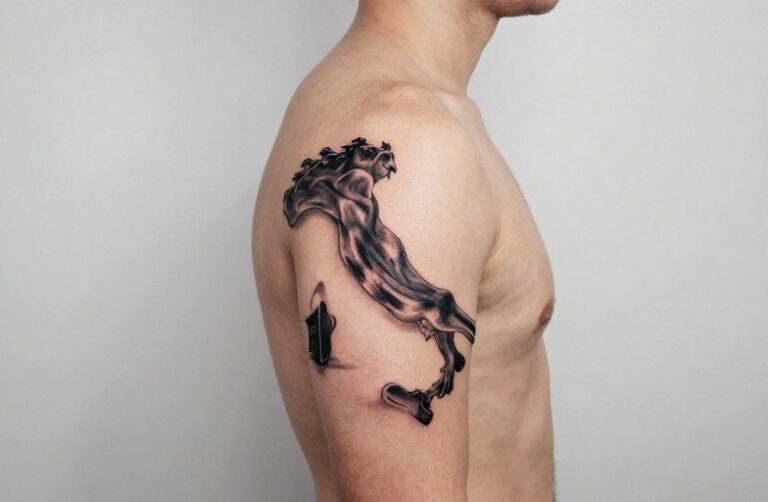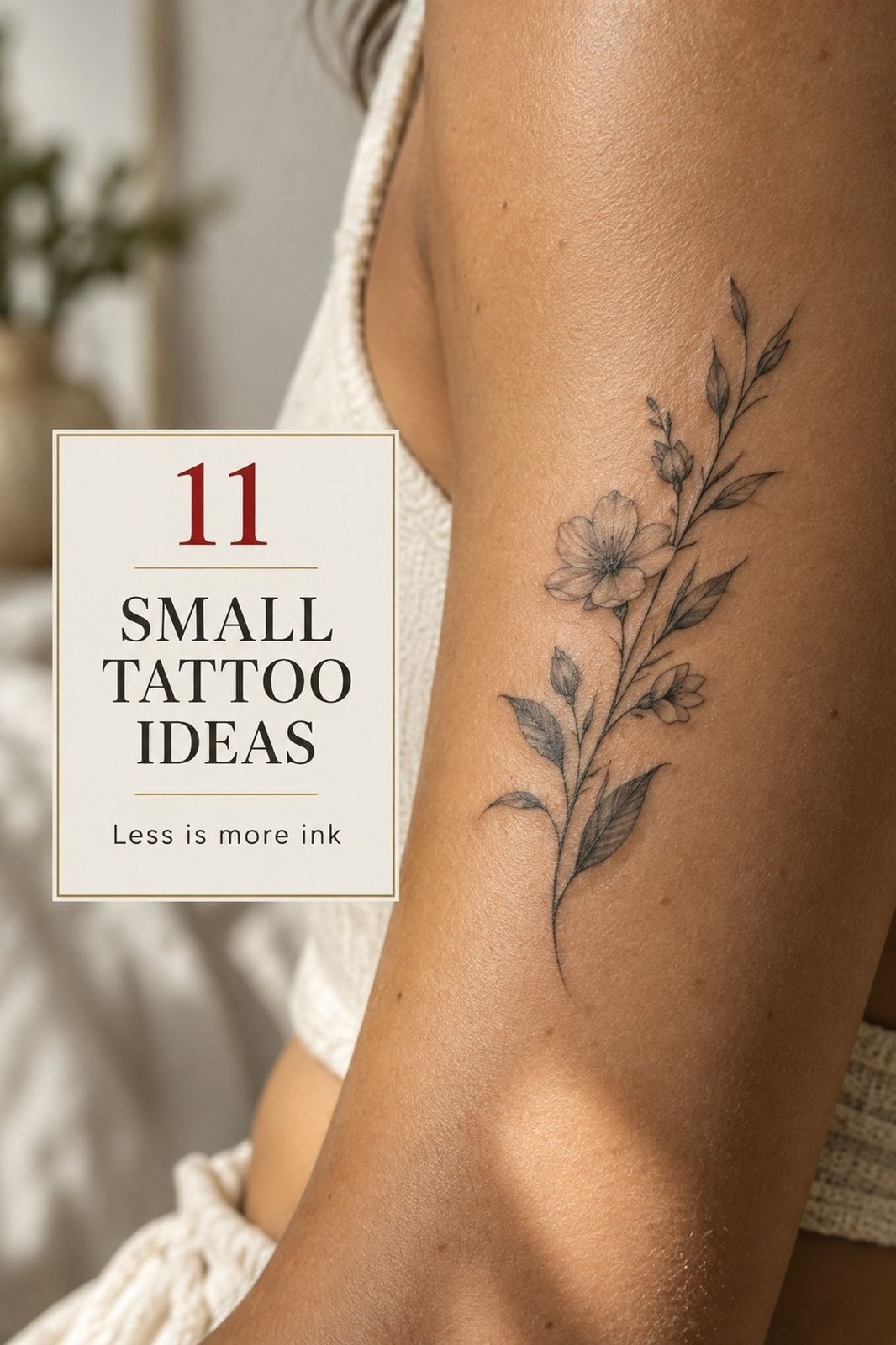
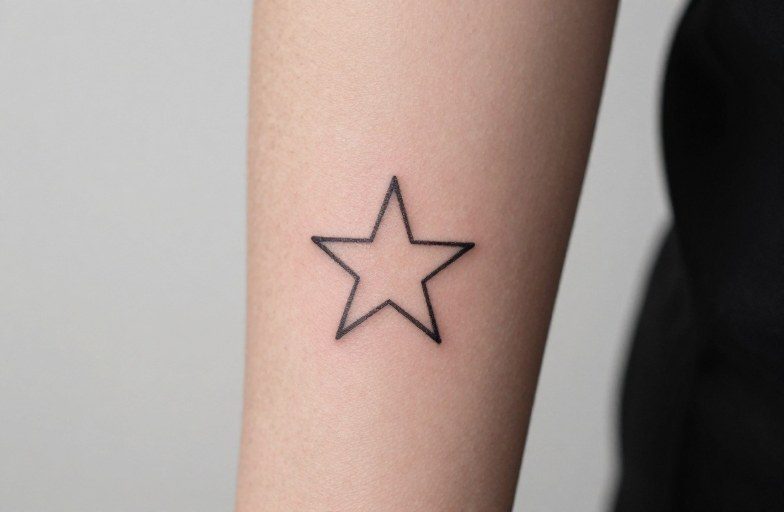
Minimalist star tattoos strip away the noise. A few millimeters of black ink, a single continuous line, maybe a cluster of three dots, nothing extra, nothing to hide behind. This restraint demands precision. The tattoo has to hold up because there’s no shading to distract from a wobble, no color to mask a blowout. Stars work especially well at this scale because their geometry is immediately readable even at fingernail size, and the symbol carries enough weight across cultures that you don’t need to explain it.
Size & Scale
The sweet spot for minimalist stars sits between 8mm and 25mm. Below 8mm, lines can spread during healing and the shape collapses into a blob. Above 25mm, the “minimalist” label starts to strain unless the design is deliberately sparse.
Single Star vs. Constellation Spacing
One isolated star reads as a mark, a punctuation point. Multiple stars need breathing room, at least 3mm between elements at small sizes, more if they’re connected by thin lines. Those connecting lines age poorly if they’re too fine; 0.3mm is the practical floor for most skin types, and even that will soften over five to ten years.
Line Weight and Aging
Minimalist work lives or dies by line weight. A single-needle star looks crisp for six months, then fuzzes. A three-needle round liner at slightly heavier weight, think the diameter of a sewing needle, not a hair, holds its geometry for years. The tradeoff is subtle: slightly bolder, slightly less “delicate,” but actually readable in decade-old photos.
Standout Design Ideas
Not all minimalist stars are created equal. The difference between generic and memorable usually comes down to one deliberate choice in the geometry.
- Hand-poked five-point stars: Slightly irregular points, visible needle texture, no machine buzz. The imperfection becomes the point.
- Open stars: One or two points don’t connect, creating negative space that moves with the body.
- Dot-to-dot constellations: No solid lines at all, just carefully placed dots forming Ursa Minor, Cassiopeia, or a personal pattern.
- Overlapping thin stars: Two or three identical stars offset by millimeters, creating a moiré effect that shifts as you move.
- Single continuous line: The star drawn without lifting the needle, often with a tail that loops into an abstract curve.
Each of these approaches ages differently. Open stars and dot-to-dot work stay cleaner longer because there’s less ink density to spread. Continuous line designs can blur where curves cross themselves.
Trending Variations
What’s current in 2024-2025 isn’t necessarily what will look good in 2035, but some directions have enough structural integrity to outlast the trend cycle.
Astrological and Astronomical Hybrids
Minimalist stars paired with planetary glyphs, orbital ellipses, or phase-of-moon arcs. The star stays central; the extra elements stay thin enough to read as annotation rather than clutter. These work best when the secondary symbol is placed asymmetrically, above or below, not framing.
Micro-Realism Meets Geometry
Some artists are rendering actual stellar photography, solar flares, nebulae, at thumbnail scale using single-needle stippling. The result reads as a textured star from a distance, reveals density variation up close. This is technically demanding and requires an artist with specific stippling experience; the technique isn’t forgiving of error.
For First-Timers
A minimalist star is a common first tattoo for good reason: low pain, quick session, easy to conceal, hard to regret. But that same low stakes can lead to sloppy decisions.
- Research the artist’s healed work, not just fresh photos. Instagram fresh shots lie; healed photos on their portfolio or Reddit threads tell the truth.
- Ask specifically about their experience with small blackwork. Not every talented color artist can control a single needle for twenty minutes.
- Budget for quality. A 15-minute tattoo shouldn’t cost $200, but if someone’s charging $40, they’re not spending time on stencil placement or sterile setup.
- Consider the commitment of visibility. Wrist and hand stars are professional non-issues in most fields now, but they’re still there in every job interview handshake, every wedding photo.
First tattoos also heal differently, more swelling, more anxiety about every stage. A simple star lets you learn your body’s healing pattern without worrying about color saturation or large scabbed areas.
Tips for Choosing
The decision process matters more than the design itself. Here’s how to think through it without spiraling.
Reference Discipline
Collect images, then delete 80%. What’s left will show your actual preference, not your Pinterest algorithm. Look for consistency: are you drawn to sharp angles or soft? Isolation or grouping? Pure black or slight graywash? Bring that narrowed mood board, not a hundred screenshots.
Artist Matching
Minimalist tattooing is its own specialization. An artist who does bold traditional sleeves might technically execute a tiny star, but their muscle memory is tuned for different speeds, different needle angles. Search for portfolios where small blackwork appears repeatedly, not as an exception.
During consultation, pay attention to whether they adjust your placement suggestion. A good artist will move a wrist star two millimeters to avoid a tendon or a spot that sees constant friction. That’s the expertise you’re paying for.
Best Placements
Skin thickness, sun exposure, and movement all affect how minimalist stars age. Some spots are forgiving; others punish fine lines.
- Inner forearm: Flat, stable, easy to show or hide. Lines age well here; the skin doesn’t stretch dramatically with most movement.
- Behind the ear: Trendy but tricky. The area swells significantly during healing, and hair products can irritate. The tattoo also sits in a shadow, making it hard to see without a mirror.
- Collarbone: Visually striking, but sun exposure is constant unless you’re diligent with SPF. A faded star here looks like a mistake, not a choice.
- Ankle/heel: High friction from socks and shoes, slow healing, significant blur potential over time. Fine lines don’t survive well.
- Finger: Near-guaranteed fade and blur. Hand tattoos are a separate commitment; a minimalist star here becomes a gray smudge within a few years unless touched up regularly.
- Ribcage: Hidden, personal, but painful and prone to stretching with weight fluctuation. Good for something you want to feel more than display.
The best placement balances your daily life, how you dress, how you move, how much sun you get, with the technical reality of how skin behaves in that location.
The Bottom Line
A minimalist star tattoo succeeds when every decision is intentional: the exact angle of the points, the precise millimeter of placement, the specific needle configuration, the artist whose hands have done this shape a hundred times. The simplicity isn’t laziness. It’s the discipline of removing everything that doesn’t serve the core idea. Done well, it’s permanent geometry that stays legible, stays meaningful, and stays quiet, no explanation required, no story to tell.
Frequently Asked Questions
How small can a minimalist star tattoo be before it blurs?
Below 8mm, five-point geometry starts to collapse during healing as lines spread slightly. For long-term clarity, 10-15mm is the practical minimum for a single star. Constellations need more total space to maintain separation between elements.
Do minimalist star tattoos hurt more or less than larger pieces?
Less, generally, because the session is shorter and there’s less repeated trauma to the same area. However, certain placements like the collarbone or ribs hurt regardless of size due to thin skin over bone.
Can I get a minimalist star tattoo touched up if it fades?
Yes, and black line work touches up well. But repeated touch-ups on the same spot can cause scar tissue buildup, so it’s better to start with slightly heavier line weight than to plan for annual refreshers.
What’s the difference between a hand-poked and machine-done minimalist star?
Hand-poked (stick-and-poke) creates a softer, more organic line with visible texture variation. Machine work is more uniform and typically faster. Hand-poked heals with less initial trauma but requires an artist specifically experienced in the technique for clean results.