The moon compresses a lot into a small shape: cycles, change, light in darkness, the pull of something bigger. A minimalist version strips that down to its essence, just enough line or dot to register. The trick is knowing what survives simplification and what needs the detail back. These tattoos age well when the design accounts for how ink spreads and how skin moves. Here’s the practical side of getting one that holds up.
Best Placements
Small moons reward spots where the natural curve of the body echoes the shape. Placement also determines how fine your lines can be.
Behind the Ear and Hairline
A crescent tucked here follows the skull’s curve and stays visible with short hair or updos. The skin is thin and oily, so linework needs to be slightly heavier than you’d use on a forearm, think 0.25mm to 0.35mm lines, not hair-thin. Black ink only; color fades fast in this area from sun exposure and natural exfoliation.
Wrist and Inner Forearm
Classic for a reason. The flat plane lets a moon sit straight, and the visibility means you see it daily. Inner wrist skin is softer and holds detail longer than the outer wrist, which takes more abuse. Vertical crescents work well here; full circles tend to look like smudges from a distance unless they’re large enough to define.
Ankle and Collarbone
Both carry a moon naturally. The ankle bone’s protrusion can distort a design over time as the skin stretches and compresses with movement. Collarbone placement sits beautifully but hurts more, thin skin over bone, and will need touch-ups sooner than fleshier areas. Rib and sternum placements work for larger minimalist designs, but the moon’s simplicity usually suits smaller scale.
Matching & Pairing Ideas
The moon pairs with specific imagery better than others because of actual astronomical relationship, not just aesthetic matching.
- Sun and moon: The visual contrast of solid black circle versus hollow crescent, or line versus filled shape. Works as matching tattoos with a partner or as a single composition on one person.
- Stars: Small dots or single-line starbursts near a crescent. Keep count low, three to five. More than that and the minimalist effect breaks into clutter.
- Mountain or wave silhouette: The moon sits above or behind, creating horizon lines. The mountain anchors the floating quality of a lone moon.
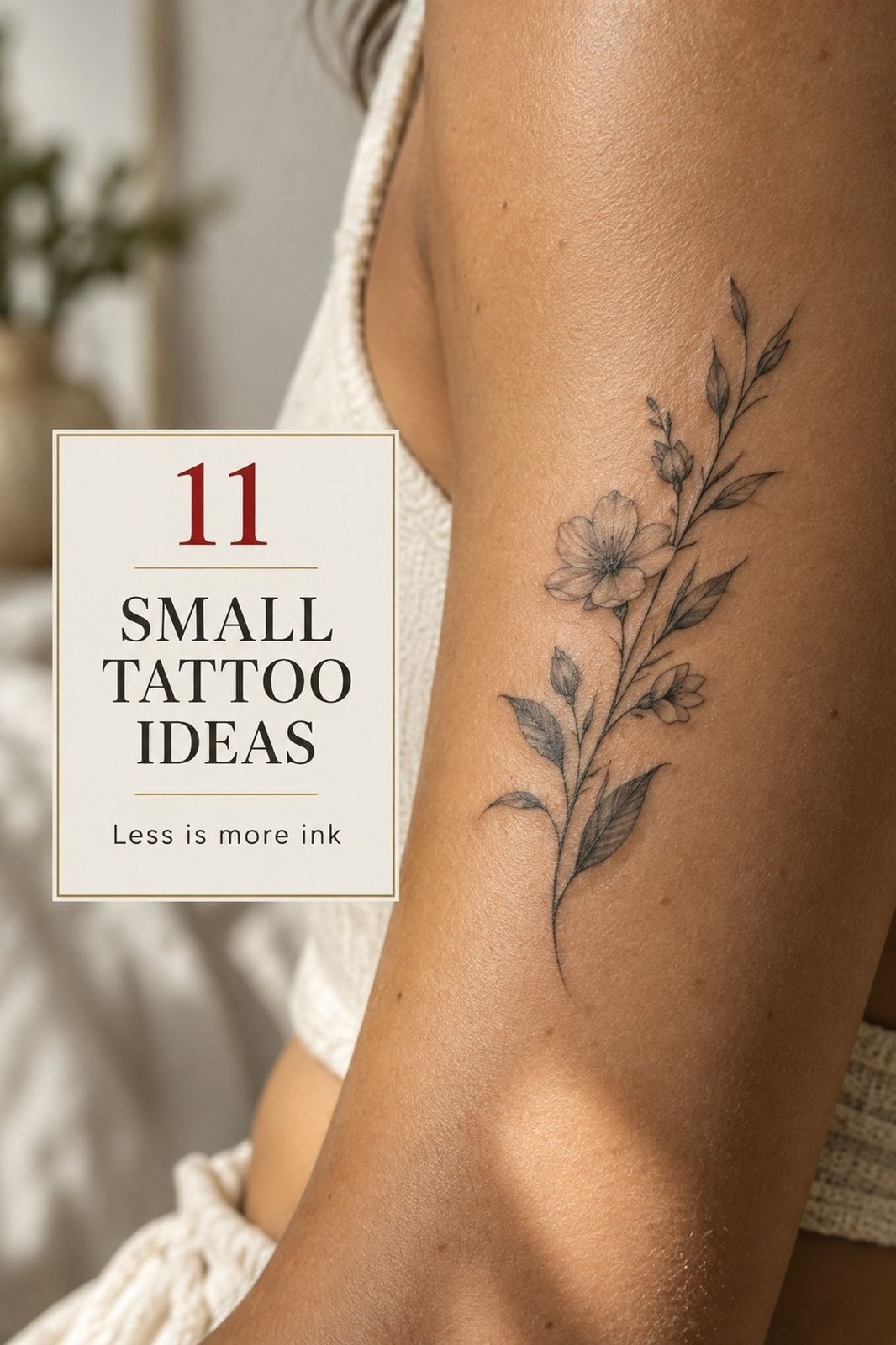
- Floral stem: A single line with a small bloom, the moon as negative space or background. Orchid or poppy work better than roses, which carry too much visual weight in their layered petals.
For actual matching tattoos between two people, consider phase pairs, one person gets waxing crescent, the other waning, rather than identical copies. The connection reads without being literal.
Tips for Choosing
Size and Longevity
Tiny moons, under an inch, blur faster than you’d expect. A 1.5-inch crescent gives the line enough room to breathe and the artist enough space for consistent needle depth. Solid black fill ages more predictably than stippled or gradient shading, which can look patchy as dots spread or tones settle unevenly.
Line Weight and Style Consistency
Decide early if you want single-line continuous work or multiple clean strokes. Single-line moons have a specific fluid look but require an artist experienced in that technique, one wobble ruins the whole piece. Multi-line versions are more forgiving and easier to touch up. Don’t mix: a single-line moon with a traditionally lined sun beside it looks like two different tattoos.
Phase Selection
Each phase carries different visual weight:
- New moon: Hard to render minimally, often reads as a circle or absent. Usually needs context (stars, surrounding space) to register as moon rather than dot.
- Crescent: Most popular for good reason. Recognizable at small sizes, dynamic curve, works in any orientation.
- Half moon: Strong geometric presence. Divides space cleanly, good for pairing with text or other symmetrical elements.
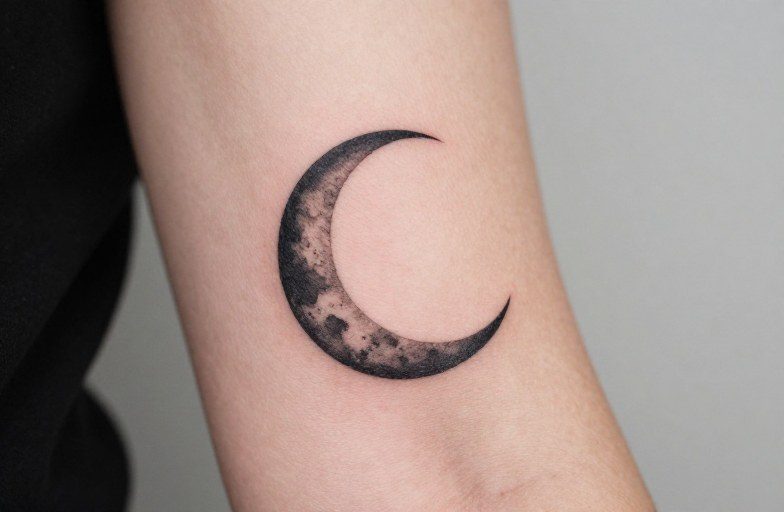
- Gibbous and full: Need more size to avoid reading as plain circle. Full moons work well with crater detail or subtle texture, which pushes them slightly out of strict minimalism but keeps them restrained.
Trending Variations
What’s actually showing up in shops now, not just on Pinterest.
Negative Space Moons
The moon shape is carved out of a larger black fill, solid black sky, skin-tone crescent. Striking when fresh, but the black fill requires heavy saturation and heals with more scabbing than linework. The contrast is dramatic for the first few years, then the black may soften to dark grey while the skin tone stays constant, actually improving the effect for some.
Orbit Lines and Geometric Frames
A thin ellipse around the moon suggesting orbital path, or a perfect circle framing it. These add structure without adding complexity. The ellipse must be geometrically true; hand-wobbled circles look accidental, not minimalist. Some artists use single-needle rotary machines for this, others freehand with tight grouping, ask to see healed examples of their fine circles specifically.
Micro Realism Shift
Very small moons with subtle crater shading, almost greywash but restrained to a few tones. Pushes against “minimalist” technically but fits the spirit when kept under two inches. Requires an artist who specializes in small-scale black and grey; generalist shops often over-darken these, losing the subtlety.
Popular Styles
Not every minimalist moon looks the same. The style label changes the approach.
- Fine line: Needles grouped tight, often single needle or 3RL. Delicate, but the lines must be dark enough to survive. Best on pale, untanned skin where contrast does the work.
- Blackwork: Heavy solid fill, sharp edges. The moon becomes a graphic shape rather than a suggestion. Holds up longest, suits larger placements or negative space designs.
- Hand-poked: No machine, dot by dot. Slightly irregular line quality that reads as organic rather than imperfect. Heals with less trauma, good for small pieces, but takes longer to apply and costs more per hour.
- Stick-and-poke aesthetic with machine: Artists mimicking the hand-poked look for consistency and speed. Ask directly which they do; the healing difference matters.
Standout Design Ideas
Specific compositions that solve common problems.
The Hanging Crescent with Thread
A crescent suspended from a single vertical line, like a pendant or a plumb line. The line gives it placement context, reads intentional rather than random. Works vertically on sternum, spine, or forearm. The thread must be dead straight; any curve looks like a mistake.
Phase Sequence
Three to five tiny moons in a row showing progression. Best placed where the body has natural horizontal: collarbone, forearm, ribs. Spacing is everything, equal gaps, consistent size, identical line weight. One slightly off and the whole sequence looks amateur.
Moon as Letter or Punctuation
A crescent replacing the dot on an ‘i’, or standing in for a circular letterform in a word. Requires custom lettering design; don’t drop a stock moon image onto existing text. The curve must match the typeface’s character or the integration fails.
Overlapping Double Moon
Two crescents, one slightly offset, creating a lens or eye shape. Suggests eclipse without literal depiction. The overlap area needs clear decision: which moon is “in front,” how the lines interact. Ambiguity here looks like error, not poetry.
Key Takeaways
A minimalist moon succeeds on precision, not decoration. Prioritize clean line weight appropriate to your placement, size that allows the shape to read, and an artist whose healed work you can inspect. The moon’s symbolism is already present, you don’t need to load the design with extra elements to justify it. Single needle and fine line are techniques, not guarantees of quality; the healed result matters more than the fresh photo. If you’re drawn to this image, the simplest version is often the one you keep loving. Complexity can be added later; a blown-out intricate moon can’t be simplified after the fact.
Frequently Asked Questions
How small can a minimalist moon tattoo be before it starts to blur?
Under one inch risks significant spread and loss of definition within a few years. One and a half to two inches gives the line enough room to hold its shape as the ink settles and the skin ages.
Do minimalist moon tattoos hurt more in certain placements?
Bone-adjacent areas like collarbone, ankle, and sternum hurt more due to thin skin and lack of cushioning. Fleshier spots like the outer forearm or thigh are more manageable for first tattoos.
Can I add color to a minimalist moon design?
Solid black ages most reliably. If you want color, a muted blue or grey wash works better than bright yellows or oranges, which fade fast and can look muddy when they do.
How do I find an artist who specializes in this kind of fine linework?
Look for healed photos in their portfolio, not just fresh work. Ask specifically about their experience with single-needle or tight grouping, and whether they have examples of small geometric pieces after one to two years of aging.