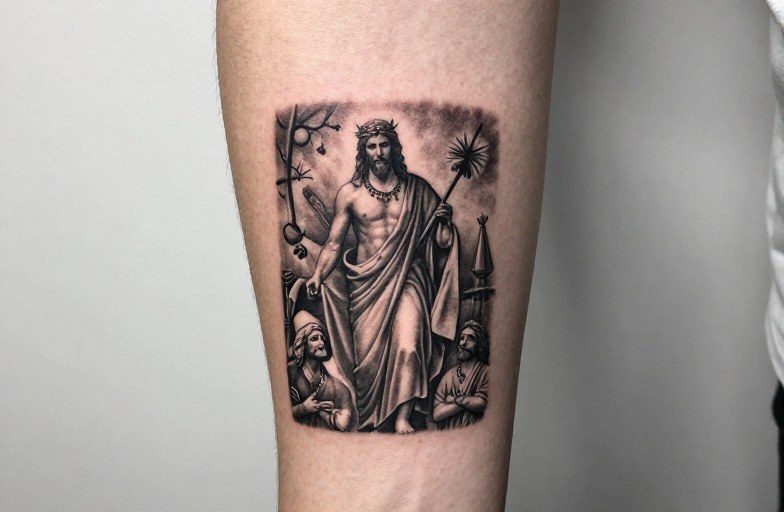
Biblical tattoos carry weight. The words and symbols reference millennia of history, personal faith, and cultural memory. But translating scripture into skin requires more than picking a favorite verse. Lettering too small blurs. Placement too visible creates professional friction. Imagery without context reads as generic. This guide breaks down what actually works, design, placement, color, and style, so your biblical piece reads clearly at twenty years, not just twenty days.
Color Choices
Black and grey dominates biblical work for good reason. It ages cleaner, stays readable longer, and suits the gravitas of religious subject matter. That said, color has its place when used deliberately.
When Black and Grey Wins
Script-heavy pieces, full verses, chapter references, Greek or Hebrew text, need the contrast that solid black ink provides. Over time, black settles slightly blue-grey in the skin, a natural process that actually softens lettering without destroying legibility. Color in text, by contrast, tends to muddy. Reds become brownish, blues fade to grey-green. For anything you want readable at arm’s length, stick to black.
Strategic Color Accents
Some biblical imagery benefits from restrained color. A small crimson thread in a David-and-Goliath composition. The faint gold halo on a saint’s head. The green of olive branches in a piece referencing Gethsemane or Romans 11. These touches work best as accents, not foundations. Ask your artist about muted earth tones, ochre, burnt sienna, deep olive, rather than saturated primaries. They fade more gracefully and maintain the sober tone biblical subjects deserve.
- Black ink for all text and fine linework
- Earth tones for natural imagery (olive, fig, desert scenes)
- Red sparingly: blood of the lamb, scarlet thread, Pentecost flame
- Gold as highlight only, never fill, yellow ink has poor longevity
Best Placements
Where you put a biblical tattoo changes how it’s read, by others and by you. Rib pieces stay private. Forearms announce. The choice should match both your daily life and the passage’s personal significance.
Visible but Professional
Inner forearms and outer biceps carry text well. They’re flat enough for clean lettering, visible when you choose, coverable with sleeves. The side of the calf works similarly. These spots suit verses you want to reference in conversation, or imagery that functions as personal witness.
Intimate Placements
Ribs, sternum, upper thigh, and shoulder blade keep the work closer. These suit deeply personal passages, something between you and your understanding of the divine. The rib cage curves, so script needs careful layout to avoid distorting letters. Thighs offer large, flat canvas for narrative scenes: Daniel in the lions’ den, the burning bush, Peter walking on water.
- Forearm: best for single verses, short phrases
- Upper back/shoulder blade: large scenes, full compositions
- Ribs: personal text, but challenging for long passages
- Calf: medium imagery, good for vertical compositions
- Behind ear: tiny symbols, ichthys, chi-rho, small crosses
Standout Design Ideas
Moving beyond obvious crosses and John 3:16 opens stronger work. The biblical text offers visual language that predates and transcends contemporary tattoo trends.
Architectural and Object Imagery
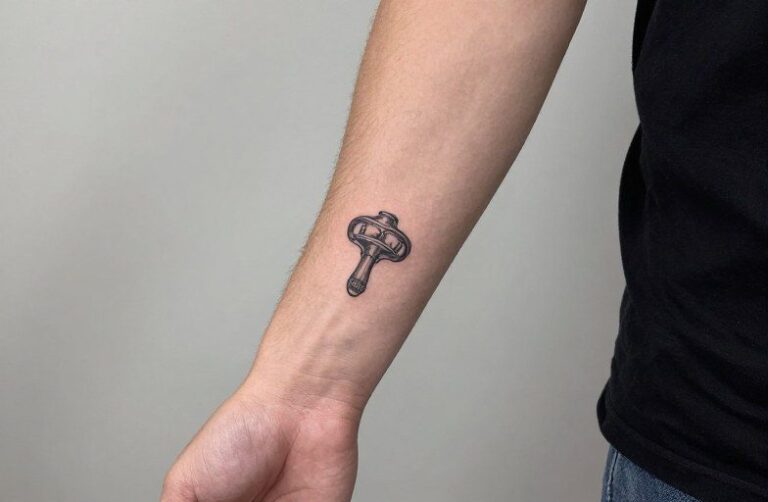
The ark of the covenant, mercy seat, or bronze serpent pole carry specific narrative weight without being overused. A broken jar of alabaster references the woman who anointed Jesus, intimate, costly worship. The fig tree, cursed and withered, makes for stark, memorable imagery about fruitfulness and judgment. These objects require research to render accurately, but reward that effort with depth.
Text as Image
Hebrew calligraphy, Greek uncial script, or even Ge’ez for Ethiopian Christian tradition turns language into visual form. The Shema in Deuteronomy 6:4, rendered in Paleo-Hebrew script. The first lines of John’s Gospel in koine Greek. These function as text and design simultaneously. Work with a letterer who understands the script’s formal rules, not just its approximate shapes. Bad Hebrew or Greek is unfortunately common and immediately obvious to readers of those languages.
- Tree of life with twelve fruits (Revelation 22)
- Lion of Judah combining animal and tribal imagery
- Dove with olive branch in minimalist line work
- Hands of the high priest blessing (Aaron’s blessing, Numbers 6)
- Manna jar, Aaron’s rod, budding, triple reference to God’s provision
Trending Variations
Contemporary biblical tattooing has moved toward restraint and hybrid approaches. The maximalist, photorealistic religious sleeve still happens, but more collectors want integration, not declaration.
Minimalist Symbol Work
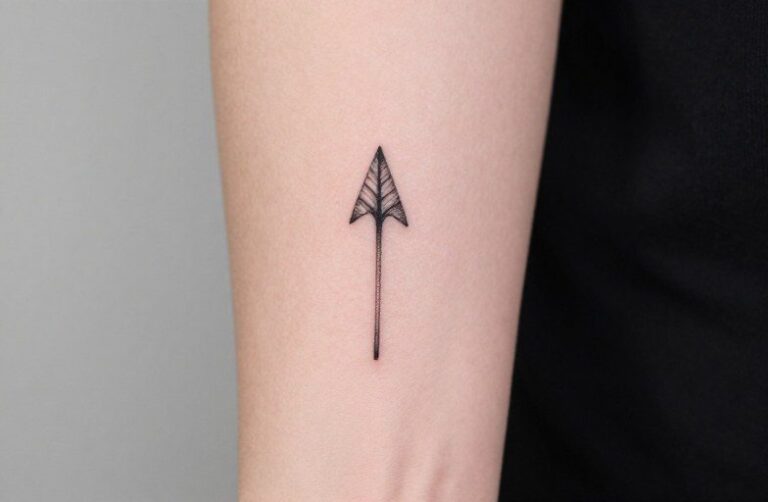
Single continuous lines forming a fish, an anchor, or the chi-rho monogram. These read as design first, faith second, subtle enough for mixed company, specific enough for personal meaning. The trend works because it trusts the symbol’s accumulated weight rather than adding ornament. Placement tends toward wrist, collarbone, or ankle, small enough to be discovered rather than displayed.
Combined Imagery
Biblical symbols merged with natural forms: the tree of life rendered as an actual oak species native to the wearer’s region. The good shepherd as a figure in contemporary dress, not classical drapery. This approach, often linked to Celtic Christian artistic tradition, roots ancient text in present geography. It risks sentimentality if done poorly, but succeeds when the natural detail is observed and specific rather than generic.
- Single-needle script with no outline, just whispered text
- Negative-space crosses formed by surrounding imagery
- Biblical scenes in Japanese woodblock-inspired composition
- Stylized manuscript illumination borders framing modern text
For First-Timers
Your first tattoo shouldn’t be half a sleeve, and biblical subject matter deserves extra consideration because you’ll live with its implications long-term.
Start Small, Stay Specific
A single word in original language, hesed (covenant faithfulness), agape, shalom. One small symbol in a discreet spot. This lets you learn how your skin takes ink, how you feel about permanence, and whether you want to build outward. Many who start with a full verse later wish they’d chosen more carefully; those who start with one word often deepen the collection thoughtfully.
Research Before You Commit
Verify your verse reference. Verify your translation. Verify your Hebrew, Greek, or Aramaic with someone who reads it, not just an online generator. I’ve seen Philippians 4:13 rendered with the wrong chapter number, and Hebrew with letters facing backward. The embarrassment lasts longer than the tattoo. Bring your artist multiple source images, not just one screenshot.
- Wait six months after choosing your design before booking
- Check how the verse reads in multiple translations
- Consider whether the passage’s context matches your intended meaning
- Ask: will I still want to explain this at sixty?
Popular Styles
Style choice shapes how biblical content reads. A photorealistic crucifixion carries different emotional weight than the same scene in traditional American bold lines. Neither is wrong; they’re different languages.
Traditional and Neo-Traditional
Bold black outlines, limited color palette, strong readable shapes. This style suits biblical imagery because it was developed partly for sailor and soldier tattoos, symbols meant to be identified at distance, under strain. The good shepherd, the anchor of hope, the ship of the church: these read immediately in traditional vocabulary. The style’s limitations become strengths; you can’t get lost in excessive detail.
Blackwork and Woodcut
Heavy black, high contrast, sometimes dotwork texture. References the illustrated Bibles of the fifteenth and sixteenth centuries, when woodcut and metal engraving were the primary reproduction methods. This style carries historical resonance for biblical subjects and ages exceptionally well, the solid black doesn’t depend on subtle grey washes that blur over decades. Artists working in this mode often study Albrecht Dürer’s religious prints directly.
- Traditional American: bold, readable, historically appropriate
- Blackwork/woodcut: archival, dramatic, references print history
- Fine-line single needle: delicate, contemporary, risks faster aging
- Realism: technically demanding, requires excellent artist, can age poorly on small scale
- Illustrative/etching style: detail-oriented, suits narrative scenes
Key Takeaways
Biblical tattoos succeed when design serves content. Black ink preserves text. Original languages reward study. Placement matches your daily life and the passage’s intimacy. Style choices carry emotional and historical weight. Start smaller than you think, verify everything, and choose an artist who respects the material enough to research it with you. The best biblical tattoos don’t shout their reference; they invite the curious to ask, and the wearer to remember.
Frequently Asked Questions
How do I make sure Hebrew or Greek text is tattooed correctly?
Work with a letterer who reads the language, not just copies shapes. Bring multiple source images including typed and handwritten references. Verify with a native reader or academic if possible, online generators frequently error.
Will a full Bible verse on my forearm still be readable in ten years?
Probably not if the lettering is small. Text blurs as ink spreads slightly in skin. For longevity, keep script at least 1/4 inch tall, use bold clean fonts, and avoid ornate cursive. Consider shorter phrases or key words instead.
Are biblical tattoos considered disrespectful in some traditions?
Some Jewish interpretations of Leviticus 19:28 prohibit tattoos entirely. Many Christian traditions have no issue. If your faith community matters to you, consider their perspective before committing. Your body, but relationships have weight too.
What’s the best style for a first biblical tattoo?
Traditional or neo-traditional offers the best balance: readable, time-tested, and technically forgiving. The bold lines hold up well and the style’s symbolic approach matches biblical content naturally without requiring excessive detail.