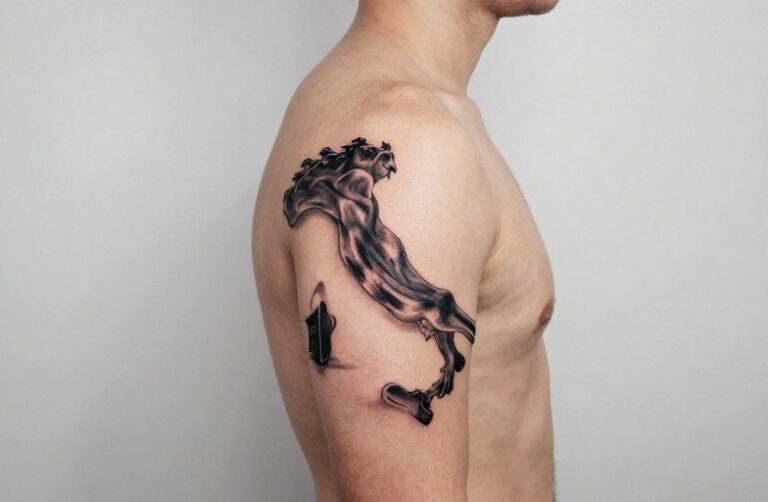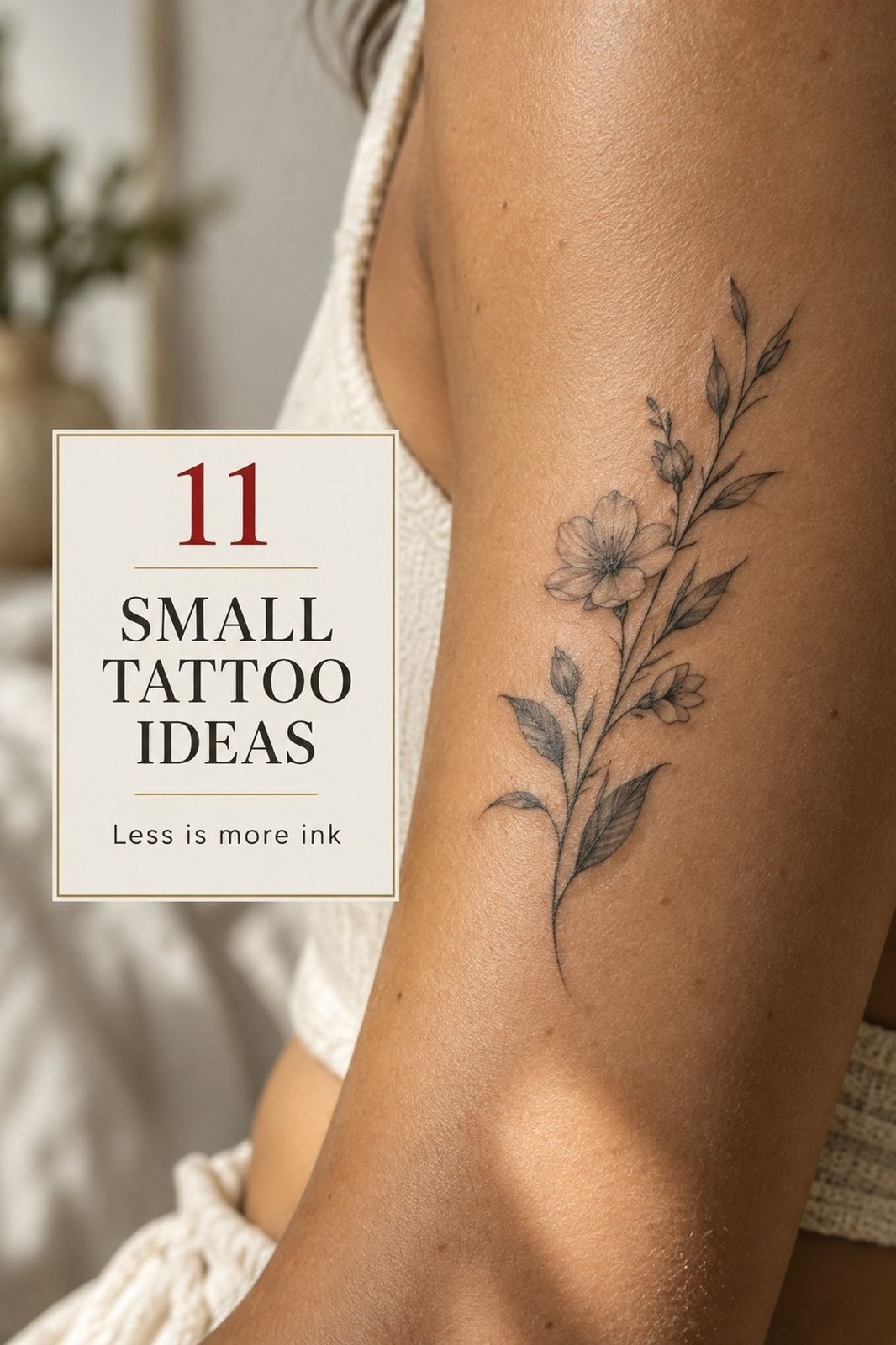
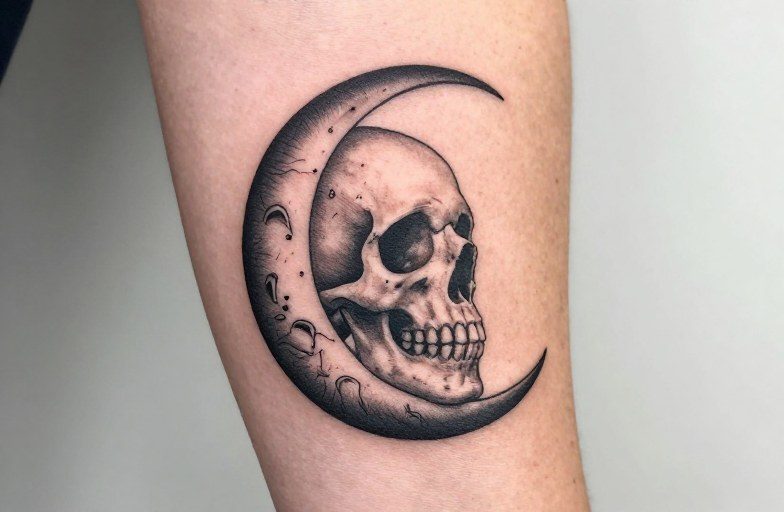
Crescent moon and skull tattoos hit that sweet spot between celestial wonder and macabre cool. The curved horn of the moon cradles a skull like a dark nursery rhyme, or the skull bites into the moon like something hungry. Either way, this pairing carries weight without needing explanation. Here’s how to get it right.
Tips for Choosing
Decide Who Eats Who
The composition changes everything. A skull nested inside the crescent moon reads protective, almost womb-like. Flip it so the skull overlaps or breaks through the moon’s curve, and the tone shifts to something more aggressive, more lunar eclipse with teeth. Small skulls scattered along the moon’s inner edge create a beaded, ritual feel. One dominant skull centered in the crescent anchors the design and draws the eye immediately.
Consider the Moon’s Direction
A waxing crescent (points right) traditionally suggests growth, emergence. Waning (points left) leans toward release, endings. Most people choose based on visual flow with their body’s lines rather than symbolism, but the direction does affect how the tattoo moves with you. Right-pointing crescents follow the natural sweep of a forearm or calf; left-pointing can counterbalance that flow for something more deliberately unsettling.
Trending Variations
Botanical and Organic Skulls
Flowers pushing through eye sockets, mushrooms sprouting from cranial seams, roots threading through nasal cavities, these living-dead hybrids are everywhere right now. The moon becomes a garden bed or a night sky backdrop rather than the main container. Roses and peonies soften the skull without weakening it; wildflowers and dried seed heads keep things stranger, less romantic.
Cosmic Deconstruction
Some of the strongest recent work dissolves the skull into star fields. The cranium becomes negative space filled with constellations, or the moon itself fragments into geometric shards around a half-visible skull. This plays beautifully with dotwork and stipple shading, where density of ink creates the illusion of depth without hard outlines. The effect is ghostly, less literal, more open to interpretation.
Matching & Pairing Ideas
These designs companion well with specific imagery. A crescent moon skull paired with a matching sun piece on the opposite limb creates balance, have the sun hold a living face, perhaps, or an animal skull for contrast. Moth or bat wings extending from the moon’s horns turn the composition into something that flies. Snake bodies coiled through the crescent add movement and danger.
- Matching set: one partner gets the moon-skull, the other gets a sun with a different skull or living face
- Opposite limbs: forearms, calves, or thighs for visual balance when standing together
- Adjacent tattoos: hourglasses, nooses, or coffin shapes that share the memento mori theme
- Above/below pairings: a crescent moon skull on the chest with a full moon phase strip down the ribs
For couples or close friends, identical small crescent moon skulls behind the ear or on the inner wrist carry private significance without broadcasting it.
Popular Styles
American Traditional
Bold black outlines, limited color palette, the skull rendered with exaggerated features and the moon in solid black or deep navy with a single white highlight. This style ages like iron. The simplicity reads instantly from across a room. Traditional crescent moon skulls often include a banner with lettering, though the image stands alone just fine. Expect thick lines, no subtle gradients, and a graphic punch that doesn’t soften over decades.
Black and Gray Realism
Here the skull gets every pore, every crack, every reflection of imaginary light. The moon becomes a textured sphere with visible craters, or stays flat and graphic to push the skull forward. Smooth black-and-gray shading requires more skin real estate to breathe, small realism blurs into muddy confusion as the ink spreads. Go palm-sized minimum, larger if you want the moon’s surface detailed too.
Linework and Etching
Fine parallel lines build tone without washes of black. The skull emerges from crosshatching like an old woodcut. This style stays crisp at smaller sizes and suits people who want the imagery without heavy coverage. The moon’s curve becomes an opportunity for elegant, unbroken contour lines. Healing is less forgiving, any scabbing or picking destroys fine detail permanently.
Best Placements
Where the Curve Fits
The crescent’s arc naturally follows certain body contours. The outer upper arm, wrapping slightly, lets the moon’s horns point toward shoulder and elbow. The side of the calf mirrors this flow. Ribs and hips can hold larger versions where the moon’s curve traces the body’s own geometry. Behind the ear, a tiny crescent moon skull becomes a secret, visible only when hair moves.
Flat Surfaces for Detail
The chest plate, upper back between shoulder blades, and outer thigh offer flat planes where the skull won’t distort with movement. These spots suit realism and heavy black fill. The moon’s interior can go solid black here without the ink pooling unevenly, which happens on bonier areas. Forearms work well for medium sizes visible daily, though sun exposure will fade the black faster than covered skin.
How to Personalize It
Generic crescent moon skulls flood image searches. The difference between flash art and yours lives in specific details. Add the constellation of your birth month scattered around the moon, rendered in white ink or left as negative space. Replace the skull’s teeth with something meaningful, small shapes, letters, or patterns that read abstract from distance. Incorporate a moon phase meaningful to a specific date: the exact thin crescent from a birthday, a loss, a beginning.
Color shifts everything. A blood-red moon behind a bleached skull reads apocalyptic; soft lavender and sage green suggest something more melancholy, more dream than nightmare. Metallic gold or copper ink in the moon’s highlight catches light strangely, though these pigments fade to yellow-brown over time and some artists refuse them entirely.
The skull itself offers endless variation. Animal skulls, cat, deer, bird, swap human mortality for something wilder. A child’s skull, rendered respectfully, carries devastating weight. A skull in profile rather than frontal view changes the composition’s silhouette entirely, stretching the crescent into a longer, more elegant curve.
Key Takeaways
Strong crescent moon skull tattoos succeed through clarity of composition and honest aging expectations. Bold traditional work holds up; delicate realism demands space and commitment to touch-ups. The moon’s direction, the skull’s treatment, and the specific combination of line versus black fill determine whether the piece feels like a classic or a trend. Most importantly, this imagery carries enough built-in resonance that you don’t need to overbuild it, let the two forms do their work, and trust your artist to find the specific version that belongs on your skin.
Frequently Asked Questions
Do crescent moon skull tattoos age badly because of the fine details?
The skull’s small details, teeth, eye socket cracks, nasal cavity, are the first to soften as ink spreads naturally over years. Bold-line traditional versions age significantly better than fine-line realism. If you want longevity, prioritize strong outer contours and let interior detail be suggestive rather than photographic.
Can a crescent moon skull work as a cover-up tattoo?
The solid black fill of the moon’s body can mask older work underneath, but the skull’s negative spaces (eye sockets, nasal opening) require clean skin to read properly. An experienced artist can sometimes position the moon’s dark portion over faded older ink while placing the skull on clearer skin.
How much should I expect to pay for a quality piece?
A palm-sized crescent moon skull in American traditional style typically runs $200-400 at a reputable shop. Black and gray realism of the same size doubles that range easily. Custom design fees, artist experience, and geographic location all shift the number significantly. This is not a design to bargain-hunt.
Is the crescent moon skull specifically a masculine design?
The imagery carries no inherent gender. The skull’s rendering and accompanying elements steer the feeling more than the core concept itself. Floral integrations, softer color palettes, and more rounded skull proportions read differently than aggressive line work and dark saturation, but the combination works across all presentations.