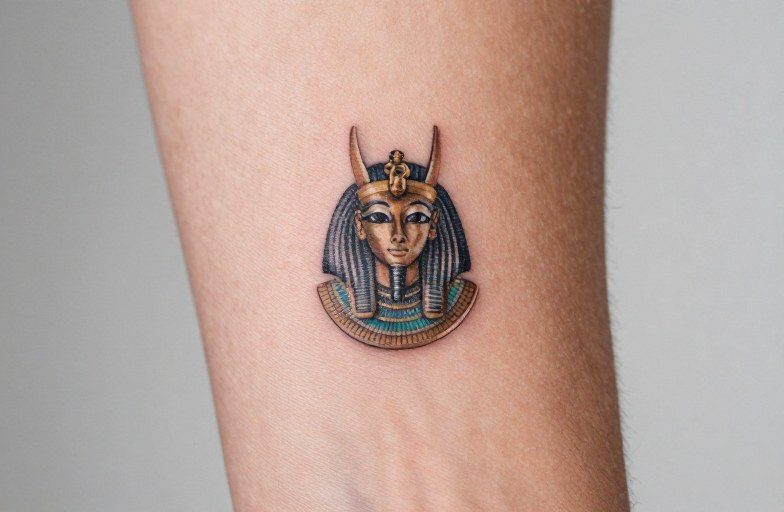
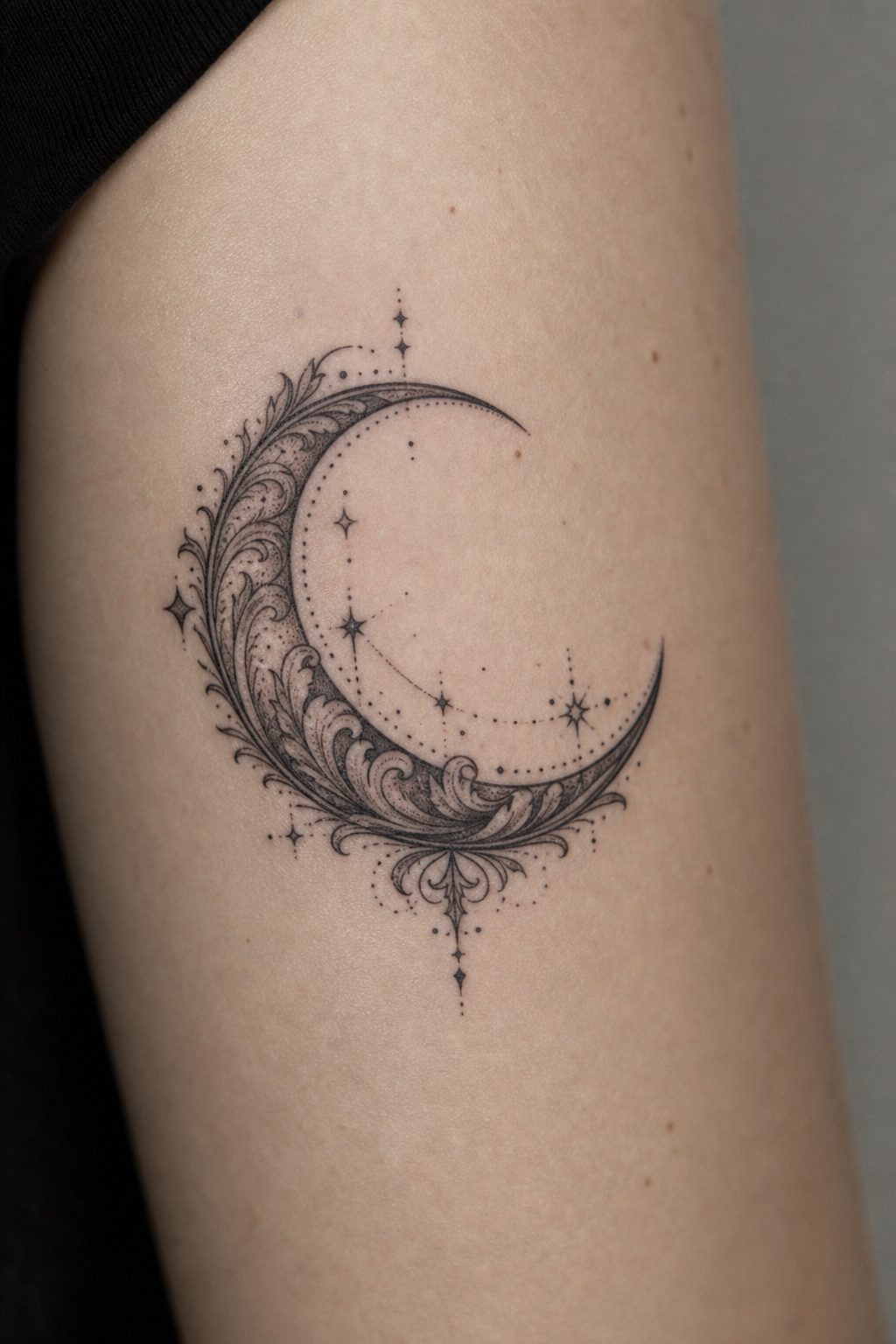
A detailed crescent moon tattoo can go in dozens of directions, fine botanical vines curling around the curve, cratered lunar surfaces rendered in dotwork, or Art Nouveau frames with face-like profiles. The shape itself is simple, which makes the detailing do the heavy lifting. What separates a moon that ages gracefully from one that blurs into a smudge is how the detail is distributed, how the lines are weighted, and where on your body it lives. This guide covers the concrete decisions that shape the final result.
Tips for Choosing Your Design Direction
Linework vs. Texture-First Approaches
Clean, single-weight linework around the crescent edge gives a graphic, almost stamp-like quality. It holds up well but can look flat if there’s no interior detail. Texture-first approaches, stippled craters, etched shading, or ornamental filigree, add depth but require more skin real estate to read clearly. A common sweet spot: a bold outer contour with finer interior work that doesn’t compete for attention. The eye needs somewhere to rest.
What “Detailed” Actually Means Here
Detail can mean precision (hair-thin lines, exact symmetry) or density (layers of small elements packed inside the shape). Precision-heavy designs need flat, stable skin, upper forearms, outer biceps, collarbones. Density works better where the skin sees some movement, since the overall composition survives minor spreading. Mix both on a single piece and you risk the fine lines disappearing while the dense areas turn muddy. Pick one dominant strategy.
- High-contrast crater shading pops on medium to dark skin tones when done with deep blacks, not gray washes
- Ornamental details (beading, filigree) along the inner curve frame the negative space; place them too close to the edge and they bleed together over years
- Facial features inside the moon, classic “man in the moon” style, need minimum 3 inches of height for the expression to stay readable
How to Personalize It
Integrating Secondary Motifs
Stars, moths, snakes, botanicals, and celestial bodies all pair naturally with lunar imagery. The integration method matters more than the motif itself. A snake wrapped around the crescent reads as one continuous form if the scales follow the curve’s flow; if it cuts straight across, it fractures the composition. Moths or butterflies positioned at the horn tips create visual tension that draws the eye along the arc. Hanging botanicals from the lower horn soften the shape, making it feel like a pendant or mirror frame.
Symbolic Specificity Without Cliché
Phases within the crescent, showing a thin sliver of full moon surface still visible, suggest transition. A cracked or fractured surface, rendered with careful white ink or negative space, reads as imperfection made visible. The orientation matters too: waxing (right-lit, horns pointing left) versus waning reverses the implied momentum. These aren’t universal symbols everyone recognizes, but they give the piece internal logic you can explain without reaching for generic “mystery of the night” language.
Best Placements
Flat Planes for Symmetry
The outer upper arm, front of the thigh, and sternum (between the breasts, not directly on bone) offer the most predictable surfaces for symmetrical crescents. The sternum in particular suits vertical orientations with dangling details, think chains, drops, or suspended elements that follow the body’s center line. On the upper arm, a horizontal crescent with horns pointing outward wraps slightly with the muscle, which can be used deliberately to give the moon a subtle three-dimensional quality.
Curved and Mobile Areas
Ribs, inner biceps, and calves introduce movement that distorts the shape with every shift. These spots favor softer, less rigid crescents, hand-drawn wobbles to the line, or organic details that excuse the natural skin stretch. A rigid geometric crescent on the ribs will look bent every time you breathe; a slightly irregular one with flowing interior vines just looks alive. Behind the ear and along the jaw’s edge work for small, horn-forward orientations that peek from hairlines.
- Upper back, below the neck: excellent for large pieces with radiating details; the skin stays relatively stable with age
- Side of the hand: high visibility but fast fading; best for bold, simple crescents without interior finework
- Ankle and foot: the crescent echoes the bone’s natural curve, but detail must be minimal due to thin skin and friction from footwear
Color Choices
Working With Black and Gray
Most detailed crescent moons live in black and gray, and for good reason. The moon’s actual surface reads as value shifts, not color. Crater depth comes from solid black cores with graduated gray halos, not from blue tinting. A common mistake: too much mid-gray without enough true black anchor points, causing the whole piece to look washed out after two years. Reserve the darkest blacks for the deepest shadows and the outer contour.
Strategic Color Accents
When color appears, it works best as isolated punctuation. A single gold tone for hanging stars or beading. Deep indigo or violet in the shadowed interior of the crescent, leaving the lit horn bright skin-tone. Red for a poppy or rose integrated at the lower horn, limited to that element, not scattered across the moon. Full-color lunar surfaces rarely age well; the subtle tonal shifts that sell realism blur into each other, and touch-ups are hard to match.
Standout Design Ideas
Architectural and Ornamental Frames
Crescents functioning as frames for portraits, eyes, or miniature landscapes have grown in popularity for good reason. The curve contains the detail, giving the composition natural boundaries. Art Deco sunburst rays extending from the outer edge, or Victorian mourning jewelry styling with hanging jet beads and ribbon loops, reference specific historical periods rather than generic “boho” aesthetics. The frame itself must be substantial enough to hold the interior; a thin wire-like crescent collapses under the weight of a detailed central image.
Topographic and Scientific Renderings
Actual lunar maps, Mare Tranquillitatis, Tycho crater’s ray system, translate into fascinating tattoo detail for those with astronomy leanings. These read as abstract patterning to most viewers, recognizable only to fellow enthusiasts. The detail level is extreme, requiring larger scale and experienced execution. Alternatively, a cutaway section showing layered geological strata, or a crescent dissolving into particle effects at one horn, plays with the form’s solidity.
- Double crescents interlocking or mirroring: creates negative-space stars or other shapes between them
- Crescent as vessel: hollow interior holding liquid, flame, or a miniature scene
- Scrimshaw-style etching: fine crosshatching mimicking carved bone or ivory, historically linked to sailor art
Size & Scale
Minimum Viable Detail
A detailed crescent needs room to breathe. At under two inches, crater stippling becomes indistinguishable from blur. Interior filigree lines merge. The absolute floor for a piece with both outline and interior detail is roughly 2.5 inches in the longest dimension. At that size, prioritize: one strong outer line, one clear interior focal point, and no more than three secondary elements. Everything else is noise that won’t survive.
Scaling Up for Impact
Large crescents, 6 inches plus, allow for graduated detail density. The horns can stay relatively clean, drawing the eye inward to complex central zones. This creates visual hierarchy: the shape announces itself from distance, the detail rewards closer inspection. Large-scale pieces also accommodate more dramatic shading gradients, from near-white at the lit edge to deep charcoal in the shadowed interior. The trade-off is commitment to a single dominant placement and the session time required for proper saturation.
Scale affects line weight too. A detail-heavy small piece needs uniformly fine lines; scaled up, those same lines would look scratchy. Larger crescents demand bolder contours with variation, thick outer, medium secondary, fine tertiary, to maintain structure at viewing distance.
Before You Decide
Look at healed photos, not just fresh work. Fine lines in a crescent’s interior can look crisp on day three and fuzzy by month six. Ask specifically about how the artist’s similar pieces have aged. Bring reference that shows the detail level you want, but trust the artist to translate it into line weights that survive. Consider your own skin’s behavior: oily skin spreads ink faster, dry skin holds fine detail longer but may heal patchy. The moon is ancient and common imagery; your version should be specific enough that someone else’s doesn’t substitute for it. Sleep on the design. The crescent has patience built into its shape, half there, half waiting, so there’s no rush to fill it completely.
Frequently Asked Questions
How much detail can realistically fit in a small crescent moon tattoo?
At under 2.5 inches, stick to a bold outline plus one clear interior element. Multiple fine details blur together within a couple years. If you want dense crater work or filigree, plan for at least 3-4 inches.
Do crescent moon tattoos fade faster on certain body parts?
Hands, feet, and inner fingers fade fastest due to friction and thin skin. The upper arm, outer thigh, and upper back hold detail significantly longer with less sun exposure and mechanical wear.
What’s the difference between stippling and smooth shading for lunar craters?
Stippling (dotwork) creates texture and reads well at small sizes but takes longer to execute. Smooth gray-wash shading looks more photographic but requires more skin real estate and can muddy if overworked. Many artists combine both.
Can a detailed crescent moon be covered up or modified later?
The curved shape and typically dark interior make crescents moderately difficult to cover. The horns offer some extension possibilities, but dense interior detail limits options. Plan for the long term rather than assuming easy revision.