American traditional tattoos are a visual language built on bold black outlines, flat saturated color, and instantly recognizable imagery. Originally developed for sailors and working-class communities in the early 20th century, this style communicates protection, identity, and belonging through simplified forms that read clearly across decades of skin aging and sun exposure. The meaning depends on which specific image you choose, each carries its own lineage.
History & Cultural Roots
From Sailor Jerry to Shop Walls
The style crystallized in Honolulu and San Francisco port districts, where artists like Norman “Sailor Jerry” Collins refined techniques for a transient clientele. Ships, swallows, and pin-up girls weren’t random decorations, they marked voyages completed, nautical miles logged, or months away from home. The visual vocabulary spread through flash sheets: pre-drawn designs hung on shop walls that let clients point and choose without lengthy consultation.
Key symbols and their established associations include:
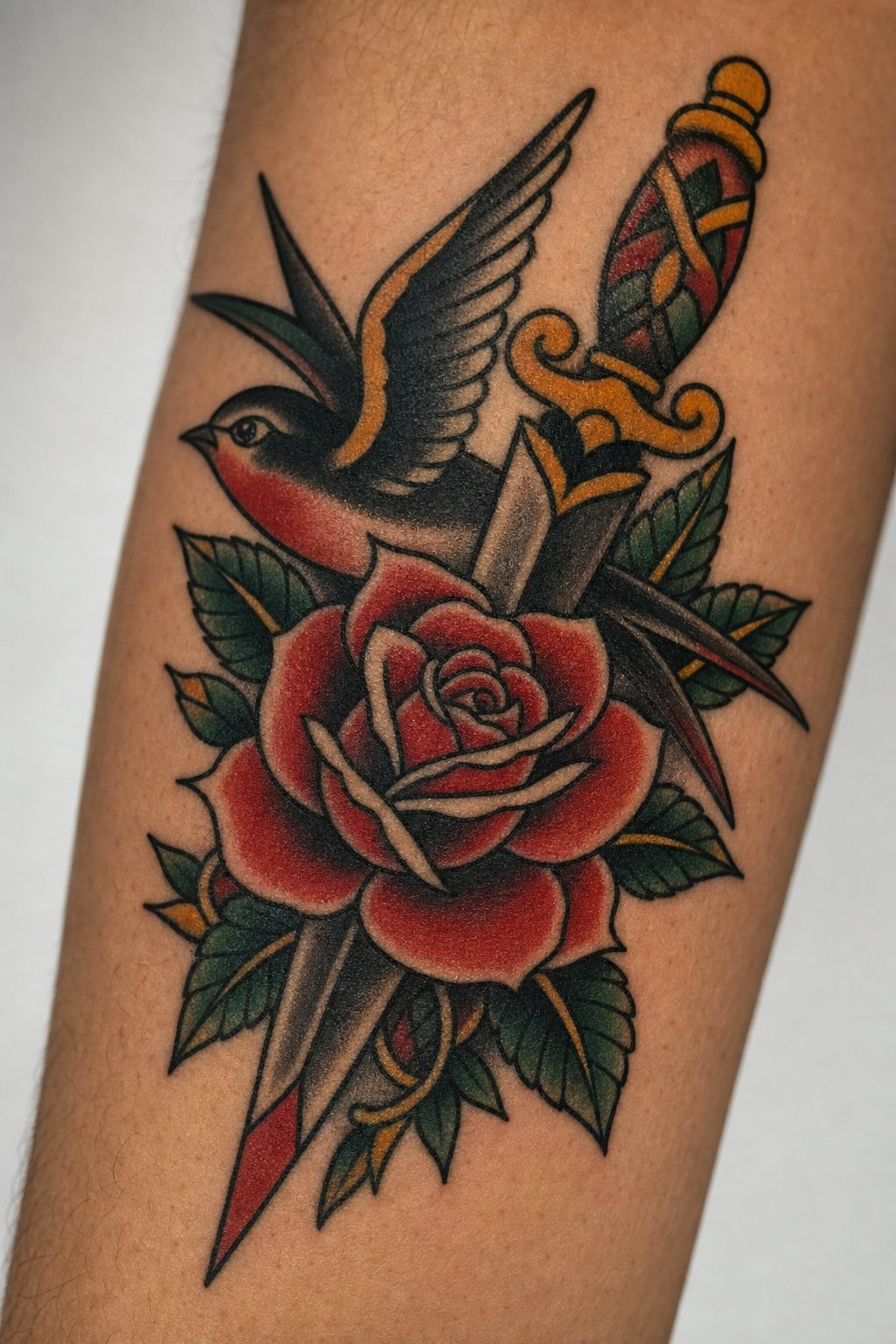
- Swallows: traditionally earned after 5,000 nautical miles; also linked to the idea of returning home safely
- Ships: literal profession markers for sailors, later adopted more broadly for “journey through life” symbolism
- Snakes: often linked to rebirth and danger, sometimes to medical or pharmaceutical backgrounds
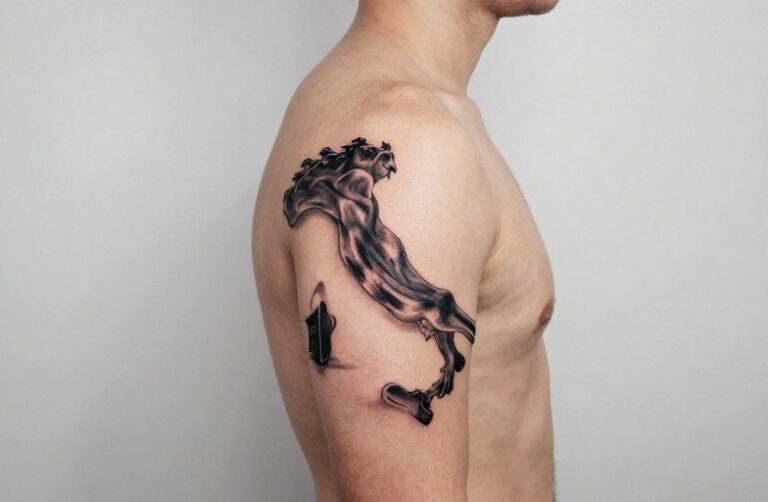
- Panthers: strength and ferocity, frequently placed on muscular areas to emphasize movement
- Daggers: betrayal, protection, or military service depending on accompanying elements
- Roses: love and beauty, commonly paired with other images to soften or complicate their meaning
The Flash Sheet Legacy
Standardized designs served a practical purpose. Sailors needed tattoos finished between ship departures, so artists developed repeatable motifs that could be executed quickly and healed reliably in harsh conditions. This efficiency shaped the aesthetic: thick lines hold up under sun and salt; limited color palettes (red, yellow, green, black) reduced variables that could fade unpredictably. The constraints became the style’s signature.
Religious & Spiritual Angles
Christian Imagery in Secular Hands
Crosses, praying hands, and Madonna figures appear frequently in traditional flash, though their use often diverged from devotional practice. For sailors facing mortality at sea, these images functioned as protective talismans rather than statements of orthodox faith. The praying hands design, often linked to German Renaissance printmaker Albrecht Dürer’s work, became particularly widespread, sometimes accompanied by banners bearing names of mothers or sweethearts, sometimes standing alone as generalized hope.
Supernatural Protection
Less explicitly religious symbols carried spiritual weight. The pig and rooster pair, often tattooed on feet or ankles, stemmed from a folk belief that these animals, which frequently survived shipwrecks in their wooden crates, would help a sailor stay afloat. Sharks represented ferocity and survival. The hula girl, seemingly decorative, sometimes marked crossing the equator and invoked Polynesian spiritual territory. Whether artists and clients fully believed these protections mattered less than the comfort of ritual.
Design Tips & Pairings
Placement in American traditional work follows functional logic developed through decades of observation. Bold designs need room for lines to breathe; cramming a ship into a space too small causes ink spread and lost detail over time.
Strong placements include:
- Outer forearm: classic visibility, flat surface preserves line integrity
- Upper arm/shoulder: muscular movement animates panthers, eagles, snakes
- Chest: symmetrical designs like swallows or ships work well centered
- Thigh: ample space for complex compositions like dagger-through-rose
- Hands and knuckles: historically reserved for specific markers (HOLD FAST across knuckles, for instance), now more broadly adopted
Pairing elements requires attention to scale and visual hierarchy. A small banner beneath a large eagle looks unbalanced; a snake coiled around a dagger needs the snake’s head positioned for immediate recognition. Traditional artists often “build” flash by combining established elements, adding a rose to a skull, wrapping a banner around a heart, creating new compositions from tested components.
Color vs Black and Grey
The Classic Palette
Traditional color work relies on specific, predictable pigments: a warm red, a cool green, a mustard yellow, and solid black. These weren’t aesthetic choices alone, they were the pigments available that held reliably in skin. Red often carries emotional intensity: hearts, roses, blood. Green frequently appears in snakes, leaves, and military insignia. Yellow highlights and skin tones. The flat application, without modern blending or gradients, ensures the tattoo reads as clearly at ten years as at ten days.
Black and Grey Adaptations
Some shops and clients prefer black and grey traditional work, particularly where color healing poses challenges or personal taste leans subtler. This approach uses black ink diluted to grey washes for shading, maintaining bold outlines but replacing color blocks with tonal variation. The meaning of the imagery doesn’t shift, but the visual impact changes, less immediate, more graphic, sometimes reading as older or more severe. Healing tends to be slightly more forgiving since there’s no risk of red turning pink or green muddying.
Personal & Modern Meanings
Contemporary wearers often select traditional imagery without the original context, no sailing experience, no military service, no rough-and-tumble subculture membership. The style itself has become the signifier: choosing American traditional signals appreciation for craft history, for permanence, for visual clarity in an era of digital noise.
Modern adaptations include:
- Name banners: still used for family memorials, but also for pets, places, or abstract concepts
- Occupational imagery: chefs getting knives, mechanics getting pistons, translated into traditional visual language
- Regional symbols: local flora and fauna rendered in bold lines and flat color
- Humor and subversion: traditional formats carrying unexpected content (a crying clown with a “NAP TIME” banner, for instance)
The personal meaning emerges from selection and combination rather than any universal symbolism. Two people with swallow tattoos might share nothing beyond aesthetic preference, one honoring naval family history, another simply drawn to the form’s elegance.
Mythology & Folklore
Sea Monsters and Tall Tales
Traditional imagery draws heavily on maritime folklore. The kraken, giant squid, and sea serpent designs reference stories sailors traded to explain the inexplicable, sudden ship disappearances, unexplained damage, bioluminescence. Mermaids occupy ambiguous territory: sometimes siren danger, sometimes comfort fantasy, sometimes simply the exotic made portable. These images functioned as shared cultural references, visual shorthand for stories told in forecastles.
Land-Based Myths
Panthers, wolves, and bears carried frontier mythology into urban shops. The panther crawling up an arm or across a chest invoked wildness tamed just enough to wear. Eagles specifically referenced American national symbolism, but also broader concepts of vision, height, and predatory capability. Some trace certain animal poses to specific tattooers’ signature styles, Sailor Jerry’s particular eagle head angle, for instance, became widely copied and modified.
The folklore layer adds depth without requiring belief. You don’t need to think mermaids exist to understand what they represented to generations of isolated, superstitious sailors, and what that historical weight adds to the image now.
Final Thoughts
American traditional tattoos offer a rare combination: established visual language with flexible personal application. The style’s constraints, bold lines, limited color, recognizable imagery, function as features, not limitations. They ensure the work lasts, reads clearly, and connects to a craft tradition that predates most contemporary tattoo styles.
Choosing this style means accepting those constraints and finding your meaning within them. Whether you select a classic symbol with intact historical resonance or adapt the format for contemporary content, the visual grammar remains. The meaning isn’t in the style itself but in what you populate it with, where you place it, and what you carry forward from a century of working-class visual culture.
Frequently Asked Questions
Do American traditional tattoos fade faster than other styles?
Actually, they tend to age better. The thick black outlines and flat color application resist blurring and fading more effectively than fine-line work or heavy shading. The limited palette also means fewer variables in how different pigments break down over time.
Can I get a custom design in American traditional style?
Absolutely, though the design must obey the style’s rules: bold readable lines, flat color or solid black, no photographic realism. Many artists enjoy translating personal concepts into traditional visual language, but they’ll push back against elements that won’t hold up technically.
Why do so many traditional tattoos look similar?
Shared flash history and deliberate standardization. Artists historically copied and modified successful designs, creating a communal visual vocabulary. Contemporary traditional tattooers often continue this practice, viewing it as participation in a craft tradition rather than creative limitation.
Is it disrespectful to get nautical tattoos if I’m not a sailor?
Generally no, though specific military insignia or unit identifiers should be avoided. Broad symbols like ships, swallows, and compasses have transcended their origins. The style itself has become a universal tattoo language, not a closed subculture.