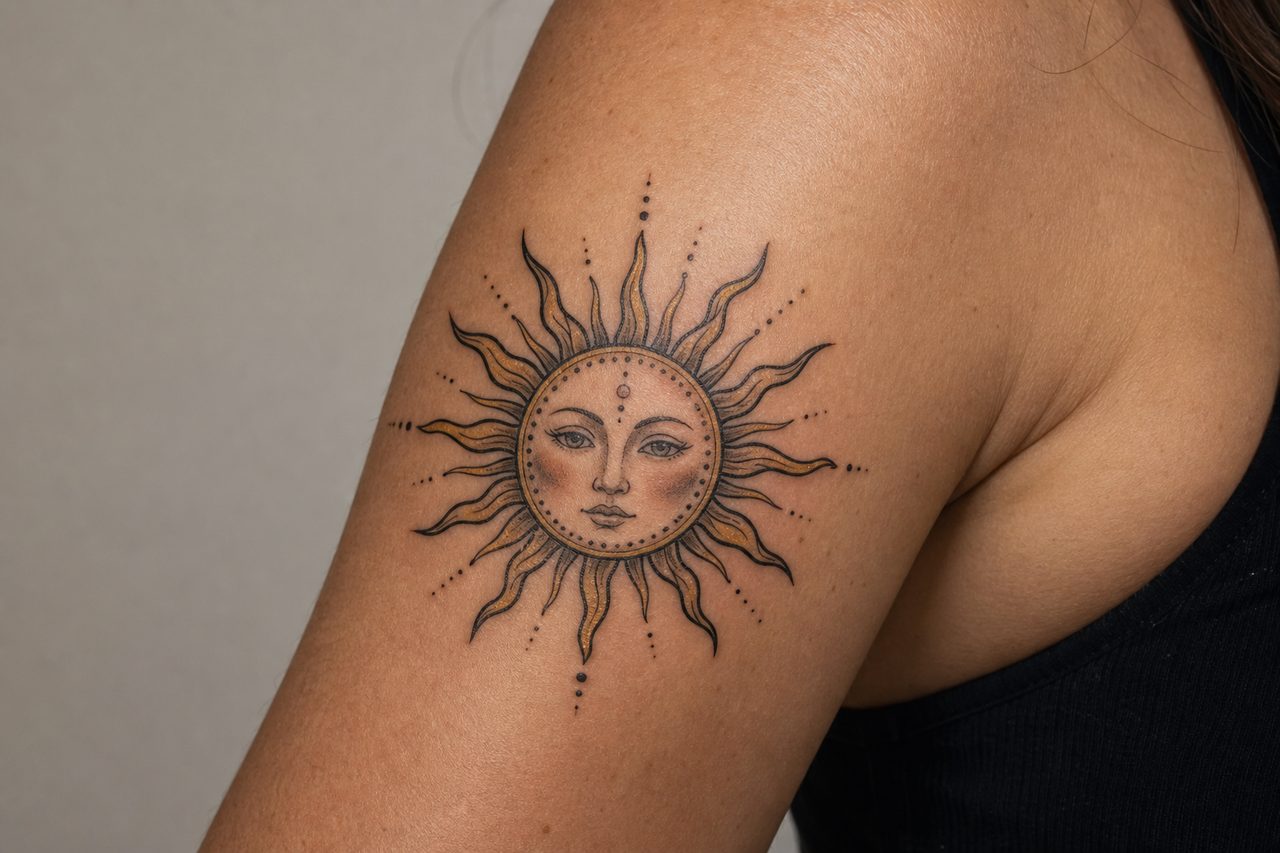
A sun tattoo most commonly represents vitality, clarity, and the cyclical nature of existence, rising, falling, returning. The specific meaning shifts with design choices: a geometric sun reads as intellectual order, a tribal sun as raw masculine energy, a minimalist line sun as quiet optimism. Understanding these layers helps you choose something that won’t feel generic in five years.
Symbolism & Core Meaning
The Duality of Light
The sun’s symbolism carries inherent tension. It sustains life but also burns, reveals truth but exposes vulnerability. A rising sun typically signals new beginnings or recovery, common after major life transitions. A setting sun can mark acceptance, completion, or honoring something finished. The noon sun, blazing and centered, usually speaks to confidence, ego in the healthy sense, or claiming one’s space. These aren’t rigid codes; they’re starting points for thinking through what you actually want marked on your body.
Universal vs Personal Resonance
Culturally, the sun sits at the center of countless creation stories. That universality cuts two ways: the symbol connects easily but risks feeling impersonal. The difference between a meaningful sun tattoo and a stock image often comes down to specific customization, incorporating a particular number of rays, a non-standard color, or pairing it with elements that narrow the meaning to your experience.
Personal & Modern Meanings
Recovery and Mental Health
In contemporary tattoo culture, sun imagery has become a quiet marker for people who’ve come through depression, addiction, or prolonged illness. Not the “I survived” declaration of a semicolon tattoo, but something more integrated, light returning, the possibility of warmth after absence. A small sun behind the ear or on the inner wrist serves this purpose without requiring explanation. The placement matters: visible enough as personal affirmation, hidden enough for professional contexts.
Identity and Orientation
For some, sun tattoos mark geographical or cultural identity, Arizona natives, Californians, people with Mediterranean or Latin American heritage reconnecting with solar traditions. Others use sun-moon pairings to represent romantic partnership or internal balance between action and reflection. The modern polyamory community has adopted sun imagery occasionally, though this remains niche and shouldn’t be assumed without context.
How It Ages on Skin
Line Weight and Detail Loss
Fine-line suns with delicate rays look crisp for two to four years, then soften significantly. The thin lines between rays blur first, turning what was precise into a generalized glow. Bold outlines with consistent line weight, think traditional American or Japanese bold-line styles, hold definition for decades. If you want intricate ray patterns, consider dotwork or stippling rather than hairline single-needle lines; the texture survives better than the geometry.
Color Fading Realities
Yellows and oranges, the obvious sun palette, fade fastest. Cadmium yellow especially turns muddy or beige within five to seven years of regular sun exposure. Red-orange holds better. Black and grey suns age more gracefully but lose the immediate “sun” recognition, people read them as stars or abstract mandalas unless the ray structure is unmistakable. White ink highlights on a black sun? Nearly gone in three years. Plan for touch-ups if color fidelity matters to you.
- High-detail center faces (Aztec, anthropomorphic) blur faster than geometric designs
- Outer forearm and shoulder suns fade slower than ankle or rib placements due to sun exposure patterns
- Large-scale pieces allow detail that small pieces simply can’t sustain
Color vs Black and Grey
When Color Works
Color sun tattoos succeed when the palette is limited and saturated, two to three colors maximum, with strong contrast. A solid orange disk with black rays reads instantly. Gradient sunsets with six colors often look muddy within years as the pigments settle differently. Watercolor-style suns, popular since the mid-2010s, age particularly poorly; the soft edges become indistinct blobs.
Black and Grey Sophistication
Black and grey suns rely on value contrast, how light or dark each area reads, to create dimension. This demands a skilled artist comfortable with smooth shading transitions. A poorly executed black and grey sun looks flat and muddy, while a competent one achieves a glow effect through careful gradation from white (skin) through grey to black. The best black and grey suns use negative space strategically, letting untattooed skin serve as the brightest light source.
Design Tips & Pairings
Successful Combinations
Sun and moon pairings work best when sized differently or positioned asymmetrically, equal, mirrored halves look like clip art. Sun with ocean waves balances fire and water, a classic tension. Sunflowers as a secondary element keep the solar theme literal and organic. For something less expected, consider sun with mountain silhouettes (the horizon line, limits and possibility) or sun with clock faces (time, mortality, the finite day).
Placement Logic
Central placements, chest center, upper back center, sternum, suit symmetrical sun designs and carry weight appropriately. Off-center placements (outer upper arm, calf, hip) work better for partial suns, rising or setting, with rays extending directionally. Finger and hand suns have become common but face rapid fading and social stigma in some professional contexts; the palm side of the hand, especially, sheds ink quickly.
- Small behind-ear: subtle, personal, limited detail possible
- Upper arm/shoulder: classic, allows detail, easy to show or hide
- Ribcage: painful, private, excellent for horizontal rising/setting designs
- Ankle: popular but fades fast from sock friction and sun
Mythology & Folklore
Cross-Cultural Solar Figures
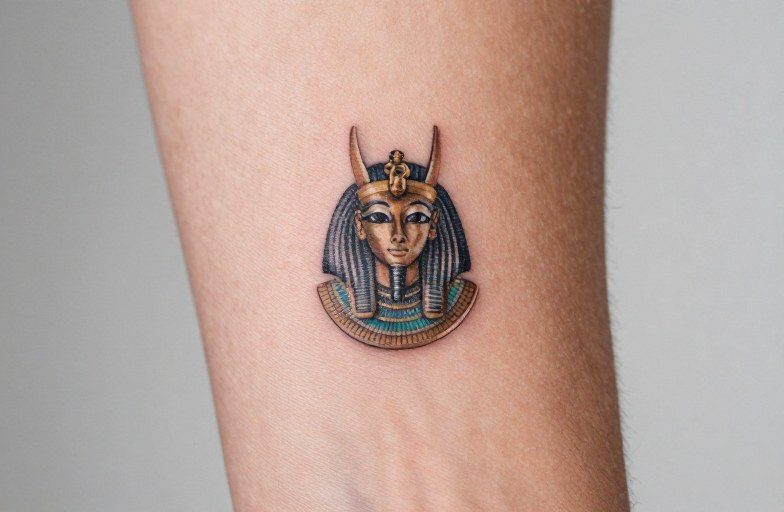
Ra’s solar barque, Apollo’s chariot, Amaterasu’s cave emergence, Surya’s seven horses, different cultures imagined the sun’s journey with remarkable narrative specificity. These stories offer design depth beyond generic “tribal sun” flash. A Japanese-inspired piece might reference Amaterasu’s mirror and cave; Egyptian revival could use the winged disk or uraeus. The key is respectful engagement rather than superficial appropriation, work with an artist who understands the iconography’s context, or stick to universal geometric forms.
Folk Beliefs and Protective Functions
In European folk traditions, sun symbols were often carved or drawn as protective marks, against darkness literal and metaphorical. The sun cross, wheel patterns, and rayed circles appear on boundary markers, tools, and buildings. This protective association persists subliminally; many people report choosing sun tattoos during vulnerable periods without consciously connecting to historical practice. Some trace the sun’s protective function to its role as truth-revealer, nothing hidden survives full light.
Final Word
A sun tattoo offers genuine symbolic depth but requires active choices to avoid cliché. The difference between meaningful and generic lies in specificity: your particular sun, your particular placement, your particular combination of elements. Consider how the design will read at twenty years’ distance, both on your aging skin and in your evolving life. The best sun tattoos balance immediate visual impact with enough personal customization that they couldn’t belong to anyone else. Start with the universal, then narrow until it fits only you.
Frequently Asked Questions
Do sun tattoos work well for cover-ups?
Solid black suns with radiating rays can cover smaller, older tattoos effectively, but the circular center needs enough un-inked skin to create the “glow” effect. A skilled artist can adapt ray direction to incorporate existing lines underneath.
What’s the most common placement mistake with sun tattoos?
People often size them too small for the detail they want. A two-inch sun can’t hold ten distinct rays with a face in the center; it becomes a blur within years. Either simplify the design or increase the canvas size.
How do I choose between a realistic and geometric sun style?
Realistic suns (with gradients, corona effects) require larger scale and skilled color work; geometric suns read clearly at smaller sizes and age better. Your pain tolerance, budget, and long-term maintenance willingness should guide this.
Can a sun tattoo be meaningful without any cultural reference?
Absolutely. Pure geometry, a circle with radiating lines, carries inherent symbolic weight through the form itself. The meaning comes from your intention and context, not from borrowed iconography.