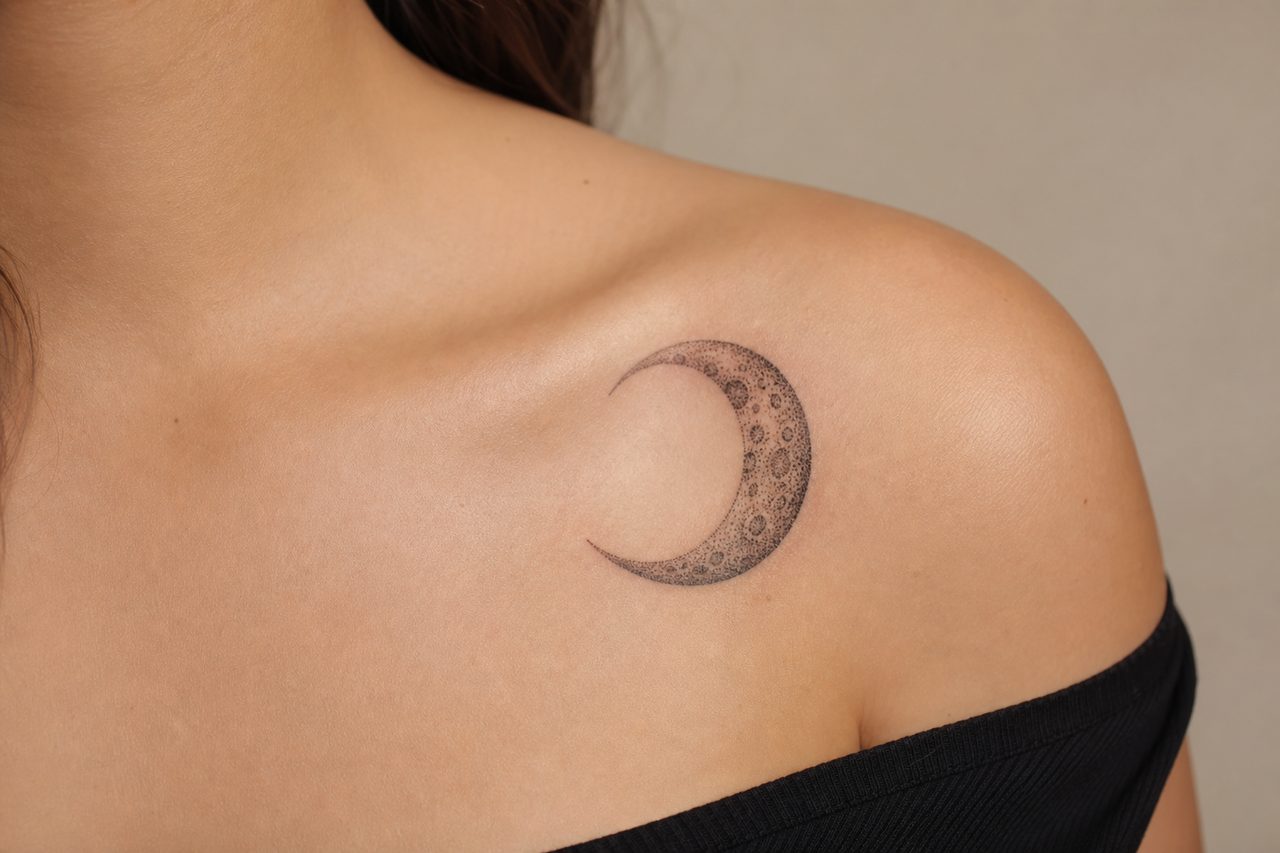
A moon tattoo most commonly represents cycles, transformation, and the tension between what we show and what we hide. The meaning shifts with phase, placement, and pairing, waxing moons lean toward growth and intention, while full moons land on completion and revelation. Crescent forms often signal intuition or the liminal space between endings and beginnings.
Symbolism & Core Meaning
Phases as Personal Timeline
Each lunar phase carries distinct weight. A waxing crescent suits someone marking a fresh start or building momentum. The full moon hits differently, it’s culmination, clarity, the thing you finally see whole. Waning phases speak to release, stripping away, or the honesty of decline. Some choose the complete cycle in a single design: a band wrapping the arm or a vertical stack down the spine showing all eight phases. That progression reads as autobiography without needing words.
Light and Shadow
The moon borrows light; it doesn’t generate its own. That dependency becomes part of the symbolism, reflection rather than projection, the inner life illuminated by external events. In design terms, this translates to how artists handle contrast. A moon with a face (the “man in the moon” tradition) emphasizes personality and witness. A bare sphere keeps it abstract, more about rhythm than character. The dark side, literally the portion in shadow, gets used as negative space in clever designs, skin showing through as the unlit portion.
Design Tips & Pairings
What Works Around the Moon
Pairings change the reading entirely. Wolves howling at a full moon push toward wildness and instinct. Moths or luna moths frame the moon as fatal attraction, the flame you can’t stop circling. Floral elements, night-blooming jasmine, moonflower, soften the symbol toward femininity and nocturnal beauty, though that reading isn’t exclusive to women. Mountains beneath a moon ground it in place and scale, suggesting solitude or perspective.
- Single small moon: behind the ear, inner wrist, ankle, quiet, personal
- Moon with script: the text competes; keep the phrase short and the lettering spare
- Multiple moons in sequence: forearm or calf work best for horizontal reading
- Moon as negative space inside a larger black shape: technically demanding, striking when healed
Line Weight and Aging
Fine-line moons trend hard on social media but age poorly if the line weight drops below a certain threshold. A crescent with an outline of 0.3mm or less will blur and soften within five to seven years, especially on high-movement areas like wrists or collarbones. Slightly heavier linework, think 0.5mm to 0.7mm, holds the silhouette longer. Shading inside the moon (textured craters, stippled darkness) gives the eye something to read even as edges soften. Solid black moons with white highlights reverse the usual value structure; they look bold fresh but can heal patchy if the black isn’t saturated enough.
Who Chooses This Tattoo
Placement Patterns
There’s no single demographic for moon tattoos, but placement choices cluster. The sternum and underbreast area carries moon designs frequently, symmetrical, centered, following the body’s natural curve. Upper arms and shoulders allow for larger compositions with surrounding elements. The back of the neck, visible with hair up and hidden with it down, suits the moon’s own quality of intermittent revelation. Ankle and foot placements are common for first tattoos, small crescents that peek from shoes or sandals.
Repetition and Collection
Some collectors build lunar sequences over years, adding a phase to mark each significant passage. Others start with one moon and find the symbol keeps fitting new meanings. The moon’s flexibility is its strength and its risk, because it carries so many possible readings, it can flatten into generic decoration without thoughtful pairing or placement. The best moon tattoos have some friction in them, some element that complicates the pretty silhouette.
Color vs Black and Grey
When Color Adds Something
Most moon tattoos stay black and grey, and that restraint usually serves the subject. The actual moon is greyscale; color requires justification. That said, deep indigo or violet backgrounds can suggest night sky without literalism. Blood moons in rusty red-orange read as event-specific, the rare eclipse rather than the constant satellite. Pastel washes (soft pink, lavender) trend toward aesthetic-first choices that may date faster than the wearer expects.
Black and Grey Technique
Smooth gradients from light to dark separate competent moon tattoos from clumsy ones. The transition from lit crescent to shadowed body needs to be gradual but not muddy. Some artists achieve this with whip shading; others prefer stippling for a more textured, cratered surface. The choice affects healing, stippled areas can scab more heavily and require gentler aftercare. White ink highlights on black or grey moons often heal to a yellowish or skin-tone tone; many experienced artists avoid relying on white for critical detail.
Mythology & Folklore
Cross-Cultural Threads
The moon’s mythological associations are vast and shouldn’t be collapsed into a single narrative. In some Japanese traditions, the moon is linked to rabbits and pounding mochi, a detail that occasionally appears in tattoo pairings. Various Celtic traditions connect lunar cycles to agricultural and herding rhythms. Artemis and Diana, huntress goddesses, carry crescent moons; that association feeds into designs emphasizing independence and self-sufficiency. Selene, the Greek personification, drives her chariot across the night sky, a narrative sometimes rendered in larger back pieces.
Modern Esoteric Uses
Contemporary witchcraft and pagan practice often employs lunar phases for ritual timing, and some wear moon tattoos as markers of that practice. The triple moon symbol (waxing, full, waning in a row) is specifically associated with goddess spirituality and Wiccan-influenced traditions. Not everyone wearing this symbol is a practitioner; some are drawn to the visual balance without deeper commitment. The design works either way, but context matters if the wearer is asked about it.
Similar & Related Symbols
Sun-moon pairings are common, representing duality, partnership, or the wearer’s own internal balance. The sun typically gets rendered in warmer tones, busier linework, more aggressive geometry; the moon stays cooler, softer, more recessive. Stars accompanying moons can feel like afterthoughts unless they’re specific constellations or arranged with intention. The ouroboros (snake consuming its tail) shares the moon’s cyclical DNA but adds a harder edge, more confrontation with mortality.
Planetary symbols from astrology, Saturn with its rings, Venus with her mirror, sometimes appear in mixed celestial compositions. These read more technically, more chart-specific, than the moon’s broader accessibility. The ocean and tides, implicitly linked to lunar pull, get rendered as waves or water elements that ground the moon in cause-and-effect rather than pure symbol.
Final Thoughts
The moon tattoo endures because it adapts without emptying out. A small crescent behind the ear and a full back piece of a moon rising over a landscape share a core vocabulary, cycle, reflection, the visible and hidden, while speaking in entirely different registers. The risk is cliché, the too-pretty moon that could be anyone’s. The antidote is specificity: your phase, your pairing, your placement, your reason for marking the body at this particular time. The moon doesn’t need your story to be valid, but it holds ink better when there’s something particular behind it.
Frequently Asked Questions
Does a moon tattoo have to be feminine?
Not at all. While moon imagery appears frequently in feminine-coded aesthetics, the symbol itself is neutral. Masculine presentations often use heavier linework, darker surrounding elements, or pair the moon with wolves, ships, or mountainous terrain.
How well do fine-line moon tattoos age?
Thin lines blur faster than bold ones, especially on high-movement areas. For longevity, ask your artist about slightly heavier outline weight and consider adding stippled or shaded texture that remains readable even as edges soften over years.
What’s the difference between a crescent and a full moon tattoo meaning?
Crescents generally suggest potential, beginning, or the liminal, what’s emerging or fading. Full moons land on completion, clarity, and revelation. The phase you choose should match what you’re actually marking, not just what looks best in the design.
Can a moon tattoo cover old work or scars?
The moon’s curved shape and potential for heavy black fill make it adaptable for cover-ups, though the existing tattoo’s darkness and location affect feasibility. A consultation with an artist experienced in cover work is essential; moon shapes can be stretched or distorted to accommodate what’s beneath.