Star tattoos sit at the crossroads of simplicity and depth. A five-point shape recognized across every culture, yet open enough to carry personal weight without spelling it out. Sailors once marked oceans crossed with nautical stars. Soldiers and civilians later adopted them for guidance, protection, or remembrance. Today the same geometry anchors everything from minimalist wrist dots to sprawling constellation back pieces. What matters is how you build the design, line weight, placement, negative space, and what happens to that ink five years down the road.
Size & Scale
Small star tattoos, under an inch, work best where skin stays relatively stable. The side of a finger, behind the ear, or along the collarbone. At this scale, solid black holds crisper than fine-line detail. A single needle can produce a delicate outline, but that line spreads. Expect blur within three to five years on high-movement areas like hands.
Medium Builds and Multi-Star Clusters
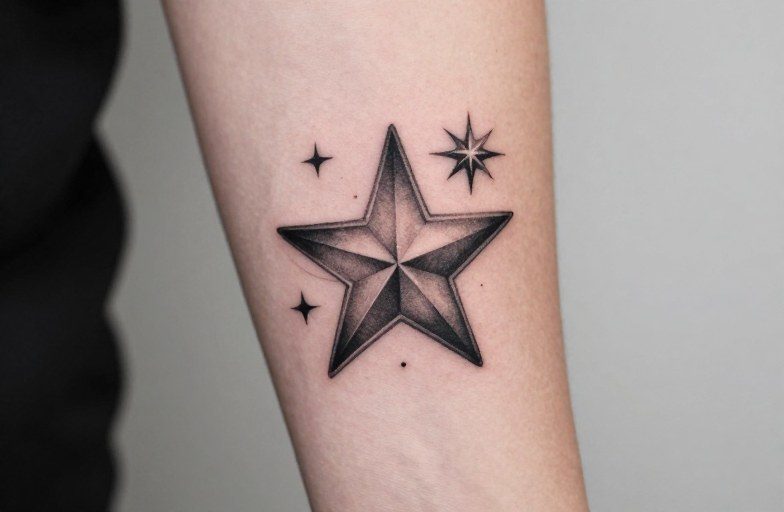
Two to four inches opens room for dimension. A cluster of three stars, graduated in size, reads as a constellation or a shorthand for family members. This scale suits the outer forearm, shoulder cap, or ankle. Shading becomes viable here, soft stipple or whip shading can suggest depth without the hard edges that age poorly.
Large-Scale Star Work
Full sleeves or back pieces centered on stars demand structural planning. A single massive star, unless heavily stylized, can look flat and poster-like. Better to integrate stars into larger compositions, celestial maps, geometric mandalas, or night-sky realism. At this size, color saturation and contrast with surrounding skin become critical for long-term readability.
How to Personalize It
The generic star risks becoming clip art. Personalization comes through specific choices, not vague symbolism.
- Point count: Five points dominate Western iconography. Six-pointed hexagrams carry different associations, often linked to balance or spiritual traditions. Seven, eight, or more points shift toward ceremonial or occult references, research before committing.
- Orientation: A star with one point downward historically carried specific meanings, some military, some subcultural. Know the context in your region.
- Interior detail: A compass rose inside a nautical star. A name worked into negative space. A small planet orbiting one point. These additions transform outline into narrative without clutter.
- Texture: Woodcut crosshatching, watercolor bleed, or engraving-style parallel lines give the same shape entirely different personalities.
Constellation Mapping
Plotting an actual constellation, your zodiac sign, a date’s sky chart, a child’s birth stars, grounds the design in verifiable data. Connect the dots with thin lines or leave them implied through placement. Some artists render the star field around the constellation in negative space, others fill the surrounding skin in black for a night-sky effect. The latter requires significant commitment and touch-ups as solid black fades to blue-gray.
Color Choices
Black and gray star tattoos age with the most predictability. Color introduces variables, fading, shifting, and the reality that yellows and whites disappear fastest on lighter skin, while darker skin tones carry deep blues and purples with more longevity.
Single-Color Accents
One colored point among black ones. A red star, specifically, carries political and military weight in many contexts, often linked to socialist movements or particular army divisions. A blue star traditionally marked a family member in military service. Green, less loaded, can suggest growth or earth connection without the same historical baggage.
Full Spectrum Approaches
Watercolor-style star tattoos look striking fresh. The technique relies on organic bleed and saturation gradients. Two years later, those soft edges often blur into neighboring skin. If you want color longevity, ask for bolder saturation with defined edges, or accept that watercolor stars need periodic refresh sessions.
Standout Design Ideas
Moving beyond the basic outline requires thinking about interaction with the body.
- Scar integration: A star’s points radiating from a surgical scar or stretch mark, not covering but incorporating. The geometry draws the eye outward from the center.
- Split placement: Half a star on each wrist or ankle, completing only when limbs align. Effective for couples or siblings, though consider the design’s integrity if viewed separately.
- Dimensional shading: Heavy black on two points, highlight on the opposite two, creating a faceted gem appearance. This demands an artist comfortable with light-source consistency.
- Dotwork fields: Hundreds of tiny dots forming a star through density variation, not outline. Slow to execute, but the texture holds interest at close range and softens to a glow at distance.
Geometric Hybrids
Sacred geometry intersects naturally with star forms. A star nested inside overlapping circles, or emerging from a Metatron’s cube. These designs scale well and carry visual complexity without requiring narrative explanation. The math itself becomes the meaning.
For First-Timers
Star tattoos offer a manageable entry point. The shape is forgiving, slight asymmetry in a portrait ruins it; in a hand-drawn star, slight irregularity often adds character.
Placement for Pain and Healing
Ribs, sternum, and feet hurt more. The outer upper arm, thigh, and calf handle needle work with less drama. Stars on the foot or ankle face constant friction from socks and shoes; expect faster fade and potential blowout from thin skin over bone. A first tattoo should heal simply, without complications from location.
What to Ask For
Request to see healed photos of the artist’s linework, not just fresh tattoos. A star looks clean when the skin is swollen and the ink sits on the surface. The real test is twelve months later, when lines settle and spread. If the artist can’t show healed work, consider that a signal.
Matching & Pairing Ideas
Star tattoos pair well without requiring identical copies.
- Same constellation, different segments: Two people carry halves of Orion’s belt, or each take one star from a shared zodiac.
- Star and moon: Classic pairing, but specify phases, crescent, gibbous, full, to avoid generic results.
- Star and script: Coordinates, dates, or short phrases placed along a point’s trajectory. The text follows the geometry rather than floating nearby.
- Star and animal: A star as the eye of a bird, the center of a flower, or the pivot point in a geometric wolf design.
Family Groupings
Each family member takes one star from a shared constellation, sized by birth order or placed by birth date coordinates. The design connects without requiring everyone to match exactly. A parent might carry the full constellation; children carry individual stars. The system holds whether two people or ten participate.
Before You Decide
Stars carry enough cultural weight that context matters. A nautical star on a sailor’s forearm reads differently than the same design on a suburban teenager, neither wrong, but the history exists whether you engage with it or not. Research the specific variant you want: point count, orientation, color, and surrounding tradition.
Consider how the tattoo ages. A solid black star with clean edges requires less maintenance than intricate dotwork or watercolor. A star behind your ear stays hidden for job interviews but needs touch-ups from hair friction and sunscreen difficulty. A star on your hand makes a statement you renegotiate every handshake.
The best star tattoo isn’t the one with the most elaborate meaning attached. It’s the one built with technical care, placed on skin that suits your life, and designed to read clearly in a mirror, in a photograph, and in the fading light of a decade from now.
Frequently Asked Questions
Do star tattoos have specific meanings based on how many points they have?
Five-point stars are the most common and widely recognized. Six-point stars often link to balance or spiritual traditions, while seven or more points tend toward ceremonial or occult associations. Research your specific point count before committing, as meanings vary significantly by culture and context.
Where do star tattoos fade the fastest?
Hands, feet, and fingers see the most friction and sun exposure, causing faster fade and blur. Behind the ear struggles with hair products and sunscreen application. The outer upper arm and thigh generally hold lines and shading longest with minimal touch-up needs.
Can a star tattoo cover or incorporate an existing scar?
Yes, stars work well for scar integration because the radiating points draw the eye outward from a center point. The star can emerge from the scar tissue rather than simply covering it. You’ll need an experienced artist to assess the scar’s age and texture first, tattooing too early in healing causes problems.
What’s the difference between a nautical star and a regular star tattoo?
Nautical stars traditionally feature alternating light and dark sections, resembling a compass rose, and were historically linked to sailors marking ocean crossings. A regular star tattoo lacks that specific interior structure and carries no inherent maritime association unless you add those elements deliberately.