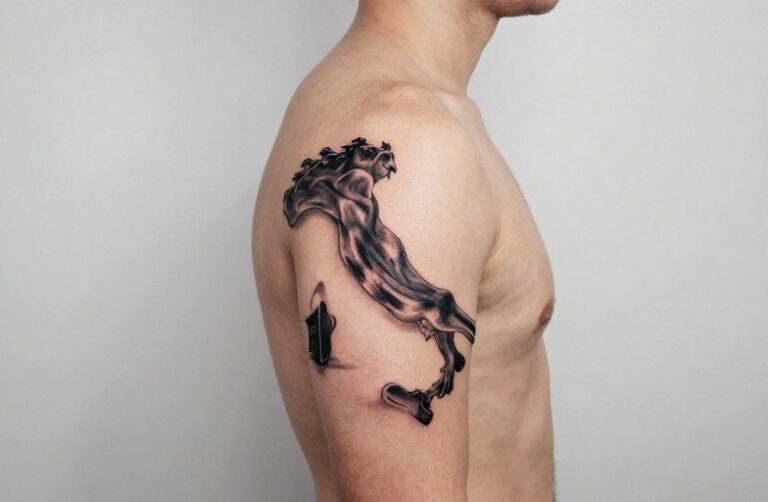
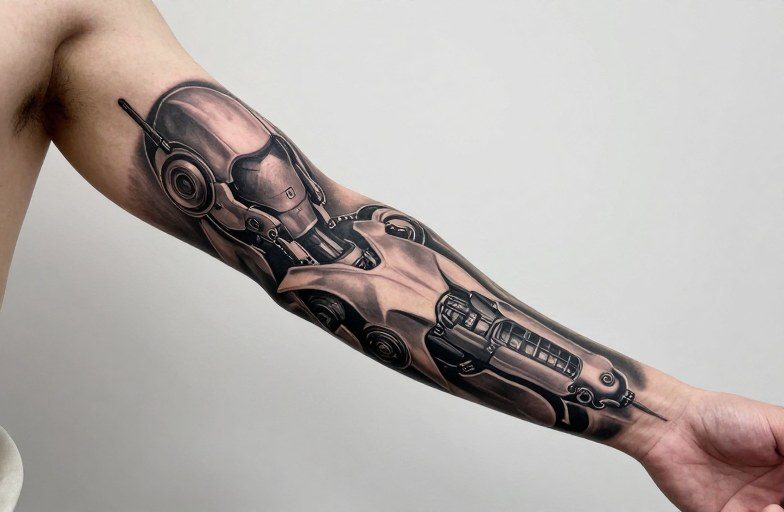
A biomech sleeve tattoo creates the illusion that your skin has been peeled back to reveal pistons, gears, circuitry, or alien machinery beneath. The core symbolism centers on the fusion of organic and mechanical, human flesh interfacing with technology, often representing transformation, the body as terrain to be modified, or anxiety about where biology ends and engineering begins. Some wearers connect it to resilience, the idea of rebuilding oneself after damage. Others approach it from transhumanist curiosity. Many simply respond to the visceral visual impact of something that looks as though it actually belongs under the skin.
Color vs Black and Grey
Full Color Biomech
Color biomech leans heavily into the “alien infestation” or “fresh wound” aesthetic. Acid greens, arterial reds, and corrosion oranges make the mechanical elements look wet, recent, possibly even infected. This approach works best on lighter skin tones where saturation holds with less layering. The downside is significant: those same vivid reds and yellows fade fastest, turning muddy within five to seven years without consistent touch-ups. Color also demands larger needle groupings for packing, which means more trauma during the session and heavier scabbing during healing. You will sit longer, heal harder, and return more often for maintenance.
Black and Grey Biomech
Black and grey dominates the biomech world for good reason. Carbon black ink mixed with distilled water creates the metallic gradients that sell the illusion: chrome reflections, shadowed recesses between piston housings, the matte finish of worn steel. It ages more gracefully than color, and the healed result often looks more convincingly three-dimensional. Silver and steel effects are achieved through negative space, your own skin tone, and careful gray wash layering, not white ink alone. White highlights added at the end heal to a subtle pearl, not a bright pop, so plan accordingly. If you want the flash of polished metal, you need to design for what your skin will actually hold, not what looks striking under studio lights.
How It Ages on Skin
Biomech sleeves face unique aging challenges because they rely on fine detail and sharp contrast to maintain the illusion. Over a decade, line spread softens the edges between “mechanical part” and “flesh,” and the gray washes that create depth tend to settle into a uniform mid-tone. The most durable biomech sleeves use bold, simplified shapes for the core mechanical elements: thick housing outlines, large piston cylinders, while reserving fine detail for areas that can blur without destroying the overall effect.
- High-friction zones: Inner bicep and elbow ditch blur fastest from constant movement and contact with clothing.
- UV exposure: The outer forearm fades proportionally to sun exposure; SPF 50 or covering clothing preserves the gray gradients.
- Weight fluctuation: Significant muscle gain or loss distorts cylindrical mechanical elements more than organic imagery, because straight lines and perfect circles telegraph distortion immediately.
- Touch-up reality: Most biomech sleeves need refinement at year eight to twelve, not because the tattoo looks bad, but because the mechanical illusion depends on precision that skin simply doesn’t hold indefinitely.
History & Cultural Roots
Origins in Airbrush and Illustration
The visual language of biomech emerged from 1970s airbrush art and the illustrations of H.R. Giger, whose work on the 1979 film Alien fused skeletal structures with industrial machinery in ways that felt biological rather than constructed. Tattoo artists adapted these aesthetics in the late 1980s and early 1990s, often linked to the broader cultural anxiety about computing and cybernetics. Some trace the style to Southern California and biker culture, where mechanical imagery already resonated, though the specific “flesh peeled back to reveal machine” motif developed more gradually across multiple artists’ portfolios rather than from a single origin point.
Japanese Influence
Separately, Japanese tattooing contributed the full-sleeve format and the compositional logic of wrapping imagery around the arm’s natural topography. Early biomech sleeves borrowed the “glove” or “bodysuit” approach from traditional Japanese work, replacing waves and wind bars with cables and coolant tubes. The two traditions merged most visibly in the work of artists who trained in both structural approaches, adapting Japanese background techniques to create the atmospheric haze that makes mechanical elements appear to float in subcutaneous space.
Design Tips & Pairings
Working With Anatomy
The best biomech sleeves exploit rather than fight the arm’s structure. The deltoid becomes a housing for a main gear cluster; the elbow joint transforms into a ball-and-socket mechanical articulation; the forearm’s two-bone structure suggests parallel piston rods. Bad biomech ignores anatomy and simply pastes mechanical clipart onto skin, breaking the illusion every time the arm moves. Good design accounts for rotation. What reads as a coherent machine at rest should still read as coherent with the arm extended or flexed.
Consider your own build. Thin arms offer less canvas for complex assemblies; the design must simplify or risk looking crowded and muddy. Muscular arms provide more surface and dimension, but also more movement that will test the mechanical coherence. Existing tattoos create additional constraints, biomech does not blend easily with unrelated styles, so plan for coverage or integration from the start.
Complementary Additions
Biomech pairs naturally with several adjacent styles when extending beyond the sleeve format. Bio-organic elements, tendons, membrane, exposed muscle, soften the transition between machine and flesh. Geometric patterns can read as circuitry or programming underlying the mechanical layer. Some collectors extend the sleeve across the chest by continuing coolant lines or power cables into a central “core” over the sternum, creating a torso piece that feels functionally connected rather than arbitrarily adjacent.
- Skull integration: A cranial structure rendered as mechanical housing, often placed on the outer upper arm where the deltoid curve suggests a rounded form.
- Clockwork internals: Visible escapements and balance wheels replacing organic joint structures, particularly effective at the wrist.
- Cable and conduit sleeves: Simplified approach focusing on bundled wiring running the arm’s length, easier to heal and maintain than full mechanical assemblies.
Common Variations & Styles
Organic Biomech
Softens the mechanical elements with bone-like textures, chitinous surfaces, or membrane housings rather than polished metal. Often associated with Giger’s influence, this variation ages better on skin because the irregular surfaces hide blur and the organic textures integrate more naturally with the body’s own movement. If you want biomech but fear the maintenance demands of hard mechanical precision, this is the more forgiving path.
Industrial/Steampunk Biomech
Visible screws, riveted plates, brass fittings, and pressure gauges. The steampunk variant leans decorative and nostalgic; the industrial variant looks functional and brutal. Both require the artist to understand actual mechanical drafting: perspective, thread patterns, how materials abut. Without this knowledge, the result suffers the “floating clipart” problem that plagues amateur work. Ask to see healed photos of riveted joints and plate overlaps, not just fresh work. Fresh steampunk looks crisp; healed steampunk reveals whether the artist understood material logic.
Minimalist Circuitry
Reduced to fine lines suggesting circuit traces or neural pathways, sometimes with small nodes that read as LED points. Easier to conceal professionally, faster to execute, but demands extremely steady line work because there is no shading to hide wobble. Heals to a subtle, almost subdermal appearance that some collectors prefer to the aggressive “ripped open” look. Be realistic: this style ages fastest of all biomech variations, and touch-ups will eventually thicken the lines beyond the original intent.
What to Expect During the Process
Session Planning
A full biomech sleeve typically requires twelve to twenty-five hours of tattooing, spread across multiple sessions. The first session establishes the black foundation and major structural elements. Subsequent sessions build gray wash depth, add mechanical detail, and refine highlights. Sessions longer than four hours produce diminishing returns, your skin swells, the artist works through fluid, and the quality drops. Plan for six months to two years of appointments, depending on your healing speed, the artist’s booking availability, and your budget.
Pain Considerations
Biomech hurts more than many styles because of the saturation required. Heavy black packing on the inner bicep or elbow ditch tests pain tolerance significantly. The repeated passes necessary for smooth gray gradients mean areas get worked longer than in simpler styles. Numbing creams help for the first hour but fade before the session ends; some artists discourage them because they alter skin texture and blood flow. Communicate openly with your artist about breaks, and do not pretend to be tougher than you are, flinching at the wrong moment damages the line work permanently.
Before You Decide
Committing to a biomech sleeve means accepting a style that will require maintenance and that limits certain future directions. The heavy black saturation and structural lines make cover-up or transformation into a different style extremely difficult. This is permanent in a more absolute sense than, say, a floral arrangement that could be reworked into something else.
The artist selection process matters enormously here. Biomech requires understanding of mechanical drafting, human anatomy, and how ink settles in skin over time. Few artists genuinely specialize in this; many claim to. Evaluate portfolios with skepticism: fresh photos prove technical skill, but healed photos from two to five years prior prove the artist understands how their work lives in skin. Look for consistent mechanical logic across multiple pieces, not just one impressive sleeve. Ask specifically about their background in illustration, industrial design, or mechanical drafting. An artist who cannot explain why a piston housing would be cast rather than machined is an artist who will paste clipart onto your arm.
Consider your lifestyle honestly. Biomech sleeves attract attention, sometimes aggressively. They read as confrontational in professional contexts that value conformity. The maintenance commitment is real, not theoretical. If you struggle to schedule annual dental cleanings, you will not schedule tattoo touch-ups, and this style specifically punishes neglect.
Finally, sit with the imagery before committing. The best biomech sleeves belong to collectors who chose the style for reasons they can articulate, even if only privately. Whether that reason is philosophical, aesthetic, or personal narrative matters less than that it exists. This is not a style to choose because it looks cool in a shop portfolio. It is a style to choose because the image of your own skin opened to reveal something else beneath resonates at a depth you cannot shake.
Frequently Asked Questions
How much does a biomech sleeve typically cost?
Full biomech sleeves range from $3,000 to $10,000+ depending on the artist’s rate, geographic location, and complexity. Specialists who do this work exclusively often charge $200-$400 per hour, and the hourly estimate is more reliable than a flat quote because skin behavior and design evolution during the process are unpredictable. Budget for 20-30% more than the initial estimate.
Can I cover an existing tattoo with biomech?
Biomech can cover older work, but the heavy black saturation required means the new piece will be significantly darker and denser than if applied to blank skin. Small, faded tattoos disappear more easily than large, dark pieces. A skilled artist can integrate existing imagery into the mechanical logic, turning an old tribal band into a structural plate seam, but this requires design flexibility on your part and genuine cover-up experience on theirs.
How do I find a qualified biomech artist?
Start with healed portfolio photos, not fresh Instagram posts. Look for artists who post one-year and five-year updates of their own work. Attend conventions where biomech specialists guest; watching an artist work on someone else reveals their process and patience. Ask specifically about their drawing background, mechanical illustration experience, and how they account for anatomical movement in their designs. Avoid artists whose biomech consists of downloaded 3D renders traced onto skin.
Will a biomech sleeve affect my job prospects?
Biomech sleeves are harder to conceal than many styles because they typically use the full arm and the imagery is visually arresting even at a distance. Long sleeves cover them, obviously, but the density means they may be slightly visible through thin fabrics. Consider your industry realistically: visible tattoos are increasingly accepted in tech and creative fields, but remain limiting in law, finance, medicine, and client-facing corporate roles. The style’s aggressive aesthetic can read as more confrontational than, say, botanical work.