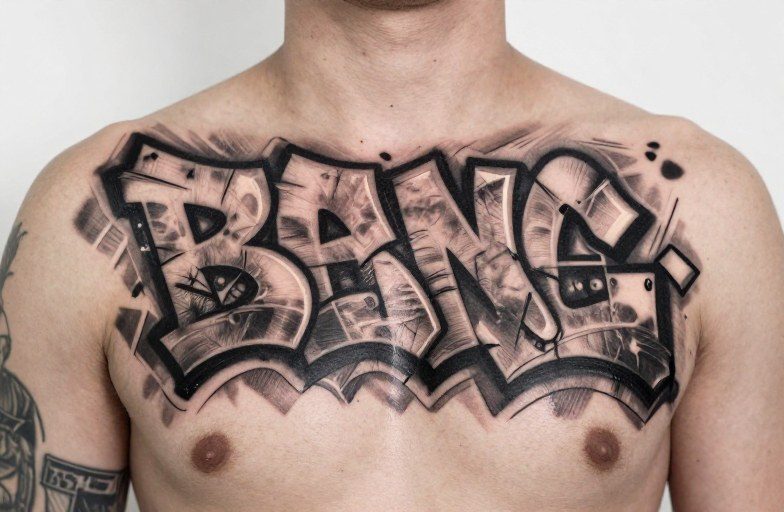
Graffiti tattoos translate the urgency and color of street art into permanent body work. The same principles that make a burner pop on a subway wall, legible letterforms, balanced negative space, color contrast against a surface, apply directly to skin, though with added constraints. Skin stretches, fades, and ages differently than concrete or metal. A graffiti piece that reads clearly at ten feet on a wall needs rethinking when compressed onto a forearm or ribcage. This guide covers how graffiti style adapts to tattooing, where it works best on the body, and which approaches hold up over time.
Best Placements
Flat Surfaces and Flowing Lines
The broad planes of the outer forearm, upper arm, and calf function like legal walls, stable, relatively flat, and offering enough real estate for letterforms to breathe. Graffiti relies on consistent baseline alignment; curved surfaces like the shoulder cap or thigh front can warp straight horizontal bars and make words tilt unexpectedly. The outer forearm remains the most requested spot for names, crew initials, or single words in bubble or throw-up style because the viewer reads it at a natural angle.
Ribcage placements demand vertical or diagonal compositions. Stacked letters, top-to-bottom tags, or pieces that drip downward adapt well here. The ribs also suit black-and-grey spray-can shading or stencil-style portraits of graffiti writers, where the soft tissue movement becomes part of the aesthetic rather than fighting it.
Hands, Fingers, and the Knuckle Question
Knuckle tattoos in graffiti style walk a fine line. The eight-letter maximum forces abbreviation; “THROW UP” fits, “WILDSTYLE” does not. Lettering here typically uses simple block or serif caps because fine detail blurs between the metacarpal ridges. Finger sides accommodate tags and small signatures, though ink migration in this high-wear zone is significant. Expect visible fading within two to three years regardless of artist skill.
- Outer forearm: best for horizontal pieces, readable at arm’s length
- Calf: excellent for vertical throw-ups, minimal distortion when standing
- Upper back/shoulder blade: suited for larger wildstyle or character combinations
- Ribcage: ideal for stacked letters, dripping effects, portrait-stencil work
- Neck: high visibility; simple tags or clean bubble letters recommended over complex fills
Color Choices
Bold Primaries vs. Faded Realism
Classic graffiti color theory, high-contrast primaries, hot pink against electric blue, chrome silver outlines, translates to tattoo pigment with modifications. Tattoo yellows and oranges fade fastest; placing them as highlights rather than field colors preserves the design’s energy longer. Purple and teal hold remarkably well, making them reliable alternatives to pure red-blue contrasts that can muddy as the red darkens.
Silver and chrome effects, central to graffiti’s visual language, require white ink highlights over grey washes. On darker skin tones, this approach needs adjustment, heavy black outlines with selective white points read as metallic without relying on large white fields that heal to a translucent, ashy quality. Some artists build chrome through negative space instead, letting the skin tone function as the reflective surface.
Black and Grey Adaptations
Black-and-grey graffiti tattoos strip the style to structure: line weight, letter spacing, and form. This approach suits smaller pieces and locations where color would compete with professional dress codes. The limitation becomes an advantage, without color distraction, the technical skill of the letterform itself becomes the entire statement. Grey-wash backgrounds can suggest a concrete wall or subway car surface without literal depiction.
Popular Styles
Throw-Ups and Bubble Letters
Throw-ups, quick, two-color bubble letter pieces, adapt naturally to tattooing. The rounded forms accommodate skin movement; there are no sharp corners to blow out or thin lines to disappear. A classic throw-up uses a fill color (often white or light grey) with a black or dark outline and a thin highlight line. This three-layer structure gives tattoo artists a familiar workflow: base, outline, detail.
Bubble letters specifically suit names, short words, and single initials. The inflated forms allow for custom fills, flames, camouflage patterns, or city skylines inside the letter bodies. The key restraint: bubble letters need consistent inflation. A “B” that balloons outward while the adjacent “O” stays compressed reads as amateur, on skin as on a wall.
Wildstyle and Technical Lettering
Wildstyle, the interlocking, arrow-studded, barely-legible evolution of graffiti letterforms, presents genuine challenges at tattoo scale. What reads as impressive complexity on a ten-foot wall becomes indecipherable black static at six inches. Successful wildstyle tattoos simplify: fewer arrows, more negative space between interlocks, and a single readable word rather than full phrases. The back piece or full sleeve offers enough territory for authentic wildstyle; anything smaller forces abstraction that loses the graffiti connection entirely.
- Tags: single-line signatures, usually black, suited for wrists, ankles, neck sides
- Throw-ups: bubble letters with outline and fill, forearm and calf optimal
- Stencil portraits: Banksy-influenced, black and grey, ribcage and upper arm
- Character pieces: spray can mascots, graffiti writers in hoods, often paired with lettering
- Wildstyle: reserved for large back pieces, thighs, or full sleeves
Matching & Pairing Ideas
Letterform and Image Integration
Graffiti tattoos gain dimension when the lettering interacts with a secondary element rather than floating alone. A name rendered in dripping chrome might appear to melt over a brick wall texture built from stippled grey wash. A crew’s three-letter abbreviation could emerge from a stylized spray can, the cap’s nozzle line extending into the first letter’s serif. The integration needs to feel intentional, not like clip art layered together.
Couples and friends sometimes request matching tags, each person’s nickname in the other’s handwriting, adapted to tattoo. This works when the handwriting has genuine character; generic cursive translated to skin lacks the street credibility that makes graffiti compelling. Siblings occasionally get matching throw-ups of a shared neighborhood reference, though this risks trending toward generic unless the specific location carries real personal history.
Complementary Placements for Pairs
Matching forearm pieces that face each other when two people stand side-by-side create a moment of connection without demanding identical design. One person might carry “RISE” in ascending letters, the other “FALL” descending, opposed but related. The visual dialogue matters more than literal duplication.
Trending Variations
Digital and Glitch Inflections
Contemporary graffiti tattoos increasingly incorporate digital corruption aesthetics, pixelated edges, RGB color separation, scan lines. These effects reference how graffiti now circulates: photographed, filtered, compressed, shared. A piece might render clean bubble letters with a “glitch” stripe running through the center, the letters fragmenting into blocky artifacts. This requires precise geometric work; freehand glitch looks accidental rather than intentional.
Regional Style References
East Coast graffiti, with its subway origins, often features subway map color lines, tunnel textures, or token imagery. West Coast styles lean into cholo lettering influences, heavier serifs, blackletter hybrids, religious iconography mixed with street elements. European writers sometimes reference train systems and station architecture. These regional markers help anchor a piece in actual culture rather than vague “urban” aesthetic.
Another emerging variation: graffiti as memorial. Dates, names, or RIP pieces rendered in the deceased’s actual tag style, sometimes incorporating their crew’s emblem. This demands accurate reference; approximating someone’s handstyle from memory disrespects the source.
Standout Design Ideas
Negative Space and Skin as Surface
The most technically impressive graffiti tattoos treat skin as the wall itself, not merely a substrate for paint simulation. A design might leave the natural skin tone as the “concrete” while black ink builds the shadow of a throw-up that was never fully painted, suggesting an unfinished piece, a buffed wall, the ghost of something removed. This requires confident negative space planning; the tattoo artist must think in reverse, building absence rather than presence.
Three-Dimensional and Forced Perspective
Forced perspective makes letters appear to project from the body surface. The effect works when the viewpoint matches how the tattoo will actually be seen, forearm pieces viewed from the front, calf pieces from above. A “3D” piece designed for a flat photograph but applied to a cylinder will distort comically in real space. The best perspective graffiti tattoos account for the body’s actual geometry, not an idealized plane.
- Buffed-wall ghosts: faded letterforms suggesting removal, heavy on grey wash
- Sticker slap compositions: layered tags like wheat-pasted flyers, overlapping edges
- Chrome drip pieces: liquid metal effects flowing down from letters
- Train car panels: rectangular frames containing full color pieces, often on thigh or side
- Handstyle excerpts: actual signatures of influential writers, reproduced as tribute
Final Word
Graffiti tattoos carry the risk of any style rooted in subculture: appropriation without understanding. The aesthetic appeal of bubble letters and chrome effects is genuine, but the work resonates when the wearer knows why arrows point, why certain letters interlock, why a throw-up differs from a burner. A good artist will ask about your connection to the culture, whether you wrote, whether you grew up around it, if you’re responding to a specific scene or a general vibe. That question isn’t gatekeeping; it’s ensuring the design has enough specificity to avoid looking like stock clip art. The best graffiti tattoos function as membership and memory simultaneously, legible to those who know how to read them.
Frequently Asked Questions
Do graffiti tattoos fade faster than other color tattoos?
The bright yellows and oranges common in graffiti style do fade faster than blacks and deep blues. However, the heavy black outlines typical of throw-ups and bubble letters create a structural skeleton that keeps the design readable even as color softens. Strategic placement away from constant sun exposure helps longevity significantly.
Can any tattoo artist do graffiti style well?
Not reliably. Graffiti lettering requires understanding letterform structure, negative space balance, and how interlocking elements read at small scale. An artist who does excellent traditional script may still struggle with wildstyle arrows or bubble letter consistency. Review their portfolio specifically for street-influenced work, not just general lettering.
How small can a graffiti tattoo be before it becomes unreadable?
Single-word throw-ups in bubble style can work at palm-size if the artist simplifies appropriately. Wildstyle or highly interlocked pieces need significantly more space, think handspan minimum for a single complex word. Tags and signatures can go smaller, but expect detail loss within a few years on fingers or wrists.
What’s the difference between a graffiti tattoo and a regular script tattoo?
Graffiti tattoos derive from street art conventions: inflated letterforms, architectural extensions like arrows and drips, color fills with outline separation, and often deliberate illegibility as aesthetic value. Script tattoos follow calligraphic or typographic traditions focused on flow and readability. The two can hybridize, but their origins and visual priorities differ substantially.