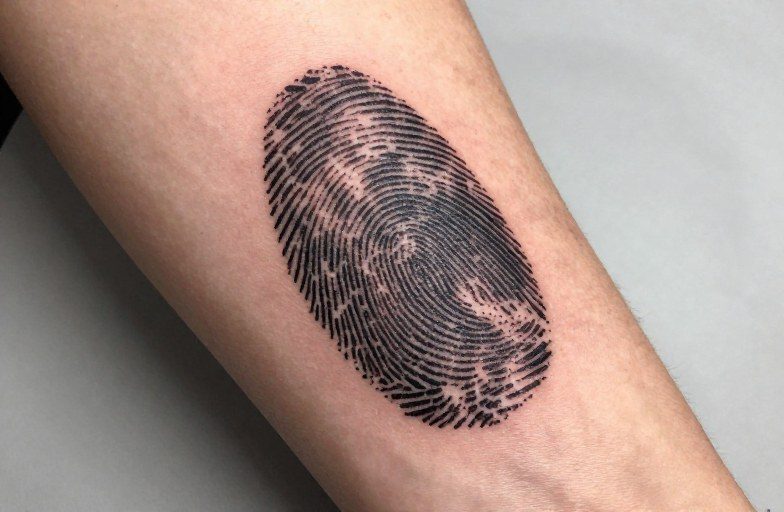
A fingerprint tattoo is exactly what it sounds like, the unique ridge pattern of a real person’s finger, permanently inked onto skin. Most commonly, it represents an unbreakable bond with someone specific: a child, parent, partner, or lost loved one. The symbolism hinges on the biological fact that no two fingerprints match, making the image a literal one-of-one marker of individual presence.
Symbolism & Core Meaning
The Unrepeatable Self
Fingerprints have served as identification tools for over a century because they cannot be duplicated naturally. Transferred to tattoo form, that irreplaceability becomes emotional. You’re not getting a generic heart or name, you’re carrying a pattern that belongs to one body alone. This specificity cuts through the generic symbolism that plagues so much tattoo imagery. The wearer isn’t saying “love matters”; they’re saying “this person’s existence matters to me, specifically.”
The symbolism also carries a shadow side: fingerprints are left at crime scenes, on death certificates, on objects touched for the last time. A fingerprint tattoo can mark absence as powerfully as presence. Someone who lost a parent young might have nothing else that was uniquely theirs, no voice recording, no handwritten letter, but a fingerprint lifted from an old document becomes a physical trace they can keep.
Consent and Its Absence
Here’s a practical consideration most articles skip: whose print is it, and did they agree to its use? A partner’s fingerprint, given willingly during a relationship, becomes complicated after a breakup. A deceased parent’s print, lifted from a funeral card or legal document, carries no such ambiguity but raises its own questions about intimacy and bodily autonomy after death. The symbolism shifts depending on whether the print was offered or recovered.
Common Variations & Styles
Line-Work vs. Dot-Work Reproduction
Actual fingerprint ridge patterns are minuscule valleys and raised skin. Translating that to tattoo requires choosing a visual language. Clean single-needle lines can reproduce the pattern with clinical precision, reading as a technical diagram. Dot-work or stippling softens the image, creating tonal variation that mimics how ink pads actually transfer, uneven, with pressure spots and fade. Single-needle line work ages better on high-detail areas; dot-work tends to blur faster as dots spread and merge.
- Actual-size prints (roughly 2-3 cm) work only on flat, stable skin, inner forearm, upper chest, thigh
- Enlarged prints (5-10 cm) allow for detail but lose the intimacy of true scale
- Partial prints, just the whorl center, or a smeared edge, create abstraction while retaining recognition
- Negative-space prints, where the ridges are skin and the background is inked, invert the expected form
Combined Elements
Some designs incorporate the print into a larger image: pressed into wet clay beside a child’s handprint, trailing into a constellation, or forming the silhouette of a face in profile. These combinations dilute the pure symbolism but solve a practical problem, standalone prints can look accidental to viewers who don’t know the context, like a smudge or a partial cover-up. The combination approach makes the intent visible immediately.
Who Chooses This Tattoo
The choice often follows a specific life event rather than a gradual aesthetic preference. Parents after a child’s birth. Adult children after a parent’s death. Partners marking a milestone, sometimes with exchanged prints. There’s also a smaller but notable group: people in recovery or post-incarceration, using their own print as a reclamation of identity after systems that reduced them to numbers.
What separates fingerprint tattoos from other memorial or relational work is the requirement of source material. You can’t walk into a shop and ask for “a fingerprint” the way you’d ask for a rose. You need the actual print, which means planning, preservation, and often emotional preparation. That friction filters out impulse decisions.
Color vs Black and Grey
Black and Grey: The Standard
Fingerprint tattoos are almost exclusively black. The reference material, ink pads, forensic photography, digital scans, exists in monochrome, so color feels like a departure from the source. Black and grey also ages more predictably. The fine lines and dots that define ridge patterns are vulnerable to sun damage and ink migration; adding color saturation increases the risk of blurring within five to seven years.
When Color Appears
Exceptions exist and usually serve a specific purpose. A print pressed into red ink, then surrounded by healed green, might reference a particular country’s entry stamp for someone who immigrated with that person. Watercolor-style backgrounds behind a black print can soften the forensic quality without compromising the pattern itself. These work best when the color carries independent meaning, not when it’s decorative afterthought.
Best Placements
Scale dictates placement more than symbolism here. A fingerprint’s detail is its entire point; lose the ridges and you have an oval smear. This eliminates high-movement areas where skin twists and stretches, wrists, fingers themselves, ribs during breathing, ankles.
- Inner forearm: Flat, visible, stable. Most common for prints meant to be seen and explained.
- Over the heart (left chest): Literal placement for love or loss; accommodates larger scale.
- Upper back, between shoulder blades: Private, stable, good for larger combined designs.
- Thigh: Ample flat space, less sun exposure than arms, easily concealed.
- Behind the ear or on the neck: Possible only with extreme simplification; detail loss is nearly guaranteed within a few years.
One practical note: fingerprints are convex patterns. Placing them on a convex body part (outer arm, calf) creates a double curve that can distort the image from certain angles. Flat placements preserve the recognizable shape.
Similar & Related Symbols
Handprints and Footprints
Newborn handprints and footprints share the biometric specificity but operate at a different scale and life stage. They’re softer, less individuated to the untrained eye, more universally readable as “baby.” A fingerprint is adult, criminal, bureaucratic, carrying harder associations that the wearer either accepts or reclaims.
DNA Helix and Genetic Imagery
DNA tattoos represent inherited connection but remain abstract. You can’t look at a double helix and see your specific mother; you look at a fingerprint and see her literal touch. The fingerprint is indexical, physically caused by contact, whereas DNA is symbolic, a diagram of relation. People sometimes combine both: a print for the person, a helix for the lineage.
Signatures and Handwriting
These are the closest relatives. Both require source material from the specific person. Both carry the tension between document and devotion. Signatures flow; fingerprints resist. A signature is chosen, practiced, performative. A fingerprint is given, involuntary, biological. The choice between them often reveals whether the wearer values the person’s agency or their irreducible physical presence.
What to Remember
A fingerprint tattoo succeeds or fails on the quality of its source material and the honesty of its intent. A blurry print from a smudged document will tattoo blurry. A print taken without the person’s knowledge may sour in meaning as relationships change. The image itself is neutral, ridges and valleys, technically reproducible, until it’s anchored to a specific life.
Healing demands care: fine detail is vulnerable to scabbing and sun. Plan for touch-ups, especially if the print is actual size. And consider that this is one tattoo where explanation is usually necessary. Strangers will ask. The answer, who it belongs to, why they matter, whether they’re present or absent, is part of the wearing.
What you’re committing to isn’t just a pattern. It’s a decision to carry someone’s literal mark, publicly or privately, for the duration. The symbolism is built into the biology: unique, unrepeatable, left behind by touch.
Frequently Asked Questions
Can any fingerprint be tattooed, or do some prints work better than others?
Prints with strong ridge contrast and clear whorl or loop patterns reproduce best. Very faint prints, elderly skin with flattened ridges, or partial smudges may need a skilled artist to interpret and reinforce the structure without inventing false detail.
How do artists get the fingerprint image onto skin accurately?
Most work from a high-resolution scan or photograph of an inked print. Some will enhance the digital file to clarify ridge lines, then stencil it directly. Freehanding a specific person’s print is nearly impossible and generally not attempted.
Do fingerprint tattoos blur faster than other fine-line work?
Yes, because the detail is so minute and the pattern relies on negative space between ridges. Sun exposure accelerates the blurring significantly. Placement on low-movement, low-sun areas extends clarity by years.
Is it weird to get a current partner’s fingerprint tattooed?
It’s a genuine risk. Unlike a name, which is abstract, a fingerprint is their literal biological identifier. If the relationship ends, the tattoo becomes forensic evidence of a connection that no longer exists, more specific and harder to reinterpret than symbolic imagery.