The Gadsden flag’s coiled rattlesnake has been inked onto skin for decades, long before it became a fixture at political rallies. Today the motif attracts history buffs, libertarians, military veterans, and plenty of people who simply admire the graphic power of a snake ready to strike. Stripping away the noise around the symbol, what remains is one of the most visually compelling images in American tattooing: a serpent, coiled, alert, sometimes on a field of yellow, sometimes standing alone. Here’s how to make it work on your body.
Tips for Choosing
Decide What You’re Actually Depicting
The full Gadsden flag design includes the yellow background, the coiled timber rattlesnake, and the words “DON’T TREAD ON ME” in a specific serif typeface. Many people opt for just the snake, which reads cleaner as a tattoo and ages better. The text, especially at smaller sizes, can blur into illegibility over five to ten years. If you want the words, consider them as a separate element, perhaps arched above or below the snake rather than crammed into the same space. Script and Old English fonts are common choices, but a clean block serif holds up more reliably against skin movement.
Color vs. Black and Grey
The yellow field is iconic, but yellow ink is notoriously finicky. It fades faster than black, can heal patchy on darker skin tones, and requires touch-ups more often. A black-and-grey snake with strong contrast and strategic white highlights often looks more aggressive and holds its detail longer. If you want color, a muted olive or khaki background reads as military heritage without the maintenance headache of bright yellow. Full color also demands more skin real estate to read correctly; a yellow postage stamp on your wrist will look like a bruise in three years.
Standout Design Ideas
The Classic Coiled Strike
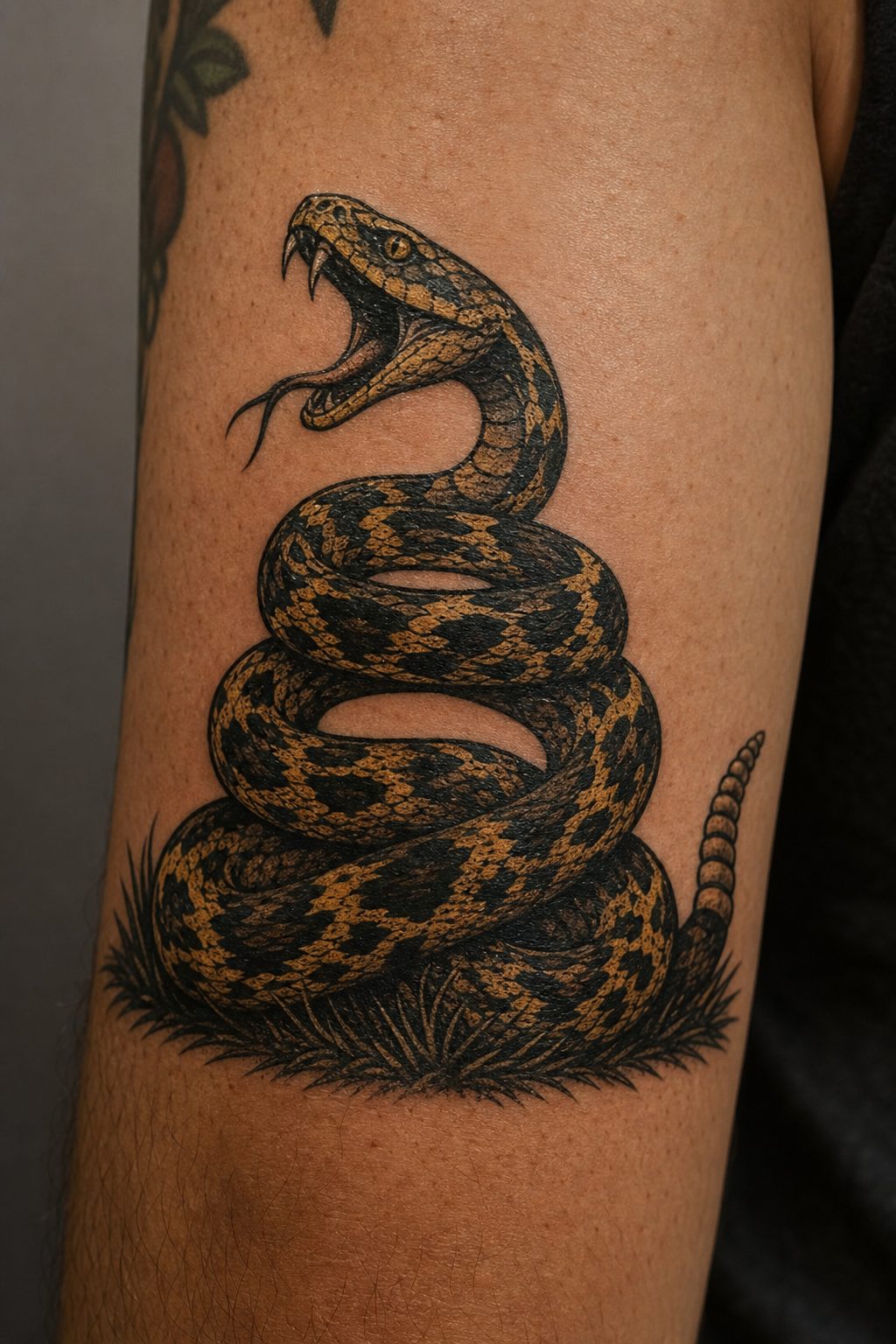
The traditional pose shows the snake in an S-curve, head raised, tongue flicking, rattle raised. This works as a standalone piece or with the words wrapped around it. For variation, some artists render the snake mid-strike, body uncoiling, which creates dynamic movement across the skin. The scales can be drawn tight and geometric for a modern feel, or loose and organic for something more traditional. Rattlesnake rattles specifically, segmented, textured, give the artist something interesting to render at the tail.
Deconstructed and Minimalist Approaches
A single fang, a rattle silhouette, or the snake’s eye with the text in thin line work strips the image to its essence. These designs suit smaller placements and pair well with other American heritage imagery, eagles, thirteen stars, colonial script. Another approach: the snake skeleton, all vertebrae and ribcage, which carries a darker tone and avoids the political freight of the living reptile. Skull and snake combinations exist, but they’re a crowded field; the skeletal snake alone is more distinctive.
- Coiled snake with full flag background (large, color or near-black-and-grey)
- Snake head in profile with text banner
- Minimalist line-art snake, no text
- Rattle and fang pairing, ultra-compact
- Snake intertwined with thirteen stars or colonial-era elements
For First-Timers
Your first tattoo carrying this much symbolic weight deserves extra thought. The Gadsden imagery carries associations you may not control, viewers will project politics onto it regardless of your intent. If that possibility bothers you, consider the snake without text, or a historical variation like the Culpeper Minutemen flag (snake plus “LIBERTY OR DEATH”). Both nod to the same era without the same modern baggage.
Pain-wise, the snake’s curves often land on spots that hurt more: ribs, shoulder blade edges, inner bicep. The coiled shape requires the artist to follow body contours, which can mean longer sessions than a simpler geometric piece. Budget for a skilled artist comfortable with animal realism or bold traditional work; a muddy snake looks like a mud snake, not a timber rattler. Ask to see healed photos of their reptile work, not just fresh ones.
Size & Scale
Minimum Effective Size
The snake’s scales and facial features need room to breathe. At under three inches tall, the head becomes a smudge and the rattle loses its segmentation. Four to six inches is the practical minimum for a recognizable coiled snake with any detail. Text below that size becomes unreadable faster than you’d expect, skin spreads, ink migrates, and “DON’T TREAD ON ME” collapses into black bars.
Going Large
Full back pieces, thigh panels, or side ribs allow the snake to stretch to naturalistic proportions, sometimes three feet of body curving around muscle structure. At this scale, the artist can render individual scale patterns, shadow under the coils, and the distinctive diamond pattern of the timber rattlesnake. Large-scale work also accommodates the full flag design with proper color saturation. The trade-off: multiple sessions, higher cost, and a lifetime commitment to a very visible statement.
Best Placements
High-Visibility Spots
The outer bicep remains the most common placement for this design, enough flat surface for detail, easy to show or cover, and the coiled snake follows the arm’s natural curve. The calf offers similar advantages with more vertical space, letting the snake climb or descend. Chest pieces center the snake over the sternum, with the head rising toward the collarbone; this placement reads as confrontational, which suits the image.
Subtle and Contained
Behind the ear, a tiny snake head or rattle works as a whispered reference rather than a declaration. The forearm, especially the inner wrist to inner elbow line, lets the snake’s body flow with the arm’s length. Ankle placements suit smaller, self-contained coils but suffer from slower healing due to movement and shoe friction. The hand and fingers are possible but inadvisable, the snake’s fine details blur quickly, and the political visibility of the symbol on your knuckles is not something to choose lightly.
- Outer bicep: classic, versatile, manageable pain
- Calf: vertical space, easy concealment
- Upper chest/sternum: bold, centered, high impact
- Forearm inner line: follows natural anatomy
- Behind ear: minimal, private reference
Popular Styles
American Traditional renders the snake in bold black outlines, limited color palette, heavy black shading in the coils. This style ages exceptionally well and reads instantly from across a room. The snake’s eye becomes a simple white dot with black pupil; the rattle is stylized into clear segments. Traditional artists often add yellow selectively, background flashes, perhaps the tongue, rather than full fields of color.
Black-and-grey realism demands an artist who understands reptile anatomy. The timber rattlesnake’s keeled scales (ridged down the center) catch light differently than smooth scales, and getting that texture wrong flattens the image. Good realism shows the snake’s weight, the way the body presses into the ground coil, the slight flare of the neck before a strike. Photographic reference helps, but the best artists interpret rather than copy, adjusting for how the image will wrap around your specific anatomy.
Neo-traditional and illustrative styles split the difference, bold lines with more color variation, stylized scales with decorative elements. Some artists incorporate woodcut textures, referencing the original flag’s printed origins. Others add ornamental borders, daggers, or colonial-era flourishes that frame the snake without competing with it. These approaches work well when you want something recognizable but personalized.
What to Remember
The Gadsden snake endures because it’s a genuinely powerful piece of visual design: threatening, compact, unmistakably American. That power cuts both ways. The image will be read as political by many viewers regardless of your personal intent, so choose your placement and visibility with that reality in mind. From a technical standpoint, prioritize the snake’s readability over text, scale over detail, and black ink’s longevity over yellow’s instant recognition. A well-executed rattlesnake in strong black and grey, coiled and ready, carries the same defiant energy without the maintenance headaches. Find an artist whose animal work you trust, bring clear reference, and let the image do what it has done for nearly two hundred fifty years: warn, declare, and endure.
Frequently Asked Questions
Does the Don’t Tread On Me tattoo always have political meaning?
Not necessarily. Many people choose it for historical American heritage, military service connections, or simply the visual appeal of the coiled snake. However, the symbol carries strong political associations for most viewers, so you should be comfortable with that interpretation being projected onto you.
How well does yellow ink hold up in the Gadsden flag design?
Yellow fades faster than black and can heal unevenly, especially on darker skin tones. Many experienced artists recommend muted olives or black-and-grey approaches for longevity, saving any yellow for small accent areas rather than full backgrounds.
What’s the best style for a first tattoo of this design?
American Traditional handles this imagery exceptionally well, bold lines, readable at a distance, and it ages gracefully. The style’s limitations actually help the snake stay recognizable for decades without the fine detail that blurs in other approaches.
Can the snake be done small, like on a wrist or ankle?
Below three to four inches, the scales and facial features lose definition. The rattle becomes a blob, the eye a dot. If you want something compact, consider a minimalist line-art snake head or the rattle alone rather than a fully detailed coiled body.