Compass tattoos carry a straightforward appeal: direction, movement, finding your way. The design has been steady shop floor request for years, and for good reason. It adapts well to different styles, scales cleanly, and holds meaning without demanding explanation. But the difference between a compass that looks sharp for decades and one that blurs into a messy star comes down to specific choices in design, placement, and how the artist handles the details. Here’s what actually matters.
For First-Timers
Start Simple, Build Later
A basic compass rose with clean cardinal points and a simple needle makes an excellent first tattoo. The geometry is forgiving, the lines are classic, and you won’t outgrow it. Many people later add a banner, coordinates, or surrounding map elements, so leaving negative space around the design gives you room to expand without crowding the original work.
Black and grey heals more predictably than color for beginners. The contrast between deep blacks and skin tone stays readable even as sun exposure and time do their work. If you want color eventually, a well-executed black compass can always be enhanced later.
Size Reality Check
Compass tattoos need enough real estate for the directional markings to remain distinct. Below two inches, the fine lines between north, south, east, and west start to compress. At that scale, the needle can lose its definition and the whole piece reads as a generic star shape from across a room. Three to four inches gives the artist room for proper line weight variation and keeps the north arrow immediately recognizable.
Standout Design Ideas
Working with Line vs. Shading
Linework compasses rely on precise needle execution. The advantage is crispness; the risk is that unshaded areas can look flat or unfinished if the line quality isn’t exceptional. A single-needle outline with no fill demands near-perfect symmetry because there’s nowhere for small wobbles to hide.
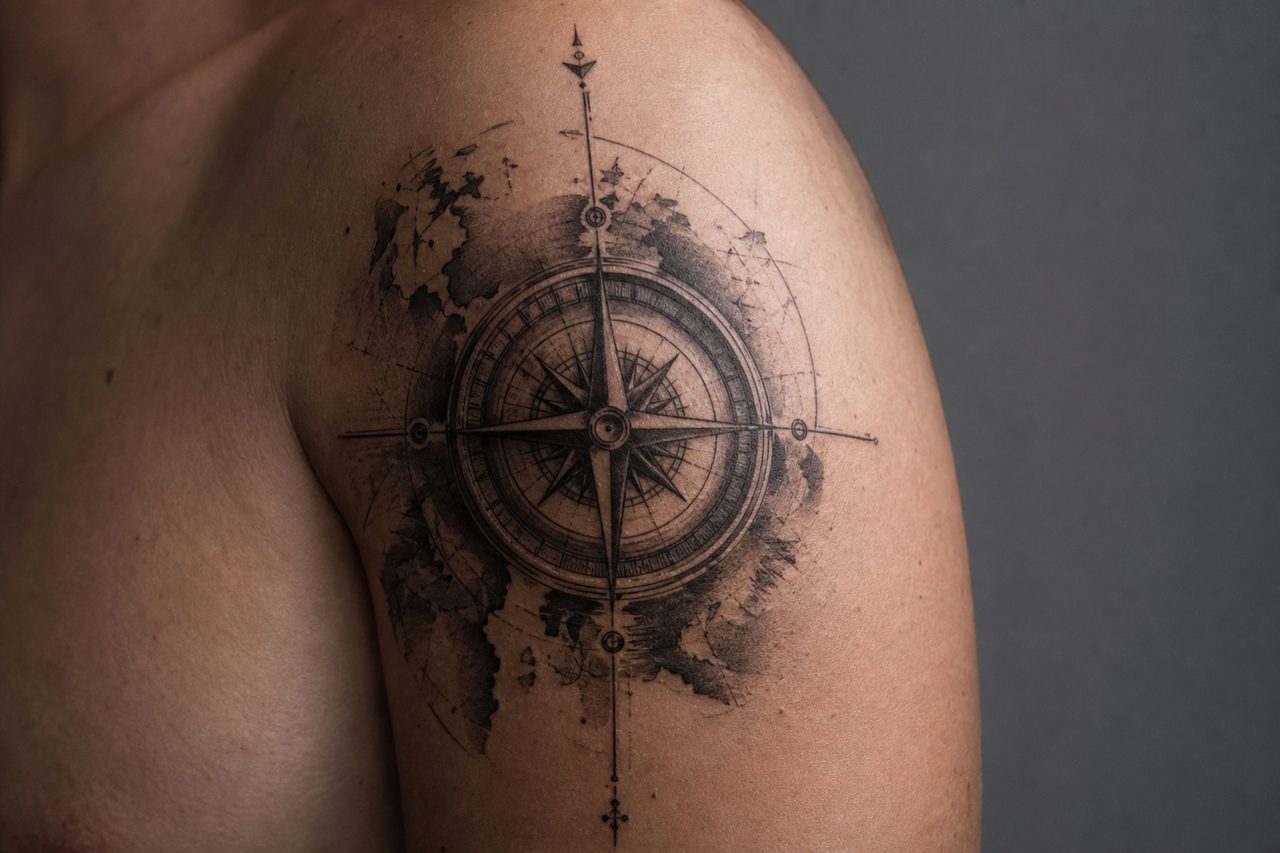
Shaded compasses, whether whip-shaded traditional or smooth greywash, add dimension and depth. The needle can cast a subtle shadow, the degree markings can recede visually, and the piece gains weight. The trade-off: shaded areas settle slightly softer over time, and heavy black backgrounds can spread more than open skin. Most successful compass tattoos mix both approaches, strong outlines to hold the structure, selective shading to create depth.
- Dotwork mandala compasses: geometric precision with stippled gradients that age gracefully
- Broken compass with wildflowers: the needle askew, nature reclaiming the instrument
- Antique brass finish: warm tones, verdigris hints, engraved numerals
- Split-style: half traditional sailor compass, half realistic modern instrument
- Negative space needle: the pointer formed by uninked skin within a dark field
Adding Coordinates or Text
Latitude and longitude numbers, dates, or short phrases pair naturally with compass imagery. The key is legibility at size. Script below 10-point equivalent tattoo scale becomes hard to read within a few years. Block lettering or clean serif numerals hold up better. Position text where it follows a natural curve, along the compass circumference, or on a banner that flows with the circle’s geometry rather than fighting it.
Matching & Pairing Ideas
Compass tattoos work exceptionally well in sets. Two people can carry complementary pieces: one holds the compass face, the other the needle, which only reads complete when shown together. For couples or close friends, this creates genuine visual connection without matching identical images.
Another approach places the same compass design on both parties but with different orientations, one pointing toward a shared location, the other pointing home. The coordinates can differ meaningfully while the core design unifies the pair.
Siblings sometimes choose compasses with identical structural elements but different surrounding landscapes: mountains for one, coastline for another, desert for a third. The compass ties the family reference together; the environment individualizes each piece.
Trending Variations
Biomechanical and Industrial
Gears visible through transparent compass faces, piston-driven needles, riveted brass housings, this direction draws from steampunk aesthetics but strips away the theatrical excess. The result reads as functional machinery rather than costume. These demand artists comfortable with mechanical drawing and perspective; a gear at the wrong angle breaks the illusion immediately.
Minimalist and Abstract
Reduced to three lines suggesting a needle, or a circle with a single off-center mark indicating north. These live or die on exact placement and proportion. There’s no detail to distract from a slightly oval circle or a needle that doesn’t quite bisect the angle. The best minimalist compass tattoos often come from artists who specialize in graphic design or logo work, with portfolios full of clean geometric pieces.
Watercolor backgrounds behind traditional compass structures have cooled from their peak popularity, but selective use persists. The effective versions keep the compass itself in solid black linework while the color wash occupies peripheral space. Reversing this, colorful compass with black background, tends to muddy as the pigments blend during healing.
Tips for Choosing
Reference material matters more than most people expect. Bring your artist actual compass images: antique brass instruments, modern hiking gear, ship’s binnacles. Not other tattoos. Working from source objects yields more convincing detail than copying a copy.
Consider how the compass will interact with your existing or planned tattoos. A standalone compass on a blank forearm carries different weight than one integrated into a sleeve. The directional arrow can point toward or away from other pieces, creating visual flow or tension intentionally.
- Ask to see healed photos of the artist’s geometric work, not just fresh
- Request a stencil test placement before committing to exact size
- Verify that “north” on your design actually points where you intend on your body
- Discuss how the artist handles the center pivot point, this detail often blows out
Style coherence matters. A photorealistic compass surrounded by American traditional roses creates visual dissonance unless that’s specifically the intended effect. Most successful pieces commit to a single approach: all traditional, all realistic, all graphic, all ornamental.
Best Placements
Flat Surfaces and Curves
The outer forearm offers an ideal flat canvas for compasses, with the radius bone providing natural structure. The design sits visibly, ages relatively well with sun protection, and scales appropriately for the available space. Inner biceps work similarly but experience more movement during healing, which can affect fine detail settlement.
Thighs and calves provide larger fields for elaborate pieces with map backgrounds or multiple instruments. The muscle movement in these areas demands slightly bolder line work than stationary placements; what reads as delicate on paper can blur with skin flexion.
Challenging but Effective
Ribcages and sternums accommodate compasses well because the body’s center line naturally supports the directional symbolism. However, these areas hurt more, heal slower due to constant movement with breathing, and often require touch-ups. The center chest specifically lets the compass sit over the heart, which many people find personally significant despite the physical trade-offs.
Hands and fingers remain popular for small compass marks, but the reality is harsh: palm-side ink rarely holds, and dorsal finger tattoos fade substantially within two to five years. If you want a compass on your hand, commit to maintenance or accept it as a temporary marking.
Behind the ear and along the side of the neck work for very small, simple compass marks, essentially directional arrows or minimal north indicators. Anything more complex fights for space and clarity.
The Bottom Line
A compass tattoo succeeds when the design respects the instrument’s actual geometry and the placement respects how human skin behaves over time. The most enduring pieces tend toward bold clarity over intricate delicacy, toward meaningful specificity over generic symbolism. Choose an artist whose healed geometric work you can examine, bring source references rather than tattoo copies, and give the piece enough room to breathe. The compass has been a reliable tattoo subject for generations not because it reinvents itself, but because it does its job honestly: marking direction, holding steady, staying readable across the years.
Frequently Asked Questions
How much detail can a small compass tattoo actually hold?
Below two and a half inches, most degree markings and fine needle details merge together within a few years. Focus on strong north-south-east-west indicators and a clear needle; skip the ornate wind rose flourishes unless you’re going larger.
Do compass tattoos always need to point north in the design?
Not at all. Many people orient the needle toward a meaningful location, home, where they met someone, a place they’re heading. Just communicate this clearly to your artist so the stencil placement aligns correctly on your body.
Why does the center of my compass tattoo look blurry after healing?
The pivot point where needle lines converge is prone to ink spread during the healing process. Experienced artists leave micro-gaps or use slightly lighter saturation at the exact center to compensate for this natural settling.
Can a compass tattoo be covered up if I change my mind?
The circular format and radial lines make compasses moderately challenging to cover. Solid black backgrounds or large ornamental frames work best. A poorly executed compass with blown-out lines is harder to disguise than a clean, bold one.