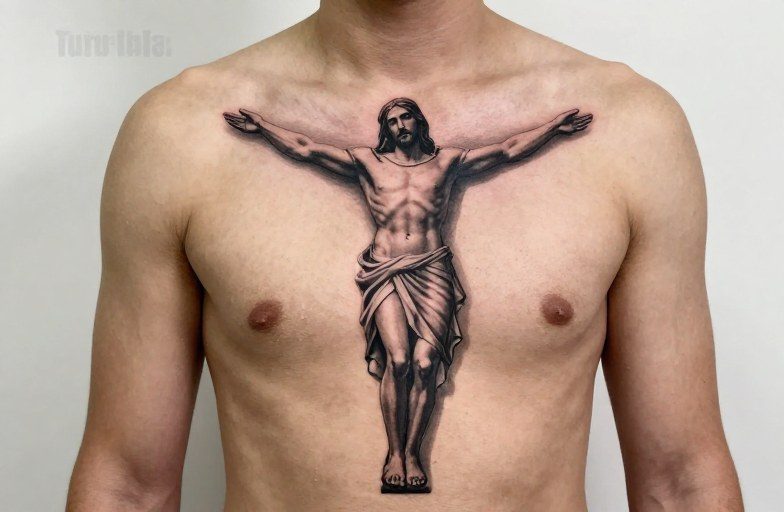
Christ tattoos carry weight. Not just spiritual weight, the imagery demands technical precision if you want it to look recognizable in ten years. A poorly planned portrait of Jesus can blur into unrecognizable gray mush. A crucifix placed wrong fights the body’s movement. This guide covers what actually works: where to put it, how to style it, and how to keep the meaning sharp without the ink going soft.
Best Placements
Skin stretches, sun hits, and gravity pulls. Some spots preserve detail better than others.
High-Retention Areas
The outer upper arm, the outer thigh, and the upper back between the shoulder blades age gracefully for Christ imagery. These areas see less daily friction, minimal sun exposure under clothing, and the skin doesn’t stretch as dramatically with weight fluctuation. A full-color Sacred Heart or a black-and-gray crucifixion scene stays readable here for decades.
- Forearms: Visible, but sun exposure fades color faster; plan for touch-ups or stick to bold black-and-gray.
- Ribs and sternum: Canvas for large crucifixion scenes, but painful and prone to blowout on thin skin over bone.
- Calves: Excellent for standing figures like the Risen Christ; stable skin, good for vertical compositions.
- Hands and neck: High visibility, high maintenance. Fine lines blur quickly; these spots demand thick, simple designs.
Flow With the Body
A crucifix on the forearm should follow the arm’s natural line, not fight it. A Christ face looking upward works with the chest’s curve, not against it. Bad placement makes a serene face look distorted when the muscle flexes. Your artist should map the design with you standing, sitting, and moving the limb through its full range.
Color Choices
Black-and-gray dominates Christ tattoos for good reason. It ages cleaner, heals more predictably, and carries the historical weight of religious iconography, think Byzantine mosaics, old Catholic statues, the chiaroscuro of Baroque paintings.
When Color Works
Strategic color, not rainbow explosions. The Sacred Heart demands red. A crown of thorns can carry subtle burgundy. Skin tones in portraits need warm ochres and pinks, but limit the palette. Too many hues in a small space muddy together as they age. Gold halos? Yellow ink fades to mustard; consider leaving the skin negative for light, or using pale yellow as a highlight that can be refreshed.
- Black-and-gray: Best for photorealistic portraits, full scenes, anything meant to last 20+ years.
- Limited color: One or two accent colors, blood red, stone blue, against a grayscale foundation.
- Full color: Requires larger scale, more budget, more commitment to sun protection and future touch-ups.
Popular Styles
Not every style handles religious subject matter with the gravity it needs. These approaches consistently deliver.
Black-and-Gray Realism
The go-to for portraits of Christ. Requires an artist who specializes in smooth shading, not just line work. Look at their healed photos, not fresh Instagram posts. Fresh realism looks deceptively perfect; healed work reveals whether they understand how gray wash settles into skin over time. The best artists build contrast through layered passes, not heavy black saturation that turns to solid blocks.
Traditional and Neo-Traditional
Bold lines, limited shading, readable from across the room. Traditional crucifixes, praying hands with rosaries, and Christ heads with halos work naturally here. The style’s graphic simplicity means they hold up on high-wear spots like forearms and hands. Neo-traditional allows more color variation and ornamental detail, floral wreaths, decorative thorns, without sacrificing longevity.
Religious Iconography and Byzantine Influence
Flat perspective, gold backgrounds, stylized faces. This references actual church art rather than attempting photographic likeness. The aesthetic translates beautifully to tattoo: bold outlines, flat color fields, minimal shading. It avoids the uncanny valley of a mediocre portrait and ages exceptionally well because the design never depended on subtle gradation.
Size & Scale
Small Christ tattoos fail. The face needs room for eyes, nose, mouth, and the subtle shadows that make them human. A thumbnail-sized Jesus becomes a gray smear in five years. Minimum viable size for a recognizable portrait: palm-sized, and that’s pushing it. For a full crucifixion scene with landscape and figures, you’re looking at a full back or a large thigh piece.
- Small accents: IHS monogram, simple cross, fish symbol, fine for wrists or behind ears, but not representational Christ imagery.
- Medium (4-8 inches): Single figure, bust or half-body. Upper arm, calf, ribs.
- Large (10+ inches): Full scenes, multiple figures, architectural elements like columns or clouds. Back, chest, thigh.
Scale also affects detail density. A large back piece can handle individual hair strands in a beard; a forearm piece needs to simplify those to grouped shadows. Your artist should adjust the reference image’s complexity to the actual size on your skin, not just shrink a photograph.
Trending Variations
Contemporary approaches that avoid the cliché of a floating Jesus head.
Partial and Fragmented Compositions
Cropping in tight on eyes, hands, or the wound in the side. This borrows from Renaissance close-ups and modern photography. A pair of eyes looking upward, filling a shoulder cap, carries emotional weight without needing full context. The fragment invites the viewer to complete the image mentally.
Combined Imagery
Christ figure merged with natural elements, roots growing from the cross, water flowing from the wound, the face emerging from clouds. These require an artist who understands both religious symbolism and organic composition. Done well, they avoid the static quality of traditional religious tattoos. Done poorly, they look like clip art layered together.
Another variation: the Christ figure as architectural element, integrated into a cathedral window frame, a Gothic arch, or a stained-glass border. This gives the tattoo structure and grounds the figure in a specific visual tradition rather than floating it in empty skin.
Standout Design Ideas
Specific concepts that move beyond the obvious.
- The Man of Sorrows: Christ showing his wounds, a medieval image format that translates to powerful chest or stomach pieces. The direct gaze creates confrontation, not comfort.
- Christ in the Wilderness: Temptation scene, solitary figure against rocks. Less common than crucifixion imagery, more narrative room for environment and mood.
- Ecce Homo: The crowned, robed figure presented to the crowd. Dramatic lighting potential, strong profile or three-quarter view.
- The Last Supper from behind: Viewing the table over Christ’s shoulder, the disciples arrayed before him. Unusual perspective, works as a full back piece.
- Negative space crucifix: The cross formed by un-inked skin, surrounded by dark clouds or storm. High contrast, graphic impact, ages excellently.
Consider also the non-figurative: the Chi-Rho, the Alpha and Omega, the pelican feeding her young (a medieval symbol of Christ’s sacrifice). These carry the meaning without requiring portraiture skill from your artist.
Key Takeaways
Plan for the long term. Black-and-gray realism and traditional styles offer the most reliable aging for Christ imagery. Placement on outer upper arms, thighs, or upper back preserves detail. Scale matters: go bigger than you think, or simplify to symbolic forms. Vet your artist through healed work, not fresh photos. And know that the most powerful religious tattoos often come from specific, lesser-known iconographic sources, the Man of Sorrows, the Ecce Homo, rather than the generic floating head that every shop has stenciled a hundred times.
The image carries weight. Make sure the technical execution carries it equally far.
Frequently Asked Questions
How do I find an artist who can actually do a good Christ portrait?
Look for healed photos in their portfolio, not just fresh work. Ask specifically about their experience with black-and-gray realism and religious subject matter. A strong portrait artist understands facial anatomy and how to build contrast that survives the healing process.
Will a color Sacred Heart tattoo fade faster than black-and-gray?
Red ink holds reasonably well but requires more sun protection. The bigger issue is that color portraits need larger scale to prevent colors from bleeding together. Plan for touch-ups every few years if you choose full color.
Is it disrespectful to get a Christ tattoo on my leg or arm instead of my chest or back?
Placement is a personal and theological decision, not a universal rule. Some traditions have specific guidance; others don’t. What matters most is that the placement makes sense for the design’s scale and your commitment to maintaining it.
How much should I expect to budget for a detailed Christ tattoo?
Quality black-and-gray realism starts around $150-200 per hour and large pieces require multiple sessions. A palm-sized portrait might take 4-6 hours. A full back scene could be 30+ hours across months. This is not a budget tattoo category if you want it done well.