Anubis carries unusual weight in tattoo culture. The jackal-headed god of mummification and the afterlife offers sharp angles, dramatic silhouette, immediate recognition. But the real opportunity lies deeper than iconography. You can build something personal here, something that holds meaning beyond the initial visual punch. An Anubis design rewards patience and research. Here is how to approach it with care.
Understanding the Source Material
Study Authentic Depictions
Authentic Egyptian art shows Anubis in specific, repeated forms: seated or standing, often holding a was scepter or ankh, sometimes weighing a heart against the feather of Ma’at. These poses carry built-in narrative structure. A standing guardian figure reads differently than a seated, watchful presence. The classic profile view, one eye visible, ear erect, snout elongated, provides that instant recognition factor. Stray too far from these proportions and you risk generic “dog-headed thing” territory. Study temple reliefs and papyrus illustrations before committing to a custom piece. Your artist needs reference too, and most will not have deep Egyptian art training.
Symbolism and Personal Honesty
Anubis carries associations with death, transition, and protection of the dead. For some, this resonates as a memorial piece or meditation on mortality. For others, the imagery simply compels. Be honest about your motivation. In my observation, Egyptian revival pieces age better when the wearer actually connects to the symbolism, not just the aesthetic. The design holds up because the commitment behind it holds up. Consider what you want this figure to mean on your body in ten, twenty, thirty years.
Related reading: Anubis design tattoo | eye of Horus tattoo design | daredevil tattoo ideas | Christian tattoo ideas
- Standing Anubis: active guardian, protective energy
- Seated Anubis: judgment, weighing souls, contemplative
- Anubis with scales: the weighing-of-hearts scene, moral accountability
- Anubis guiding a soul: transition, passage, memorial connection
Building Your Personal Design
Integrating Meaningful Objects
The Egyptian visual vocabulary offers combinable elements, each with specific resonance. Scarabs, lotus columns, cartouches with hieroglyphs, solar disks. A cartouche spelling a name or meaningful word anchors the piece personally. The ankh, often paired with Anubis, can stand as separate element or integrate into the composition’s structure. Some collectors incorporate astronomical elements: the star Sirius, whose heliacal rising coincided with Nile flooding and was often linked to Isis and Osiris in Egyptian tradition. Anubis’s own mythological parentage varies by source, commonly Nephthys and Osiris or Set, so family connections to Sirius depend on which textual tradition you follow.
Modern Juxtaposition Done Right
Contemporary approaches place Anubis in unexpected contexts: cyberpunk circuitry, geometric frameworks, abstract backgrounds. This works when the contrast feels intentional rather than random. A geometric Anubis with clean lines and negative space reads as deliberate design choice; random tribal elements around a traditional figure usually look dated. The key is unified visual language. If you mix eras, commit fully. Discuss this explicitly with your artist: what visual rules govern the entire piece?
Style Directions That Work
Blackwork and Archaeological Texture
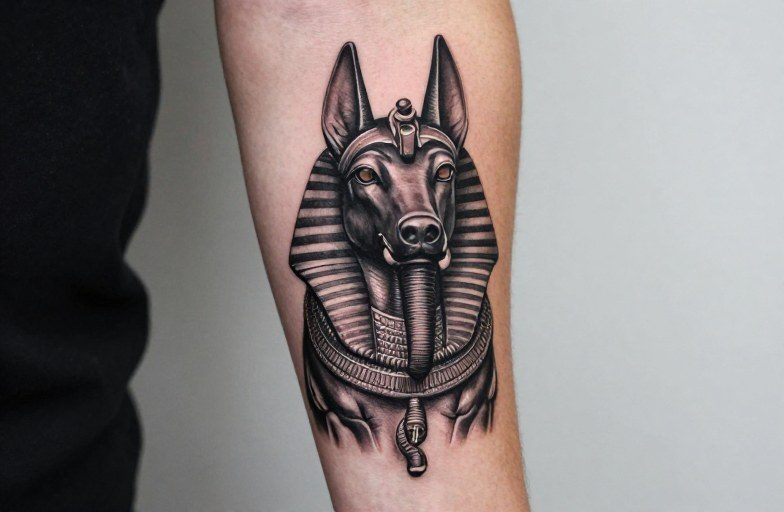
Heavy black fill emphasizes the jackal head’s natural darkness, creating dramatic contrast against skin. This approach ages well because bold shapes remain readable even as fine details soften. The “broken statue” or archaeological aesthetic extends this: Anubis appears as cracked stone, missing sections, with gold leaf or lapis lazuli color hints suggesting ancient material. This variation plays beautifully with texture and can incorporate realistic stone rendering alongside stylized Egyptian proportions.
Neo-Traditional and Graphic Approaches
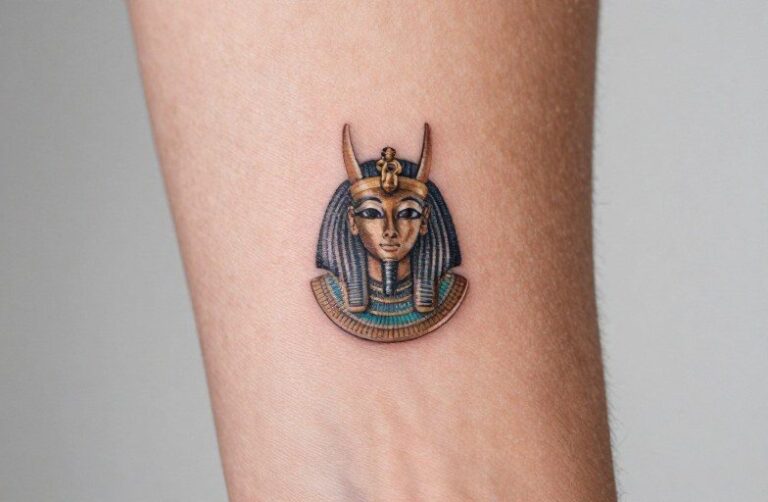
Neo-traditional pieces use bold outlines and limited color palettes of American traditional tattooing applied to Egyptian subject matter. Heavy black, muted gold, perhaps a touch of crimson. The style’s inherent graphic clarity suits the subject’s strong silhouette. Pure linework also succeeds: Egyptian art’s inherent flatness and profile views suit confident contour lines and strategic hatching. The original source material was essentially linework on stone. A skilled artist renders the figure with minimal shading, letting line weight variation create depth. This heals cleanly and ages exceptionally well.
- Blackwork/statue: heavy fill, archaeological texture, stone-like surface
- Neo-traditional: bold lines, limited color, graphic impact
- Geometric/abstract: fractured planes, mathematical precision, modern minimalism
- Realistic-surrealist: photorealistic jackal features merged with human elements, dramatic lighting
Scale, Placement, and Longevity
Small to Medium Solutions
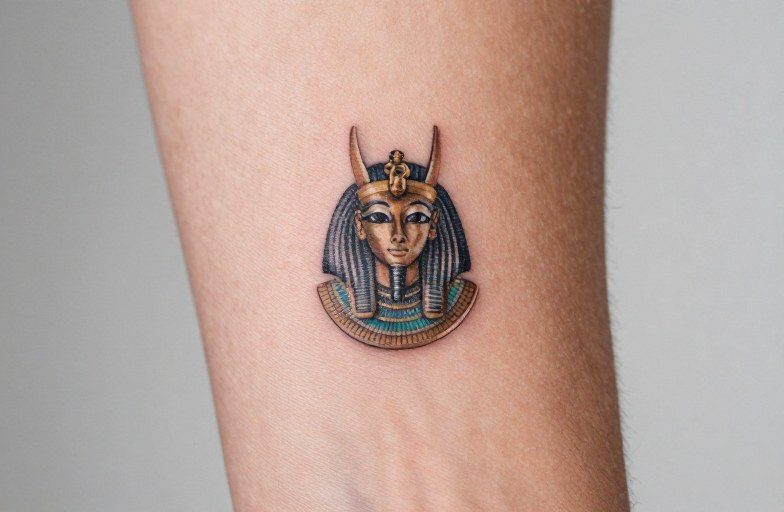
Anubis does not demand massive scale, but the design needs room for the snout and ears to read correctly. At three inches or smaller, you are essentially doing a logo: recognizable but simplified. The forearm, calf, and upper arm handle medium sizes well. A seated Anubis roughly palm-sized can sit beautifully on the inner bicep or thigh, the body’s natural curves complementing the figure’s posture.
Large Compositions
The real impact comes at larger scales. A full standing Anubis, six to eight inches tall, allows for detailed regalia: the nemes headdress, collar necklace, ceremonial apron. The back, chest, and full thigh become spaces for narrative scenes: the weighing of the heart, the journey through the underworld. These compositions need careful planning for flow and negative space. A dense Egyptian piece without breathing room turns into visual noise within a few years as ink settles and spreads slightly.
Placement affects longevity significantly. Areas with frequent sun exposure, forearms and hands, fade faster. The black ink that makes Anubis visually powerful is particularly susceptible to UV breakdown. The upper arm and torso preserve dark work better long-term. Plan your aftercare and sun protection accordingly; this matters more for black-dominant pieces than most clients realize.
Pairing and Composition Strategy
Natural Egyptian Pairings
Anubis pairs naturally with other Egyptian deities in complementary compositions. Ma’at, goddess of truth with her feather, completes the weighing-of-hearts narrative. Osiris, lord of the underworld, provides mythological context. Bastet offers feline counterpoint to the canine Anubis. These pairings work as separate tattoos that converse across the body, or as unified compositions. For couples or close friends, Anubis and Bastet as guardian figures create meaningful connection without obvious cliché. The two deities shared temple cults historically, so the pairing has authentic precedent.
Sleeve and Large Project Integration
Sleeve integration requires thinking about Anubis’s visual weight. The figure’s vertical emphasis and dark values need balancing elements: open sky, architectural columns, horizontal registers of hieroglyphs. A good composition moves the eye through the scene rather than dropping a dark figure into empty space. Work with an artist who plans the full sleeve, not just individual pieces. Egyptian subject matter demands this coherence more than most styles.
- Anubis + scales + Ma’at’s feather: the judgment scene
- Anubis + Eye of Horus: protection doubled, complementary symbolism
- Anubis + pyramids/Nile landscape: geographic and mythological context
- Anubis + scarab + solar barque: the full underworld journey
What to Remember
An Anubis tattoo done well carries centuries of visual tradition into contemporary skin. The figure’s inherent graphic strength, those alert ears, that long muzzle, the formal Egyptian posture, gives artists solid foundation to build upon. You might go minimal and linear, or dense and narrative. Either path requires respecting the source material enough to understand it, then making deliberate choices about where to deviate. Dark ink, strong silhouette, meaningful personal integration: get those right, and this ancient guardian will watch over your skin for decades.
Frequently Asked Questions
Does an Anubis tattoo mean I worship Egyptian gods?
No. Most people choose Anubis for aesthetic, symbolic, or personal reasons rather than religious practice. The imagery resonates across many belief systems and none.
How do I find an artist who does Egyptian work well?
Look specifically at their portfolio for Egyptian pieces, not just general skill. Ask how they research historical proportions. An artist who cannot discuss profile conventions or proportional systems may not understand the source material.
Will heavy blackwork fade badly over time?
Black ink actually holds better than most colors, but it is vulnerable to sun exposure. Protect your piece from UV, especially on forearms and hands. Proper aftercare and long-term sun protection matter more than the specific ink brand.
Can I add color to a primarily black Anubis piece?
Yes, but restraint usually serves the subject better. Traditional Egyptian palettes used lapis blue, gold, carnelian red, turquoise as accents. Limited color reads as intentional; full color risks fantasy illustration rather than Egyptian art.
What is the most common placement mistake?
Choosing too small a scale for the detail desired. Anubis needs room for the snout and ears to read correctly. Below three inches, you lose the specific proportions that make this figure recognizable rather than generic.