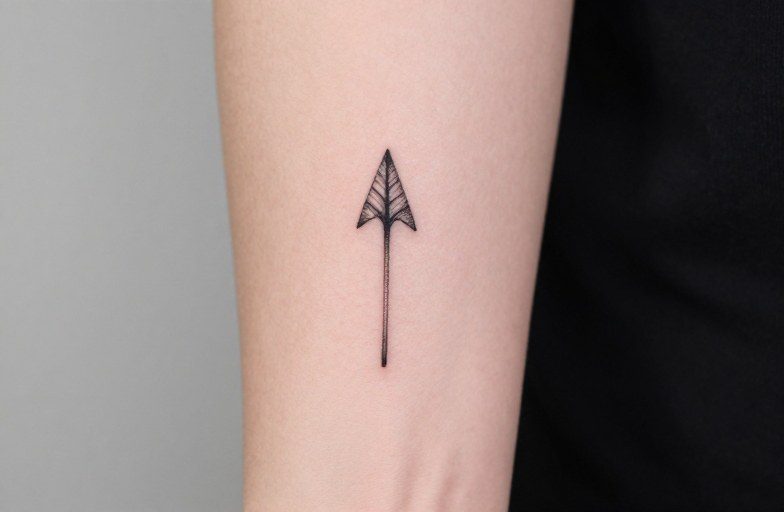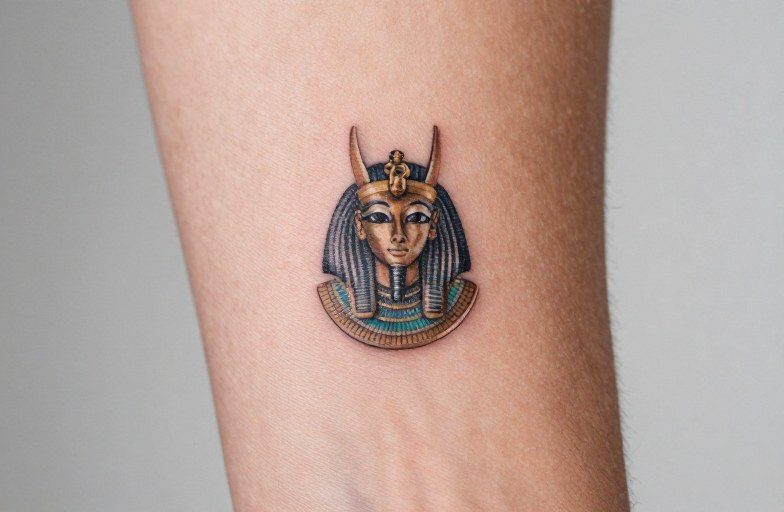
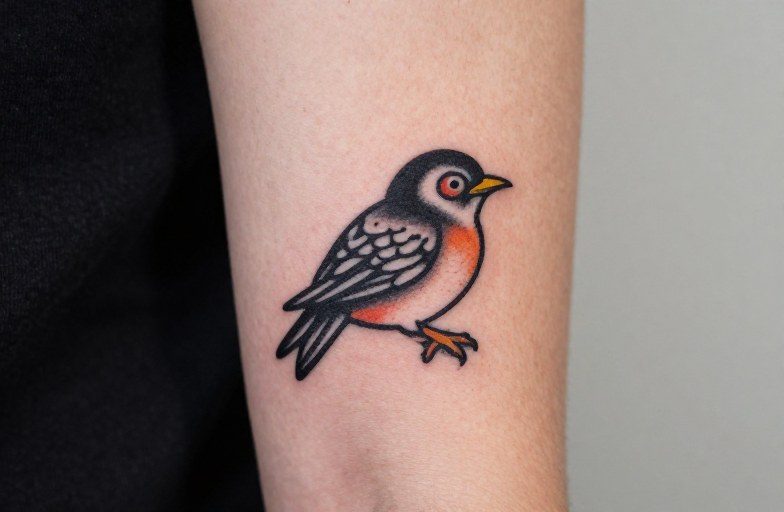
American traditional doesn’t need real estate to land. A swallow the size of a quarter, a dagger no longer than a thumb, these designs were born on sailors with limited skin and unlimited miles between ports. The style’s bold lines and limited palette actually favor small scale; the simplicity keeps them readable where photorealism would dissolve into a gray blob. What changes is the precision required. Every line earns its place. There’s nowhere for a shaky curve to hide.
Color Choices
The Classic Palette
Small American traditional lives or dies by its colors. The standard set, sailor red, cobalt blue, butter yellow, forest green, and heavy black, wasn’t chosen for nostalgia. These pigments are dense and opaque, which means they stay visible as the tattoo ages and skin changes. On a small piece, you rarely have room for smooth gradients, so each color sits flat against the next like cut paper.
- Red: Roses, hearts, flames. Vermillion or true blood-red; avoid orange-leaning shades that look muddy at small scale.
- Blue: Water, ribbons, bird wings. Cobalt holds better than navy, which can read as black within a few years.
- Yellow: Gold accents, flower centers. Needs a solid white highlight or it flattens into skin tone on darker complexions.
- Green: Leaves, serpent scales. Use sparingly; large green fields in small tattoos tend to dominate the composition.
- Black: Outlines, whip shading, all negative space. The skeleton that holds the design together.
What Happens When Color Fades
All tattoos spread slightly under the skin over decades. Small pieces have less buffer. A red rose petal that bleeds a millimeter outward still reads as a rose. A delicate watercolor gradient that bleeds becomes a bruise-like smear. American traditional’s color blocking accounts for this. The black outline acts as a dam. Even when red softens to pink and blue dulls to slate, the shape stays legible.
Standout Design Ideas
Single Motifs That Carry Weight
Some images need narrative context. Others work as pure icon. Small American traditional favors the latter. A dagger through a heart communicates betrayal or devotion without needing surrounding elements. A swallow in flight reads as travel, loyalty, or safe return, pick your association, the image carries it regardless.
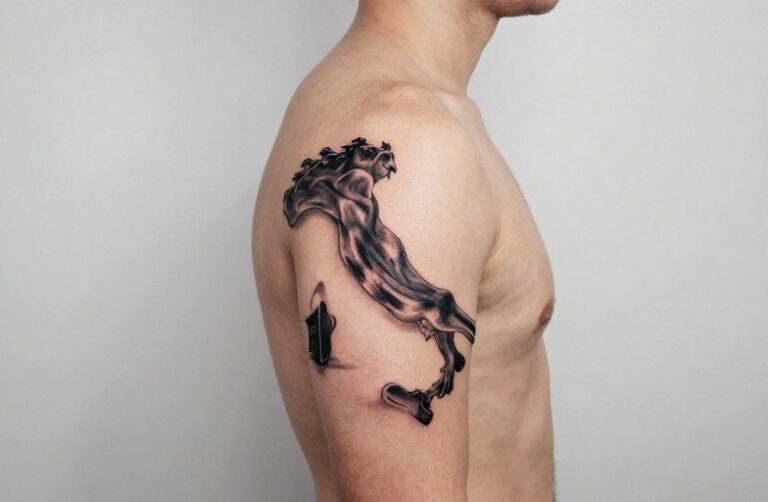
Strong small designs include: a coiled snake with head raised and tongue flicking; a single rose with three leaves and a thorned stem; a banner scroll with two words maximum; a skull facing forward, no jaw, heavy eye sockets; a pin-up girl’s face in profile, hair flowing into solid black; a ship’s wheel with eight spokes; a panther head, mouth open, one color for the body, black for the stripes.
Negative Space as Design
The skin you don’t ink matters as much as the skin you do. A small anchor can be mostly black silhouette with a thin white highlight where the shank catches light. A heart can be outlined in black with the center left completely open, just skin, no fill. This reads as clean, heals faster with less ink trauma, and ages exceptionally well. The temptation is to fill every gap. Resist it.
Popular Styles
Within American traditional, several substyles handle small scale differently. Understanding which you’re drawn to helps you communicate with your artist and set appropriate expectations.
- Classic sailor: Heavy black outlines, minimal shading, limited palette. Most forgiving for small work. Think 1940s flash sheets.
- Traditional with bold color: Slightly expanded palette, more saturated fills. Riskier small, color needs room to breathe, and too many hues in a tiny space compete.
- Traditional with whip shading: Black gradients achieved through parallel lines rather than smooth gray wash. Adds dimension without softness. Excellent for small animal fur, fabric folds, or cloud backgrounds.
- Traditional blackwork: No color, just black ink and skin. Relies entirely on line weight and negative space. Striking on any skin tone, heals with minimal color-shift concerns.
Most reputable shops have flash sheets, pre-drawn designs, organized by size. Ask to see their small flash specifically. Designs drawn at 4 inches often don’t shrink cleanly to 1.5. Good flash artists draw multiple versions of the same motif at different scales.
How to Personalize It
Meaning Without Literalism
American traditional vocabulary is symbolic, not literal. You don’t need a portrait of your grandmother to honor her. A rose with her initials in a banner does the work. A swallow for a sailor grandfather. A dagger for a difficult year survived. The personalization lives in the combination and the specific details, not in inventing a new image language.
Specific Modifications That Work
Small changes keep the style intact while making the piece yours. Add a birth year in the banner instead of “MOM.” Choose a specific flower, traditional rose, but with the petal count of your anniversary month. Pick a snake species with personal resonance (cobra, rattler, python) rendered in traditional simplified form. Select a ship type, clipper, tug, submarine, rather than generic “boat.” These details don’t break the style; they deepen it.
What doesn’t work: adding realistic elements like photorealistic eyes to a traditional skull, or soft watercolor backgrounds behind crisp traditional lines. The styles fight each other, and the small scale magnifies the clash.
Matching & Pairing Ideas
Symmetrical Pairs
Small American traditional excels as matched pairs. Swallows on each collarbone, facing inward or outward. Anchors on both forearms. Dagger and rose on opposite wrists, related but not identical. The key is consistent size and comparable visual weight. Two pieces that should match but don’t (one dense with fill, one mostly outline) look like accidents or cover-ups.
Building a Larger Composition
Starting small doesn’t mean staying small. Many collectors begin with scattered single pieces and later connect them into sleeves or torso panels. American traditional was designed for this. The heavy black “suit” background, solid black fill between designs, unifies disparate elements into a cohesive body of work. Plan placement with future expansion in mind. A small piece on the center of your forearm might block a larger composition later; the same design two inches toward the wrist leaves room to grow.
For First-Timers
Why This Style Forgives Beginners
American traditional is the safest first tattoo for several concrete reasons. The bold lines hold up even if your aftercare is imperfect. The limited color palette means fewer variables in how your skin reacts. The style’s long history means most experienced artists can execute it competently, you don’t need to find a hyper-specialist. And the small scale keeps commitment manageable. You learn how your body heals, how ink sits on your particular skin, without a massive piece to regret if something goes wrong.
What to Ask in the Consultation
Look at the artist’s healed work, not just fresh photos. Ask to see small traditional pieces they’ve done that are at least a year old. Request their minimum size for the specific design you want, good artists will refuse to go too small rather than do work that won’t hold. Discuss placement in terms of sun exposure (fades color), stretching (joints, stomach), and your professional context. Bring reference images, but trust the artist to adapt them to traditional conventions. A photo of a realistic rose won’t translate directly; the artist needs freedom to simplify.
The Takeaway
Small American traditional offers a rare combination: immediate visual impact, long-term durability, and genuine stylistic integrity. It doesn’t borrow from other traditions or chase trends. The same swallow design that read clearly on a sailor’s forearm in 1945 reads clearly on yours today. The constraints, bold line, flat color, limited scale, aren’t limitations. They’re the structure that makes the style survive. Choose a motif that resonates, find an artist whose healed small work you respect, and let the vocabulary do what it’s been doing for nearly a century: communicate something direct, lasting, and visually unmistakable.
Frequently Asked Questions
How small can an American traditional tattoo be before it starts to blur?
Most artists won’t go below one inch for complex designs, or half an inch for very simple shapes like stars or anchors. Below that, line spread over time makes details merge. Ask your artist their hard minimum for the specific design you want.
Do small traditional tattoos hurt more than larger ones?
Pain depends on placement and your individual nerves, not size. A small tattoo on bone (ankle, wrist, collarbone) often hurts more than a larger piece on muscle. The session is shorter, though, which some people find easier to manage.
Can I add color to a black traditional tattoo later?
Technically yes, but it’s not ideal. Traditional color sits inside the black outline, not over it. Adding color later means working around existing lines, which limits the artist. Plan color from the start if you want it.
How do I know if an artist is actually good at small traditional work?
Ask to see healed photos specifically, not just fresh Instagram shots. Look for consistent line weight, no blowouts (blurred lines), and color that still reads clearly. Good artists keep these records; hesitation to show them is a red flag.