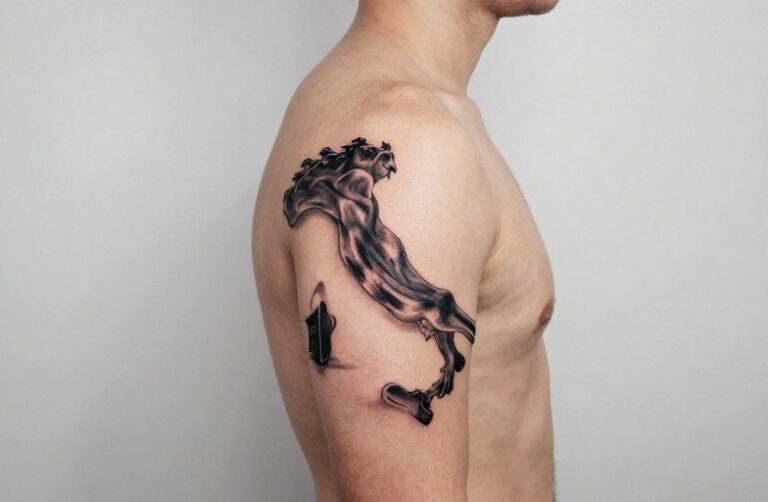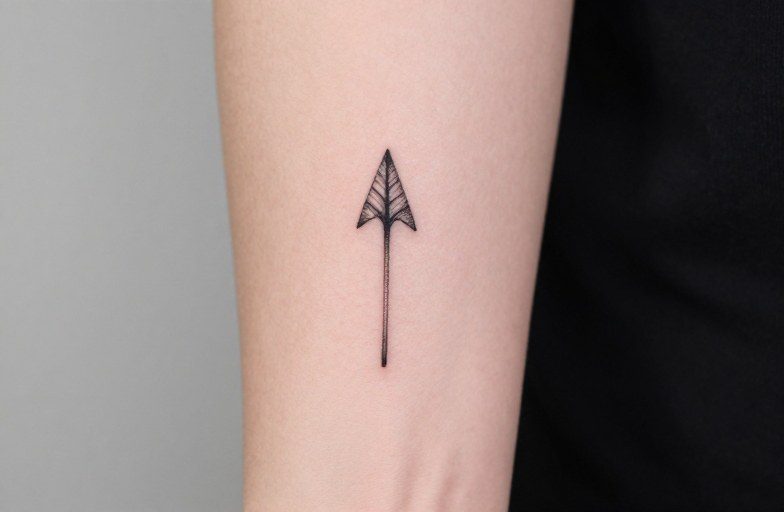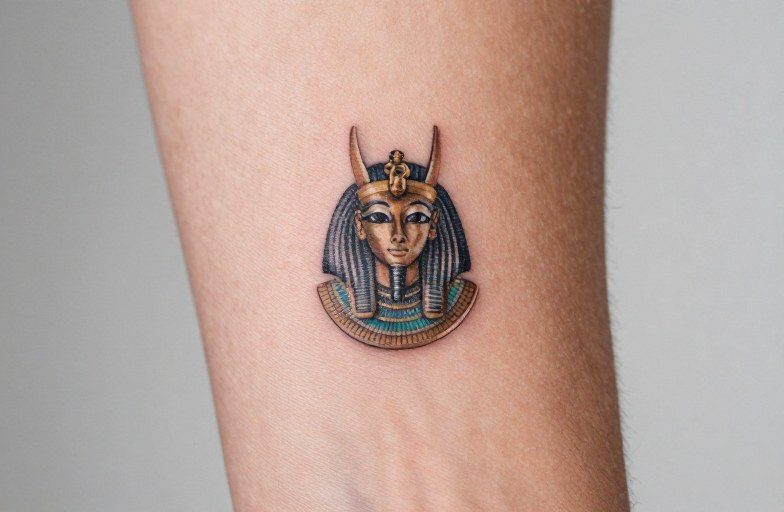
A religious tattoo marks belief made visible. It can signify devotion to a specific faith, a protective emblem worn on the body, or a personal milestone in someone’s spiritual journey. The meaning depends entirely on which tradition, symbol, or figure you choose, and how you adapt it to your own story.
Common Variations & Styles
Religious imagery spans virtually every artistic approach in tattooing, from photorealistic portraits to abstract geometry. The style you pick changes how the symbol reads on skin and how it ages over decades.
Figurative and Portrait Work
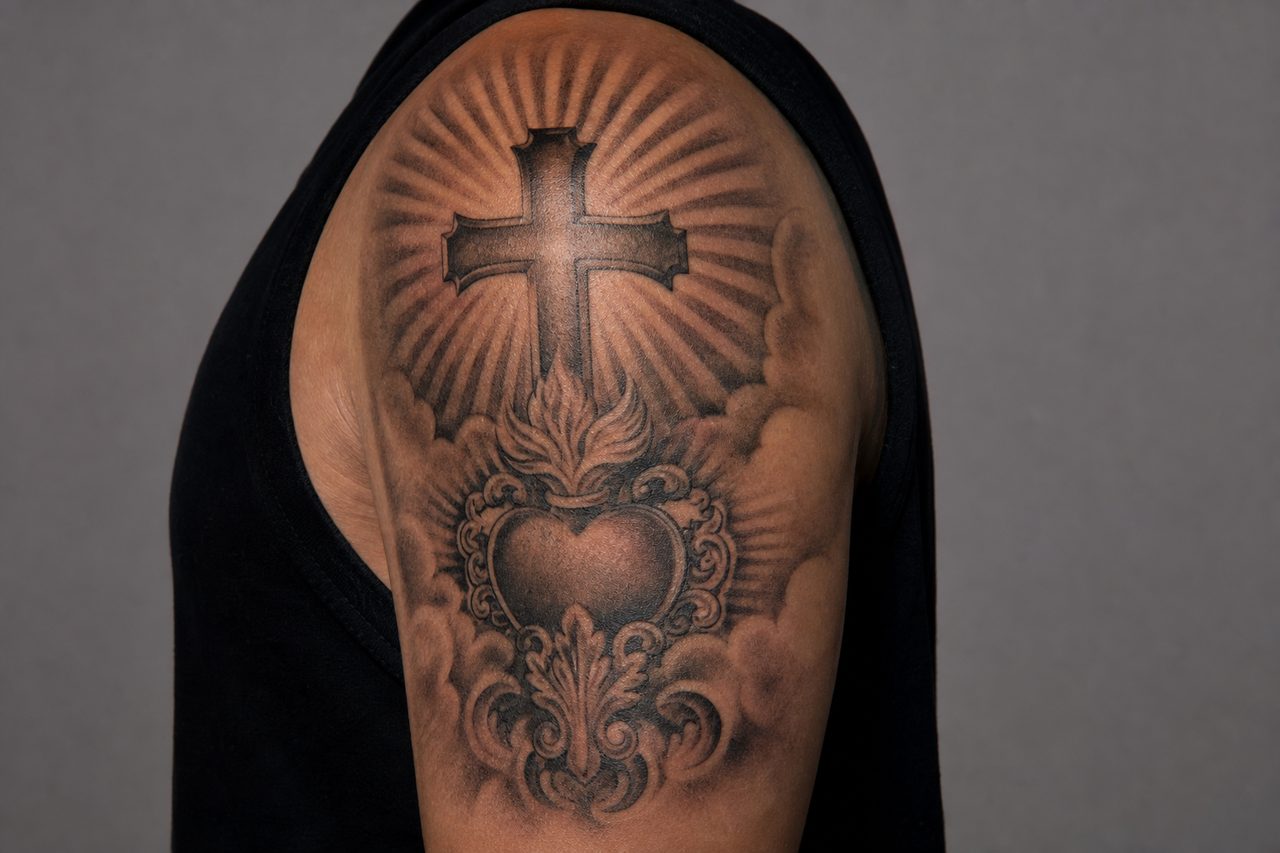
Christian subjects dominate Western shops: crucifixes, the Virgin Mary, praying hands, and depictions of Jesus. These pieces range from small line-drawn crosses behind the ear to full-back scenes of the crucifixion. Portrait-oriented religious work demands technical precision. Eyes, in particular, are unforgiving; slightly asymmetrical pupils or flat shading turns a sacred face into something unsettling. For longevity, bolder contrast and slightly larger scale hold up better than hyper-detailed micro-realism, which blurs within five to ten years on most body placements.
Buddhist and Hindu imagery offers equally rich territory: the Buddha in meditation, Ganesha, Hanuman, Saraswati, mandalas, and the unalome. These often incorporate ornamental framing, lotus details, or Sanskrit script. Islamic calligraphy, particularly Arabic script of the 99 Names of Allah or specific verses, avoids figurative representation entirely and relies on the fluid beauty of the lettering itself.
Ornamental and Geometric Adaptations
Many religious symbols translate beautifully into decorative formats. Celtic crosses merge Christian and pre-Christian knotwork. Sacred geometry, the Flower of Life, and Sri Yantra patterns appeal to seekers who identify as spiritual rather than doctrinally religious. These designs work exceptionally well as black-and-grey sleeve fillers or as centered chest or back pieces where symmetry matters.
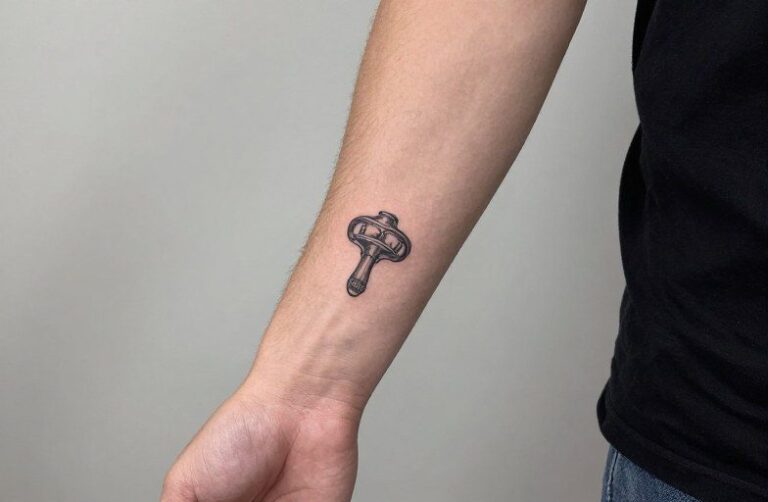
- Cross/crucifix: simple two-line variants, ornate Celtic or Russian Orthodox styles, three-dimensional carved-wood effects
- Praying hands: single figure, paired with rosary beads, or integrated into larger memorial compositions
- Eyes: Eye of Providence, Hamsa, Evil Eye (Nazar), each with distinct protective associations
- Angels and archangels: Michael, Gabriel, Raphael, Uriel, often depicted in battle or guardianship poses
- Eastern deities: Buddha, Kali, Shiva, Tara, Ganesha, each with specific iconographic rules (number of arms, objects held, posture)
- Script and calligraphy: Hebrew, Arabic, Sanskrit, Latin, Greek, Pali, sometimes combined with imagery, sometimes standing alone
History & Cultural Roots
Marking the body with religious significance predates organized tattooing as a profession. Some trace Christian tattooing to Coptic and Ethiopian traditions, where small crosses were cut or inked on children’s wrists as baptismal marks and identifiers. Pilgrims to Jerusalem historically received tattoos as proof of their journey, a practice some shops in the Old City continue today.
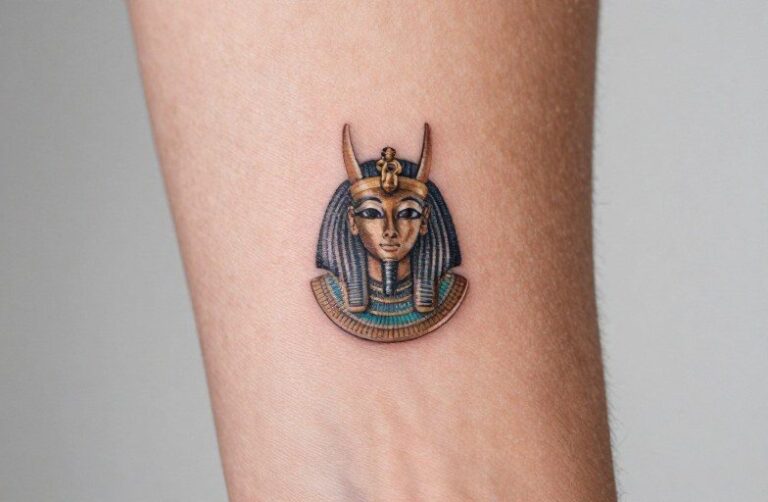
Southeast Asian Buddhist tattooing, particularly Sak Yant in Thailand, Cambodia, and Laos, involves monks or ajarns hand-poking sacred geometrical designs while chanting blessings. These aren’t merely decorative; the ceremony, the specific design (Gao Yord, Hah Taew, Suea), and the associated mantra carry layered protective and fortune-bringing functions. Similarly, Hindu tattooing in India has roots in devotional marking, with specific symbols tied to pilgrimage sites and deity worship.
Jewish tattooing carries particular complexity given traditional prohibitions against marking the body. Contemporary practice is varied and personal, with some choosing Hebrew script, Star of David imagery, or Holocaust memorial numbers as acts of reclamation.
Similar & Related Symbols
Religious imagery bleeds into protective, memorial, and spiritual-adjacent territory. Understanding the distinctions helps you choose precisely what you intend.
Protective Symbols with Religious Overlap
The Hamsa hand appears across Middle Eastern and North African Jewish, Islamic, and Christian communities, though its origins often linked to pre-monotheistic goddess worship. The Evil Eye (Nazar) bead, common in Greek, Turkish, and Arab cultures, serves a purely protective function without necessarily invoking a specific deity. These work well for people seeking cultural connection without doctrinal commitment.
Angels occupy ambiguous territory: biblical messengers, guardian figures in folk belief, or purely aesthetic winged human forms. A seraphim with six wings and covered eyes reads as explicitly biblical; a generic beautiful winged figure does not. Know which you want.
Memorial and Devotional Overlap
Rosaries, often tattooed as wrapped bracelets or hanging necklaces, function as prayer tools and memorial markers. Dates of death, names, and “Rest in Peace” banners frequently accompany them. This blurs the line between religious devotion and personal grief, which is fine if intentional, but worth distinguishing before you commit.
- Cross vs. crucifix: the cross is the shape; the crucifix includes Christ’s body. Different denominations prefer one or the other
- Star of David vs. Seal of Solomon: six-pointed star vs. hexagram with interlaced triangles, historically distinct
- Om vs. unalome: the sacred sound/syllable vs. the path-to-enlightenment symbol, often confused
- Dove with olive branch: peace, Noah’s ark, or the Holy Spirit, depending on context
Color vs Black and Grey
Color choices in religious work carry both practical and symbolic weight. Black and grey dominates Christian imagery in Western traditions, partly from association with classical sculpture and church statuary, partly because it ages gracefully on diverse skin tones. A black-and-grey crucifixion scene or Virgin portrait maintains readability for decades if the contrast is strong enough.
Color becomes more relevant with Eastern religious subjects. Buddhist and Hindu deities have traditional skin colors: blue for Krishna or Shiva, white or golden for certain Buddha forms, red for wrathful deities. Departing from these can feel inauthentic or even disrespectful depending on your community and intentions. Gold ink, while visually striking, is notoriously difficult: most “gold” tattoo pigments heal to a mustard yellow, and metallic effects are impossible to achieve in skin.
Skin tone significantly affects color vibrancy. Lighter skin carries bright reds, blues, and yellows more true-to-bottle. Darker skin makes pastels and low-saturation colors disappear; bold, high-contrast palettes work better. A skilled artist adjusts value ranges accordingly, not just hue selection.
Personal & Modern Meanings
Contemporary religious tattooing often separates from institutional affiliation. Someone raised Catholic but no longer practicing might still wear a small cross as connection to family or childhood. A person exploring Buddhism might choose a lotus or Dharma wheel as a marker of practice rather than conversion. The meaning is specific, not universal, and that’s the point.
Reclamation and Transformation
Religious tattoos sometimes mark recovery from religious trauma, re-entry into a tradition, or deliberate hybridity. A former evangelical might tattoo a serpent or forbidden fruit as ironic commentary. A convert might choose their new tradition’s imagery alongside birth-culture symbols. These compositions require particular care; juxtaposition without thought reads as collision rather than integration.
Some choose religious imagery for aesthetic reasons alone, which is valid but worth acknowledging. A Japanese back piece of Fudo Myoo or Kannon looks powerful regardless of the wearer’s Buddhist practice, but the imagery carries specific iconographic weight that knowledgeable viewers will read. Being able to explain or defend your choice matters if asked.
Best Placements
Religious tattoos occupy every possible placement, but certain locations carry traditional or practical associations.
Visible placements (hands, neck, forearms) signal public identification with a tradition. This can be empowering or professionally limiting depending on your field and geography. Small crosses behind the ear or on the wrist are common enough to rarely raise eyebrows in most Western contexts. Hand tattoos of crosses, praying hands, or script are prevalent in specific communities and read as serious commitment given the visibility and pain involved.
The chest and back offer space for complex compositions: crucifixion scenes, full deity portraits, mandalas, or scriptural passages. The chest, over the heart, has obvious symbolic resonance for devotional pieces. The back functions as a canvas for large-scale narrative or ornamental work.
Upper arms and shoulders accommodate medium-scale pieces that can be shown or concealed. This is where you’ll find many Celtic crosses, Buddhist sleeves, and Hindu deity portraits. The calf and thigh work well for vertical compositions: standing figures, rosary wraps, scriptural columns.
Foot and ankle placements, while popular for small crosses and om symbols, heal poorly due to friction, swelling, and thin skin. Touch-ups are common. Similarly, finger tattoos of crosses or script blur rapidly and require commitment to maintenance.
Before You Decide
Research the specific symbol’s origins and variations. A cross is not a cross is not a cross: the Coptic cross, Russian Orthodox cross, Celtic cross, and inverted cross carry distinct histories and, in some contexts, opposite meanings. The same applies to Eastern imagery; a wrathful deity and a peaceful manifestation of the same principle are not interchangeable.
Consider the tradition’s relationship to tattooing. Some communities actively embrace it; others have complex or prohibitive stances. Your personal right to choose exists alongside potential social friction with family or community members. Know what you’re entering.
Choose an artist with specific experience in your desired style. Religious realism, traditional Thai temple work, Hebrew calligraphy, and Japanese deity rendering each require specialized knowledge. A portfolio full of black-and-grey skulls does not guarantee skill in rendering a serene Buddha face or balanced Arabic script. Ask to see healed photos, not just fresh work; religious pieces often rely on fine detail that must survive the healing process.
Finally, sit with the design. Religious imagery, precisely because it carries weight, deserves deliberation. The permanence is the point.
Frequently Asked Questions
Will a religious tattoo affect my job prospects?
In most Western workplaces, small or concealable religious tattoos are a non-issue. Visible pieces on hands, neck, or face can still limit opportunities in conservative fields, though acceptance has broadened significantly in the last decade.
Is it disrespectful to get a tattoo from a religion I don’t practice?
Context matters. Some symbols are broadly cultural; others carry specific initiatory or protective functions that require proper ceremony. Research the specific tradition, and consider whether your use honors or extracts from its source.
How well do fine-line religious symbols age?
Fine line work blurs faster than bolder designs, especially on high-movement areas like wrists and ankles. For longevity, choose slightly thicker lines and adequate spacing between elements, or plan for periodic touch-ups.
Can I combine symbols from different religions in one tattoo?
You can, but do so thoughtfully. Juxtaposition without understanding can read as collision or appropriation. Work with an artist who understands both traditions, and be prepared to explain your personal reasoning.