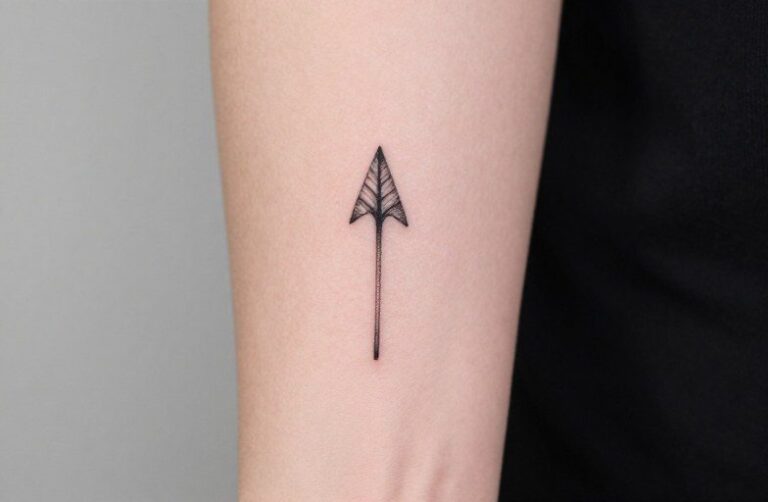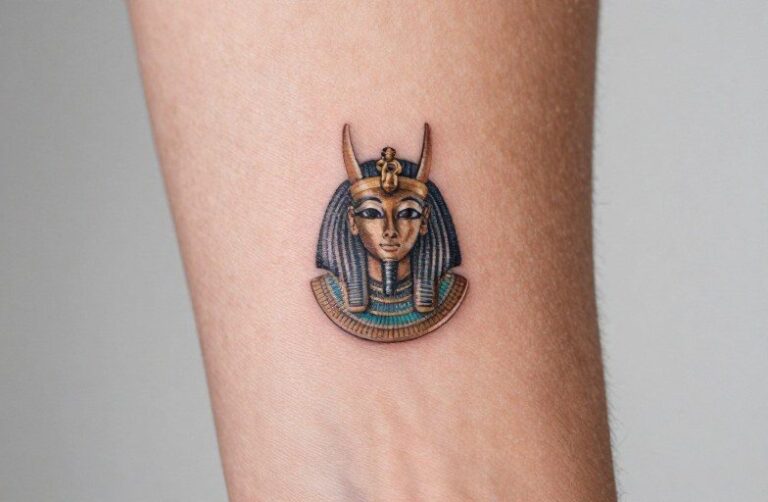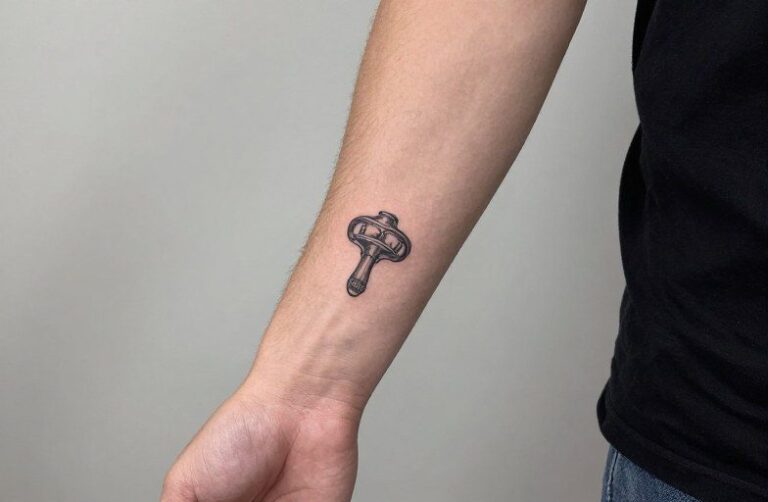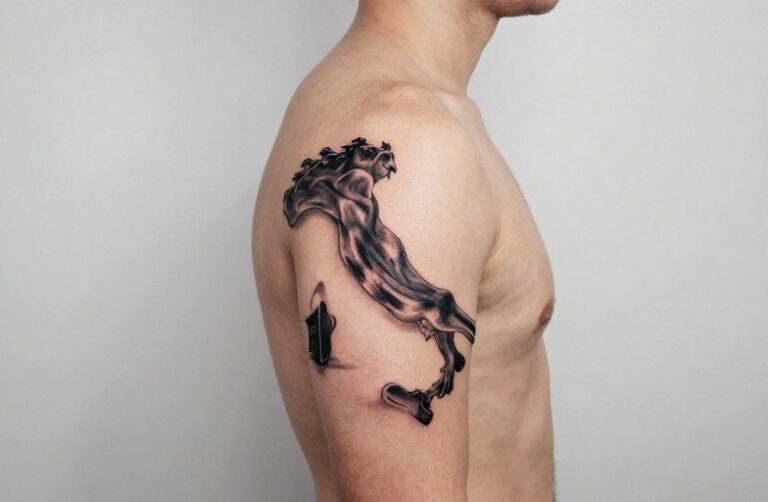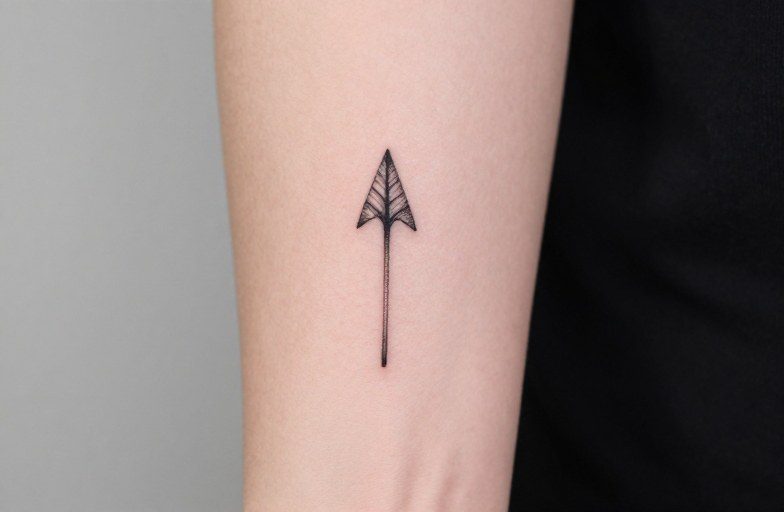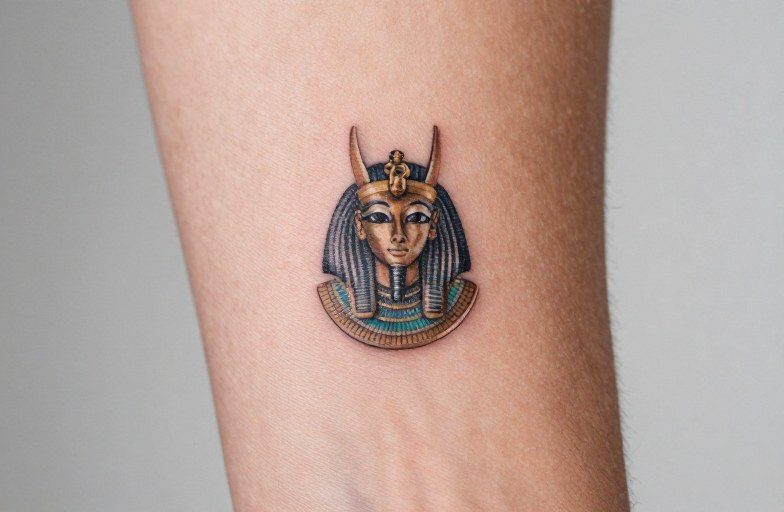
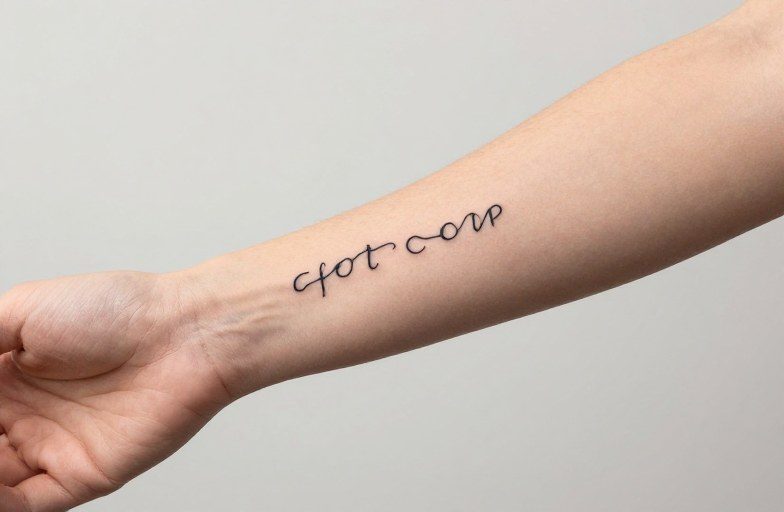
A forearm tattoo on a woman is, first and always, a statement of visibility. Unlike back pieces or thigh work that stays private by default, the forearm faces outward. It greets people at arm’s length. It says: this is mine, and I am not keeping it secret. That physical fact shapes every layer of meaning that follows.
Religious & Spiritual Angles
Sacred Visibility
Forearm placement has long served religious marking. Some trace Celtic cross forearm work to early Christian pilgrims who wanted faith visible during travel and labor. Hindu and Buddhist practitioners sometimes place mantras or deity eyes on the inner forearm, where the wearer can glance down during meditation. The arm becomes a portable altar, a reference point for practice rather than mere decoration.
Modern Spiritual Adaptations
Contemporary designs often secularize these traditions. A geometric mandala on a woman’s forearm may carry no doctrinal affiliation but still functions as a focal object, something to center attention during anxiety or grief. The inner forearm specifically invites this use: easy to see, easy to touch, positioned near the body’s own pulse point.
How It Ages on Skin
Placement Mechanics
Forearm skin behaves differently than other popular spots. It sees regular sun exposure, which fades pigment faster than back or hip work. The outer forearm (the radius side) catches more UV and experiences more friction from desks, car doors, and sleeves. Inner forearm skin is thinner, holds detail longer, but blurs slightly with age as collagen shifts.
- Line work: Single-needle and fine lines look crisp for 3-5 years, then soften; thicker outlines survive decades
- Shading: Whip shading and smooth gradients age more gracefully on forearms than saturated color blocks
- Color: Red and yellow fade fastest on sun-exposed outer forearms; black and deep blue hold
- Touch-ups: Most forearm pieces need refreshment at 8-12 years depending on lifestyle
Healing Reality
Forearms heal relatively easily compared to joints or feet. The skin is stable, not stretching dramatically with movement. Still, the location tempts picking, visible, accessible, hard to ignore during the two-week peeling phase. Sleeves and bracelets complicate aftercare. Plan around seasons; fresh forearm work in summer means constant sunscreen vigilance or covering up.
Symbolism & Core Meaning
The forearm occupies a symbolic middle ground. Not as hidden as the torso, not as aggressively confrontational as the neck or face. It permits retreat, long sleeves exist, but defaults to exposure. This creates a meaning of chosen openness. The wearer controls revelation but does not start from concealment.
Historically, forearm tattoos on women carried specific social coding. In early 20th-century circus and sideshow culture, tattooed ladies often displayed forearm work as their primary visible canvas, since legs and torsos remained covered by period dress. The forearm became the boundary of respectable transgression, visible enough to draw paying crowds, covered enough to maintain plausible deniability in polite company.
Today that tension persists. A woman with forearm tattoos still fields questions that men rarely face: professionalism, femininity, future regret. Choosing the placement anyway asserts that these concerns are secondary to self-definition. The meaning becomes refusal to preemptively shrink for hypothetical discomfort.
Personal & Modern Meanings
Commemoration and Milestone
Forearm placement suits markers of transformation. Sobriety dates, survival anniversaries, name memorials, these benefit from daily visibility. The wearer does not forget; the body reminds. This is practical function, not mere sentiment. A forearm piece works as behavioral anchor, something to notice during moments of decision or distress.
Aesthetic and Identity Signal
Some women choose forearm work primarily for visual cohesion with existing style. The tattoo extends an aesthetic system already present in clothing, jewelry, or hair. It signals subcultural affiliation, punk, botanical, minimalist, witchy, without requiring explanation. The meaning here is membership and continuity, not singular event.
- Botanical sleeves: Often read as growth, change, natural cycles; also simply beautiful
- Typography: Quotes or single words function as private mantra made public
- Abstract geometry: Frequently chosen for visual pleasure and arm-flattering flow rather than symbolic payload
Common Variations & Styles
Inner vs. Outer Forearm
Inner forearm tattoos face the wearer; outer faces the world. This technical choice carries meaning. Inner placement suggests intimacy, self-reference, something primarily for the person bearing it. Outer placement accepts social engagement, invites comment, declares before being asked. Many women choose inner for first forearm work, testing visibility comfort before committing to outer exposure.
Wraparound and Partial Sleeve
Wraparound designs that circle the forearm create continuous narrative or pattern. These read as commitment to the form, not a single image isolated on skin. Partial forearm sleeves, covering from wrist to mid-arm, offer compromise between statement and coverage. They disappear under three-quarter sleeves, appear with rolled cuffs. The meaning becomes modularity, adaptability to context.
Style-specific considerations matter. Fine-line floral work on forearms requires skilled artists; the area’s visibility exposes shaky technique mercilessly. Traditional bold designs hold up better over time but read differently, more historical reference, less contemporary softness. Blackwork and ornamental patterns suit forearm geometry well, following the bone structure and muscle flow.
History & Cultural Roots
European and American Threads
Women’s forearm tattooing in Western contexts often links to maritime and working-class traditions. In the late 1800s, some European women in coastal communities wore forearm anchors or ship names, connected to sailor family members or livelihoods. These were not fashionable choices but identity markers within specific economic worlds. Respectability politics later pushed such visibility underground.
Global Parallels
Some trace forearm tattooing among women to Berber and Amazigh traditions in North Africa, where specific patterns indicated tribal affiliation and marital status. Inuit women’s chin and forearm tattoos (often linked to, though distinct from, each other) carried spiritual and social significance. Contemporary Indigenous tattoo revival movements sometimes reclaim forearm placement specifically for visibility and cultural assertion, separate from colonial appropriation patterns.
Japanese irezumi historically excluded women from full body work, though some wore partial forearm pieces as part of yujo (courtesan) culture. Modern Japanese tattooing maintains some of this gendered complexity, though international influence has shifted practice.
The Takeaway
A woman’s forearm tattoo means what the specific image means, filtered through the fact of its placement. The forearm adds layers: visibility as default, the history of women negotiating public appearance, the practical reality of aging and sun exposure. It does not mean rebellion automatically, or femininity compromised, or any single thing. It means someone chose to put something where others would see it, where she would see it, where it would become part of daily life rather than occasional revelation.
The placement itself is the first symbol. Everything else follows.
Frequently Asked Questions
Do forearm tattoos hurt more than other arm placements?
The forearm ranks moderate on pain scales. Outer forearm skin is thicker with more muscle padding; inner forearm is thinner and more sensitive near the wrist crease. Most people find it easier than elbow, ribs, or foot tattooing.
Can I still get hired with a visible forearm tattoo?
Workplace acceptance varies sharply by industry. Creative fields, trades, and many service jobs rarely object. Conservative corporate environments may still require coverage. Consider your specific career path before committing to outer forearm placement.
How do I choose between inner and outer forearm?
Inner forearm offers more privacy and self-reference; outer forearm accepts public visibility. Test with temporary tattoos in both locations. Consider which direction your arm naturally falls during conversation and work.
Will a forearm tattoo stretch if I gain muscle or weight?
Forearm skin stretches moderately with significant muscle gain or weight fluctuation, but less dramatically than stomach or thigh. The area generally holds shape well unless changes are extreme. Design flow matters more than exact placement for long-term appearance.