Moon and star tattoos sit in that sweet spot between instantly recognizable and endlessly adaptable. The basic symbols are simple, crescent, full moon, a few points of light, but the real craft is in how you combine them, where you put them, and how much detail the skin can actually hold. This is a design family that works as a tiny behind-the-ear piece or sprawled across a shoulder blade, but each scale demands different technical choices. Below is what actually matters when you’re planning one.
Best Placements
Skin thickness, sun exposure, and how much the area moves all affect how moon and star tattoos age. These symbols have thin lines and small negative spaces that blur faster in spots that stretch or see a lot of friction.
Small and Contained
Behind the ear, the inner wrist, and the ankle bone are classic for a reason. A crescent moon with two or three stars fits cleanly in about two square inches. On the wrist, stay above the palm side if you want it crisp, the flex zone there blurs fine detail within a few years. Behind the ear heals tenderly and needs careful aftercare, but the skin doesn’t move much, so linework stays sharp. Ankle pieces look great but take abuse from socks and shoes; expect a touch-up.
Medium and Flowing
The outer forearm, collarbone, and top of the shoulder give you room to let the moon and stars follow muscle or bone. A crescent sweeping along the collarbone, with stars trailing toward the shoulder, uses the body’s natural lines instead of fighting them. The upper arm and calf hold solid saturation well if you want a fuller moon with heavier fill.
Large and Complex
Ribcage, thigh, and back pieces let you build real scenes, moons in phases, constellations, night sky gradients. The ribcage hurts and breathes with every movement, so artists usually work in shorter sessions. Thigh skin is forgiving and holds color well. Full back pieces with moon phases across the spine require planning the gaps; your spine’s natural valley can split a design awkwardly if the artist doesn’t account for it.
Standout Design Ideas
The difference between a generic moon-and-stars piece and something memorable usually comes down to specific choices in composition and technique.
Line Weight and Moon Phases
A single thick-outline crescent with a clean black fill reads bold and graphic. Multiple phases in a row, new to full to new, need thinner lines or stippled edges to avoid a bulky parade of identical shapes. Some of the strongest designs use only the waxing and waning crescents, skipping the full moon entirely. That negative space becomes the visual anchor.
Dotwork and Stippled Stars
Instead of solid star shapes, clusters of hand-poked or machine-stippled dots build constellations. This ages better than tiny solid stars, which can blob together as the ink spreads slightly under the skin. A stippled Milky Way trail behind a crescent moon gives texture without heavy black that might heal patchy.
Embedded Imagery
The moon’s curve can frame another element, mountain silhouettes, ocean waves, a wolf howl, a human profile. The key is contrast: the moon needs to read as moon first, frame second. If the interior image is too busy, the whole thing turns into a dark smudge from a few feet away. Simple black shapes inside a white moon, or white negative-space shapes inside a black moon, solve this cleanly.
Matching & Pairing Ideas
Moon and star tattoos pair naturally with other symbols, but the combinations work best when there’s a real visual or thematic logic, not just a checklist of “things that are night-related.”
- Moon and sun: The classic duality. Works as matching tattoos for two people, or as a single piece with both elements. If doing one on each person, agree on style beforehand, matching linework weight matters more than exact identical size.
- Moon and snake: The snake’s curve echoes the crescent. This pairing often wraps the snake around the moon or has it passing through phases. Scales add texture that balances the moon’s smooth edge.
- Moon and florals: Roses, poppies, or night-blooming flowers (actual moonflowers, datura) at the base of a crescent. The stems give vertical movement to a shape that otherwise sits horizontally.
- Moon and cat: Specifically a sitting cat silhouette on or within the moon. It’s common because it works, the cat’s arched back mirrors the crescent curve.
For actual matching tattoos between two people, consider asymmetry: one person gets the moon, the other gets a specific star or constellation that completes a shared sky map when you stand together. More interesting than two identical halves of a heart.
Trending Variations
Style trends in moon and star tattoos shift slowly, but a few approaches have gained real traction in the last several years.
Ornamental and Decorative
Mandala-inspired patterns filling the moon’s body, or filigree extending from the points of a star. This borrows from henna and Art Nouveau line habits. The risk is overloading the symbol, ornament works when it supports the moon shape, not when it competes for attention. Artists often use a heavier outer border to contain the detail.
Abstract and Broken
Moons that aren’t fully rendered, perhaps only the terminator line (the shadow edge) is drawn, with the rest implied. Stars as single radiating lines rather than filled shapes. This style depends on confident, clean linework; any wobble reads as mistake rather than intention. Heals well because there’s less small detail to lose.
Micro-realism
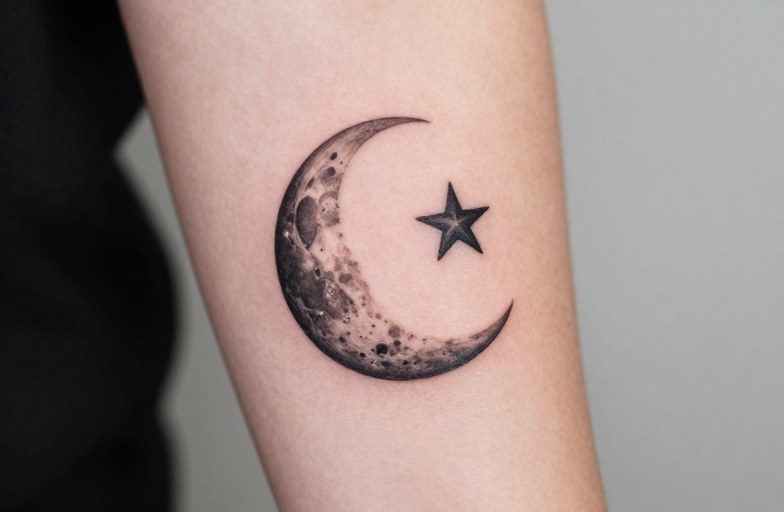
Actual photographic moon surface texture, tiny and precise. This requires an artist who specializes in micro-realism; standard single-needle work won’t hold the subtle grays. These pieces often need larger scale than people expect, a dime-sized moon won’t carry craters. Plan for at least two inches to read as textured rather than muddy.
Color Choices
Black and grey dominates moon and star tattoos for good reason. The subject is literally light in darkness, and heavy color can fight that concept.
- Black and grey: The standard. Use white ink sparingly for highlights on a black moon; it yellows faster than black and may need reinforcement. Soft grey wash behind stars suggests atmospheric glow without color.
- Blue and purple: When color appears, it’s usually deep navy or violet, not bright primary shades. These darker hues age closer to black and don’t look like stickers. A gradient from dark blue to skin tone behind a moon can suggest sky without dominating.
- Red and orange: Blood moons, harvest moons. These work as specific references but fade toward brownish tones on most skin. Plan for saturation loss; what starts vivid ends subtle.
- White ink alone: Rarely works for moons. Heals to a faint scar-like visibility, and the yellowing issue is real. Some artists use white as a highlight over grey, not as the main event.
If you want color, commit to a larger piece where the moon is one element in a colored scene rather than a colored symbol floating alone.
How to Personalize It
Generic moon-and-stars tattoos are everywhere. The personalization comes from specificity.
Actual Sky Events
A specific date’s moon phase, your birthday, a loss, a birth. Artists can look up the exact phase. Pair it with the constellation visible that night, not a random zodiac sign. The Big Dipper, Orion, Cassiopeia: real patterns with real positions. This grounds the tattoo in time without needing text.
Number and Arrangement
Three stars often gets read as Orion’s belt whether you meant it or not. Seven in a specific cluster might reference the Pleiades. The number of points on your star matters too: nautical stars are five-pointed and have a specific fill pattern; hexagrams carry different associations; seven-pointed stars are less common and more distinctive. Don’t default to five because it’s easy.
Scale and Relationship
A tiny moon with one enormous star suggests one thing; a massive moon with a single distant star suggests another. The relative sizes tell a story without words. Consider which body dominates, and whether they’re separate or overlapping.
What to Remember
Moon and star tattoos reward simplicity. The symbols are already loaded with meaning, night, navigation, cycles, distance, so the artist’s job is visual clarity, not adding more symbolism. Thin lines and tiny stars blur; plan for touch-ups or choose bolder versions from the start. If you’re going small, go simpler. If you’re going detailed, go bigger than you think.
Healing matters especially for these designs. Any scabbing or sun damage hits the fine lines first, and moons are all fine lines at their edges. Keep it out of the sun during healing, and long-term, sunscreen preserves the contrast that makes a moon read as moon rather than grey blob.
Finally, the best moon and star tattoo is one where the shape fits your specific body part like it belongs there, not like it was stamped on. Bring reference, but listen when an artist suggests shifting the angle or curve to follow your anatomy. That’s the difference between a design that sits on skin and one that lives in it.
Frequently Asked Questions
Do moon and star tattoos fade faster than other designs?
They can, especially if they’re small with thin lines. The moon’s curved edges and tiny stars are prone to softening over time. Larger pieces with bolder linework hold up better, and sunscreen helps preserve the contrast.
What’s the best moon phase to choose for a tattoo?
Crescents are most popular because they’re visually distinctive and fit many body contours. Full moons work well for detailed surface texture. New moons are harder to render, essentially empty space, so they’re usually paired with other elements.
Can a moon and star tattoo be covered up later?
It depends on size and placement. Small black moons are relatively easy to expand into larger pieces. Heavy black fill limits options, so if you might want cover-up flexibility later, leave some skin showing and avoid dense solid black.
How much should I expect to pay for a quality moon and star tattoo?
Small simple pieces might start around a shop’s minimum, often $80-150. Detailed stippling, multiple phases, or micro-realism take longer and cost more. Good linework is worth paying for, this design lives or dies on clean edges.