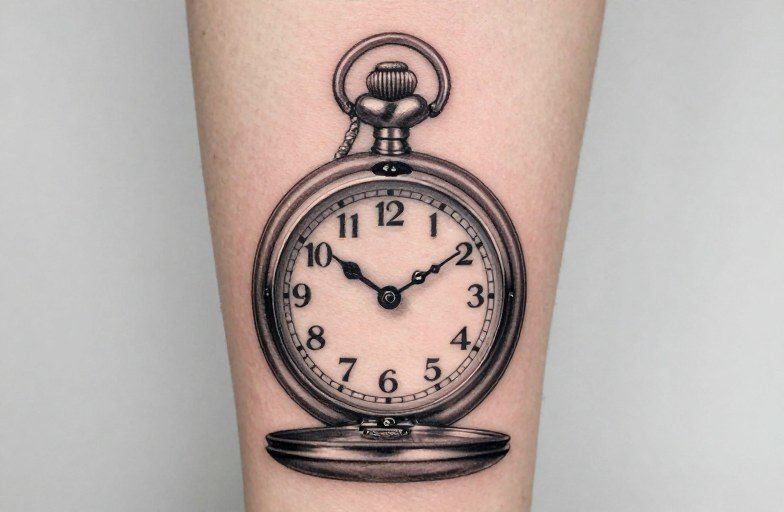
Pocket clock tattoos occupy a sweet spot between technical craft and personal weight. The rounded case, exposed gears, and Roman or Arabic numerals give artists plenty to work with, while the stopped hands let you freeze a specific hour and minute that actually matters to you. Unlike a plain clock face, the pocket watch form carries vintage texture, hinges, chains, engraving plates, that reads as object rather than symbol. That material quality makes these designs adaptable across styles, from photorealism to traditional to fine-line illustration.
Best Placements
Flat Surfaces for Round Forms
The chest, outer thigh, and upper back offer the most natural canvas for a pocket clock’s circular shape. These areas let the design sit without distortion, preserving the readability of numerals and the proportional balance of the case to the chain. The outer forearm works too, though you’ll want to keep the diameter under three inches to avoid wrapping into the ditch or wrist bone, where detail blurs over time.
Smaller pocket clocks thrive on the side of the neck, behind the ear, or on the top of the foot. These placements suit simplified designs, minimal linework, no internal gears visible, since skin movement and thinner dermis in spots like the ankle will soften fine detail within a few years.
Chains and Movement
A pocket clock rarely sits isolated. The chain or fob creates natural flow, letting the design travel from one body area to another. A clock on the chest with a chain extending toward the shoulder reads as suspended, kinetic. On the thigh, a chain wrapping toward the knee or hip adds dimension without requiring a second object at the end. Some collectors add a locket, compass, or key at the chain’s terminus, but the chain alone carries enough visual logic.
How to Personalize It
The stopped time is the obvious entry point: birth times, death times, moments of transformation. But the personalization runs deeper in how you treat the clock’s condition. A pristine, gleaming case suggests preservation or idealization. A dented, tarnished surface with cracked glass reads as survival, elapsed struggle, memory held despite damage. Rust blooms, missing hands, or a shattered face each carry distinct emotional weight.
- Engraving plates: Most pocket watches have a cartouche or interior lid space. Names, coordinates, short phrases, or dates fit here without cluttering the main face.
- Background integration: Rather than floating the clock alone, some designs nest it in pocket lining (waistcoat fabric, denim), among scattered gears, or emerging from smoke or floral elements.
- Dual times: Two pocket clocks set to different hours can mark long-distance relationships, time zones of origin and current home, or before-and-after moments.
Color Choices
Black and Gray Realism
The majority of pocket clock tattoos execute in black and gray, and for good reason. Silver tones, shadowed brass, and the contrast of white highlight against black wash replicate actual watch materials convincingly. This palette ages cleanly; as blacks soften to charcoal and grays settle, the metallic illusion holds better than color would. For photorealistic work, request that your artist use varying needle groupings, tight liners for engraving text, magnum shaders for broad reflective surfaces, single needle for hairline cracks in glass.
Strategic Color Accents
When color appears, restraint usually wins. A single rose with stem wrapping the chain, a splash of teal in the glass reflection, or a thin line of gold in the case engraving draws the eye without overwhelming the mechanical subject. Full color traditional renderings exist, red roses, blue ribbons, yellow gold cases, but these read more as Americana composition than as pocket clock specifically. Watercolor backgrounds behind a black and gray clock have become common; the effect can work if the clock itself stays crisp and the color bleeds intentionally rather than looking like afterthought.
Size & Scale
Pocket clock tattoos demand enough real estate for the numerals to remain legible as the ink spreads. As a baseline, the clock face should be no smaller than two inches in diameter if it includes numbers. At one inch, you’re limited to hash marks or blank face with hands only. Internal gearwork visible through a cutaway or glass back requires closer to four inches minimum to distinguish individual teeth and cogs.
Scale also determines chain detail. A delicate chain at small size becomes a solid black stripe within five years as lines blur. At larger scale, each link can be drawn with dimension, catching hypothetical light. Consider whether you want the chain as suggested texture or as engineered object, this choice should drive size decisions from the start.
Tips for Choosing
Reference Material Quality
Bring your artist actual watch photographs, not other tattoos. Second-generation reference (tattoo of a tattoo) flattens detail and perpetuates errors. Antique Elgin, Waltham, or Hamilton pocket watches offer varied case shapes, open face, hunter case with hinged cover, half-hunter with small viewing window. Each silhouette changes the composition entirely. Know which you prefer before the design phase begins.
Artist Specialization
Mechanical subject matter rewards artists who understand how metal reflects, how glass transmits and refracts light, how shadow pools in engraved grooves. Review portfolios for similar objects, lockets, compasses, machinery, not just clocks specifically. An artist strong on reflective spheres and cylindrical forms will adapt faster than one who typically does flat graphic work.
- Ask to see healed photos, not just fresh work. Fine lines in clock faces often fall out or blow out; healed examples reveal whether the artist’s precision holds.
- Discuss hand placement early. The angle of the hour and minute hands affects the overall composition dramatically. Vertical hands at 12:00 feel static; angled hands create diagonal energy.
- Consider the long view: highly detailed gearwork in the background may become indistinguishable mush. Prioritize the case edge, glass dome, and front-facing hands as the permanent readable elements.
Standout Design Ideas
Moving beyond standard realism opens distinctive territory. A pocket clock dissolving into constituent gears, some falling, some floating, some transforming into birds or mechanical butterflies, plays with time as deconstruction. The steampunk vein exaggerates: multiple dials, visible escapements, external winding keys, riveted plates. These designs read as invention rather than preservation, more mad-scientist than heirloom.
Negative space approaches invert expectations. The clock outline rendered in skin tone against black background, or the face left blank while the case and chain carry all detail, creates graphic punch. Some collectors opt for the clock as architectural element, embedded in a raven’s chest cavity, replacing a heart in anatomical compositions, or as the face of a figure itself.
Biomechanical fusion merges watch parts with organic form: tendons as mainsprings, veins as chain links, the clock face nested among muscle fibers. This demands an artist comfortable with both mechanical precision and organic flow, but the result avoids the generic quality that standard pocket clocks can accumulate.
Final Thoughts
Pocket clock tattoos persist because the form solves a design problem: how to make time tangible, wearable, specific. The object itself carries enough visual interest that even a straightforward rendering satisfies, yet the structure accommodates infinite variation for those who want something singular. The key decisions, placement that respects the circle, scale that preserves the numerals, personalization that goes beyond the obvious stopped time, separate enduring work from flash-sheet filler. Choose your moment, choose your condition, and let the mechanical details do what they do best: suggest precision within something that will, like all tattoos, slowly soften and change.
Frequently Asked Questions
Do pocket clock tattoos always need to show a specific time?
No. Many designs use random or decorative hand placement. Freezing a meaningful time is common but not required, the form itself carries enough weight.
How well do fine gear details hold up over years?
Poorly. Internal gearwork often blurs into gray texture within five to ten years. Prioritize clean case edges and readable numerals if longevity matters.
Can a pocket clock work in a small tattoo?
Yes, but simplify. At under two inches, drop the numerals for hash marks or a blank face. Chains become suggested lines rather than individual links.
What’s the difference between a pocket watch and a regular clock tattoo?
The pocket watch form includes case, hinge, crown, and usually chain, material qualities that suggest portability and personal ownership. Wall clocks or sundials carry different associations and less mechanical detail.