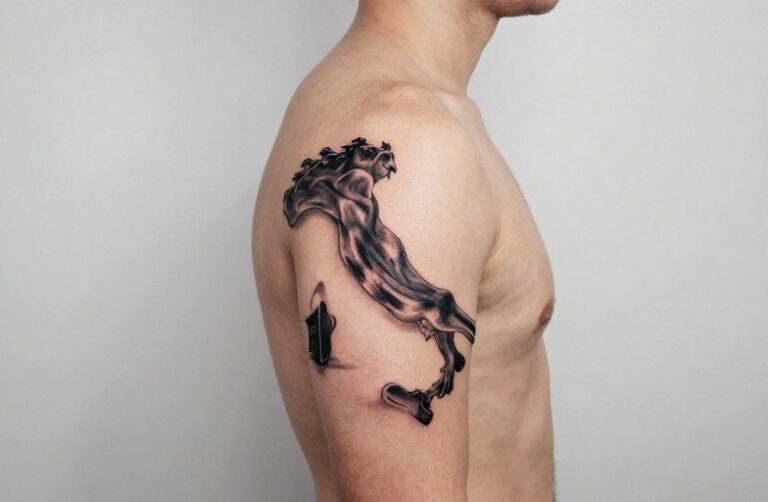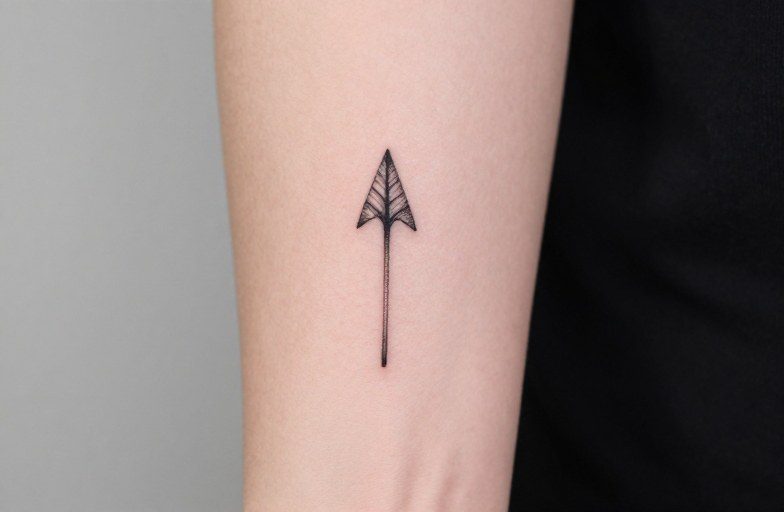
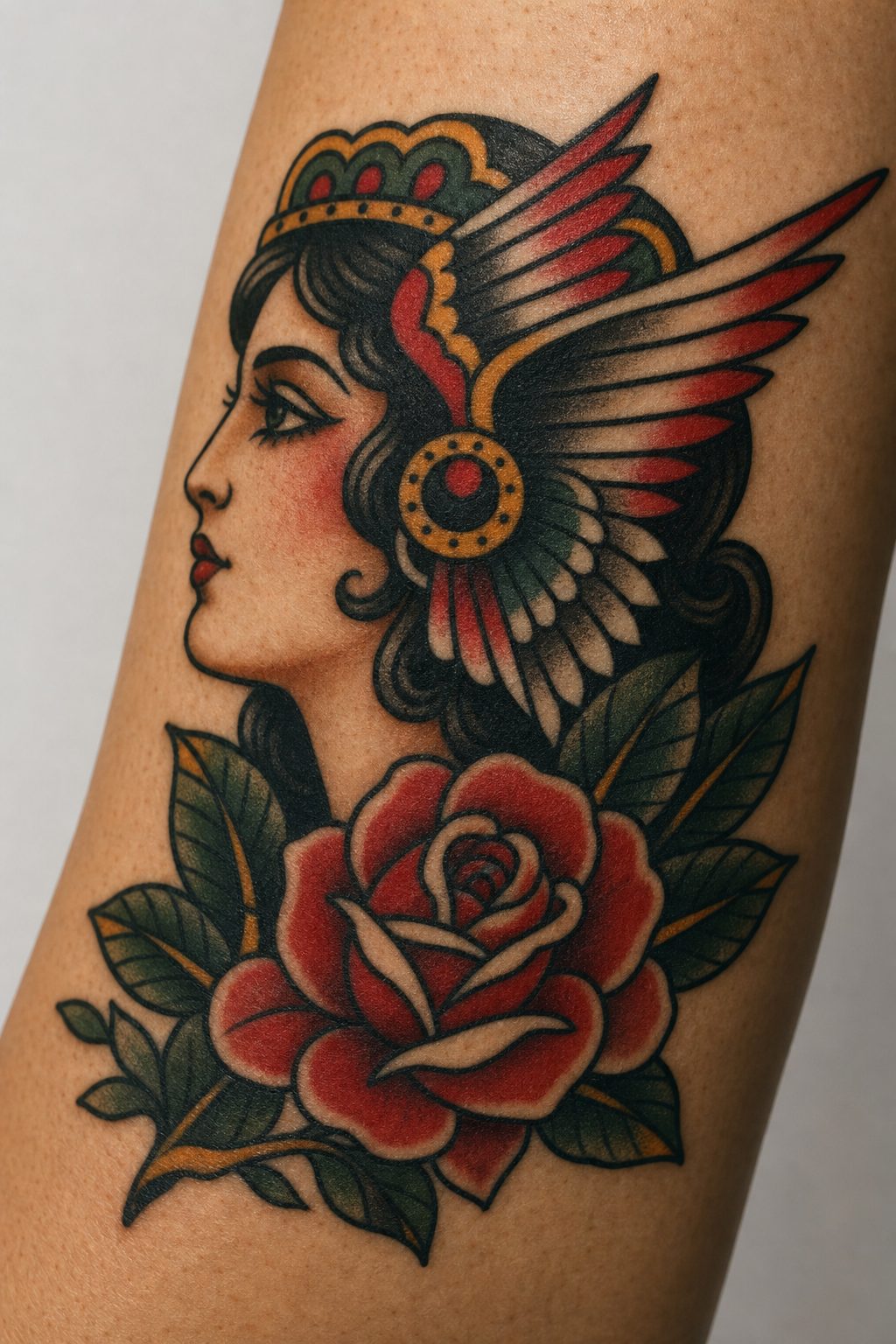
A traditional tattoo carries meaning through its visual language of bold black outlines, saturated primary colors, and immediately recognizable imagery. Rooted in American and European tattooing from the early-to-mid 20th century, this style communicates through archetypes, anchors, roses, swallows, daggers, pin-up figures, rather than personalized custom art. The symbolism is collective and readable: strength, love, travel, mortality, luck, protection.
Symbolism & Core Meaning
The Visual Vocabulary
Traditional tattooing operates like a coded alphabet. An anchor signals stability and often naval service. A swallow marks miles traveled, originally one for 5,000 nautical miles, two for 10,000. A dagger through a rose juxtaposes beauty and danger, love and pain. These aren’t abstract suggestions; they’re legible symbols that communicate across language barriers. The style’s deliberate limitations, bold lines, flat color fills, minimal shading, force clarity. Every element must read instantly from across a room or decades into the future.
- Red: passion, blood, courage, love
- Black: death, mourning, strength, outline foundation
- Yellow/gold: prosperity, achievement, the sun
- Green: life, land, growth (used sparingly in classic palettes)
- Blue: water, travel, loyalty, sadness
Why the Symbols Persist
The same images recur because they work. A panther coiled and snarling communicates ferocity without explanation. A ship in full sail speaks to movement, escape, adventure. These aren’t chosen for novelty; they’re chosen because they carry weight accumulated through repetition. The meaning is partly in the image itself, partly in the tradition of choosing it. Getting a traditional tattoo connects you to a lineage of people who made the same choice for similar reasons.
History & Cultural Roots
American Origins
The style commonly called “traditional” or “old school” solidified in the United States between the 1900s and 1960s, though its ingredients came from multiple sources. Sailor Jerry (Norman Collins), working in Honolulu from the 1940s, refined and popularized the aesthetic that now defines the style. He borrowed from Japanese tattooing, particularly in background elements and composition, while maintaining the bold, readable approach suited to working-class military clientele. Other key figures, Percy Waters, Bert Grimm, Cap Coleman, developed regional variations, but the core vocabulary remained consistent: fast to execute, easy to read, built to last.
European Connections
Some trace elements of traditional tattooing to British and European maritime traditions. Captain Cook’s crews returned from Polynesia with tattoos in the 18th century, and by the 19th century, tattooed sailors were commonplace in British ports. The professional tattoo shop emerged in London and New York around the same time, with similar visual catalogs. The flash sheet, pre-drawn designs displayed on shop walls, standardized imagery across shops and countries. A sailor could walk into a shop in San Diego, London, or Sydney and point to essentially the same panther or anchor.
How It Ages on Skin
Technical Durability
This is where traditional tattooing earns its reputation. The heavy black outlines function as containment walls. As ink naturally spreads beneath the skin over years, a process called blowout or feathering, the bold line keeps color from bleeding into chaos. Flat color fills without gradients mean less fine detail to lose. A traditional rose at ten years looks like a traditional rose, slightly softer, not like a bruise or a blob.
Placements matter. The upper arm, outer forearm, and calf age best, these areas see less stretching and sun exposure. A traditional piece on the inner bicep or side of the torso will blur faster. The chest holds up reasonably well if kept out of the sun. Hands and feet? The ink drops out faster in these high-wear zones, regardless of style, but traditional’s bold lines at least give it a fighting chance compared to fine-line work.
Color Longevity
Black lasts. Red lasts reasonably well. Yellow and green fade faster, especially with sun exposure. Classic traditional work often uses limited color for this reason, a red rose with black leaves and minimal green reads strong for decades. Modern traditional artists sometimes expand the palette, but the old-school restraint wasn’t just aesthetic; it was practical knowledge about what survives.
Mythology & Folklore
Maritime Superstitions
Sailors carried specific tattoos as protective talismans, often linked to folk beliefs rather than formal religion. A pig and rooster on the feet, one on each, supposedly prevented drowning, since these animals often survived shipwrecks in their wooden crates. A north star guided you home. Crossed anchors on the webbing between thumb and index finger marked a boatswain’s mate. These weren’t decorative choices; they were functional magic, visible proof of membership in a dangerous profession.
Animals and Their Lore
The traditional panther, snake, and eagle draw on established symbolic traditions. The panther often linked to ferocity and cunning, sometimes associated with military units. The snake, particularly coiled or with a dagger, referenced mortality and temptation, the Garden of Eden compressed into a few square inches. Eagles carried obvious national associations but also broader connotations of vision, freedom, and predatory power. These animals weren’t chosen for personal spirit-animal reasons; they were chosen because their cultural meanings were already established and understood.
Common Variations & Styles
Japanese-American Fusion
Sailor Jerry and his contemporaries incorporated Japanese imagery, dragons, koi, cherry blossoms, into traditional formats. The result flattened Japanese complexity into bold outlines and limited color, creating a hybrid that read as exotic to American audiences while remaining technically traditional. These fusion pieces remain common: a dragon in traditional format, a geisha in bold lines and flat color rather than the subtle shading of actual irezumi.
Neo-Traditional and Modern Evolutions
Neo-traditional work keeps the bold outlines and readable composition but expands the color palette, adds more complex shading, and introduces subjects outside the classic canon, animals, portraits, surreal imagery. The technical foundation remains: this is still built to last, still readable from a distance. Some modern artists work in “strict traditional,” adhering to period-correct palettes and subjects. Others use the format as a starting point for personal expression. Both approaches honor the core principle: clarity and durability over delicate complexity.
- Strict traditional: limited palette, classic subjects, period techniques
- Neo-traditional: expanded color, more detail, broader subject matter
- Traditional-inspired: uses format for custom imagery while maintaining readability
Personal & Modern Meanings
Today, someone chooses a traditional tattoo for multiple overlapping reasons. The aesthetic appeal is immediate, bold, graphic, visually confident. There’s also the connection to history, to a craft tradition that predates digital design and custom everything. Some people select classic imagery for its established meaning: the anchor for stability, the swallow for travel, the rose for love or memorial.
Others choose the style itself as a statement about permanence. In an era of infinite customization and ephemeral digital content, traditional tattooing offers something deliberately constrained, collective, lasting. The meaning isn’t hidden or private; it’s visible, readable, shared. That transparency appeals to people who want their body art to communicate rather than mystify.
Modern placements have expanded. Classic traditional concentrated on arms, chests, backs, areas visible in short sleeves. Now you’ll see traditional work on thighs, ribs, sternums, even throats. The style adapts to contemporary body presentation while maintaining its technical DNA.
The Bottom Line
A traditional tattoo means what the imagery has always meant, what the technique guarantees, and what the choice itself communicates. It’s a commitment to readability, to durability, to participating in a visual language that predates you and will outlast you. The symbolism isn’t ambiguous or bespoke, it’s collective, accumulated, tested by time. You don’t get a traditional tattoo to be unique. You get it to be connected, to wear something that communicated clearly in 1945 and will communicate clearly in 2045, slightly softened by age but still legible, still itself, still carrying weight.
Frequently Asked Questions
Do traditional tattoos hurt more than other styles?
The pain depends on placement and your personal sensitivity, not the style itself. Traditional work sometimes finishes faster than detailed realism because the technique is efficient, bold lines, flat fills, less shading. A small traditional piece might actually hurt less overall than a long session of fine, repetitive work.
Can I get a custom design in traditional style?
Absolutely. A skilled artist can translate personal imagery into traditional vocabulary, bold outlines, limited shading, readable composition. The result won’t look like a classic flash piece, but it will carry the style’s durability and graphic clarity. Bring reference images and trust the artist’s translation process.
Why do traditional tattoos use so much black?
Black ink is carbon-based and physically stable, it holds its place in skin better than most colors. The heavy outlines also serve as structural walls, keeping color fills contained as they age and spread slightly. It’s functional engineering, not just aesthetic preference.
How do I find an artist who specializes in traditional work?
Look for portfolios with consistent bold lines, healed photos showing how work ages, and comfort with classic imagery. Ask to see healed pieces from one to five years prior. Traditional specialists often apprenticed in shops that value the craft’s technical foundations rather than jumping straight to custom fine art.