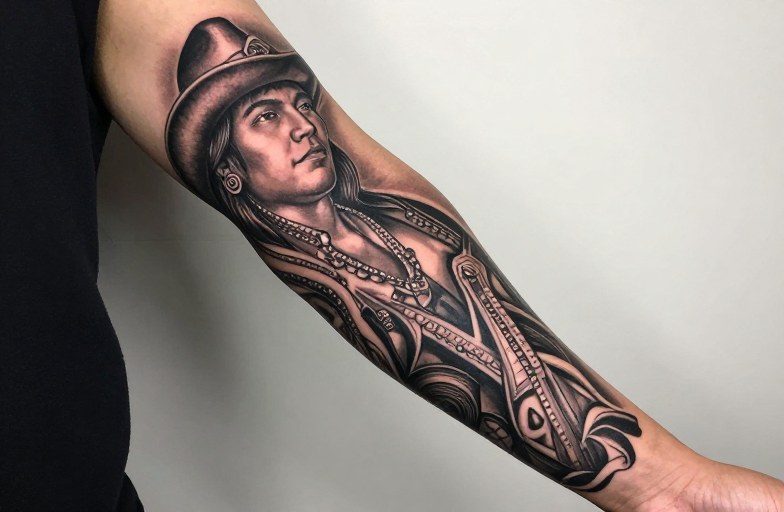
A Chicano sleeve tattoo is a full-arm composition rooted in Mexican-American experience, Pachuco culture, lowrider aesthetics, Catholic iconography, and barrio life rendered in black-and-grey realism. It functions as a visual autobiography: religious devotion, familial bonds, struggle, and pride woven across the entire arm. The meaning is inseparable from the cultural context; these pieces emerged from specific neighborhoods in Los Angeles and San Diego during the mid-to-late 20th century and remain deeply tied to that lineage.
Symbolism & Core Meaning
Religious Devotion
Virgin Mary portraits, praying hands, rosary beads, and crucifixes dominate Chicano sleeve work. These aren’t generic spiritual imagery, they reference the particular Catholicism practiced in Mexican-American households, where saints serve as intermediaries and protection. The Sacred Heart, often rendered with anatomical precision and thorn crowns, appears frequently as a promise or a memorial. When placed on the inner bicep or forearm, these religious elements stay visible to the wearer, reinforcing their function as personal covenant rather than public display.
Street Survival & Barrio Identity
Clown faces, laughing now, crying later, represent the duality of street life: performative joy masking hardship. Old English lettering spelling out neighborhood names, birth years, or RIP memorials anchor the sleeve to specific geography and loss. The payasa (female clown) and pelon (bald figure) derive directly from Pachuco and cholo style conventions, not from mainstream tattoo flash. These motifs carry weight precisely because they signal insider knowledge; misappropriation by outsiders has been a persistent tension in the tradition.
Family & Memory
Portrait realism of deceased relatives, children, or parents occupies the most prominent real estate on Chicano sleeves, typically the outer upper arm or forearm, where the image faces outward. Dates of birth and death, often in ornate script, frame these portraits. The technical execution here matters enormously: a poorly rendered memorial portrait reads as disrespect, not merely as bad art. This is why specialization in Chicano black-and-grey portraiture requires years of dedicated practice before artists attempt faces on clients.
How It Ages on Skin
Black-and-Grey Longevity
Chicano sleeves rely on single-needle and fine-line work for detail, which presents aging challenges. The soft grey washes that create depth in Virgin Mary mantles or clown face shadows tend to blur faster than bold black lines. After ten to fifteen years, fine facial features in portraits may soften into indistinct grey masses. Experienced artists compensate by building contrast: deeper blacks in the eye sockets, hair, and background elements, with mid-tones reserved for transitional areas. The best-aged sleeves maintain readable silhouette even when detail degrades.
Placement Considerations
Forearm Chicano sleeves see the most sun exposure and friction, accelerating fade. The inner arm, protected from UV and less subject to abrasion, preserves greywash better but offers less flat canvas for large compositions. Elbow ditch and wrist bone areas, common spots for rosary wraps or script banners, experience constant movement and stretching, which can distort lettering over time. Many artists design sleeves with simpler, bolder elements at these stress points, reserving intricate detail for the stable upper arm planes.
Common Variations & Styles
Religious Narrative Sleeves
Some sleeves unfold as sequential religious tableaux: the Last Supper wrapping from shoulder to elbow, the Stations of the Cross descending the forearm, or a single massive Virgin of Guadalupe occupying the entire outer arm with radiating light beams rendered in stippled grey. These pieces often incorporate filigree, decorative clouds, and architectural elements, cathedral windows, marble columns, that frame the sacred figures. The style descends directly from Mexican devotional retablo and ex-voto painting traditions, translated into skin.
Lowrider & Street Culture Compositions
Impala silhouettes, hydraulic suspension diagrams, dice, money roses, and neighborhood street signs compose the secular counterpart. These sleeves frequently incorporate Aztec calendar stones or Maya glyphs as background texture, asserting indigeneity alongside modern barrio identity. The technical approach shifts here: more hard edges, less soft portraiture, with lettering often taking precedence over image. Color remains rare; when it appears, it’s typically limited to deep burgundy or brown accents in money roses or lip details.
Design Tips & Pairings
Cohesion matters more in Chicano sleeves than in many other styles because the narrative logic, religious, memorial, or territorial, must read clearly across the entire arm. Random assembly of cool-looking elements produces incoherent results. Start with a dominant anchor piece: a large portrait, a Virgin, or a central clown face. Build outward thematically rather than collecting unrelated flash.
- Lettering and image must scale together; tiny script beside a massive portrait creates visual imbalance
- Negative space functions as intentional design, not absence, use skin breaks to separate narrative sections
- Background filigree (smoke, clouds, decorative patterns) unifies disparate elements across sessions
- Matching the opposite arm requires planning; symmetrical religious sleeves are common, but each arm should still carry distinct personal content
Pairing with Other Styles
Chicano sleeves traditionally stand alone, but contemporary collectors sometimes blend them with adjacent black-and-grey traditions. Realistic black-and-grey from European or Asian schools can integrate if the tonal range matches, no high-contrast blackwork adjacent to soft Chicano greywash. Script-heavy Chicano sleeves pair poorly with heavy geometric or tribal patterns; the visual languages clash. When extending to chest panels or back pieces, maintain the same single-needle approach and cultural theming rather than switching to unrelated Japanese or American traditional motifs.
Who Chooses This Tattoo
The core demographic remains Mexican-American collectors with direct cultural connection to the style’s origins, often second or third generation, frequently from California, Texas, Arizona, or Illinois. These aren’t trend adopters; the commitment of a full sleeve signals deep identification with the symbolism, not aesthetic tourism. Within this community, the tattoo often marks specific life transitions: surviving incarceration, honoring a deceased parent, claiming neighborhood pride after moving away, or religious conversion.
Outside this demographic, serious collectors sometimes seek out Chicano sleeves for the technical mastery of black-and-grey realism, but this requires careful navigation. The style’s cultural specificity means appropriation risks are high. Respectful engagement involves choosing artists embedded in the tradition, often from the same communities, and selecting personal imagery that doesn’t falsely claim barrio identity. Memorial portraits of one’s own family, universal religious devotion, or commissioned original compositions that honor rather than mimic street culture can work. Wearing a specific neighborhood’s name without connection does not.
Mythology & Folklore
Aztec and Maya Roots
Chicano sleeve imagery often incorporates pre-Columbian elements: feathered serpents, jaguar warriors, calendar glyphs. These are commonly associated with Chicano nationalist movements of the 1960s and 70s, which sought to reclaim indigenous heritage as counter-narrative to assimilationist pressure. The Aztec warrior in profile, rendered in stone-textured grey, appears frequently as a symbol of ancestral pride and resistance. However, the specific iconographic accuracy varies widely; many artists reference simplified calendar stone designs rather than rigorous archaeological reconstruction. The folkloric power matters more than museum fidelity.
La Santa Muerte and Folk Saints
Though controversial within mainstream Catholicism, Santa Muerte (Saint Death) appears in some Chicano sleeve work, particularly among collectors with ties to Mexican folk religion or those seeking protection in dangerous circumstances. Juan Soldado, the folk saint of undocumented migrants, and Jesús Malverde, often linked to Sinaloa and sometimes associated with narco culture, also surface in regional variations. These figures carry complex, sometimes contradictory meanings depending on the wearer’s intent and community context. Artists working in areas with strong Santa Muerte devotion, South Texas, parts of Los Angeles, may be asked to incorporate her skeletal visage into sleeve compositions alongside conventional Catholic imagery.
Final Thoughts
A Chicano sleeve tattoo operates as cultural document, devotional act, and technical achievement simultaneously. The black-and-grey palette isn’t merely aesthetic preference; it emerged from prison tattooing constraints and Pachuco style conventions, then was refined by street shop artists into a globally recognized but still culturally rooted tradition. The meaning resides in the specificity: this Virgin, that neighborhood, these dates, this face. Generalized Chicano-style imagery without personal narrative reads as hollow costume. For those with legitimate connection, the sleeve offers a permanent, visible commitment to identity, memory, and faith rendered across the entire arm in tones of black and grey.
Frequently Asked Questions
Do Chicano sleeves always have to be black-and-grey?
Traditional Chicano sleeves are almost exclusively black-and-grey, rooted in prison tattooing limitations and Pachuco aesthetic conventions. While some contemporary artists add minimal color, full color is generally considered outside the tradition.
How long does a full Chicano sleeve take to complete?
A detailed black-and-grey sleeve typically requires 30 to 60 hours across multiple sessions, depending on complexity, artist speed, and how the skin tolerates long sittings. Large portraits and extensive lettering add significant time.
Can someone who isn’t Mexican-American get a Chicano sleeve respectfully?
This requires extreme care. Avoid specific neighborhood references, barrio imagery, or cultural claims you don’t hold. Universal religious themes, personal family memorials, or original compositions with an artist from the tradition can work, but consultation with culturally embedded artists is essential.
Why are clown faces so common in this style?
The laughing/crying clown or payasa represents the emotional duality of street life, public performance of strength versus private struggle. It emerged from Pachuco and cholo visual culture and functions as coded communication within the community.