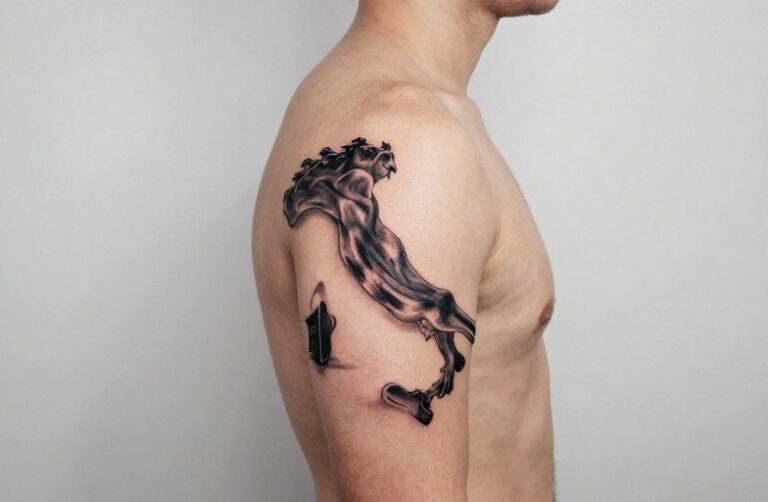
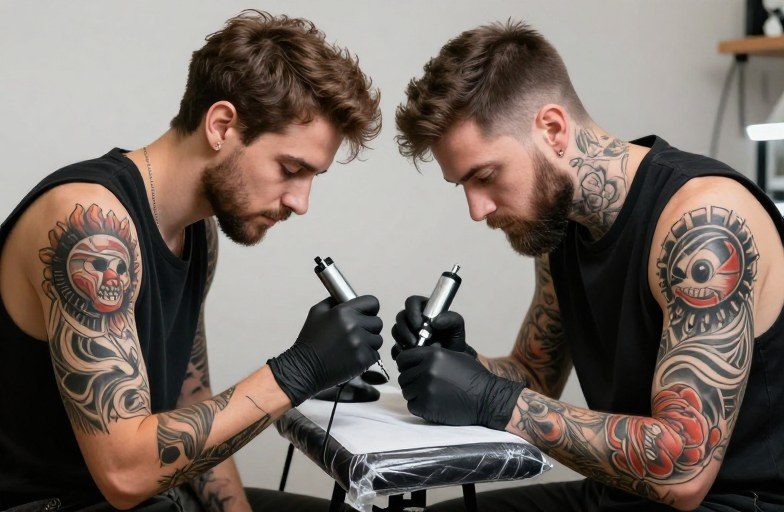
A full sleeve tattoo built around tattoo artists and their craft signals something different from decorative work. It turns the wearer’s own skin into a record of the tools, traditions, and physical labor that define the profession. You will see these on working artists, on apprentices proving commitment, and on collectors who have spent enough hours in shops to understand what the imagery actually means. The subject matter centers on identity forged through repetition, through the hierarchy of apprenticeship, and through the toll the work takes on the body.
What the Imagery Actually Means
The Tools as Totems
Coil machines, rotary pens, needle groupings, and ink caps form a visual vocabulary specific to this subject. Crossed machines read as flags of belonging, markers of affiliation with particular shops or lineages. Single needle configurations honor the precision of fine-line work. Power supplies and foot switches, rarely celebrated in other art forms, become legitimate iconography. These are not generic symbols of creativity. They refer to the physical act of pushing pigment through skin, and that specificity matters.
The Recursive Quality
There is a self-referential weight to tattoo artists marking themselves with tattoos about tattooing. The sleeve becomes a portfolio piece that cannot be removed, a permanent resume visible in short sleeves. For apprentices, it often marks passage from shop helper to trusted hand. For established artists, it commemorates years of building clientele and refining personal style. The symbolism carries weight because the wearer knows exactly how much each element hurt, how long it took, how the ink will settle and shift over decades.
History and Where This Comes From
Trade Tattooing Before Artist Self-Promotion
Sailors and dockworkers carried some of the earliest occupational tattoo clusters: anchors, ships, names of ports. Tattoo artists themselves, however, are often thought to have kept personal work minimal until the mid-twentieth century, when shops became visible storefronts rather than backroom operations. The full sleeve as advertisement for one’s own skill is often dated to the rise of street shop culture in the 1970s and 1980s, particularly on the West Coast and in larger East Coast cities, though this development was gradual and regional.
From Restraint to Visibility
Earlier generations of tattooists often maintained mystery around their own skin. The shift toward elaborate self-tattooing by artists tracks with tattooing’s gradual professionalization: licensure, health department oversight, formal apprenticeships replacing informal mentorship. The full sleeve artist tattoo emerged as both defiance of old-guard restraint and embrace of new visibility. The specific motif of tattoo machines on skin is often linked to Ed Hardy and the San Francisco scene, though parallel developments likely occurred in multiple cities simultaneously.
Shop Stories and Shared References
Narratives That Bind
Tattoo culture generates its own folklore. The apprentice who practiced on fruit until their hands cramped. The artist who worked through illness. Marathon sessions that tested endurance. Sleeve imagery often references these shared stories: flash sheets from legendary shops, the “Born to Lose” skull, reapers holding machines instead of scythes. These are not universal myths in the classical sense. They are narratives that bind shop communities across regions, and artists wearing them typically intend the reference.
Transformation and Permanence
Some designs invoke older symbolic frameworks. The ouroboros, snake consuming itself, reimagined with a machine cable. Icarus figures with wings built from needle bars. The tension between transformation, tattooing literally changes bodies, and permanence, the irreversibility of both the craft and its results, surfaces repeatedly. Collectors sometimes request these motifs without knowing the full context. Artists wearing them usually mean the deeper reference.
Color, Black and Grey, and How to Choose
Traditional Boldness
Color-heavy sleeves dominated much of American traditional and Japanese-influenced work: saturated reds, heavy blacks, limited green. For artist-themed sleeves, this palette connects to flash art history, to the visible readability that shop windows demanded before social media. Color holds up differently depending on placement. The outer arm sees more sun. The inner arm preserves saturation longer. Bold traditional color in this subject matter signals alignment with specific lineage and working methods.
Black and Grey Realism
Photographic machine renderings, hyper-detailed skin textures, and portrait work of tattoo pioneers all favor black and grey. This approach ages with softer edges. What reads as crisp contrast at two years may settle into more atmospheric values at ten. The choice often reflects the artist’s own working style. Black and grey specialists tend to wear what they execute best. Some collectors deliberately mix both approaches, reserving color for traditional flash elements and greywash for realistic portraiture.
Practical Considerations
Color fades faster on sun-exposed outer arm and requires bolder outlines for longevity. Black and grey is more forgiving of fine detail, though subtle gradation can be lost if the skin is overworked. A mixed approach demands careful planning to prevent visual chaos across the full circumference. Skin tone matters significantly. Color saturation varies dramatically, and what pops on pale skin may disappear on darker complexions without adjustment in pigment choice or technique.
How the Sleeve Should Wrap
The Full Sleeve as Cylinder
The outer upper arm offers the flattest canvas for large machine portraits or detailed flash sheets. The inner bicep, more painful and prone to stretching with age, suits smaller symbolic elements: single needles, dates in shop numerals, shop logos. The forearm rotates into view constantly. Readable imagery works better here than dense abstraction.
Problem Areas
Elbow ditch and inner elbow present technical challenges: thin skin, constant movement, difficult healing. Experienced artists plan these areas carefully, often using them for transitional elements rather than primary focus. The wrist and hand transition, if the sleeve extends toward knuckles, requires attention to how tattoo culture itself views hand tattoos. Once radical, now increasingly mainstream, still potentially limiting in certain professional contexts even within the trade.
Composition for Rotation
Unlike flat paper or screen, an arm rotates. Good sleeve design accounts for multiple viewing angles. Some artists compose around a “hero view”, what displays when the arm hangs naturally at the side, while ensuring the piece holds together when the arm moves. For tattoo-themed sleeves, this often means placing the most recognizable iconography in the hero view and more abstract or textural elements in secondary positions.
Spiritual and Religious References
Sacred and Profane
Tattooing occupies liminal space in several religious traditions. The marked body reads as deviant in some, as sacred in others. Artist sleeves sometimes play with this tension: praying hands clutching a machine, rosaries threaded with needle bars, saintly figures reimagined as shop patrons. These are not typically devotional in the conventional sense. They acknowledge the quasi-religious intensity of apprenticeship and practice. The “church of the needle” is not formal doctrine, but it is recognizable shop shorthand.
Process as Discipline
For some wearers, the process itself carries weight. Sitting for extensive work, forty, sixty, eighty hours over months, becomes meditative discipline. The subject matter reinforces this: tattooing as calling, as practice requiring faith in incremental improvement. Buddhist imagery occasionally appears in Japanese-influenced artist sleeves, not as religious statement but as reference to tebori tradition and the patience it demands. Christian imagery, particularly Catholic, surfaces in Chicano-influenced work with similar cultural rather than doctrinal intent.
What to Remember
Full sleeve tattoos celebrating tattoo artists and their craft carry specific weight because they emerge from inside the practice rather than outside admiration. The symbolism does not transfer cleanly to generic creativity or passion. It references exact tools, shop hierarchies, physical consequences, and historical lineages that outsiders partially grasp at best.
Whether rendered in screaming traditional color or subdued black and grey, these sleeves function as membership markers, as accumulated autobiography, as advertisements for skill that cannot be faked once the machine starts. Choosing this subject matter means accepting that the tattoo will be read by other tattoo people first. They will notice whether the machines are technically accurate, whether the flash references are legitimate, whether the execution matches the ambition of the concept. The standard is higher because the audience knows the difference.
Frequently Asked Questions
How do I verify that a machine depicted in my sleeve design is technically accurate?
Bring reference photos of actual machines from your own shop or from manufacturers you respect. A coil machine with the capacitor in the wrong position, or a tube grip that does not match the needle grouping shown, will be noticed immediately by working artists. Ask your tattooist to show you their machine reference before the stencil goes on.
Does a tattoo artist sleeve limit me if I later want to work in a different style?
Not professionally, but visually it creates expectations. Clients who see traditional machine imagery may assume you specialize in that approach. If your working style shifts dramatically, the sleeve becomes a historical document rather than a current advertisement. This is common and accepted, but worth considering during design.
How long should I expect a detailed machine portrait to take compared to simpler flash elements?
Photorealistic machine work in black and grey typically requires 15 to 25 hours for a single large element, depending on the artist’s pace and your skin’s tolerance. Traditional bold flash fills faster, often 8 to 12 hours for comparable coverage. Plan sessions accordingly, and budget for the difference.