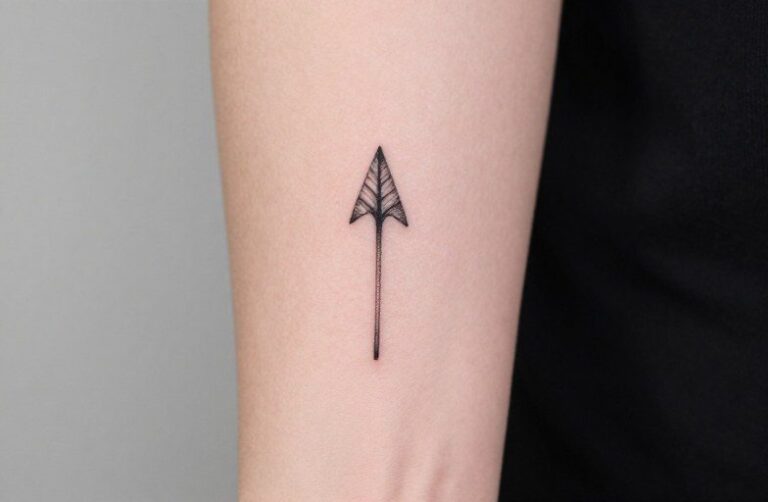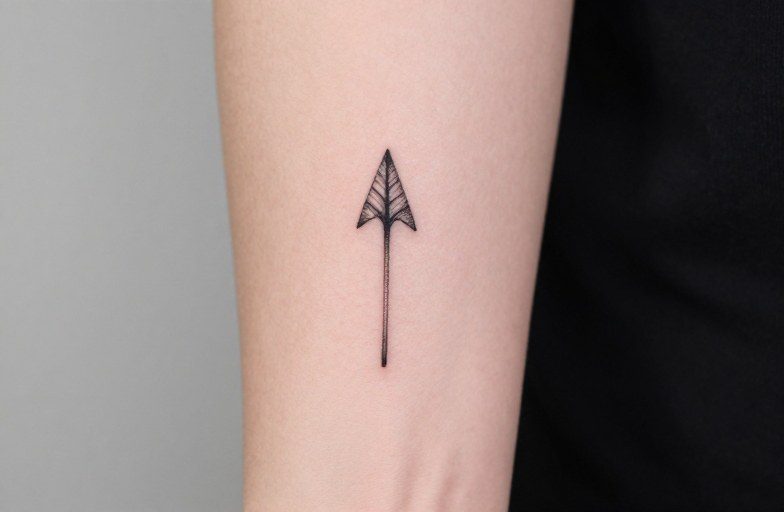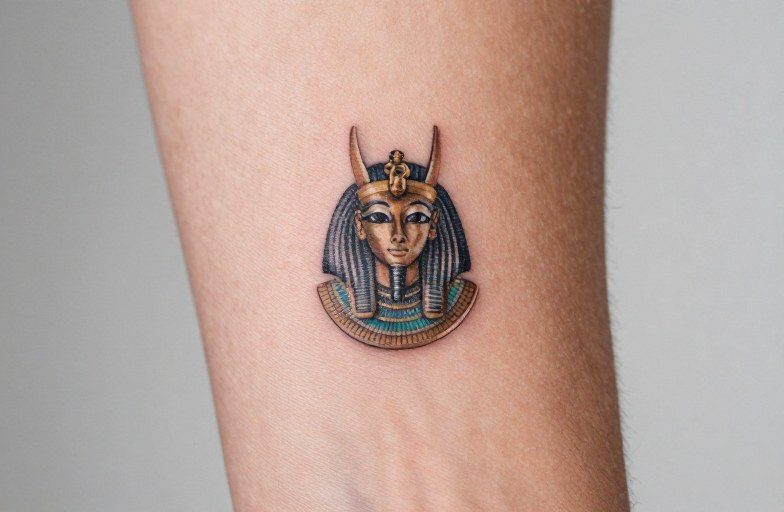
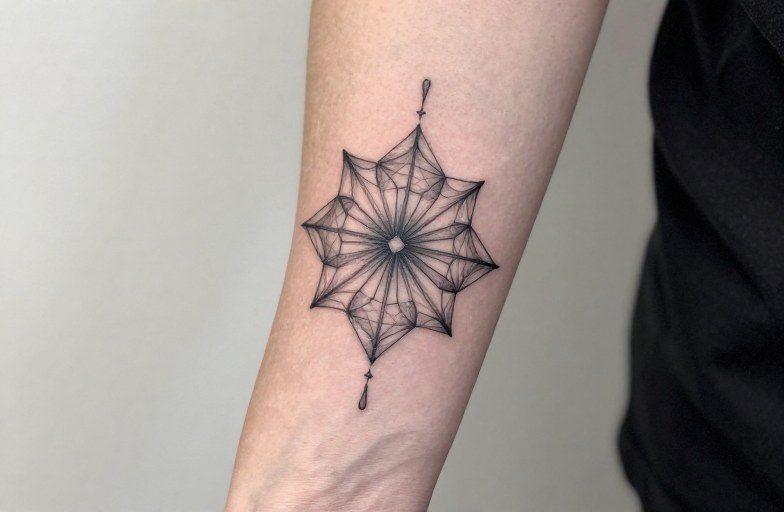
Fine line geometric tattooing is exactly what it sounds like: mathematically precise shapes, circles, triangles, polygons, sacred geometry patterns, executed with needles grouped tight enough to lay down ink at hair-thin widths. The style demands machines running at lower voltage with a lighter hand, and artists who understand that a wobble in a 0.3mm line reads as a glaring mistake, not character. Unlike bold traditional geometry, this approach lives in negative space and subtle contrast, making precision the entire point.
Modern Variations
The style has splintered into several recognizable branches over the last decade, each with different technical demands and visual results.
Minimalist Single-Shape Pieces
One perfect hexagon behind the ear. A single unbroken circle on the inner wrist. These live or die on execution, there’s nowhere for the eye to wander, no surrounding detail to distract from a waver. The best artists map these with stencil paper cut to exact dimensions, then freehand the final pass to follow skin tension lines. Placement matters enormously here: a circle on the bicep becomes an oval when the muscle flexes, which defeats the purpose.
Pattern-Field and Dotwork Hybrids
Some pieces fill geometric frames with stippled gradients or micro-dot patterns. This adds texture but doubles the session time and introduces a second aging variable, dots blur differently than lines. The combination works beautifully on flatter planes like the upper back or thigh, where the artist can stretch skin consistently and the pattern reads without distortion.
Floral-Geometric Fusion
Botanical elements rendered in fine line, contained within or emerging from geometric frames. The contrast between organic and mathematical creates visual tension, but it’s technically demanding. Petal curves meeting straight lines at exact points require steady rotation of the machine angle. This variation has become common enough that it’s practically its own subgenre.
Origins & History
Geometric tattooing itself is ancient, Ötzi the Iceman carried parallel lines and crosses, and indigenous cultures across Polynesia, the Philippines, and Northern Africa used geometric patterns for ritual marking. The fine line refinement, however, is a machine-era development. Single-needle tattooing in the 1970s Los Angeles black-and-grey scene laid groundwork, but the specific aesthetic of hair-thin mathematical precision emerged from the 2010s Instagram era, when close-up photography of fresh tattoos became the primary promotional medium. Styles that photograph crisply at high resolution gained immediate traction.
The sacred geometry branch, metatron’s cubes, flower of life patterns, Platonic solids, is often linked to esoteric traditions and 20th-century occult revival movements, though many clients choose these forms purely for visual balance rather than symbolic intent. Some trace the current popularity of geometric mandalas to Tibetan Buddhist art, though the tattoo adaptation strips most original religious context.
Who It Suits
Not every skin type and lifestyle plays well with this style.
Skin Tone and Contrast
Fine line geometry relies on sharp black-to-skin contrast. On very dark skin, the same line weight can disappear faster as melanin and ink compete visually; experienced artists compensate with slightly heavier grouping or strategic use of negative space rather than attempting identical techniques across all skin tones. On freckled or heavily sun-damaged skin, the background noise competes with the precision. The style shows best on relatively even, medium-to-light skin that hasn’t seen significant UV damage.
Professional and Lifestyle Constraints
The minimal, abstract nature of geometric work reads as less culturally loaded than figurative tattooing in conservative environments. A small line triangle on a forearm is easier to explain or conceal than a portrait. That said, large-scale geometric pieces on hands, neck, or face still carry the same employment risks as any visible tattoo. The style’s discretion is placement-dependent, not automatic.
Commitment Level
Geometric designs are notoriously difficult to cover or rework, the hard edges and mathematical precision leave no organic wiggle room for a cover-up artist to blend into something new. If you’re uncertain about long-term commitment, keep it small and in a location that ages predictably.
How It Ages
This is where fine line geometry separates from sturdier styles, and not always favorably.
All tattoos spread. Ink particles migrate through the dermis over years, and lines thicken. A bold traditional line starting at 3mm might spread to 5mm and still read as intentional. A fine line starting at 0.3mm spreading to 1.5mm becomes a fuzzy ghost of its original precision. Geometric work has no forgiving blur, it looks like a mistake.
High-friction areas accelerate this: inner forearms rub desks and sleeves; fingers regenerate skin rapidly; the side of the hand takes constant abrasion. A fine line circle on the finger can become unrecognizable in three to five years. Flat, protected planes, the upper outer arm, the calf, the upper back, preserve precision longer.
Sun exposure is the other destroyer. UV radiation breaks down ink particles directly and triggers collagen changes that blur boundaries. Geometric tattoos without shading have no depth to hide behind; when the line goes, the image goes. SPF on the tattoo, always, or accept accelerated degradation.
Aftercare Notes
Healing fine line geometry requires slightly more attention than bolder work because the ink deposit is shallower and more vulnerable to being pulled out during scabbing.
- First 48 hours: Keep the bandage on per your artist’s instructions, usually longer than for heavy saturation pieces, since the thin lines seal differently. Wash gently with fragrance-free soap, pat dry, no rubbing.
- Days 3-14: Thin scabbing is normal, but thick scabs pulling across geometric lines can distort them. Keep moisturized enough to prevent cracking, not so much that the skin macerates. The line between under-moisturized and over-moisturized is narrower with fine work.
- Long-term: Once healed, the aftercare becomes preservation. Sunscreen, moisturizer, and avoiding prolonged soaking in hot tubs or chlorinated pools. The ink is in there, but the skin surface quality determines how crisp it reads.
Touch-ups are common and expected with this style. Plan for one at 6-12 months, then assess whether the piece holds or needs periodic reinforcement. Some clients choose to let fine geometry age into softer abstraction; others maintain it with scheduled refresh sessions.
Linework & Technique
Understanding what happens mechanically helps you evaluate artist quality and set realistic expectations.
Needle Grouping and Machine Setup
True fine line geometry typically uses single needles (1RL) or tight 3-round liners, sometimes 5-round for slightly heavier elements. The machine runs at lower voltage, around 5.5-7.5 volts versus 8-10 for bold packing, to prevent the needle from bouncing or tearing skin. The artist stretches skin taut, often with a three-point stretch, and moves slower than in bold styles. Each pass deposits minimal ink; multiple passes build the line rather than one heavy stroke. This is why sessions run longer and cost more per square inch than traditional work.
Stencil and Mapping
Geometric precision demands stencil accuracy. Most artists use thermal printers for complex patterns, then hand-verify measurements with calipers or grid alignment. Some freehand straight lines with surgical markers and ruler guides. The stencil must account for skin tension in the specific pose, what looks perfect flat distorts when the muscle engages. Experienced artists map geometry with the body part in multiple positions, not just relaxed.
Common Technical Failures
“Blowouts”, ink spreading below the intended line into fat or connective tissue, are more visible in fine work because there’s no surrounding boldness to camouflage them. They read as fuzzy halos. Causes include needle angle too shallow, overworking the skin, or skin type that doesn’t hold fine deposits well. “Patchiness” comes from inconsistent depth or the artist rushing multiple passes. Both flaws are permanent and difficult to correct without making lines heavier than originally intended.
The Bottom Line
Fine line geometric tattooing is a style of absolute precision with unforgiving aging characteristics. It suits people who value visual restraint, who can commit to sun protection and occasional touch-ups, and who choose placement with long-term preservation in mind. The technical demands on the artist are higher than most styles; the difference between competent and excellent work is immediately visible and permanent. Research specifically for artists whose healed work you can examine, not just fresh photography. A perfect circle on day one means little if it’s a smudged oval by year five. Choose accordingly, care for it deliberately, and the precision holds.
Frequently Asked Questions
How much does a fine line geometric tattoo typically cost compared to other styles?
Fine line geometry usually costs more per hour because sessions run longer for the same coverage area. The slow, multiple-pass technique and precise stencil work add time. Small simple shapes might start around $150-300, while extensive pattern work can run into multiple sessions at full day rates.
Can fine line geometric tattoos be removed with laser?
Black ink responds best to laser removal, so geometric work is technically easier to remove than multicolor pieces. However, the dense packing in some pattern-field designs can require more sessions than sparse linework. Straight lines also make any remaining ghosting more obvious than organic shapes would.
Why do some fine line geometric tattoos look grey instead of black?
Grey appearance usually means the ink wasn’t deposited at sufficient depth or density, or the artist used greywash intentionally for softer effect. In fine line work, true black requires enough saturation without overworking the skin. Under-saturated lines also fade faster to a washed-out grey.
Is there a minimum size for geometric shapes to age well?
Yes, and it varies by placement and skin type. Very small shapes, under 2cm in diameter, tend to lose definition faster as lines spread. For long-term readability, most artists suggest minimum dimensions around 3-5cm for primary shapes, with even larger minimums for high-movement areas like wrists or ankles.