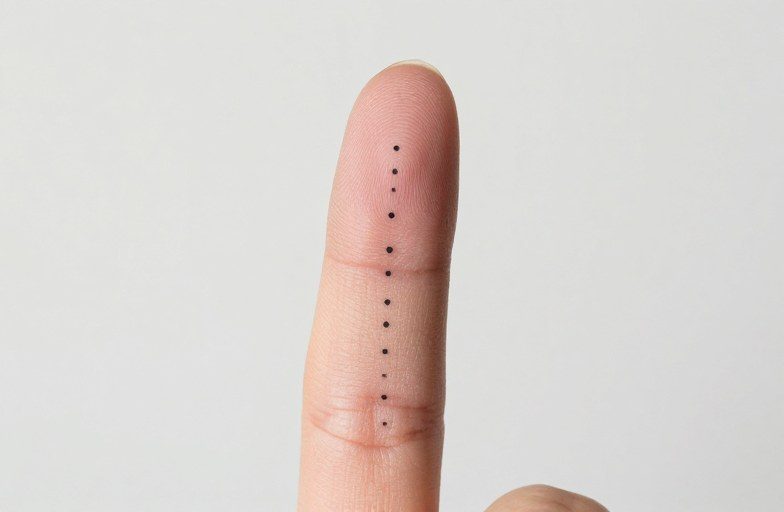
Three dots tattooed on the finger typically represent “mi vida loca” or “my crazy life,” though the meaning shifts dramatically with placement, number, and cultural context. A single dot might mark a personal triumph or serve as a minimalist reminder. Rows of dots can track time, losses, or commitments. The finger placement itself amplifies the symbolism, visible, unavoidable, intimate.
Color vs Black and Grey
Why Black Dominates
Finger skin is thin, tight, and constantly moving. Black ink holds its ground here; color tends to migrate, blur, or disappear entirely within a few years. The dense carbon in black pigment sits more stable in the dermis, resisting the accelerated fading that fingers experience from sun exposure, hand-washing, and friction. A solid black dot at 3-5 years still reads as a dot. A red one often becomes a pink smudge.
That said, some artists will pack color deliberately for clients who want the faded, ghosted look as part of the aesthetic. If you want crisp, readable dots long-term, black or very dark grey is the practical choice.
When Color Works
Color dots can function as a coded system: one red, one black, one blue for different people, events, or commitments. Some use UV-reactive ink for dots visible only under blacklight, though this requires a specialist and the same fading risks apply. White ink dots on darker skin can create subtle, raised-texture effects, but white fades fastest on fingers and often yellows.
Who Chooses This Tattoo
The Minimalist
People drawn to extreme simplicity, single needle enthusiasts, graphic designers, writers, often gravitate to finger dots. The appeal is restraint. One dot. Three dots. A line of five. No shading, no imagery, no narrative clutter. The finger becomes a canvas for pure mark-making.
The Functionally Symbolic
Prison and gang associations cling to the three-dot triangle, particularly the “mi vida loca” configuration at the web of the thumb. Outside those contexts, many people reclaim the mark to signify survival, chaotic living, or simply alignment with the number three, triplets, third children, three-year sobriety. The choice demands awareness: you will be read through that lens by some viewers regardless of your intent.
- People marking recovery milestones (one dot per year)
- Siblings getting matching dot patterns
- Musicians wanting visible but unobtrusive ink
- Those covering older, blown-out finger tattoos with solid black dots
Best Placements
Along the Finger Sides
The lateral edge of the index finger, running from knuckle to nail, offers the most stable skin on the digit. It sees less direct impact than the pad or the top joint. Dots here age cleaner, staying round rather than feathering into ovals. Tattooing the sides also keeps the mark semi-private, visible when you gesture, hidden in a fist.
The Knuckle Face
Top-of-knuckle dots read bold and declarative. They also blow out fastest. The skin stretches and compresses constantly, and the bony substrate gives less cushion for the needle. Artists often need to go slightly deeper here, which risks spread. If you want knuckle dots, accept touch-ups as part of the plan. Budget for two sessions within the first two years.
Between the Fingers
The webbing, soft tissue between digits, holds ink poorly and hurts intensely. Dots placed here blur into amorphous blobs within months. Most reputable artists will discourage this placement unless you’re committed to a specific cultural placement (some Southeast Asian sak yant traditions use this zone) or willing to accept rapid degradation.
Design Tips & Pairings
Spacing and Scale
Dots should be sized to the finger’s width, not copied from a reference photo of someone else’s hand. A 3mm dot on a large male knuckle looks proportionate; the same dot on a slender female pinky dominates. Standard spacing runs 4-6mm between centers for a clean, readable row. Closer packing risks the dots merging during healing or aging.
Negative space matters. A single dot isolated on a finger carries more weight than a cluster. The eye goes to it. Use that.
Combining with Other Elements
Dots pair well with line-based finger tattoos, rings, small words, geometric bands, because they share the same visual language of simplicity. A dot above a line can read as an exclamation point. Three dots below a word can function as an ellipsis, suggesting continuation. Some people frame larger hand pieces with dot borders, creating visual anchors that draw attention to more complex work on the back of the hand or wrist.
- Dot + line = punctuation, musical notation, Morse code
- Dot patterns + finger rings = layered texture
- Dots as “stops” between lettered knuckles
History & Cultural Roots
Pre-Columbian and Indigenous Marks
Finger dot patterns appear in scattered anthropological records, often linked to counting systems, ritual status, or protective marking. The specific practice of three dots in a triangle, however, is most commonly associated with 20th-century Chicano prison culture in the American Southwest, where it signaled gang affiliation and the “crazy life” of institutional living. The symbol spread through migrant communities and eventually into broader tattoo culture, often stripped of its original context.
South Asian Bindi and Tilak Variations
Single dots between the brows or at finger joints appear in Hindu and Jain traditions, though these are typically pigment applications rather than needle tattoos. The conceptual overlap, using a small mark to denote spiritual state, marital status, or sectarian affiliation, resonates with why people choose permanent finger dots today. Some trace the modern finger dot trend to cross-cultural fusion in 1990s-2000s tattooing, where artists and clients borrowed freely from multiple traditions.
Personal & Modern Meanings
Private Systems
Many people assign personal codes to dot counts and placements that bear no relation to historical meanings. Four dots for four family members. Seven dots for seven years in a city. A dot on each finger representing a different value or commitment. The tattoo becomes a tactile memory device, you feel it, see it, remember it without explaining it to anyone.
Aesthetic Minimalism as Statement
For some, the meaning is the refusal of meaning. A dot because a dot is enough. In an era of elaborate, Instagram-optimized tattoo designs, choosing the smallest possible mark carries its own philosophy. It rejects the expectation that tattoos must “represent” something legible to others. The finger placement ensures you see it constantly; the simplicity ensures it never exhausts you.
Key Takeaways
Finger dot tattoos reward clarity of intent. Know why you’re getting the specific number, placement, and configuration you choose, because others will project meanings onto it regardless. Prioritize black ink for longevity, budget for touch-ups, and select an artist with demonstrated finger tattoo experience. The best dot work looks effortless but requires precision: too shallow and it falls out, too deep and it blows out into a permanent bruise-like shadow. Simple is never the same as easy.
These marks endure as quiet, constant presence. You don’t explain them. You live with them.
Frequently Asked Questions
Do finger dot tattoos hurt more than other placements?
Yes, generally. Finger skin is thin with little fat or muscle padding, and the bones lie close to the surface. The vibration from the needle against bone adds a distinct sensation. Most people describe it as sharp and intense rather than deep, and the session is short, often under twenty minutes, which helps.
How long do finger dot tattoos last before needing a touch-up?
Expect significant fading within one to three years. The fingers shed skin rapidly, handle constant friction, and receive more sun exposure than covered areas. A well-placed black dot might stay readable for five years, but many people schedule touch-ups at eighteen to twenty-four months to maintain crisp edges.
Can I get finger dots if I work in a professional setting?
Finger tattoos are highly visible and still carry stigma in conservative industries. Dots on the sides of fingers or between digits are slightly less noticeable than top-knuckle placement, but they’re not hideable. Consider your specific workplace culture; some fields care less than others, but assume visibility is permanent.
What’s the difference between three dots in a triangle and three dots in a line?
The triangle configuration is most commonly associated with “mi vida loca” and carries stronger historical links to Chicano and prison culture. Three dots in a line reads more neutrally, often interpreted as ellipsis, continuation, or simply a design choice. The linear arrangement faces less automatic assumptions about background or affiliation.