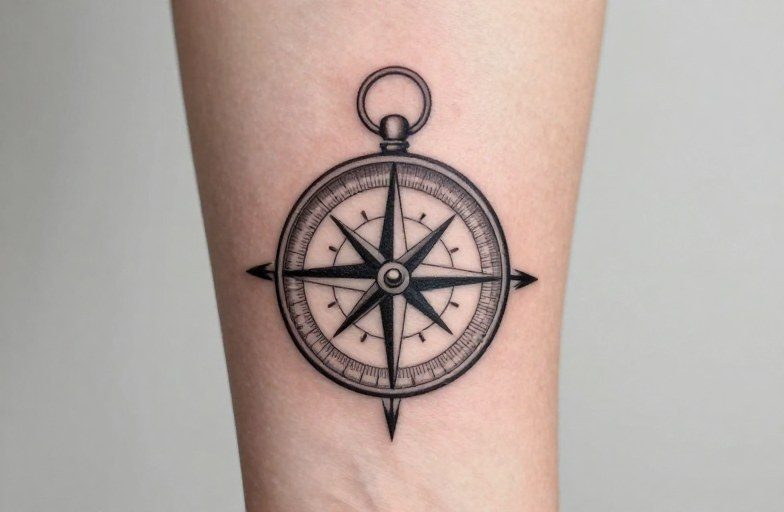
A compass stripped down to its bones still does its job. In tattoo form, that restraint becomes the whole point. No ornate filigree, no photorealistic brass casing, just the essential mechanism that says direction, choice, movement. The minimalist compass works because the symbol itself carries weight; the artist’s job is not to decorate but to clarify. This guide covers what actually matters when you’re considering one: how the design holds up, where it sits best on the body, and how to keep it from looking like a stock icon.
Tips for Choosing
Line Weight and Longevity
Thin lines age. That’s not opinion, it’s how skin works. A compass with hairline needles and a whisper-thin circle might look pristine at month three, but by year five, those lines can soften into a gray blur. The sweet spot for minimalist compass work sits around 0.5mm to 1mm for the main structural lines, with slightly heavier weight on the outer ring if you want definition that lasts. Single-needle work has its place, but for a compass that needs to read clearly from a distance, a three-needle round liner or similar grouping often gives crisper edges that survive the healing flattening and the decade after.
Negative space matters here too. A compass where the directional markers are carved out, uninked triangles or lines against a solid circle, creates contrast without clutter. But those gaps need to be wide enough. Tight negative space closes up during healing; what’s a clear gap at the stencil becomes a muddy suggestion later.
Orientation and Reading the Design
North points up on a map, but on your body, orientation gets practical fast. A compass on the inner forearm with north toward the elbow reads naturally when you hold your arm out to check it. On the ribs, north toward the sternum or toward the hip changes how the design feels when you glimpse it in a mirror. Some people align north with a meaningful geographic direction, toward a hometown, a partner’s location, a place that shaped them. Others let the placement dictate the orientation for visual balance. Neither choice is wrong, but it’s worth deciding before the stencil goes on.
For First-Timers
Pain and Placement Reality
The minimalist compass tempts first-timers because it looks small, quick, manageable. And it can be, but placement changes everything. The outer upper arm, outer forearm, and calf offer the calmest experience with the most predictable healing. The ribs, sternum, inner bicep, and foot bring more intensity and, for some, longer healing irritation. A simple compass line drawing on the ribs still involves needle on bone; don’t let the design’s simplicity fool you about the sensation.
Size floor exists even for minimal work. Below about two inches in diameter, a compass loses its legibility, the N, S, E, W markers merge, the needle becomes a blob. For first placements, three to four inches gives the artist room to work clean and gives you a result that reads as intended.
Healing and Aftercare Specifics
Minimalist linework has less ink density than saturated pieces, which means less plasma and scabbing overall. But those same thin lines are more vulnerable to damage during healing. Rubbing from clothing, sleeping position, or premature peeling can blur edges that won’t get heavy saturation to hide the flaw. Keep it clean, keep it lightly moisturized, and resist the urge to judge it at two weeks, linework settles and clarifies around the one-month mark.
Color Choices
Black dominates minimalist compass work for good reason. It ages neutral, maintains contrast against all skin tones, and keeps the focus on geometry. But restrained color has its place. A single red needle, often the north marker, creates hierarchy without breaking the minimalist rule. Some artists use a muted teal or slate blue for the same purpose, though blues can shift cooler or grayer over time depending on the pigment base.
Skin tone affects how color reads. On deeper skin, a true black line holds its authority; on very fair skin, soft black or dark gray can look less harsh. Discuss this with your artist, they’ve watched their palette age across different clients and can adjust saturation accordingly. Avoid watercolor-style washes if you’re committed to minimalism; the bleed and soft edges fight the clean geometry that makes a compass work.
Matching & Pairing Ideas
Companion Pieces That Complement
A compass pairs naturally with tools of navigation and measurement. A sextant, astrolabe, or simple map coordinates in matching line weight create a travel-themed set without thematic overload. For a more abstract pairing, a small cardinal direction marker, just the N, or a single arrow, can sit near a full compass as a call-and-response. Some people split the compass: one partner carries the circle, the other the needle, though this requires precise planning to read correctly when reunited.
Placement Relationships
Matching compasses on two people work best when the orientation is consistent, both north-up, or both aligned to the same geographic reference. On one body, a compass on the left forearm and coordinates on the right wrist creates a dialogue across the torso. The key is maintaining identical line vocabulary: if one piece uses a hairline, the partner piece should too, or the mismatch becomes visible.
Popular Styles
The geometric compass uses perfect circles, straight lines, and often incorporates sacred geometry, overlapping circles, hexagonal grids behind the main form. It reads mathematical, precise, almost engineered. The hand-poked or stick-and-poke variant embraces slight irregularity; the circle might not be machine-perfect, the needle wobbles microscopically, and that humanity becomes the style. This works best at smaller sizes where the imperfection feels intentional rather than amateur.
Dotwork minimalism builds the compass from stippled gradients rather than solid lines. The outer ring becomes a dotted arc; the needle, a density shift. It photographs beautifully fresh but requires an artist experienced in dot spacing, too tight and it heals solid, too loose and it reads as broken. The Scandinavian or folk-art influenced compass uses a single continuous line, often with small decorative notches at the cardinal points, bridging minimalism with craft tradition.
How to Personalize It
Coordinates and Specific Geography
Replacing the directional letters with latitude and longitude numbers keeps the form intact while making it specific. The numbers must be legible at size, which usually means a slightly larger compass overall, four inches rather than two. Some people add a small topographic line from a meaningful location, tracing a coastline or mountain ridge as the outer ring’s interruption.
Integrating Existing Work
A compass can be designed to interact with tattoos you already carry. The needle can point toward an existing piece, creating visual flow across the limb. The circle can break and reform around another design element, though this requires the original artist’s style to be matched closely. If your existing work is bold traditional, a fine-line compass nearby will look like it belongs to a different person; either commit to one vocabulary or find an artist who can bridge both.
What to Remember
The minimalist compass is a test of restraint. Every element that stays in the design must earn its place, the circle, the needle, the markers. What you remove matters as much as what you keep. Choose an artist whose healed work you’ve seen, not just their fresh photos. Ask about line weight decisions, about how they’ll handle the negative space, about what happens to that thin needle line in five years. A good compass tattoo doesn’t need to shout its meaning; it needs to function as a compass, clear, directed, ready to be read at a glance. The best ones do exactly that, quietly and for decades.
Frequently Asked Questions
How small can a minimalist compass tattoo be before it becomes unreadable?
Below two inches in diameter, the directional markers and needle tend to blur together during healing and over time. Three to four inches is the practical minimum for long-term clarity, though placement on areas that stretch less can sometimes allow slightly smaller work.
Does a minimalist compass tattoo have to include the letters N, S, E, W?
No, many effective designs use simple arrows, dots, or line variations at the cardinal points instead. The compass reads clearly as long as the directional hierarchy is established, whether through lettering or pure geometry.
Will a single-needle compass tattoo fade faster than one done with a larger grouping?
Single-needle lines deposit less ink and can soften more noticeably over years. For a compass that needs to maintain its structure, a slightly larger needle grouping often gives better longevity without sacrificing the minimalist look.
Can a compass tattoo be easily covered or modified later if I want something bigger?
The circular form and central needle create a defined structure that’s moderately challenging to cover. A skilled artist can expand it into a larger piece, surrounding it with ornamental work, extending the needle into a longer arrow, or integrating it into a sleeve, but the original geometry will influence whatever comes next.