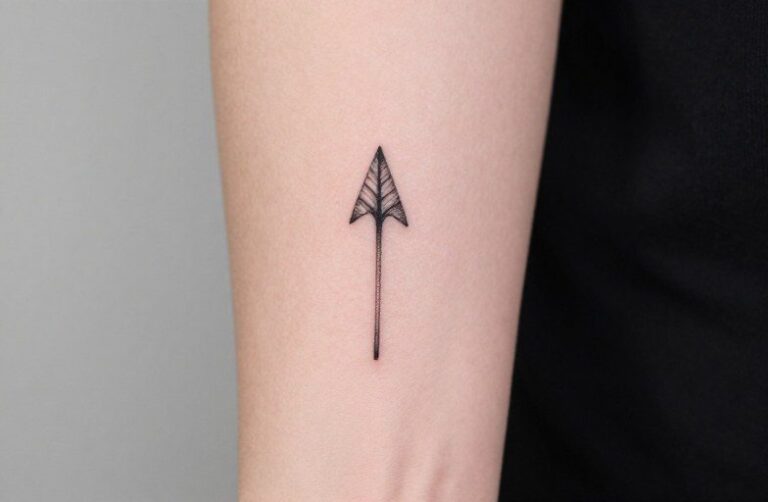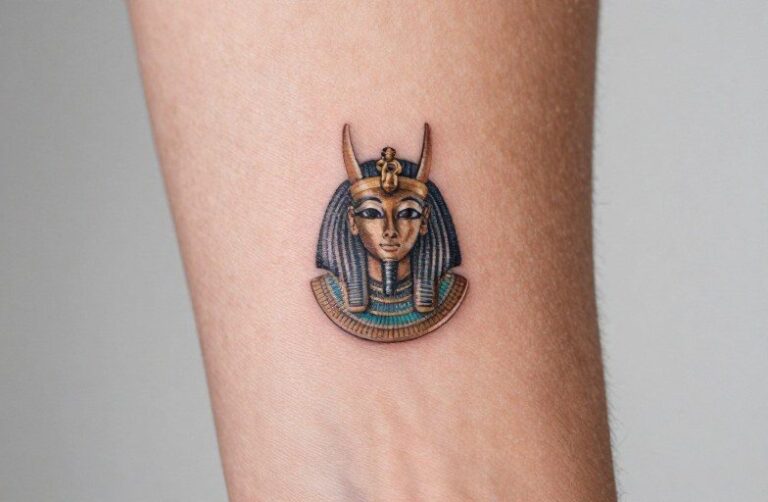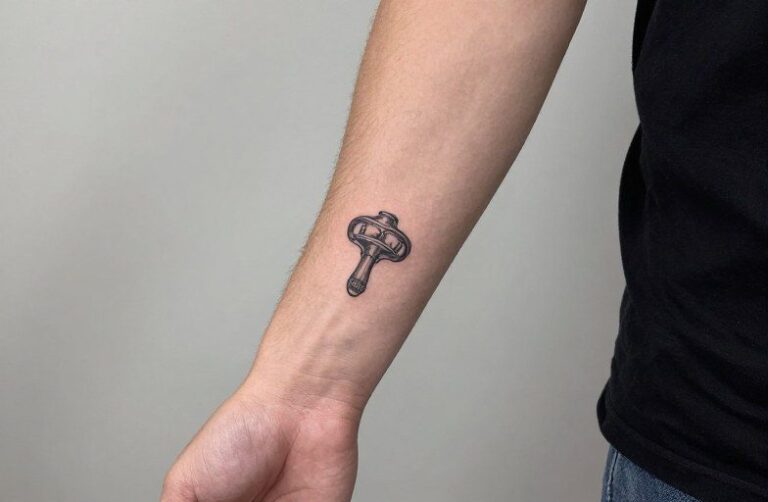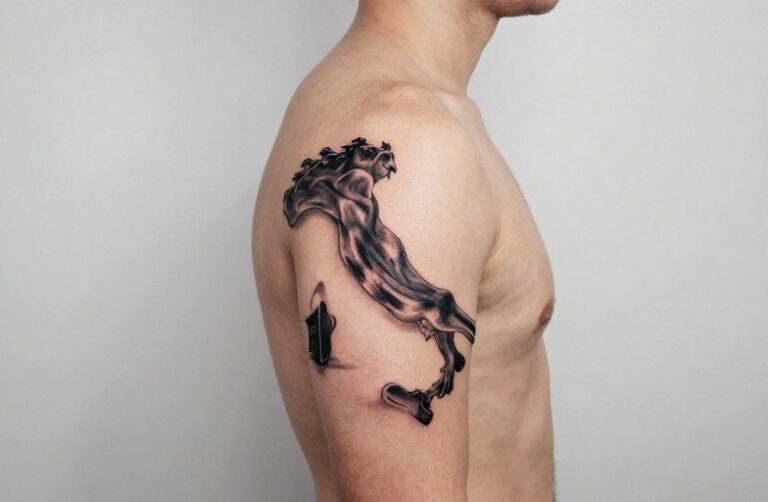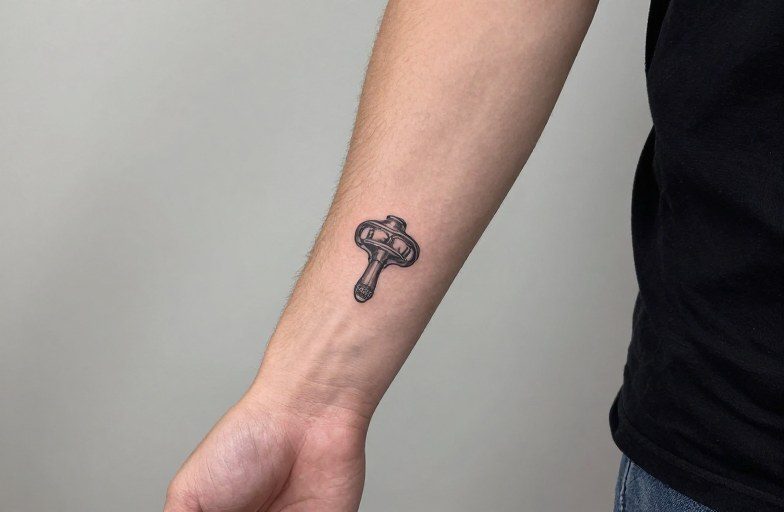
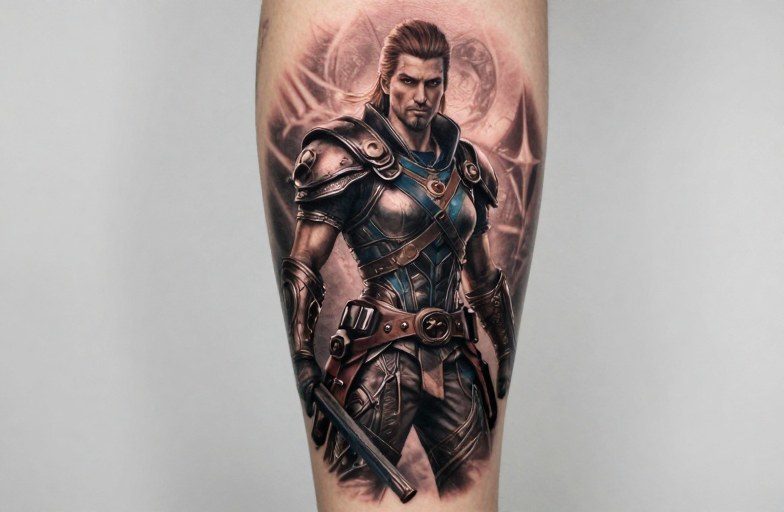
A Destiny game tattoo pulls from Bungie’s sprawling sci-fi universe, where players become Guardians, resurrected warriors wielding the Traveler’s Light against encroaching Darkness. The meaning centers on chosen purpose, cyclical rebirth, and the tension between hope and entropy. Symbols range from the spherical Ghost companions to the three class icons (Hunter, Titan, Warlock), each carrying distinct identity markers that resonate beyond the game itself.
Color vs Black and Grey
Destiny’s visual identity leans heavily on saturated, almost hallucinatory color palettes, neon arc energy, solar orange, void purple. That makes color an obvious temptation, but the decision shapes how the tattoo lives on your skin long-term.
When Color Holds Up
The Traveler’s pale sphere, a Ghost’s blue eye, or the prismatic subclass diamonds, these read as generic shapes without their signature hues. Color saturation around 80-90% in the original game art translates reasonably well to tattoo ink, particularly for larger pieces where the artist can pack solid fields without crowding. Bright arc blues and solar ambers tend to age better than the softer, more pastel Traveler tones, which can muddy into grey within five to seven years if not protected from sun exposure.
Small color accents, just the Ghost’s eye, a single subclass glow, often outlast full-color sleeves. The eye tracks to a focal point naturally, and a quarter-inch of saturated cyan holds its identity even as surrounding detail softens.
Black and Grey Interpretations
Stripping Destiny’s imagery to value and line work reveals how much the design relies on strong silhouette. The Hunter’s blade-dancer hood, the Titan’s shield-wall stance, the Warlock’s flowing coat, these shapes carry recognition without any hue. Black and grey suits smaller scales: a Ghost behind the ear, a class icon on the inner wrist, where color would blur into indistinguishable noise within a few years.
Metallic textures, Exo chassis, gun barrels, the Traveler’s weathered shell, actually read more convincingly in grey wash than in flat color. A skilled artist can render brushed steel and pitted corrosion through stipple and whip-shade techniques that have no color equivalent.
Mythology & Folklore
Destiny’s lore deliberately borrows and warps recognizable mythic structures, which gives tattoo imagery layered resonance for people who may never have raided the Vault of Glass.
The Traveler as Cosmic Duality
The Traveler, a silent, wounded god-orb granting resurrection and power, maps onto dozens of folkloric figures: the cornucopia, the wounded king, the sleeping giant whose awakening changes everything. Its visual echo of Sputnik and 2001’s monolith grounds it in secular space-age mythology too. As a tattoo, it functions as a personal emblem of received grace or borrowed power, the sense that your strength comes from somewhere outside yourself that you don’t fully understand.
Ghosts and Familiar Spirits
The Ghost, small, watchful, literally the voice in your head that brought you back to life, draws on the fylgja of Norse tradition, the daimon of Greek thought, the guardian angel rendered as hardware. Unlike passive protectors, Ghosts argue, complain, and occasionally sacrifice themselves. That active relationship appeals to people who want their tattoo to represent partnership rather than protection alone.
How It Ages on Skin
Video game tattoos face specific aging challenges: fine detail that looked crisp on a 4K monitor dissolves into skin at different rates than organic imagery.
The Hive runes and Vex geometries involve parallel lines and tight angles that spread predictably. A Vex mind-fluid circuit pattern with lines under 2mm will feather within three to five years, becoming grey smear rather than precise tech. Destiny’s UI elements, ammo counters, radar blips, the ghost shell inventory grid, suffer similarly. These work better at larger scales or as deliberate background texture, not primary readable content.
Class icons by contrast age well. The Hunter’s crossed blades, Titan’s hammer, Warlock’s eye-in-triangle, these are bold silhouettes with internal negative space that holds definition. Even blurred at the edges, the shape remains identifiable. The same holds for weapon archetypes: the Thorn hand cannon’s thorned barrel, the Gjallarhorn’s wolf-head muzzle, read as distinctive outlines without needing fine engraving.
White ink highlights, popular for “Light” effects and Ghost eye glow, typically vanish entirely within two to four years on most skin tones, yellowing to a faint scar-like tone rather than reading as white. Yellow and pale green follow similar trajectories. Plan for this: either commit to touch-ups or design the piece so that the white was never structurally necessary, only additive.
Common Variations & Styles
Destiny’s nine-year visual evolution gives artists distinct eras to draw from, each with different tattoo suitability.
Destiny 1 Era: Worn, Mysterious, Weathered
The original game’s aesthetic, dusty cosmodromes, rusted colony ships, the Traveler hanging damaged over the Last City, lends itself to painterly realism and trash-polka hybrid styles. The mystery of that era, before lore was exhaustively catalogued, carries nostalgic weight. Tattoos from this period often feature the original three subclasses (Bladedancer, Defender, Sunsinger) that were later retired, making them deliberately dated markers of long-term attachment.
Destiny 2 & Beyond: Cleaner, More Graphic
The sequel’s sharper UI, the introduction of Stasis and Strand with their distinct green and pale yellow palettes, and the more defined character of figures like Crow and Savathûn shift toward graphic, poster-style tattooing. The Darkness ships, pyramidal, almost Art Deco in their severity, translate to bold blackwork exceptionally well. Seasonal artifact designs, by contrast, tend toward clutter that doesn’t simplify cleanly to skin.
Religious & Spiritual Angles
For some wearers, Destiny’s metaphysics operate as genuine spiritual framework rather than borrowed aesthetic.
The Light and Darkness as cosmic forces map loosely onto dualistic traditions, Zoroastrian ashavan and druj, Manichaean light and matter, even the Tao in distorted form. The game’s explicit rejection of simple good/evil framing (the Light can be wielded cruelly, Darkness can be channeled with discipline) appeals to people who’ve left rigid binary belief systems. A tattoo of the Taken King Oryx, who embraced Darkness to save his people, or of the Awoken who exist between both forces, can mark that philosophical position.
The Guardian’s cyclical death and resurrection, powered by Ghost intervention, resonates with people who’ve survived clinical death, addiction recovery, or other threshold experiences. It’s not a Christian resurrection narrative, the Guardian remembers nothing, often questions whether they’re the same person, but that very emptiness, the sense of being chosen without explanation, carries its own spiritual weight.
Best Placements
Destiny’s spherical and radial motifs suggest natural placements that less geometry-driven designs don’t.
The Traveler’s sphere reads as an eye, a planet, a shield, making the upper back, centered between shoulder blades, a natural dome-like canvas. At four to six inches, it holds detail without dominating. The Ghost companion scales to palm-sized pieces on the outer bicep or calf, where its roundness echoes the muscle curve.
Class icons work as flat badges: chest pieces over the heart for Titans (protective positioning), forearm blades for Hunters, throat or sternum for Warlocks (the “speaking” class). The three classes together, as a fireteam trio tattoo, need enough spacing to read individually, three-inch minimum each, arranged across a full chest or three separate limbs.
Weapon tattoos, exotic guns, swords, follow actual firearm tattoo conventions: outer thigh for long guns, hip or ribs for hand cannons, the blade path of a sword following an existing limb line. The Black Talon’s curved blade, for instance, can trace the forearm’s natural sweep rather than fighting it.
Before You Decide
Destiny remains a live game with ongoing narrative. Today’s hero becomes tomorrow’s villain; today’s mystery gets explained in a lore book next season. The Witness, the game’s current ultimate antagonist, was only named in 2022, earlier tattoos of “the Darkness” as abstract force now reference a specific character. Consider whether your chosen image can stand independent of plot developments.
The game’s commercial relationship with its player base also matters. Bungie’s independence, acquisition by Sony, layoffs, and content sunsetting have all shifted what Destiny “means” as a cultural object. Your tattoo is permanent; the game’s ownership and direction are not. Images that rely on specific emotional associations with a particular expansion or developer era may need personal annotation to retain that meaning for you alone.
Finally, the Guardian’s defining trait is action without guaranteed success. The universe is ending, has been ending, will keep ending. You fight anyway. That’s the core resonance worth designing toward, whether your tattoo shows a specific gun, a Ghost, a class sigil, or just the word “Guardian” in the game’s typeface. Make sure the image you choose carries that weight for you, not just the visual recognition for others who play.
Frequently Asked Questions
Do Destiny tattoos work for people who don’t play the game?
The strong silhouettes and mythic imagery hold meaning independent of game knowledge, though you’ll field questions from players who recognize the reference. Choose symbols that resonate personally, not just for in-group recognition.
What’s the most requested Destiny tattoo design?
The Ghost companion and the three class icons dominate requests, followed by specific exotic weapons like Thorn and the Gjallarhorn. The Traveler itself appears more often in larger back pieces than as standalone small work.
Can you combine Destiny imagery with other tattoo styles?
The game’s sci-fi/fantasy hybrid meshes well with biomechanical work, sacred geometry, and even traditional Japanese framing. The key is matching the Destiny element’s detail level to the partner style’s density, don’t drop a hyper-detailed Ghost into minimalist line work.
How do you handle the game’s changing lore in a permanent tattoo?
Choose imagery with stable visual identity over plot-dependent significance. The Traveler’s sphere, the Ghost shape, and the class silhouettes have remained consistent since 2014. Avoid characters who might be rewritten or killed off in future content.