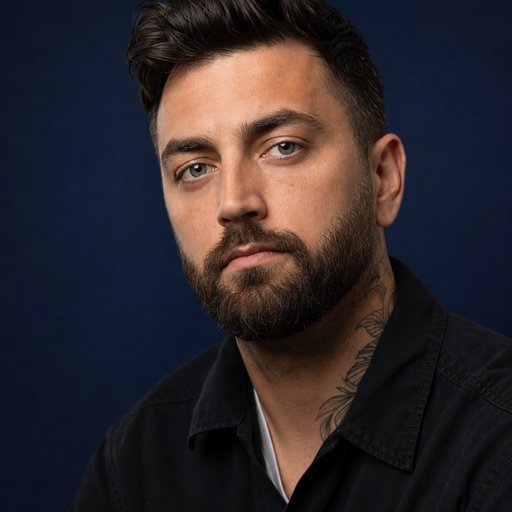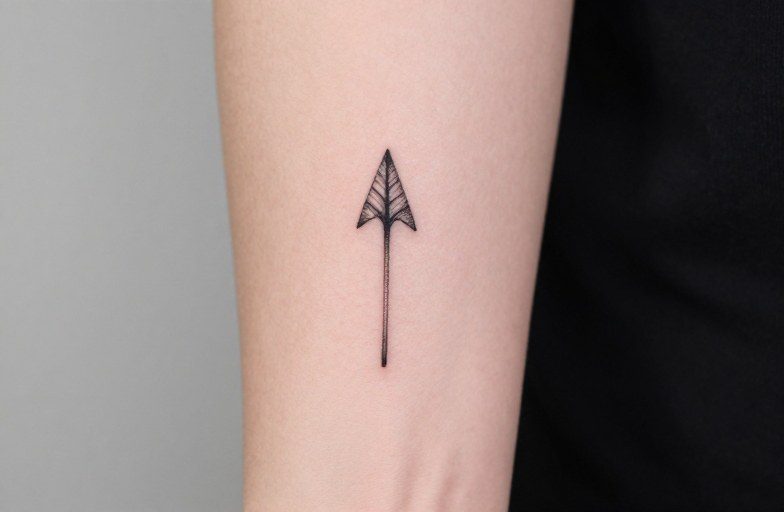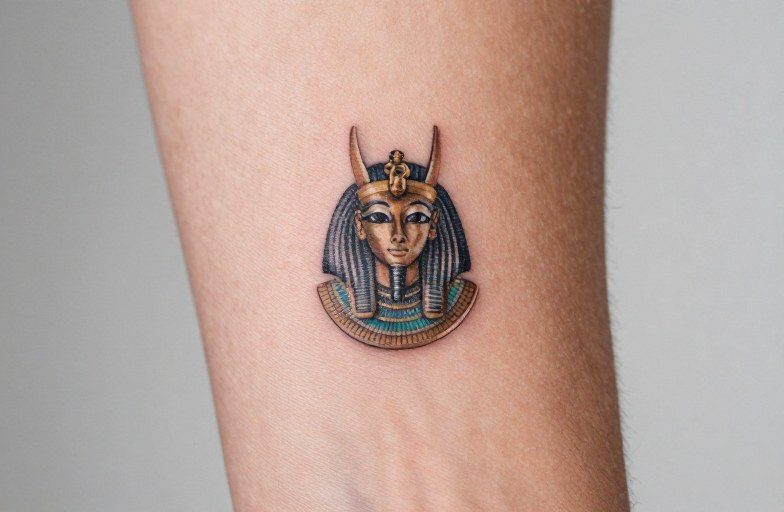

Face tattoos demand a different standard. The skin is thinner, more mobile, and constantly exposed to sun and weather. What works on a shoulder or thigh often falls apart here. The designs that succeed are the ones built specifically for this terrain, bold enough to read at conversation distance, simple enough to survive decades of blinking, talking, and squinting.
How to Personalize It
Personalization on the face isn’t about cramming in every symbol that matters to you. It’s about choosing one or two elements that hold up to daily scrutiny by everyone you meet. The face doesn’t forgive clutter.
Working With Your Features
Your bone structure should guide the design, not fight it. A straight line following the jaw’s natural angle looks intentional; the same line cutting across at random looks like a mistake. Cheekbones create natural canvases for symmetrical designs. The temple’s gentle curve suits flowing shapes. Under the eye, the skin moves constantly, designs here need to be compact and avoid fine horizontal lines that will distort every time you smile.
Meaning vs. Readability
Highly personal imagery, family portraits, specific dates, inside references, rarely works on the face. The scale is too small, the detail too fine. What translates better are abstracted forms: a simplified animal silhouette, a single word in a clean script, a geometric mark that references something larger. You know what it connects to. The public sees something striking that doesn’t require explanation.
Matching & Pairing Ideas
Face tattoos that connect to existing work create cohesion, but the connection needs to be deliberate, not accidental.
- Neck-to-face transitions: A design that begins on the throat and continues onto the jaw reads as one piece. A design that stops abruptly at the jawbone looks unfinished or like an afterthought.
- Ear framing: Small marks in front of or behind the ear can pair with larger neck pieces, creating a frame for the face without occupying it directly.
- Symmetrical pairs: Matching small tattoos on both temples or both cheeks create balance, but the design must be truly identical in execution, any variation reads as error, not artistic choice.
- Asymmetrical complements: A larger piece on one side balanced by a smaller related mark on the other. The relationship needs to be obvious: same style, same color palette, clear thematic link.
Standout Design Ideas
Certain approaches consistently work on facial skin because they account for its movement, exposure, and limited space.
Proven Formats
- Single words or short phrases: “Stay,” “Free,” a loved one’s name, kept to three or four letters maximum for legibility. All caps or clean cursive hold up best; ornate scripts blur within years.
- Small icons: A cross, star, heart, or simplified symbol at fingertip scale. These read instantly from across a room.
- Dotwork and stippled shapes: Dense black clusters that create form through point density rather than line. This technique ages well because there’s no thin line to spread.
- Geometric marks: Straight lines, simple angles, small triangles or diamonds placed at natural structural points (temple corner, cheekbone peak).
What to Avoid
Portraits, photorealism, watercolor-style color bleeds, and anything requiring fine gray shading. These techniques demand larger scale and more stable skin. On the face, they become unrecognizable mush within five to seven years. Similarly, white ink and UV-reactive pigments are unpredictable here, some fade entirely, others yellow or blur unpredictably.
Best Placements
Not all facial skin behaves the same. Placement determines how well a tattoo holds, how visible it is, and how much it interferes with daily function.
High-Visibility Zones
The temple offers relatively stable skin and a natural flat plane. Designs here are prominent but can be partially covered by hair. The outer cheekbone, high on the face, below the eye, provides another flat surface, though it moves more with expression. Under-eye placements (the “tear drop” zone) are technically challenging; the skin is extremely thin, prone to bruising during healing, and any design here carries heavy cultural associations that vary by context.
Subtler Options
Along the hairline, behind the ear, on the jaw’s underside, or at the sideburn edge. These locations allow for personal expression without dominating first impressions. They also age better, less direct sun, less constant movement. The lip’s inner surface (sometimes called a “lip tattoo”) fades dramatically within one to three years as the mucosal membrane renews itself rapidly; this isn’t a flaw, just a reality to plan for.
Tips for Choosing
The decision process for a face tattoo should be slower, not faster, than for other placements.
- Live with a marker version: Draw the design on daily for two weeks. Notice how it interacts with your expressions, how it reads in different mirrors and photos, whether you stop seeing it or fixate on it.
- Consider professional context: Not all industries accept visible face tattoos. Some do. Know your field, not just your current job but your likely career path over decades.
- Plan for the second session: Most face tattoos need touch-up. The skin’s thinness and high blood flow can push out pigment during initial healing. Budget for this, don’t treat it as failure.
- Choose an artist with specific experience: A great tattooer on backs or arms isn’t automatically great on faces. The pressure control, needle depth, and healing guidance differ. Ask to see healed photos, not just fresh work.
Popular Styles
Some stylistic approaches have proven track records on facial skin.
Blackwork and Bold Line
Heavy black lines, solid fills, high contrast. This style ages best because there’s no subtlety to lose. A solid black teardrop, a thick-lined star, a block-letter word, these remain readable after decades. The tradeoff is aesthetic: bold blackwork is assertive, not delicate.
Minimalist and Fine Line (With Caveats)
Single-needle work can succeed on the face but requires extreme restraint. Lines must be spaced wider than on other body parts to prevent blurring into each other. The design should be simple enough that even if lines spread 50%, the form remains clear. Many artists refuse fine-line face work because the risk of poor aging is high; respect an artist who declines rather than pushes forward.
Traditional and Neo-Traditional
The bold outlines and limited color palettes of American traditional tattooing translate well to facial scale. A small traditional rose, dagger, or swallow on the temple or cheek maintains its character because the style was built for readability at distance. Neo-traditional’s slightly more detailed approach can work but needs heavier linework to compensate.
Final Word
A face tattoo is a commitment to a single design’s permanence in your most public space. The best ones are built from the start with the location’s limitations in mind, bold enough to survive, simple enough to endure, placed with awareness of how skin moves and ages. Take the time to find an artist who respects the territory, not just the image. The work you carry afterward will speak for itself, without needing explanation.
Frequently Asked Questions
How long do face tattoos take to heal compared to other placements?
Face tattoos typically heal faster than arm or leg work due to abundant blood flow, but the first week is more visually intense, swelling and bruising are common. Most artists recommend 10-14 days of careful afterthought before resuming normal skincare and sun exposure.
Can face tattoos be removed or covered up effectively?
Laser removal on facial skin is possible but challenging; the area’s sensitivity and proximity to eyes require specialized protocols. Cover-up options are severely limited by the small scale and high visibility. Assume permanence when choosing.
Do face tattoos hurt more than tattoos on other body parts?
Pain varies by exact placement, but the face generally ranks high due to thin skin, numerous nerve endings, and proximity to bone. The temple and cheekbone tend to be most intense; areas with more muscle padding like the jaw’s outer edge are somewhat more manageable.
Why do some face tattoos blur or fade faster than others?
Constant sun exposure, frequent facial movement, and thinner epidermis all accelerate aging. Fine lines and light shading blur fastest; solid blackwork and bold outlines resist these factors significantly longer. Aftercare and sun protection matter enormously for longevity.